
Fort St Pieter
Fort Sint Pieter
Netherlands · Limburg · Near Maastricht
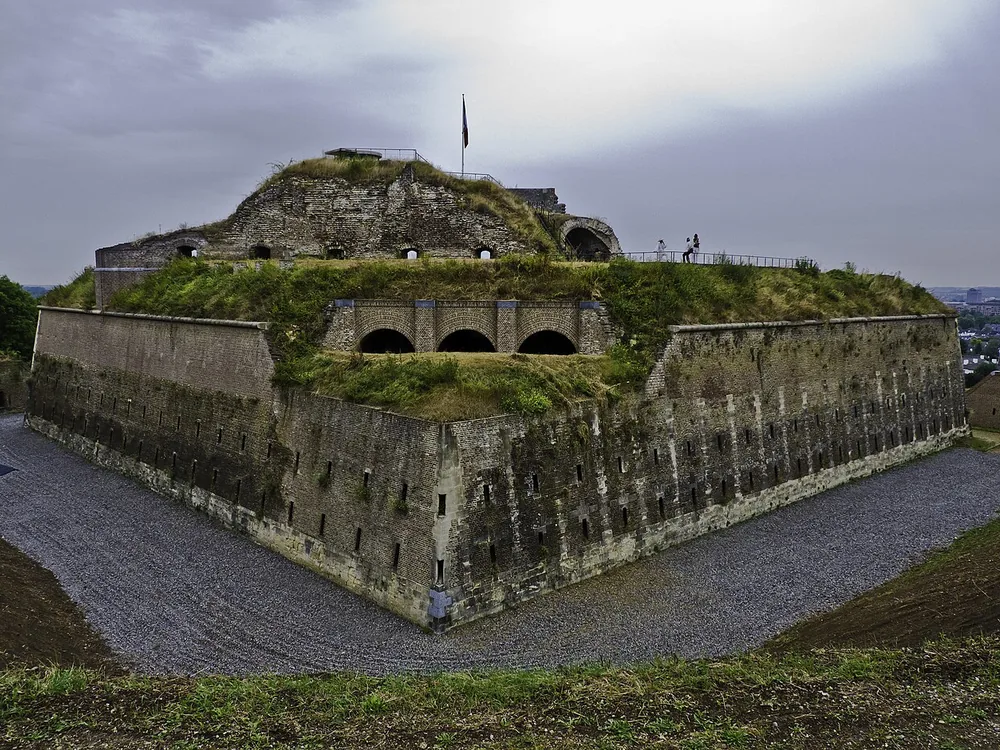
Built 1701 · Early 18th-century Dutch Baroque military fortress (hornwork system) — Fort Sint Pieter was designed and built between 1701 and 1702 by the Dutch military engineer Isaac van Couhorn, son of the celebrated Menno van Coehoorn (Coehoorn being the principal Dutch rival to Vauban in the development of systematic siege and fortification engineering); the fort is an example of the hornwork defensive system — a central tower with two projecting 'horns' of bastion that extend forward to protect the main gate; the unusual element is the network of underground passages cut into the St Pietersberg limestone beneath the fort, extending the defensive system below ground in a way unique in the Netherlands
This page is part of an independent travel guide and is not affiliated with, endorsed by, or operated by Fort St Pieter.
© Castles & Palaces
Quick Facts
- Hours
- Tue–Sun 10:00–17:00. Closed Mon
- Guided tour from
- €10
- Duration
- 1 hour (guided tour, mandatory — no self-guided access)
- Best time
- Year-round
- Booking
- Required — book 3+ days ahead
- Nearest city
- Maastricht
Featured Tour
Maastricht: Fort Sint Pieter Guided Tour (Underground Passages & Marl Inscriptions)
Cancellation available · Instant confirmation
Highlights
- ✦The underground limestone passages — the most unusual feature of Fort Sint Pieter is the network of passages cut into the St Pietersberg limestone beneath the fort; the limestone (marl) of the St Pietersberg has been quarried for centuries, and the fortification was built above a pre-existing maze of underground galleries; the guided tour descends into these passages, covering the military use of the underground (ammunition storage, troop shelter, escape routes) and the remarkable drawings and inscriptions left on the marl walls by soldiers and visitors over three centuries
- ✦The marl inscriptions — the soft St Pietersberg limestone was easily carved, and the walls of the underground passages carry inscriptions and drawings accumulated from the 17th century to the 20th; soldiers quartered in the fort during sieges and occupations carved their names, dates, drawings, and symbols; the inscriptions include graffiti from French Revolutionary troops (Maastricht was occupied by France 1795–1814), Napoleonic-era dates, and WWII-period markings when the passages served as civilian air-raid shelters; the accumulation constitutes an unintentional historical archive
- ✦Isaac van Couhorn's hornwork design — Fort Sint Pieter was designed by Isaac van Couhorn, son of Menno van Coehoorn (1641–1704), the greatest Dutch military engineer of his era and the principal rival to France's Vauban; the hornwork system — a central defensive position with two forward projecting 'horns' of bastion — is a specific type of early modern fortification well suited to the narrow St Pietersberg hill ridge; the fort is a well-preserved example of this design type
- ✦Views over the Maas Valley and Belgium — the St Pietersberg hill commands panoramic views over the Maas River valley and, on clear days, into Belgium; Maastricht is the southernmost city of the Netherlands, in the Limburg 'thumb' that projects into Belgium on three sides; the Belgian border is approximately 3km west of the fort
- ✦Maastricht's other fortifications (Hoensbroek Castle ~25km north, on this site) — Maastricht has more historic fortifications per square kilometre than any other Dutch city; the city walls, the Helpoort (oldest surviving city gate in the Netherlands), and the underground passages of both St Pietersberg and the Casemates beneath the city are part of the same heritage; Fort Sint Pieter is the most structured introduction to the system, and Hoensbroek Castle (on this site) is the natural regional castle counterpart
- ✦Guided tours only — the underground passages are accessible only with a guide (groups depart hourly); no self-guided access is available; the guided format ensures the inscriptions and military history are properly explained
Skip the queue with a guided tour
Skip-the-line tickets & expert guides
Fort Sint Pieter sits on the summit of the St Pietersberg — the flat-topped hill of marl limestone that rises at the southern edge of Maastricht, approximately 1.5 kilometres from the city centre. The hill is the geological and strategic key to Maastricht's military history: whoever held the St Pietersberg could command the approaches to the Maas crossing and the city's southern gate, and for most of the city's medieval and early modern military history, holding the hill was the essential condition of holding Maastricht itself.
The current fort was designed by Isaac van Couhorn and built between 1701 and 1702. Isaac was the son of Menno van Coehoorn (1641–1704), the greatest Dutch military engineer of the late 17th and early 18th centuries — a figure whose systematic development of fortress design and siege engineering made him the principal Dutch counterpart to France's Sébastien Le Prestre de Vauban; the two men were near-contemporaries who never met in battle but whose competing systems defined the military engineering of the period. Menno van Coehoorn's work produced the 'Coehoorn mortar' (a portable siege mortar still used in modified form into the 20th century) and a series of Dutch water-defensive fortifications in Zeeland and Brabant that adapted the Low Countries' watery geography to the purposes of early modern military engineering. His son Isaac applied the family methodology to the St Pietersberg position.
The fort design is a hornwork: a central defensive tower with two projecting 'horns' of bastion extending forward from the main gate, covering the most likely approaches with flanking fire. The hornwork form was well-suited to the constraints of the St Pietersberg ridge, which is narrow and required a longitudinal fortification. The walls and gate structure above ground are the visible expression of the fort; what is less visible, and more unusual, is what lies beneath.
The St Pietersberg is composed of marl limestone — a soft, easily worked stone that has been quarried on and below the hill since at least the Roman period. The Romans quarried the marl for building material; medieval builders continued; by the 17th century the underground workings beneath the hill covered a labyrinthine network of galleries and passages that had been cut over more than a thousand years of extraction. When the fort was built in 1701–1702, it was built above an existing underground system. The military engineers integrated the two: the underground passages became a controlled extension of the fort's defensive logic, providing ammunition storage, troop shelters, communication routes, and emergency exits. The passages were further expanded in the 18th and 19th centuries.
The walls of the marl passages are soft enough to be carved by hand with a nail or knife, and over three centuries of military occupation and later civilian use, the passage walls accumulated an extraordinary archive of human inscription. Soldiers quartered in the fort during successive occupations (Spanish, French, Dutch, French Revolutionary, Napoleonic) carved their names and dates. French Revolutionary troops who occupied Maastricht from 1795 to 1814 left inscriptions including political slogans; Napoleonic-era dating systems appear on multiple walls. During WWII, when the passages were used as civilian air-raid shelters, children who sheltered there carved drawings. The accumulation is an unintentional historical document that the guided tour uses to trace the fort's successive occupations.
The GetYourGuide guided tour (1 hour, English guide) is the standard way to experience the fort, and is in fact the only way — the underground passages are accessible exclusively on guided tours that depart hourly; there is no self-guided access. The tour covers the underground passages, the marl wall inscriptions, the above-ground fort structure, and the views from the St Pietersberg summit over the Maas Valley.
Hoensbroek Castle (on this site, approximately 25km north of Maastricht) is the natural regional castle pairing for Fort Sint Pieter — the water-moated medieval castle versus the 18th-century limestone fortress, both in the Dutch Limburg region.
History
St Pietersberg limestone quarried from Roman period onward; pre-existing underground passages used before the fort. Fort Sint Pieter designed by Isaac van Couhorn and built 1701–1702 as part of Maastricht's defensive system. Fort used during multiple 18th-century campaigns and sieges. Maastricht occupied by French Revolutionary forces 1795–1814; inscriptions left in underground passages. Incorporated into the Netherlands definitively after 1815. Underground passages used as civilian air-raid shelters in WWII. Fort and passages opened as heritage site post-war. Now operated by the Maastricht Fortifications Foundation (Stichting Vestingmaastricht).
How to Visit
Getting there: Fort Sint Pieter is approximately 1.5 km south of Maastricht city centre on the St Pietersberg hill. By foot: 20-minute walk from the Vrijthof square via the Luikerweg. By bike: 8 minutes (Maastricht has excellent cycling infrastructure). By taxi from the city centre: approximately 5 minutes.
Tickets: Guided tours are mandatory — no self-guided access to the underground passages. The GetYourGuide guided tour covers the underground passages, marl wall inscriptions, above-ground fort, and valley views. Tours depart hourly with an English guide; book in advance as capacity is limited.
Practical tips: Bring a light jacket or layer — the underground passages are a constant 10–12°C regardless of outdoor temperature. In summer this is refreshingly cool but unprepared visitors find it cold within minutes.
Combine with: Hoensbroek Castle (~25 km north) is the regional castle pairing. Within Maastricht: the Helpoort (oldest city gate in the Netherlands), the Casemates underground, the Basilica of Saint Servatius, and the Vrijthof square make a full Maastricht day.
Frequently Asked Questions
The underground limestone passage network is extensive, confusing, and lacks continuous lighting — visitors exploring without a guide would face genuine navigation difficulties and safety concerns in the darker sections. The mandatory guided format also ensures visitors receive the context for the wall inscriptions and military history that makes the passages comprehensible; without explanation, the carvings on the marl walls are visually interesting but their historical significance is opaque.
Location
Luikerweg 80, 6212 NL Maastricht, Netherlands
Nearby Castles
Tours & Tickets
Powered by GetYourGuide
From
€10/ person