
Sintra National Palace
Palácio Nacional de Sintra
Portugal · Lisbon · Near Sintra
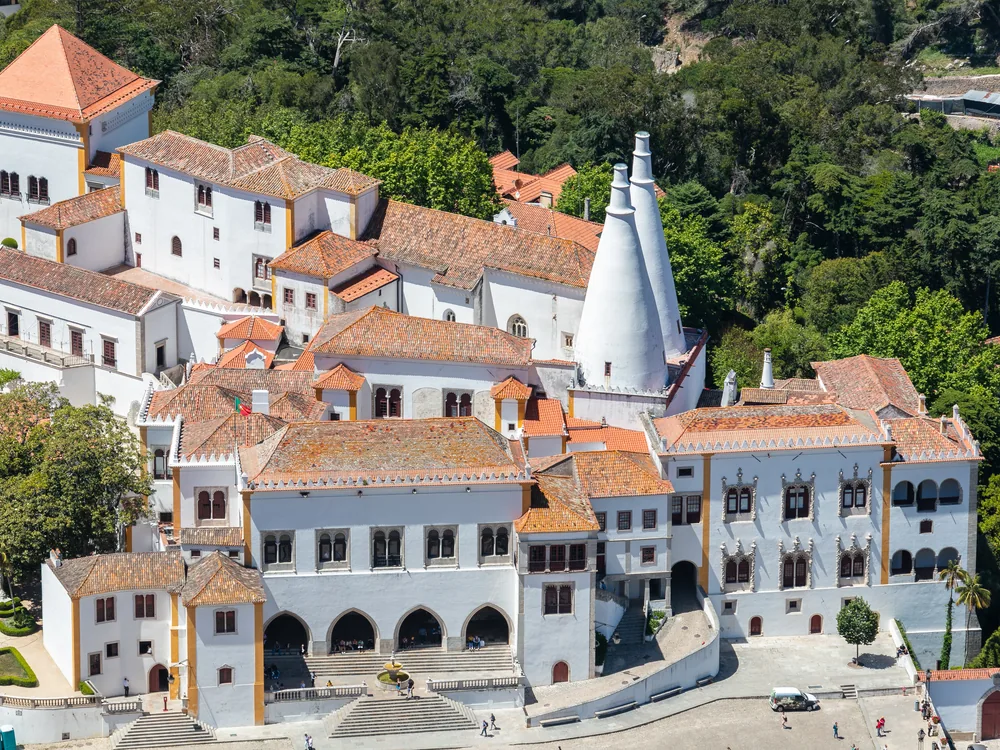
Built 1415 · The best-preserved medieval royal palace in Portugal, with construction in its current form beginning under Dom João I in the early 15th century; a hybrid of Moorish, Gothic, and Manueline architectural styles accumulated across four centuries of continuous royal occupation; distinguished externally by two enormous conical chimneys rising from the royal kitchens — the most distinctive silhouette in Sintra's historic centre; interior rooms include the Sala dos Cisnes (Swan Room) with its painted ceiling of 27 swans, the Sala das Pegas (Magpie Room) with a moralising painted ceiling commissioned by Dom João I, and extensive Mudéjar-tiled rooms reflecting centuries of Portuguese-Moorish tile tradition
This page is part of an independent travel guide and is not affiliated with, endorsed by, or operated by Sintra National Palace.
© Castles & Palaces
Quick Facts
- Hours
- Tue–Sun 09:00–18:30. Closed Mon
- Skip-the-line from
- €13
- Duration
- 1.5–2 hours
- Best time
- March to May and September to November
- Nearest city
- Sintra
Featured Tour
National Palace and Gardens Skip-the-Line Ticket
Cancellation available · Instant confirmation
Highlights
- ✦The Sintra National Palace is the best-preserved medieval royal palace in Portugal — unlike the Romanticist confection of Pena Palace on the hill above, this is the actual working palace where Portuguese kings held court from at least the early 15th century through the late 19th, with rooms intact across five centuries of continuous royal use
- ✦Two enormous conical chimneys, rising 33 metres above the royal kitchens, are the palace's most distinctive and immediately recognisable feature — visible across Sintra's historic town centre, they remain one of the most unusual architectural silhouettes of any royal palace in Europe
- ✦The Sala das Pegas (Magpie Room) has a ceiling painted with 136 magpies, each holding a banner reading 'por bem' (for good) — traditionally said to have been commissioned by Dom João I to forestall court gossip about his relationship with a lady-in-waiting, making it one of the few royal rooms in any European palace with a documented satirical backstory
- ✦The Mudéjar-tiled rooms are among the earliest and most extensive examples of azulejo tile decoration in Portugal, some dating to the 15th and 16th centuries — the palace interior represents the origin point of Portugal's distinctive tile tradition in a way that later, more famous tile displays in Lisbon and Porto cannot match for historical depth
- ✦Unlike Pena Palace and the Moorish Castle, which sit up in the hills above the town and require a bus, tuk-tuk, or steep walk to reach, the National Palace is in the centre of Sintra's historic quarter — immediately accessible from the train station, making it the most convenient of Sintra's main heritage sites
Skip the queue with a guided tour
Skip-the-line tickets & expert guides
The two conical chimneys rising from the Sintra National Palace are visible from almost anywhere in Sintra's historic centre. 33 metres tall, slightly tapered, rising from the kitchen block in a way that has no parallel in any other European royal palace, they function as the involuntary landmark of the town — the thing you identify first from the train station, the thing that orients every other building in the compact medieval centre around it. They were built to vent the smoke from the royal kitchens that had to feed a court of several hundred people, and their sheer scale is a monument to the logistics of royal hospitality across four centuries of continuous occupation.
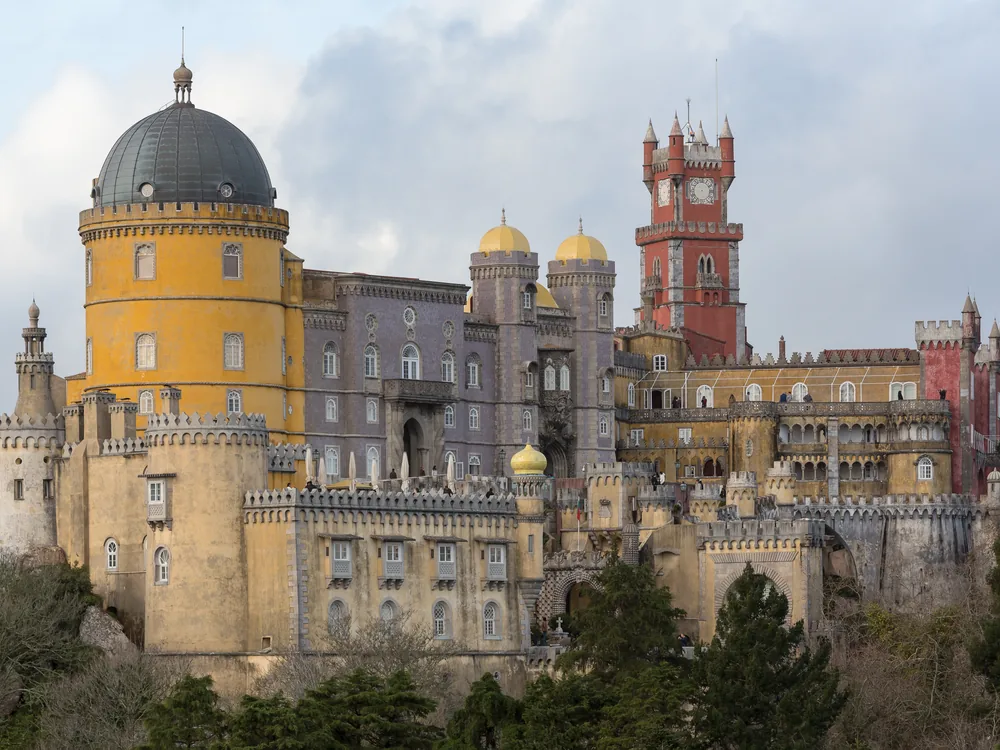
This continuity is what distinguishes the Sintra National Palace from Pena Palace on the hill above it, and the distinction is the first thing to establish for any visitor planning to see both. Pena Palace was built in the 1840s by Fernando II, the German-born husband of Queen Maria II, as a Romanticist fantasy — an eclectic mix of Moorish battlements, Gothic towers, Manueline ornament, and Renaissance domes that reflects the 19th-century taste for dramatic historical recreation more than any actual historical tradition. It is spectacular, photogenic, and almost entirely a product of one man's architectural imagination.
The National Palace in the town below is the opposite: a building of genuine continuous history, continuously inhabited by Portuguese royalty from at least the early 15th century through the last decade of the monarchy. Dom João I ordered major construction in the early 1400s, establishing the Gothic-Moorish hybrid structure that forms the building's core. Manuel I added Manueline elements in the early 16th century, at the height of Portugal's maritime empire and the artistic style that bears his name. Later monarchs added rooms, modified interiors, and maintained the palace as a functioning royal residence — not a ceremonial set piece but the actual place where the court lived, held audiences, conducted diplomacy, and spent the summer months away from Lisbon's heat.
The interior rooms accumulated across this span of occupation are the palace's main draw, and several deserve specific attention. The Sala dos Cisnes — the Swan Room — has a ceiling painted with 27 swans in gold and white, each in a slightly different pose, against a blue background. The room was used for formal receptions and the ceiling's quality reflects the investment the Portuguese crown made in the palace as a setting for court ceremony. The Sala das Pegas — the Magpie Room — has a ceiling of 136 magpies, each holding a banner reading 'por bem' ('for good'). The traditional explanation is that Dom João I commissioned this room after being caught by his queen whispering to a lady-in-waiting and decided to forestall court gossip by preempting it with this painted declaration: whatever the king does, he does for good. Whether the story is literally true or a later addition, it has the quality of a detail that reveals something real about how 15th-century courts worked — the politics of royal reputation managed through architecture and decoration.
The Mudéjar-tiled rooms are the third major element. Portuguese azulejo tile culture is ubiquitous in Lisbon and Porto, but most of what visitors encounter in those cities dates to the 17th century or later. The National Palace's tiled rooms include panels from the 15th and 16th centuries — some of the earliest surviving examples of the tradition in Portugal — and they cover walls in geometric patterns and hunting scenes in a way that shows the direct Moorish inheritance of Portuguese decorative art before it developed its own distinctive character. The palace is, in this respect, the origin point of one of Portugal's most identifiable cultural forms.
The practical argument for the National Palace over Pena as the first Sintra stop is simple: it is in the town. The train from Lisbon stops at Sintra station, which is a 10-minute walk from the National Palace. Pena Palace and the Moorish Castle are up in the Serra de Sintra hills, reachable only by a steep walk of 45–60 minutes or by bus and tuk-tuk services that run on fixed schedules. For visitors with limited time or limited mobility, the National Palace is the Sintra site that is genuinely walkable from the train. It is also, arguably, the more historically substantive visit: the actual medieval seat of the Portuguese court, rather than the 19th-century romantic recreation above it.
The GetYourGuide skip-the-line ticket avoids the entrance queue, which during the April–October peak can be substantial. The ticket is Certified by GetYourGuide and includes an optional audio guide. An optional audio guide is available to enhance the visit. The palace's position in the historic centre also makes it a natural starting point for exploring Sintra town's restaurants, cafés, and pastry shops before taking the bus up to the hill sites.
The palace's historical record includes several episodes that reflect the intimacy of a building that was a working royal home rather than a ceremonial stage. Dom Sebastião — the young king whose disappearance at the Battle of Alcácer Quibir in 1578 triggered the Iberian Union with Spain and effectively ended Portuguese independence for sixty years — spent much of his childhood at the National Palace. João II, one of the most effective Renaissance monarchs in Portuguese history, used the palace as a base for diplomatic negotiations connected to Portugal's maritime expansion and the Treaty of Tordesillas (1494), which divided the non-European world between Portugal and Spain. Manuel I — whose Manueline architectural style is visible in the palace's decorative elements and whose reign saw Vasco da Gama's voyage to India and Cabral's arrival in Brazil — used Sintra as part of the broader royal cultural programme that converted Portugal's Atlantic wealth into architectural investment. The palace is, in this sense, not a monument to one reign but the accumulated residue of the Portuguese crown's most consequential two centuries, when a small Atlantic kingdom briefly commanded the world's most extensive maritime network.
History
The Sintra National Palace is built on the site of a Moorish palace used by the Islamic rulers of the Sintra region before the Christian Reconquista. Dom João I (1385–1433) undertook major construction in the early 15th century, establishing the Gothic core of the current building. Manuel I added Manueline elements in the early 16th century. The palace served as the primary summer residence of the Portuguese royal family for four centuries, with modifications by successive monarchs, until the late 19th century. It was classified as a national monument in 1910 following the abolition of the Portuguese monarchy, and the Sintra cultural landscape — including the palace, Pena Palace, and the Moorish Castle — was designated a UNESCO World Heritage Site in 1995.
How to Visit
Getting there: The Sintra National Palace is in the centre of Sintra's historic quarter, a 10-minute walk from Sintra railway station. Trains run from Lisbon Rossio station every 30 minutes (40-minute journey). The palace is not accessible by car in the historic centre; park at the edge of town and walk.
Tickets: The GetYourGuide skip-the-line ticket avoids queues, which can be substantial in peak season. Walk-up tickets available at the door but may involve a wait.
Visit length: 1.5–2 hours for the full interior circuit.
Practical tips: March to May and September to November.
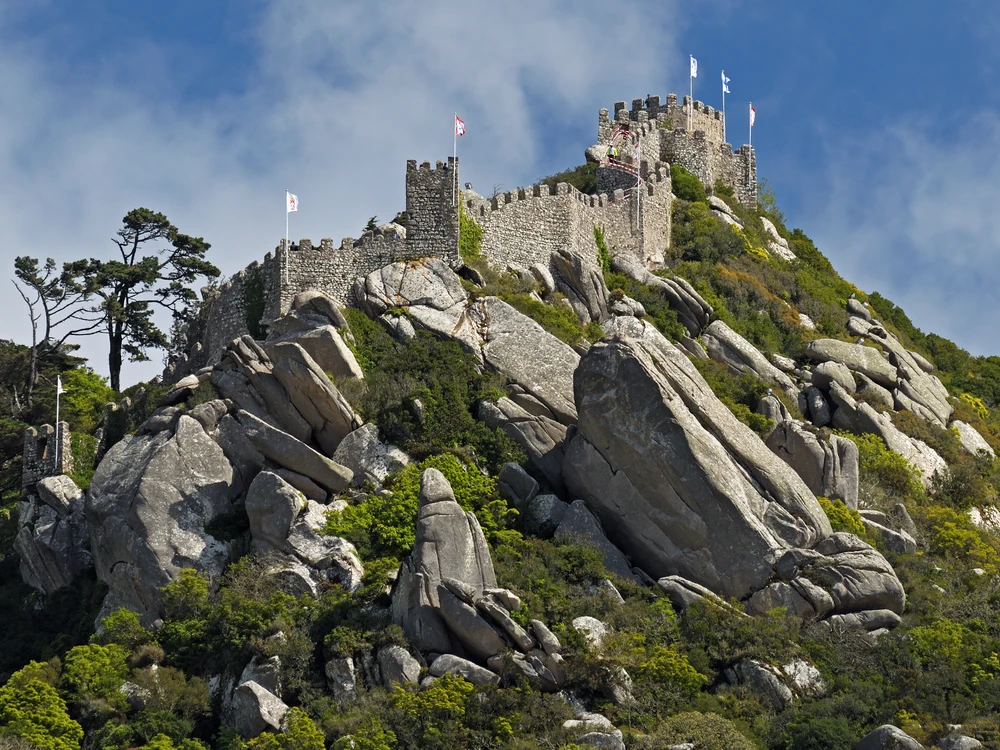
Combine with: Pena Palace (bus or tuk-tuk from Sintra centre, 15 min) and the Castle of the Moors (same area) are the other major Sintra heritage sites. Both are already on this site. Allow a full day in Sintra to visit all three comfortably.
Frequently Asked Questions
The National Palace is a genuine medieval royal palace continuously inhabited from at least the early 15th century through the late 19th century — it is the actual historical seat of the Portuguese court. Pena Palace, on the hill above the town, was built in the 1840s by Fernando II as a Romanticist fantasy in an eclectic mix of historical styles; it is visually spectacular but historically newer. Both are worth visiting, but they are very different experiences: the National Palace for real medieval and Manueline history in the town centre; Pena for dramatic 19th-century architecture in the hills.
Location
Largo Rainha Dona Amélia, 2710-616 Sintra, Portugal
Nearby Castles
Tours & Tickets
Powered by GetYourGuide
From
€13/ person