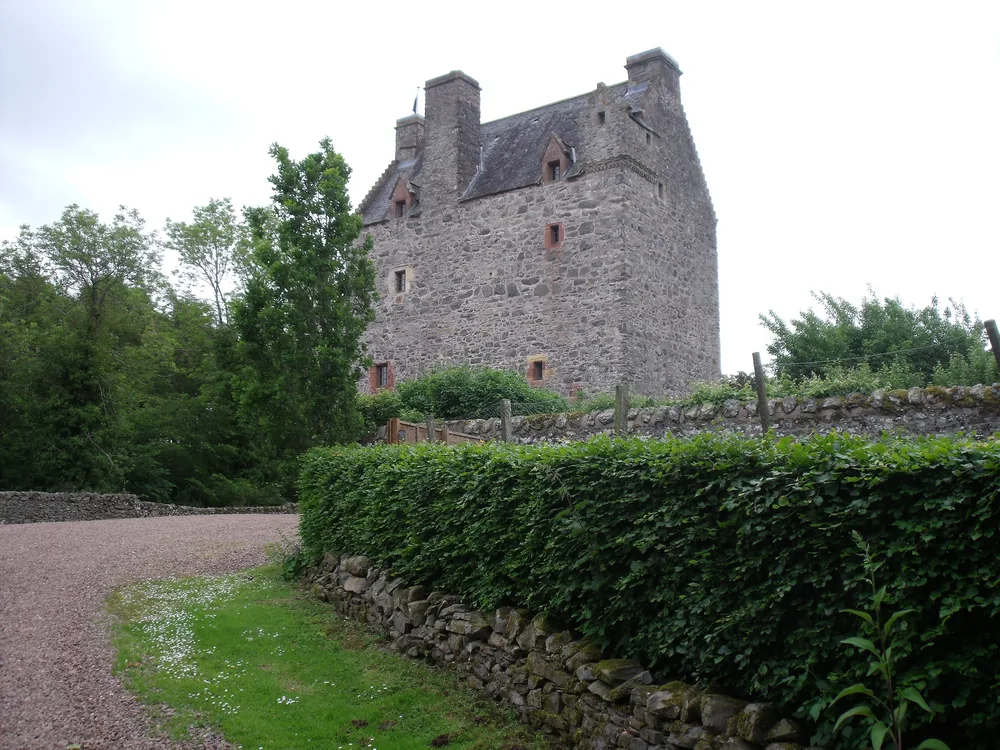
Aikwood Tower
Scotland · Scottish Borders — near Selkirk · Near Selkirk
Built 1541 · 16th-century Scottish tower house, first documented in a 1541 charter, with the present structure dating to around 1602
This page is part of an independent travel guide and is not affiliated with, endorsed by, or operated by Aikwood Tower.
© Castles & Palaces
Quick Facts
- Rooms from
- £450 / night
- Duration
- Self-catering stay only — no public visiting
- Best time
- Year-round
- Nearest city
- Selkirk
Stay Here
Aikwood Tower
Rooms are split between the historic building and a newer wing
Booked via Booking.com · Cancellation terms vary by rate
No day-visitor access — the entire tower is rented as a single exclusive-use property, similar to Faside Estate
Highlights
- ✦The lands of Aikwood are first mentioned in 1455, when James III granted them to Sir Alexander Home of Home, later 1st Lord Home
- ✦After the fall and execution of Alexander Home, 3rd Lord Home, in 1516, James V granted the lands to Michael Scott in 1517
- ✦The tower is first documented in a charter of 1541; the current structure dates to around 1602
- ✦Home of a branch of the Scott family for three centuries, later passing through Walter Murray of Livingston in 1623 to Sir William Scott of Harden, remaining with the Scotts of Harden until the late 1940s, when it passed to the 8th Duke of Buccleuch
- ✦Restored from ruin in 1988 by Sir David Steel — later Lord Steel of Aikwood, the long-serving Scottish Borders MP — and his wife Judy, who has Scott family blood of her own and moved into the tower with their youngest son Rory in 1992
Stay overnight
Book a room via Booking.com
Aikwood Tower stands in the Ettrick Valley near Selkirk in the Scottish Borders, on land whose recorded history reaches back to 1455, when King James III granted it to Sir Alexander Home of Home, who would go on to become the 1st Lord Home. The Home family's tenure ended in dramatic fashion: Alexander Home, 3rd Lord Home, fell from royal favour and was executed in 1516, and the following year James V granted the forfeited lands to Michael Scott, bringing the Scott family into a connection with Aikwood that would last for centuries.
The tower itself is first documented in a charter of 1541, though the structure that stands today dates to roughly 1602, built as the Scott family's presence in the valley became established. Aikwood served as home to a branch of the Scott family for three hundred years, a genuinely long single-family association even by the standards of Scottish Border towers, which changed hands frequently amid centuries of reiving, feuding and shifting allegiance across this contested frontier landscape. In 1623, the property passed to Walter Murray of Livingston, and later to Sir William Scott of Harden, with the tower remaining in the hands of the Scotts of Harden until the late 1940s, when it passed to Walter Montagu Douglas Scott, 8th Duke of Buccleuch — one of Scotland's largest landowning families, itself descended from the same wider Scott lineage.
By the 18th century, Aikwood had fallen out of residential use entirely, reduced to serving as a storage building for the neighbouring farm — a common fate for older Border towers once more comfortable country houses became available nearby. The tower's rescue came in 1988, when the 9th Duke of Buccleuch made its restoration possible, in a project led by Sir David Steel — later ennobled as Lord Steel of Aikwood — and his wife Judy. Steel served for decades as a Member of Parliament for the Scottish Borders and became a nationally recognised figure as Leader of the Liberal Party; Judy Steel, meanwhile, carries her own Scott family blood, meaning the restoration was, in a genuine sense, a continuation of the clan's long historical connection to this particular tower rather than an outside project imposed on unrelated ground. Restored with the help of local Selkirk craftsmen, the tower became a family home again in 1992, when the Steels moved in with their youngest son, Rory.
Today Aikwood operates purely as a self-catering property, sleeping up to ten guests across its five storeys, and there is no public visiting arrangement of any kind — anyone wishing to experience the tower needs to book the whole property rather than a single room or a ticketed tour. One additional detail worth knowing before booking: as of 2026, Aikwood Tower has itself been placed on the market, listed for sale at offers around £1,250,000, while continuing to operate as a short-term lets and events business in the meantime. As with any historic property mid-sale, this introduces some uncertainty about how long the current booking arrangement will remain unchanged, so confirming live availability before finalising travel plans is a sensible precaution.
Set deep in the Ettrick Valley — the same landscape celebrated in the writing of the 19th-century poet James Hogg, 'the Ettrick Shepherd,' and within reach of Abbotsford, the home Sir Walter Scott built a few miles away — Aikwood offers a genuinely literary corner of the Scottish Borders for anyone drawn to the region's deep connections to Scott, Hogg and the wider Border ballad tradition that shaped so much of Scotland's romantic self-image.
History
The lands of Aikwood were granted in 1455 by James III to Sir Alexander Home of Home, later 1st Lord Home. Following the execution of Alexander Home, 3rd Lord Home, in 1516, James V granted the forfeited lands to Michael Scott in 1517. The tower is first documented in a charter of 1541, with the current structure dating to around 1602. Aikwood remained home to a branch of the Scott family for three centuries, passing to Walter Murray of Livingston in 1623, then to Sir William Scott of Harden, and remaining with the Scotts of Harden until the late 1940s, when it passed to the 8th Duke of Buccleuch. By the 18th century the tower had fallen into disuse as a farm storage building. In 1988, the 9th Duke of Buccleuch enabled its restoration, led by Sir David Steel — later Lord Steel of Aikwood — and his wife Judy, who moved into the restored tower with their son Rory in 1992. As of 2026, Aikwood Tower has been listed for sale at offers around £1,250,000 while continuing to operate as a short-term lets business.
How to Stay
Getting there: near Selkirk, Scottish Borders.
Rooms & rates: The whole property is rented as one exclusive-use unit for up to 11 guests — 4 of the 5 en-suite bedrooms, including the Master Bedroom, are within the original 500-year-old Peel Tower; a fifth bedroom is in an extended wing.
On-site: Self-catering kitchen with AGA in the tower's vaulted ground floor, walled garden with croquet lawn.
Good to know: This is a whole-property rental for one group at a time (2-night minimum), not a room-by-room hotel — book the entire tower rather than an individual room.
Combine with: Selkirk town and the Scottish Borders' network of historic abbeys, all within easy driving distance.
Frequently Asked Questions
No. Aikwood Tower operates purely as a self-catering property, sleeping up to ten guests, with no public visiting arrangement of any kind — there is no day-visit access, tour or ticketed entry. Anyone wishing to experience the tower needs to book the entire property as an overnight stay.
Location
Ettrick Valley, near Selkirk, Scottish Borders TD7 5HJ, Scotland
Nearby Castles
Rooms from
£450/ night