
Manasija Monastery
Манастир Манасија / Manastir Manasija
Serbia · Central Serbia / Pomoravlje District · Near Belgrade
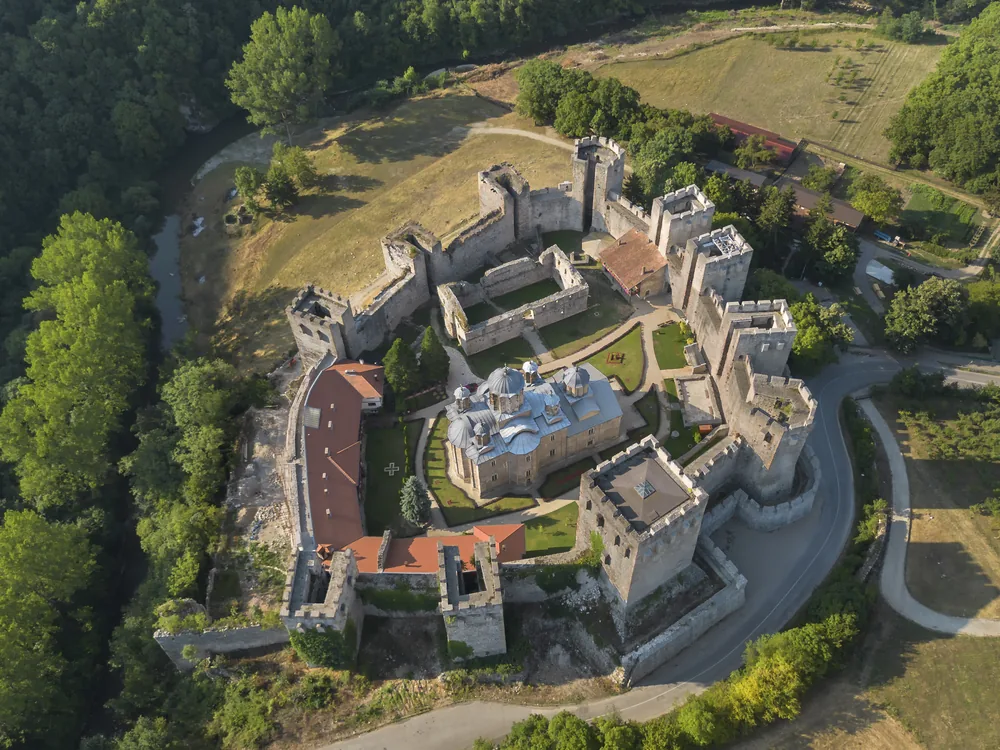
Built 1418 · Morava School fortified monastery — Manasija (also known as Resava) is the finest surviving example of the Morava School of Serbian medieval architecture: a style characterised by its intricate stone-carved ornament (vine scrolls, fantastic creatures, geometric interlace), its synthesis of Byzantine fresco tradition with Serbian political iconography, and its placement within a military fortification ring; the monastery church (the Church of the Holy Trinity) is surrounded by high defensive walls with eleven towers, built 1407–1418 under Despot Stefan Lazarević; the combination of fortification and spiritual centre is characteristic of the late medieval Serbian monastic tradition
This page is part of an independent travel guide and is not affiliated with, endorsed by, or operated by Manasija Monastery.
© Castles & Palaces
Quick Facts
- Hours
- Daily 07:00–19:00
- Day trip from
- €90
- Duration
- 1–1.5 hours at the monastery; 8 hours for the full GetYourGuide day tour (including Resava Cave)
- Best time
- April to October
- Nearest city
- Belgrade
Featured Tour
Fortified Manasija Monastery & Resava Cave Full-Day Tour from Belgrade
Cancellation available · Instant confirmation
Highlights
- ✦The Morava School architecture — Manasija is the definitive monument of the Morava School, the late 14th–early 15th century Serbian architectural style that synthesises Byzantine structural tradition with extraordinarily intricate stone-carved decorative ornament; the Church of the Holy Trinity's facade carving — vine scrolls, stylised animals, geometric interlace, and portrait reliefs — is among the most sophisticated medieval stone carving in the Balkans; the style is named after the Morava River valley where most of its monuments are concentrated
- ✦The eleven defensive towers — the monastery church is enclosed within a high defensive wall with eleven towers, built not as a symbolic gesture but as a functional military fortification that protected the monastery from Ottoman raiding parties; the towers are the best-preserved section of the complex and can be accessed on the rampart walk
- ✦Despot Stefan Lazarević and the 'Athens of the Morava' — the builder of Manasija, Stefan Lazarević (c. 1377–1427), was the last major ruler of the medieval Serbian state before its final collapse under Ottoman conquest; Stefan was a knight of the Order of the Dragon (alongside Sigismund of Hungary and Vlad II Dracul of Wallachia), a poet and literary figure in his own right, and a patron of culture who deliberately made Manasija a centre of manuscript production and literary life — the monastery scriptorium produced illuminated manuscripts and literary works that made it the cultural capital of late medieval Serbia
- ✦The frescoes — the interior of the Church of the Holy Trinity is covered with frescoes in the Morava School tradition; damaged by Ottoman raids and later repairs, the surviving frescoes represent the last major flourishing of the Byzantine fresco tradition in Serbia before the Ottoman cultural rupture; the portrait of Despot Stefan Lazarević (one of the finest surviving portraits of a medieval Serbian ruler) is among the most significant
- ✦The GetYourGuide full-day tour from Belgrade (8 hours) — covers Manasija Monastery and Resava Cave in a single day from Belgrade; the cave is one of Serbia's largest and most impressive underground systems (1.5km guided circuit, stalactites and stalagmites); the tour provides round-trip transport and English guide for both sites
- ✦The Resava Cave pairing — the Resava Cave (Resavska Pećina) is approximately 9km from Manasija Monastery and is one of the most visited natural sites in Serbia; at a constant 7°C, it is a useful summer complement to the outdoor monastery visit; the GetYourGuide day tour combines both
Skip the queue with a guided tour
Skip-the-line tickets & expert guides
Manasija Monastery — also known by the name of the nearby Resava River, as Resava Monastery — was built between 1407 and 1418 by Despot Stefan Lazarević, the last significant ruler of the medieval Serbian state before its final absorption into the Ottoman Empire. It is the most ambitious monastery construction project in Serbian history, combining the functions of a religious centre, a military fortress, and a cultural institution in a single complex built at a moment when the Serbian state was actively defending its existence against Ottoman expansion.
The context of the building is essential. Stefan Lazarević inherited a severely weakened Serbia from his father Prince Lazar, who had died at the Battle of Kosovo Polje in 1389 — the battle that is foundational to Serbian national mythology and that decisively shifted the balance of power in the Balkans toward the Ottoman Empire. Stefan governed the reduced Serbian state (as a vassal of the Ottomans after 1402, with intermittent periods of greater autonomy through his alliance with Sigismund of Hungary) and pursued a deliberate cultural policy that treated the monastery construction programme — Manasija above all — as a form of political and religious assertion. Building the greatest fortified monastery in Serbia was a statement that the Serbian state still existed and that its cultural traditions were worth preserving.
The architectural tradition that Manasija represents — the Morava School — was developed in the late 14th and early 15th centuries in the river valleys of central Serbia. Its defining feature is the extraordinary decorative stone carving that covers the facades and portals of its churches: vine scrolls inhabited by fantastic creatures (hybrid animals, sirens, griffins), geometric interlace, and portrait reliefs, all executed in a style that synthesises Byzantine iconographic convention with a distinctive local sculptural vigour. The carving programme at Manasija's Church of the Holy Trinity is the most extensive and finest quality of any Morava School monument — the portal and the window surrounds are the most-reproduced examples of Serbian medieval stone carving in scholarly literature.
The military fortification surrounding the monastery church is not symbolic. Eleven towers are integrated into the high defensive wall, and the towers were armed with artillery in the decades after Manasija's construction as the Ottoman threat intensified. The monastery was raided by Ottoman forces in 1439 and again later, and the damage to the frescoes inside the church dates from these incursions. The surviving frescoes — including the portrait of Stefan Lazarević, one of the most important surviving images of a medieval Serbian ruler — represent the last major programme of Byzantine-tradition fresco painting in Serbia before the Ottoman cultural transformation of the region.
Stefan Lazarević was a figure of remarkable breadth. He was a knight of the Order of the Dragon — the chivalric order founded by Sigismund of Hungary in 1408, whose members included Vlad II Dracul of Wallachia and (by extension, through the Dracul surname) Vlad the Impaler. He was also a poet and literary figure who composed in both Serbian and possibly other languages, and he made Manasija a centre of manuscript production — its scriptorium produced illuminated manuscripts and literary works that made the monastery the cultural capital of late medieval Serbia; his biographer Constantine the Philosopher described it as 'the new Athens.' Stefan died in 1427, and within three years the Ottomans had captured the Serbian capital; the process of Ottoman conquest that Stefan had spent his reign delaying was completed within a generation of his death.
The GetYourGuide-listed full-day tour from Belgrade (8 hours, English guide) covers Manasija Monastery and the Resava Cave in a single circuit. The Resava Cave is approximately 9km from the monastery — one of Serbia's largest and most significant cave systems, with a 1.5km guided circuit through formations of stalactites and stalagmites at a constant 7°C; bring warm layers regardless of outside temperature. The tour provides round-trip transport from Belgrade and an English-speaking guide for both sites.
History
Church of the Holy Trinity and defensive walls built 1407–1418 by Despot Stefan Lazarević, last major ruler of the medieval Serbian state. Monastery designated a cultural and literary centre; scriptorium produced illuminated manuscripts. Stefan died 1427; Ottoman conquest of Serbia completed 1459. Monastery raided by Ottoman forces multiple times; frescoes damaged. Monastery remained as active Orthodox religious community throughout the Ottoman period and to the present. Now a functioning Serbian Orthodox monastery and major cultural heritage site.
How to Visit
Getting there: From Belgrade, drive approximately 2 hours southeast on the A1/E75 toward Paraćin, then east on regional roads toward Despotovac (around 170 km total). By bus, Lasta/BAS services run from Belgrade's Lasta bus station to Despotovac in roughly 2.5 hours; the monastery is 3 km from town, reachable by local taxi.
Tickets: Walk-up entry 200 RSD adult, 100 RSD child. The GetYourGuide tour — a full-day Belgrade day trip pairing Manasija Monastery with the Resava Cave, including round-trip transport and an English-speaking guide; the cave stays at 7°C year-round so bring a warm layer regardless of the season — book in advance.
Practical tips: Dress modestly inside the monastery — shoulders and knees covered. The Resava Cave is 9 km from the monastery on a separate road; the GetYourGuide tour handles both without a car, making it the easiest option for independent travellers. Arrive early to walk the fortification rampart before coach groups arrive.
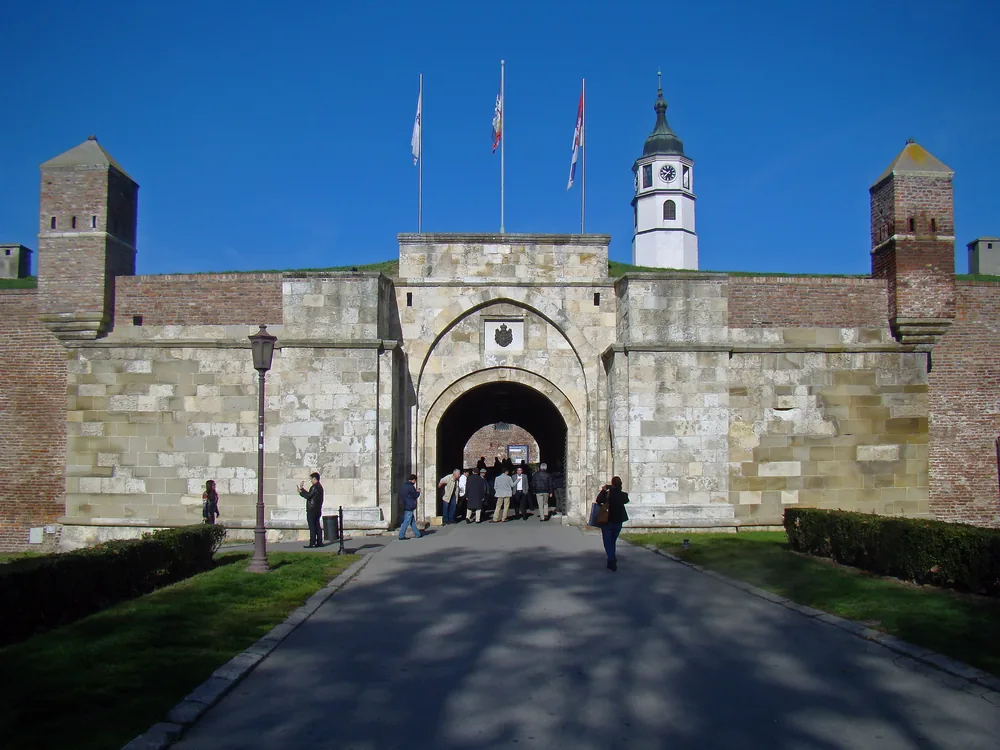
Combine with: Belgrade Fortress anchors a natural Serbia medieval circuit — the capital's riverside fortress pairs well with Manasija as a full-country itinerary bookend.
Frequently Asked Questions
The Morava School is a distinct style of Serbian medieval architecture and decorative arts developed in the late 14th and early 15th centuries in the Morava River valley region of central Serbia. Its key characteristic is the extraordinary stone carving that covers its churches' facades, portals, and windows — intricate vine scrolls inhabited by fantastic creatures, geometric interlace, and portrait reliefs. Manasija is the largest, latest, and most architecturally sophisticated Morava School monument; its stone carving is more extensive and of higher quality than earlier examples (Ravanica, Sisojevac, Kalenić). The combination of the finest Morava School church with the most complete surviving defensive wall system makes Manasija the essential Morava School site.
Location
Manasija bb, 35230 Despotovac, Serbia
Nearby Castles
Tours & Tickets
Powered by GetYourGuide
From
€90/ person