
Bratislava Castle
Bratislavský hrad
Slovakia · Bratislava · Near Bratislava
Built 1430 · Large hilltop castle complex above the Danube, with a core structure substantially established in the early 15th century under Sigismund of Luxembourg, later expanded by the Habsburgs in the 16th century and remodeled by Maria Theresa in the late 18th century as a Baroque-style royal residence; the castle suffered a catastrophic fire in 1811 caused by soldiers, leaving the interior gutted and the structure a ruin for nearly 150 years; the current appearance results from a mid-20th-century reconstruction (1953–1968) that rebuilt the exterior form but created a largely modern interior now housing the Slovak National Museum collections
This page is part of an independent travel guide and is not affiliated with, endorsed by, or operated by Bratislava Castle.
© Castles & Palaces
Quick Facts
- Hours
- Tue–Sun 10:00–18:00. Closed Mon
- Guided tour from
- €63
- Duration
- 1.5–2.5 hours
- Best time
- April to October
- Nearest city
- Bratislava
Featured Tour
Guided Walking Tour with Castle Entry Ticket
Cancellation available · Instant confirmation
Highlights
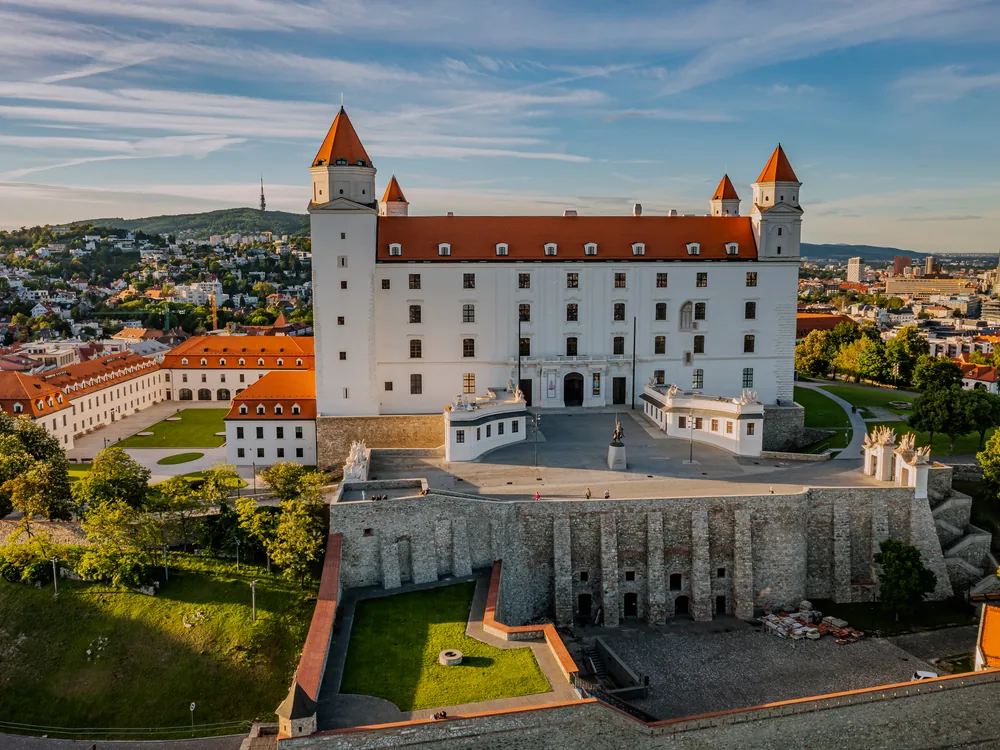
- ✦Bratislava Castle's distinctive silhouette — a white rectangular block with a tower at each corner — has been locally nicknamed 'the upside-down table' since at least the 19th century; the image is both instantly recognisable and oddly apt, since the castle's position on a solitary rock above the Danube gives it a profile unlike any other European capital city castle
- ✦The castle sits at the intersection of three countries: Austria begins immediately across the Danube, Hungary begins a few kilometres downstream, and Slovakia fills the surrounding landscape — a geographical compression that makes Bratislava's position as a medieval capital and crossing point on the Danube immediately legible from the castle hill
- ✦Maria Theresa used Bratislava (then Pressburg, under its German name) as the Habsburg coronation city for the Hungarian kingdom — she herself was crowned Queen of Hungary here in 1741 — and later converted the castle into a royal Baroque residence, adding the red-roofed towers that gave the building much of its current appearance
- ✦The castle burned in 1811 when a fire started by careless soldiers gutted the interior and left the exterior walls standing but empty — a ruin that remained as such for nearly 140 years, from the Napoleonic era through two World Wars and the beginning of the communist period, before reconstruction began in 1953 under the Czechoslovak state
- ✦The Slovak National Museum collections housed in the rebuilt castle include prehistoric and medieval archaeology from the Carpathian Basin, covering Great Moravia and the early Slovak territories in the 9th and 10th centuries — a period when the region was the cultural centre of the first major Slavic state in Central Europe
Skip the queue with a guided tour
Skip-the-line tickets & expert guides
The nickname 'upside-down table' requires a moment with a photograph to understand. Bratislava Castle sits on a solitary rocky spur above the west bank of the Danube, its white walls rising steeply from the hillside. From most angles, what you see is a massive rectangular block with a square tower at each corner — the towers extending upward from the corners of the main building in a way that, if you invert the image in your mind, does indeed look like a table standing on its legs. The nickname has been in use since at least the 19th century and has the quality of an accurate observation that becomes permanent once you've heard it: no subsequent view of the castle quite erases it.
The four-tower rectangular plan was not the building's original form. Bratislava's rock has been a fortified point since Celtic and Roman times — the Romans used it as a watchtower on the Danube limes (the frontier fortification along the river's northern bank), and the Celts before them built a settlement on the hill that archaeological excavation has documented in some depth. The first properly documented medieval castle was built by Hungarian kings in the 12th and 13th centuries. The structure took its current basic form in the early 15th century under Sigismund of Luxembourg — Holy Roman Emperor, King of Hungary, King of Bohemia, and one of the most energetically itinerant rulers of the medieval period — who used Bratislava (then called Pozsony in Hungarian, Pressburg in German) as a regional stronghold and base for his diplomatic and military campaigns. The Habsburgs expanded and modified the structure in the 16th century as it became an increasingly important administrative centre; the Ottoman conquest of much of Hungary in 1541 moved the Hungarian capital from Buda to Bratislava, and the city's status rose accordingly.
The transformation that gives the castle its most recognisable external appearance came under Maria Theresa in the 18th century. She used Bratislava as the coronation city for the Hungarian crown — she was herself crowned Queen of Hungary here in 1741, in a ceremony that has a specific historical context worth explaining. Maria Theresa's succession to the Habsburg throne was immediately challenged by Frederick II of Prussia and a coalition of European powers who disputed a woman's right to inherit the Habsburg lands. Her appeal to the Hungarian Diet at Bratislava — appearing in ceremonial Hungarian dress, presenting her infant son, and asking the assembled Hungarian nobles for military support — is one of the more dramatic scenes of 18th-century European politics, and the Diet's enthusiastic response ('We pledge our lives and blood for our Queen') turned the tide of the War of the Austrian Succession. The coronation city that witnessed this scene was then rewarded with a substantial Baroque refurbishment of its castle under her patronage.
The fire of 1811 ended this Baroque phase definitively. A fire caused by soldiers quartered in the building after Napoleon's occupation of Vienna gutted the interior entirely, leaving the exterior walls standing while the roof collapsed and the internal structure burned out. What remained was a shell: the four towers and the enclosing walls, structurally sound enough to survive but entirely unusable as a building. The ruin sat essentially untouched for nearly 140 years — through the 19th century, through the First World War, through the interwar period when Bratislava was the capital of the Slovak region of the new Czechoslovak state, through the Second World War, and into the communist period. It is a genuinely extraordinary span of abandonment for a structure in the centre of a capital city, and the castle as a ruin became a feature of the Bratislava skyline in its own right, the empty windows and roofless towers giving the hill above the Danube a melancholy grandeur that photographs of the period document clearly.
Reconstruction began in 1953 under the Czechoslovak state and continued until 1968, rebuilding the exterior to the pre-fire silhouette and creating a largely new interior to house the Slovak National Museum. The result is a building whose exterior form carries historical authority — the white walls, the red-roofed towers, the position above the Danube — while the interior is effectively a 20th-century construction wrapped in a historical shell. This is a common outcome for castles that underwent destruction followed by state-sponsored reconstruction, and the honest way to visit Bratislava Castle is to understand this distinction: you are seeing a historically accurate exterior form and a comprehensively modern interior.
The Slovak National Museum collections housed in the castle cover prehistoric and early medieval archaeology of the Carpathian Basin. The exhibits include material from Great Moravia — the 9th-century Slavic state that occupied the territory of modern Slovakia, Moravia, and adjacent areas, and that was the political entity in which Saints Cyril and Methodius introduced the Glagolitic alphabet and Christian literacy in the Slavic vernacular — as well as later medieval material tracing Slovak territorial history through the Hungarian kingdom period. For visitors interested in Central European history before the Habsburg era, the museum's holdings are the most accessible survey of the pre-medieval and early medieval Slovakian evidence available in English.
The GetYourGuide guided walking tour with castle entry covers both the Bratislava Old Town and the castle on a 2–3 hour English-language circuit. The Old Town — compact, largely intact, with Roman, Gothic, Baroque, and Art Nouveau layers visible in the streets below the castle hill — is worth exploring on its own terms, and the guided format gives the combination of castle and city centre a historical coherence that self-guided visits, focused on either one or the other, tend to lack. The walk from the Old Town to the castle via the castle hill takes approximately 15–20 minutes on foot up cobblestone paths; the views across the Danube to Austria and Hungary become visible well before the castle walls.
Bratislava's geography deserves the comment the castle view prompts. The city sits where Austria, Hungary, and Slovakia converge on the Danube — approximately 60 kilometres from Vienna, within sight of Hungary on a clear day, and at the western edge of the Carpathian arc that defines Slovak territory to the east. No other European capital sits this close to two other countries' borders. The castle hill view makes this triple-border geography immediately visible and gives the site's history — why it mattered to Celts, Romans, Hungarian kings, Ottoman-era administrators, and Habsburgs in succession — a physical explanation that no amount of reading provides as efficiently.
History
Bratislava's rocky hill has been continuously fortified since Celtic and Roman times. A medieval castle was built by Hungarian kings in the 12th–13th centuries. Sigismund of Luxembourg substantially rebuilt the castle in the early 15th century, establishing the basic four-tower plan. Habsburg expansion in the 16th century coincided with the castle's elevation as a regional capital when Ottoman conquest moved the Hungarian royal court from Buda. Maria Theresa undertook a Baroque remodeling in the 18th century and used Bratislava as the Hungarian coronation city. A catastrophic fire in 1811 gutted the interior and left the structure a ruin for nearly 150 years. State-sponsored reconstruction from 1953 to 1968 rebuilt the exterior to its pre-fire silhouette and created a modern interior for the Slovak National Museum.
How to Visit
Getting there: The castle is a 15–20 minute walk from Bratislava's Old Town via the castle hill paths. From the main train station (Bratislava hl. st.), take tram or taxi to the Old Town (10 min), then walk up to the castle. Bratislava is approximately 1 hour from Vienna by train or 2.5 hours from Prague.
Tickets: The "Guided Walking Tour with Castle Entry Ticket" covers both the Old Town and the castle with an English-speaking guide on a 2–3 hour circuit. Self-guided museum entry is also available at the castle (approximately €10 adult, €5 child).
Practical tips: The cobblestone approach from the Old Town is steep; wear comfortable shoes. The Slovak National Museum inside the castle is closed on Mondays — confirm any closure days at snm.sk before visiting.
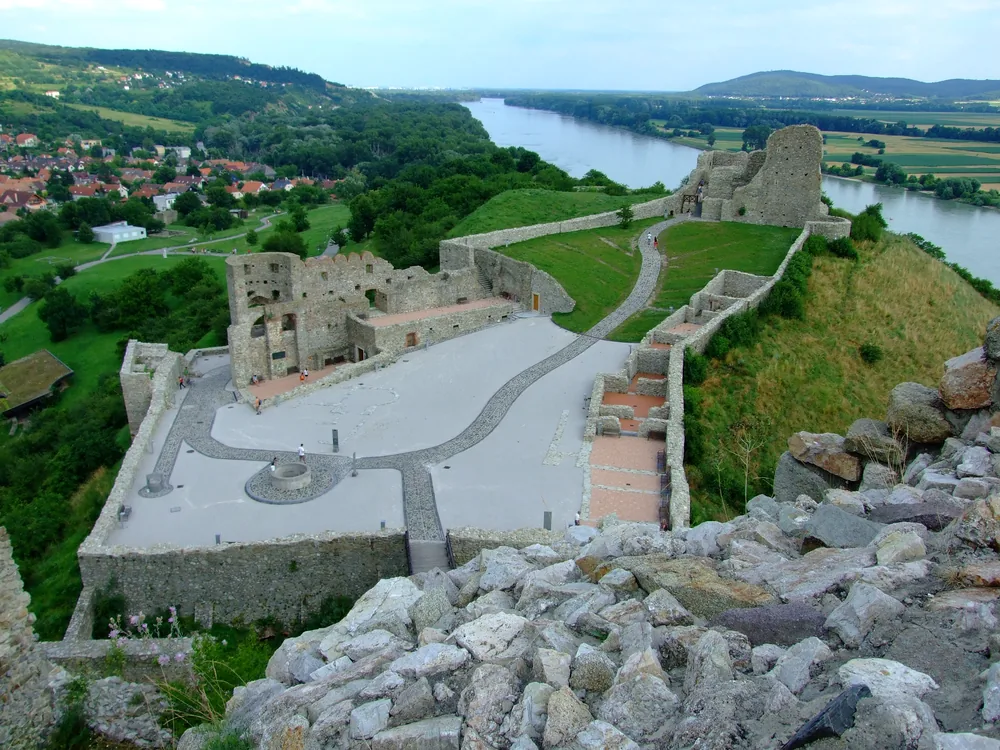
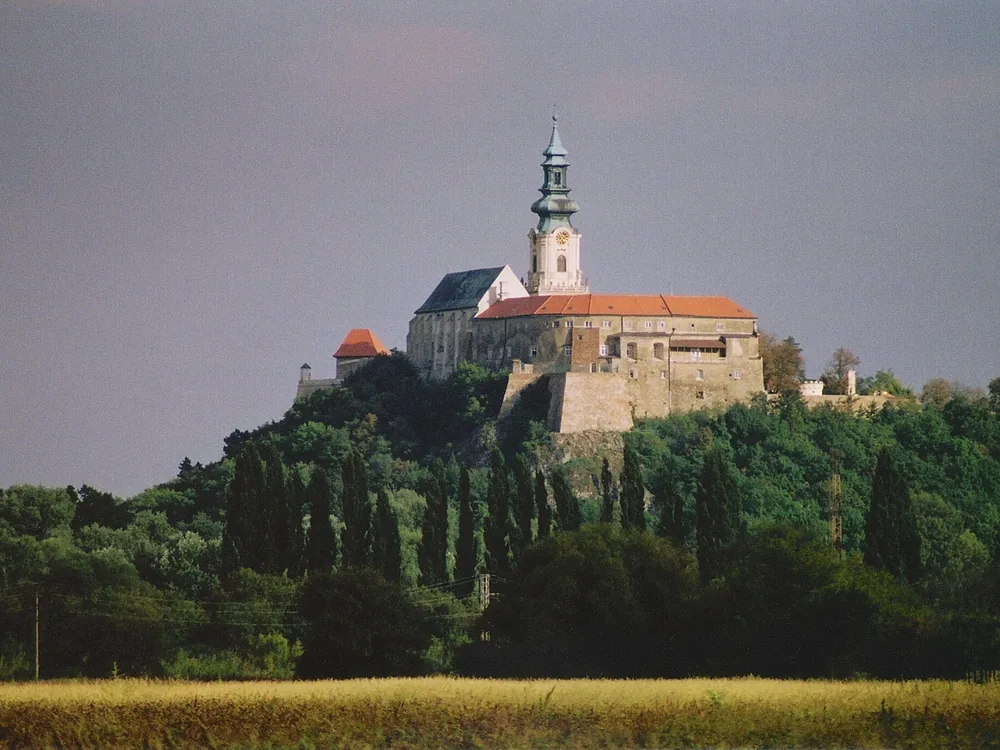
Combine with: Devín Castle (10 km west — the Great Moravian frontier fortress at the Danube-Morava confluence). Nitra Castle (90 km east — Slovakia's oldest city, site of the first documented Christian church in Slovak territory).
Frequently Asked Questions
The nickname refers to the castle's distinctive silhouette: a massive rectangular white block with a square tower at each of its four corners, visible from across the Danube and from much of the city. When the profile is mentally inverted, the four towers extending upward from the corners of the main block do resemble table legs. The nickname has been in use since at least the 19th century and accurately describes the castle's profile in a way that photographs consistently confirm.
Location
Hrad - nádvorie, 811 06 Bratislava, Slovakia
Nearby Castles
Tours & Tickets
Powered by GetYourGuide
From
€63/ person