
Nitra Castle
Nitriansky hrad
Slovakia · Nitra, western Slovakia — Slovakia's oldest city · Near Nitra
Built 828 · Hilltop fortified bishop's residence with cathedral — the castle hill's earliest documented fortification dates to the early 9th century Principality of Nitra; the present complex reflects successive building phases spanning Gothic, Renaissance, and Baroque periods; the Cathedral of St. Emmeram on the hill contains an early Romanesque rotunda (11th century), a Romanesque body, a Gothic nave, and Baroque completion — all within one continuously-used church; the enclosing fortification walls, rebuilt substantially after Ottoman-era damage in the 16th and 17th centuries, are primarily Baroque military architecture; the bishop's palace adjacent to the cathedral is a Baroque residence built in the 17th and 18th centuries; the overall impression is of a continuously inhabited hilltop enclosure that has been rebuilt rather than abandoned and re-built, accumulating layers from early medieval to Baroque without a single legible dominant period
This page is part of an independent travel guide and is not affiliated with, endorsed by, or operated by Nitra Castle.
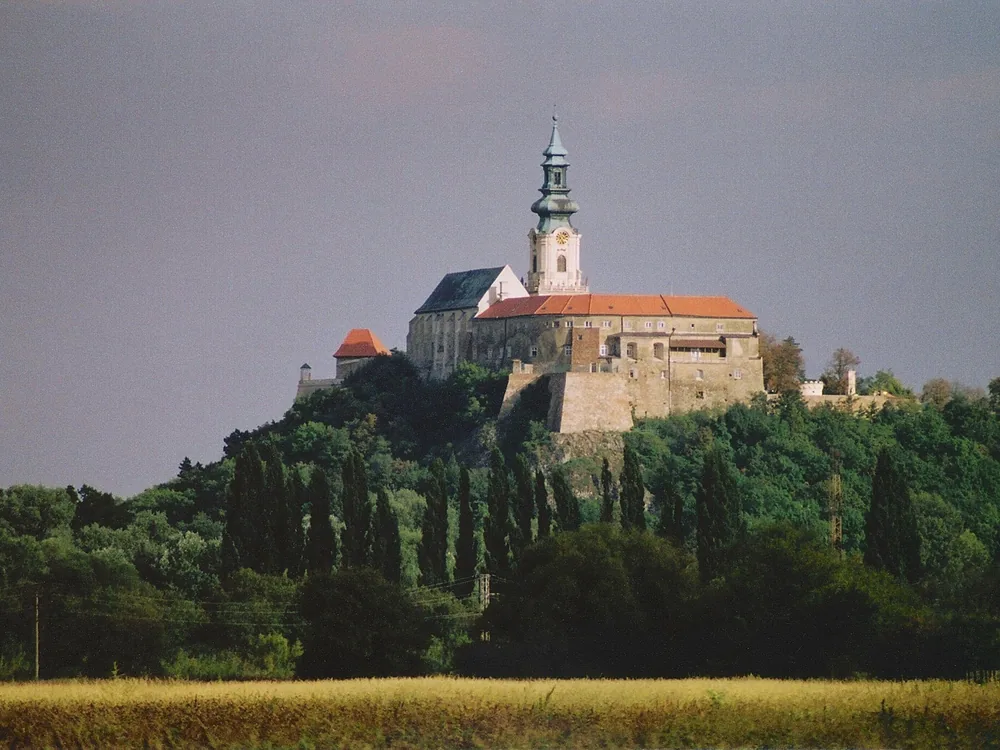
© Castles & Palaces
Quick Facts
- Hours
- Mon Variable — the castle hill (Upper Town) is generally accessible; individual buildings have their own schedules. Tue–Sun 09:00–17:00
- Guided tour from
- €119
- Duration
- 1–1.5 hours (hilltop complex on your own); 9.5 hours (GetYourGuide full day-trip from Bratislava covering 3 Slovak towns)
- Best time
- April to October
- Nearest city
- Nitra
Featured Tour
Bratislava: Nitra, Banská Štiavnica & Bystrica Guided Tour
Cancellation available · Instant confirmation
Highlights
- ✦828: the first documented Christian church in Slovak territory — Prince Pribina of the Principality of Nitra had a church consecrated on this hill by Adalram, Archbishop of Salzburg, on a date that precedes the better-known Cyril-and-Methodius mission to Great Moravia by 35 years; the 828 church is the earliest documented Christian construction on the territory of modern Slovakia
- ✦The Cathedral of St. Emmeram in layers — a single continuously-used church containing an 11th-century Romanesque rotunda, a Romanesque nave body, a Gothic choir, and Baroque completion; the architectural layering of the cathedral is a physical record of the continuous occupation of the hill from early medieval to modern times without interruption
- ✦One of the oldest bishoprics in Central Europe — the Diocese of Nitra, first established in the 9th century (suppressed and restored multiple times through the centuries of Magyar rule and subsequent politics), is among the oldest episcopal sees in the region and the principal reason the castle hill became and remained a fortified bishop's complex rather than converting to a different use
- ✦Prince Pribina and the Principality of Nitra — in the early 9th century, before the formation of Great Moravia, Nitra was the center of a Slavic principality under Prince Pribina, who navigated complex relationships with the Franks, the Moravian Slavs, and the Carolingian bishops; his decision to have a church built and consecrated with Salzburg's archbishop is the act that put Nitra on the early medieval European ecclesiastical map
- ✦Baroque reconstruction after Ottoman raids — the fortification walls visible today are primarily 17th-century Baroque military architecture, rebuilt after repeated Ottoman-era damage; the castle hill was in the front line of the Ottoman-Habsburg frontier conflict that scarred Slovakia's towns in the 16th and 17th centuries
- ✦GetYourGuide Bratislava: Nitra, Banská Štiavnica & Bystrica Guided Tour (9.5 hours) — includes a 1-hour guided stop at Nitra Castle
Skip the queue with a guided tour
Skip-the-line tickets & expert guides
The hill above Nitra has been continuously fortified and continuously inhabited since the early 9th century, making it the oldest documented continuously occupied settlement site in Slovakia. In a country where much of the built history was remade by Ottoman destruction, Counter-Reformation rebuilding, Habsburg administration, and 20th-century socialist transformation, this continuity of occupation — the bishop's palace still on the hill, the cathedral still in active use, the fortification walls still standing — gives Nitra Castle an archaeological density that younger-looking complexes do not have.
The most consequential date in Nitra's documented history is 828. In that year, Prince Pribina — ruler of the Principality of Nitra, a Slavic polity in western Slovakia that existed before the formation of the broader Great Moravian state — had a Christian church consecrated on the castle hill by Adalram, Archbishop of Salzburg. The event is documented in Frankish sources, and its significance is precise: the Adalram consecration of 828 is the earliest documented Christian construction on the territory of modern Slovakia — earlier than the arrival of Cyril and Methodius in Great Moravia in 863, earlier than the Baptism of the Bohemian princes, earlier than most of the ecclesiastical foundations that would define the early Christian landscape of Central Europe. Pribina himself appears to have remained a pagan or at most a nominal convert; his political calculation in inviting a Salzburg archbishop to consecrate a church on his hilltop was about aligning with Carolingian patronage networks, not personal faith. But the church was built and consecrated, and that documented act established Nitra in the earliest layer of Central European Christian history.
Pribina's Principality of Nitra was absorbed into the broader Great Moravian state in the 830s, when his Moravian rival Mojmír I expelled him. Great Moravia would last until its catastrophic collapse around 907, overwhelmed by Magyar invasions from the east; the hill at Nitra, like the rest of the Carpathian basin, passed into the emerging Kingdom of Hungary. Under the Árpád dynasty, Nitra became an important administrative and ecclesiastical center; the Diocese of Nitra was formally re-established in the 11th century as one of the earliest suffragen sees of the Archdiocese of Esztergom, institutionalizing the Christian presence on the hill that Pribina had initiated two centuries earlier.
The Cathedral of St. Emmeram that crowns the hill today is a building in layers — each major period of Slovak and Central European history has left a structural deposit. The 11th-century Romanesque rotunda is the earliest surviving fabric, a small circular chapel whose walls are still standing beneath the later additions. A Romanesque nave was added in subsequent centuries; a Gothic choir and presbytery extended the building eastward in the late medieval period; the Baroque towers and interior decoration were added after the Ottoman-era damage. The result is a single church that is simultaneously a Romanesque, Gothic, and Baroque building — the physical equivalent of a stratigraphic excavation, except entirely above ground and still in active liturgical use.
The Ottoman period was the most destructive in Nitra's physical history. The Ottoman front line in the 16th and 17th centuries ran directly through western Slovakia, and Nitra's hilltop fortress was a contested position repeatedly damaged by Ottoman raids and Habsburg counter-operations. The fortification walls that define the castle complex today are primarily 17th-century Baroque military architecture, rebuilt after this damage under episcopal and Habsburg patronage. The bishop's palace adjacent to the cathedral was built in its current Baroque form in the same period — an episcopal residence on a fortress hill that had by this point accumulated nearly 900 years of continuous occupation.
Today the castle complex — the Upper Town enclosed within the Baroque fortification walls — functions as a working bishop's compound open to visitors. The cathedral is in regular liturgical use; the bishop's residence is an active ecclesiastical building. The viewpoint from the hill over Nitra's lower town, the Nitra River, and the western Slovak plain is the clearest spatial explanation of why this particular hill was worth defending and rebuilding across twelve centuries: it commands the natural crossing of the river and the surrounding agricultural lowlands in every direction.
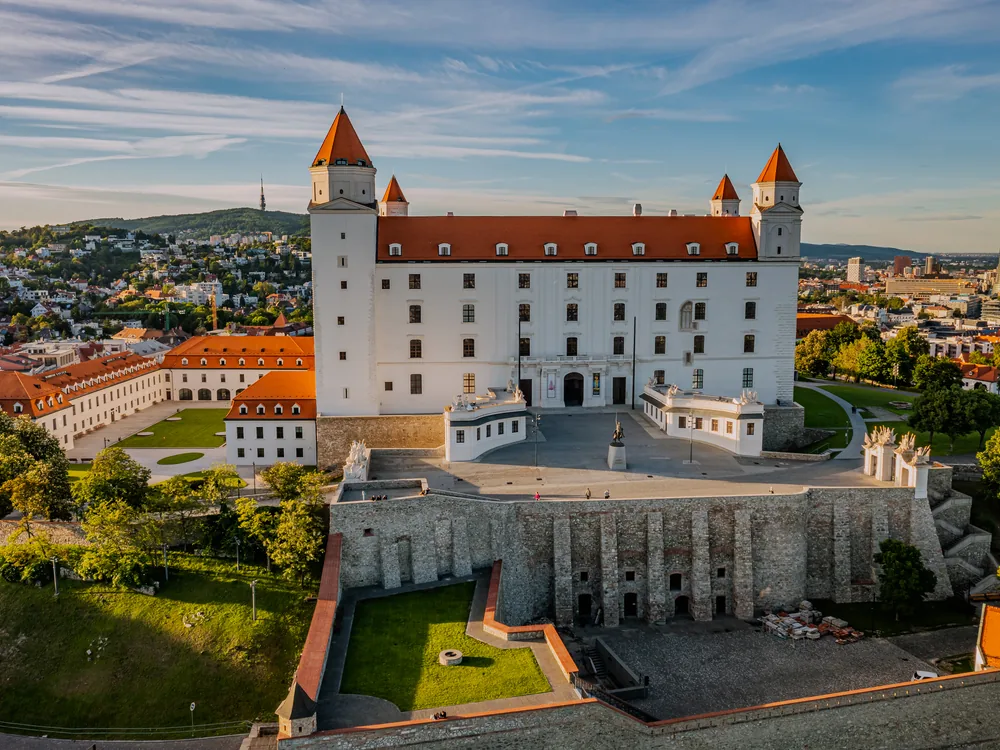
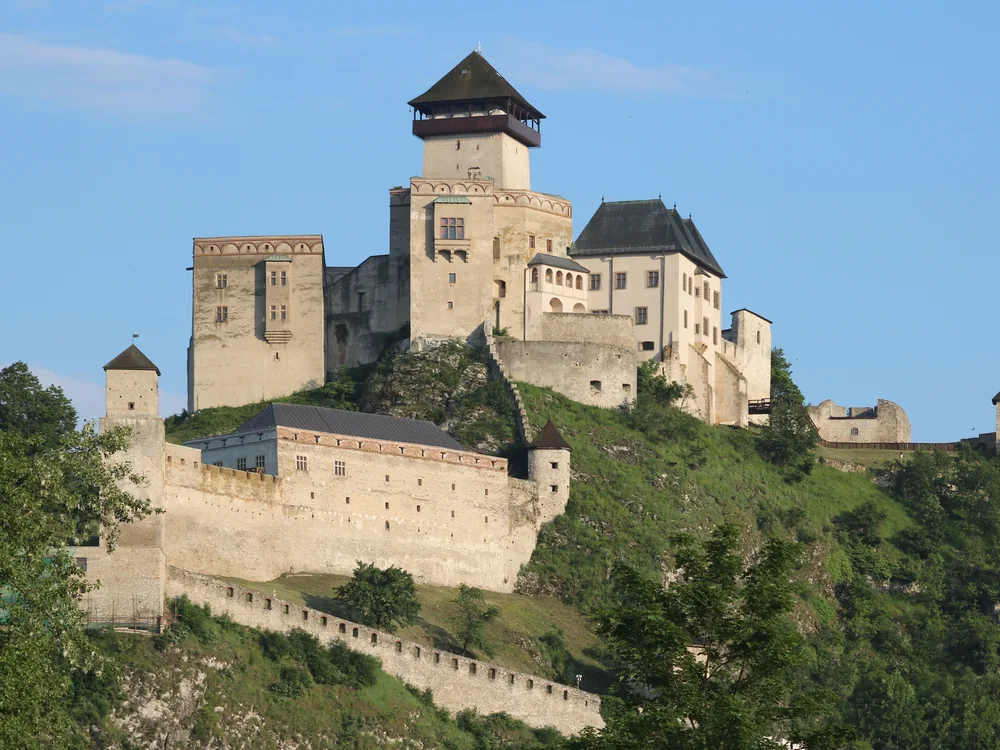
[Bratislava Castle](/castles/slovakia/bratislava-castle), 90 kilometres southwest, was the principal royal and later Habsburg administrative fortress of western Slovakia and the primary alternative royal residence to Nitra in the western Slovak castle hierarchy. [Trenčín Castle](/castles/slovakia/trencin-castle), 65 kilometres north, rises on another dramatic rocky outcrop above the Váh River — one of the most visually striking castle positions in Slovakia and a region historically linked to Nitra through the medieval Slovak administrative structure.
History
Early 9th century: Principality of Nitra under Prince Pribina — Nitra is the political and ecclesiastical center of a pre-Moravian Slavic principality in western Slovakia. 828: Adalram, Archbishop of Salzburg, consecrates the first documented Christian church in the territory of modern Slovakia on the Nitra castle hill — the earliest documented Christian construction in Slovakia. 830s: Pribina expelled by Moravian ruler Mojmír I; Principality of Nitra absorbed into Great Moravia. 863: Cyril and Methodius arrive in Great Moravia — 35 years after Pribina's 828 church consecration. c.907: Collapse of Great Moravia under Magyar invasions; Nitra passes into the Kingdom of Hungary. 11th century: Diocese of Nitra re-established as one of the first suffragan sees of the Archdiocese of Esztergom; Romanesque rotunda of the cathedral built. Medieval period: Gothic extensions to the cathedral; castle complex develops as a fortified bishop's seat. 16th–17th century: Ottoman raids damage the castle complex; Baroque rebuilding of the fortification walls and bishop's palace. 18th–19th century: Further Baroque and Neoclassical additions to the complex. Present day: Active bishop's compound; cathedral in regular liturgical use; castle hilltop (Upper Town) open to visitors.
How to Visit
Getting there: Nitra is 90 km east of Bratislava — about 1 hour by car, or roughly 1 hour by regular bus from Bratislava's central bus station. The castle hilltop (Upper Town) is a 10-minute uphill walk from the town centre.
Tickets: The hilltop enclosure is free to access; a modest fee applies for the cathedral interior and certain fortification sections — confirm pricing on-site. The GetYourGuide tour — a full-day Bratislava day trip with a 1-hour guided stop at Nitra Castle plus visits to Banská Štiavnica and Banská Bystrica; the price covers the entire 9.5-hour itinerary with transport — book in advance.
Practical tips: The approach to the hilltop is steep — wear comfortable shoes. Allow 1 to 1.5 hours to explore the enclosure, visit the cathedral's architectural layers, and enjoy the panorama over the Nitra River valley. The lower town has a pleasant pedestrianised centre worth exploring after the castle.
Combine with: Trenčín Castle is 65 km north on the Váh River — one of the most visually dramatic castle positions in Slovakia. Bratislava Castle is 90 km southwest and the natural western anchor of a Slovak castle itinerary.
Frequently Asked Questions
The 828 consecration of a church on the Nitra hilltop by Adalram, Archbishop of Salzburg, is the earliest documented Christian construction on the territory of modern Slovakia. It predates by 35 years the arrival of the Byzantine missionary brothers Cyril and Methodius, who came to Great Moravia in 863 at the invitation of Prince Rastislav; their mission is far better known internationally because of its cultural legacy — the Glagolitic alphabet, the Church Slavonic liturgical language — but Pribina's 828 church is the earlier documented event. Both events happened on the same geographical territory, which is part of why Nitra has a special place in Slovak national identity as the earliest site of Christianity in the region.
Location
Svätoplukovo námestie, 949 01 Nitra, Slovakia
Nearby Castles
Tours & Tickets
Powered by GetYourGuide
From
€119/ person