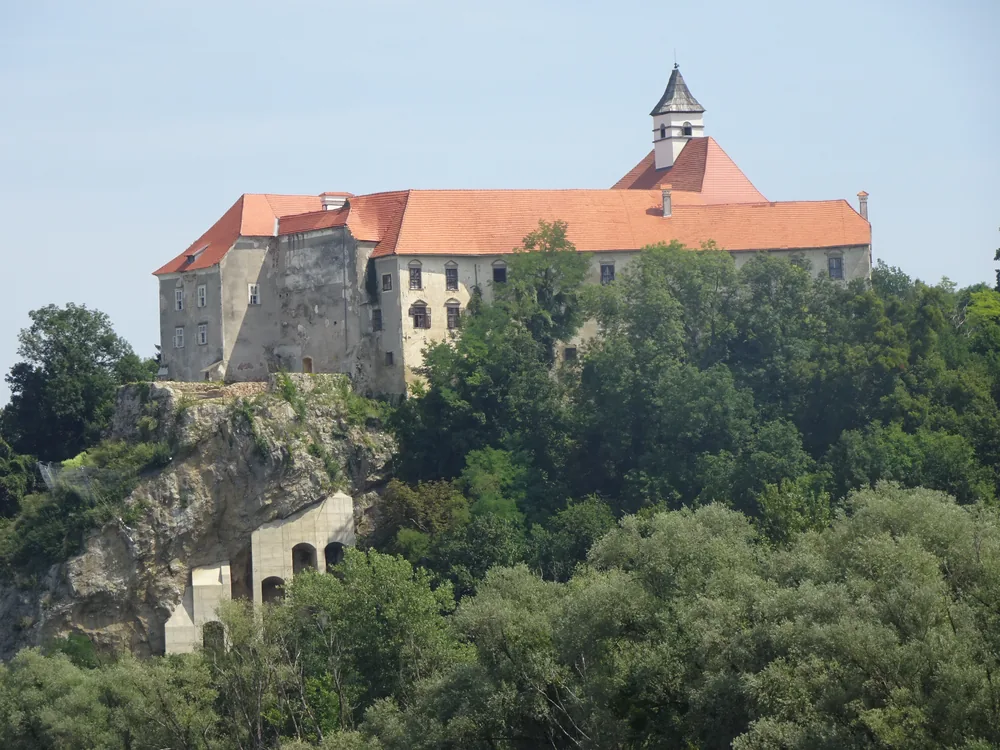
Borl Castle
Grad Borl
Slovenia · Štajerska (Lower Styria) — above the Drava river near Cirkulane, Haloze wine hills · Near Ptuj
Built 1255 · Medieval cliff-top fortification, largely 13th–16th century fabric; significant portions in ruins; sections progressively restored from 2020 following reopening April 2024
This page is part of an independent travel guide and is not affiliated with, endorsed by, or operated by Borl Castle.
© Castles & Palaces
Quick Facts
- Hours
- Fri–Sun 10:00–18:00. Closed Mon–Thu
- Guided tour from
- €430
- Duration
- 45–70 minutes
- Best time
- May to October
- Nearest city
- Ptuj
Featured Tour
Eastern Slovenia: Private Castle Tour with Wine Tastings
Cancellation available · Instant confirmation
Highlights
- ✦Borl's inverted anchor — the heraldic symbol of the castle — is the emblem of the Grail family in Wolfram von Eschenbach's 13th-century epic Parzival, and local tradition identifies the nearby area as Gandine, the ancestral homeland of Parzival's father in the poem; Borl is one of the few castles in Europe with a plausible literary connection to the Arthurian Grail legend
- ✦The castle occupies a cliff some 60 metres above a historic Drava river crossing used since Roman times, when the road linking Poetovio (Ptuj) and Siscia passed through here via a Roman bridge
- ✦The 17th-century cartographer Georg Matthäus Vischer included Borl in three separate engravings in his 1681 Topographia Ducatus Stiriae — an unusual distinction, since most castles received only a single illustration in his comprehensive regional survey
- ✦During the Second World War, the castle was used as an internment camp for Slovenes being deported under the Nazi Germanisation programme; the castle's Jewish owner, Zora Weiss, fled a Nazi arrest warrant
- ✦After nationalisation in 1946 the castle had a remarkably varied postwar life — a children's convalescent home, a refugee centre for Hungarians fleeing the 1956 Soviet invasion, and a 1,200-seat resort hotel with a hillside swimming pool (1952–1979) — before falling empty; it was sealed to visitors from 2010 until restoration allowed it to reopen in April 2024
Skip the queue with a guided tour
Skip-the-line tickets & expert guides
Wolfram von Eschenbach's Parzival, completed around 1210, is one of the great works of medieval German literature — the most fully developed Arthurian Grail romance, in which the Grail family, guardians of the sacred vessel, bears an inverted anchor as their heraldic emblem. That same inverted anchor is the heraldic symbol of Borl Castle. Local tradition further identifies the area near Borl as Gandine, the ancestral homeland of Gahmuret, Parzival's father, where the story of the Grail family begins. Whether these connections are coincidence, deliberate literary allusion, or later local identification remains debated — but Borl is one of the very few castles in Europe where the link between medieval heraldry and Arthurian legend is not simply claimed but carved in stone above the gate.
The castle itself occupies a cliff some 60 metres above the Drava river at a crossing point used since Roman times, when the road between Poetovio (Ptuj) and Siscia ran here via a Roman bridge. The strategic value was obvious: whoever held this cliff controlled passage along the Drava valley. The medieval fortification documented from 1255 was built in phases by various noble families across the 13th to 16th centuries, occupying a position on the contested frontier between Habsburg Styria and Hungarian influence. The 17th-century cartographer Georg Matthäus Vischer included it in three separate engravings in his 1681 Topographia Ducatus Stiriae — an unusual distinction that suggests the castle was still a substantial and well-regarded presence in the regional landscape.
What makes Borl's recent history as remarkable as its medieval legend is the sequence of uses the castle underwent after the Second World War. First it served as a Nazi internment camp for Slovenes resisting forced Germanisation, displacing its Jewish owners — the Weiss family, whose member Zora Weiss fled a Nazi arrest warrant. Then, after nationalisation in 1946, the castle became a children's convalescent home, then a refugee centre for Hungarians fleeing the 1956 Soviet invasion, then a 1,200-seat resort hotel with a hillside swimming pool operating from 1952 to 1979. The sequence has a dark absurdity that does not diminish the horror of its beginning.
Borl today is best understood as a partially restored ruin, not yet a fully fitted-out heritage site. After a 14-year closure from 2010, restoration works began in 2020 and the castle reopened in April 2024. Visitor infrastructure is still developing. The cliff-top position and the Drava valley views are rewarding for any visitor; the historical and literary context is best absorbed with the licensed guide on the GetYourGuide private tour, who adds what the partially restored interior cannot yet communicate alone.
History
A fortified position at this Drava river crossing may predate written record — the strategic logic of a cliff commanding the valley is ancient, and the Roman road that passed below only reinforced what earlier occupants had already understood. The first documentary evidence comes from 1255, when King Béla IV of Hungary issued a document referring to Friedrich, Lord of Ptuj, and the site of Borl. The castle's position on the contested frontier between Habsburg Styria and Hungarian-influenced territory meant it changed hands repeatedly through the 13th to 18th centuries, with the gradual consolidation of Habsburg Styria bringing relative stability to its ownership over time. The 17th-century cartographer Georg Matthäus Vischer considered the castle notable enough to include in three separate engravings in his 1681 Topographia Ducatus Stiriae — an unusual distinction suggesting it remained a substantial presence in the regional landscape. After the dissolution of the Habsburg empire in 1918, Borl passed to the Kingdom of Serbs, Croats and Slovenes under the new land arrangements. The Weiss family, who were Jewish, occupied the castle in the interwar period until the Nazi occupation: Zora Weiss fled a Nazi arrest warrant, and the castle was converted into an internment camp for Slovenes resisting forced Germanisation. Nationalisation followed in 1946. Decades of institutional use — including the unusual episode of a 1,200-seat resort hotel through the 1970s — gave way to gradual deterioration and closure to the public in 2010. Restoration works began in 2020, and the castle reopened on April 20, 2024.
How to Visit
Getting there: Borl Castle is near Cirkulane, approximately 20 km east of Ptuj along the Drava valley and close to the Croatian border. A car is effectively required — public transport to Cirkulane is very limited. From Ptuj, follow local roads east along the Drava river (signposted toward Cirkulane/Borl). The cliff-top castle becomes visible above the valley. Allow 25–30 minutes from Ptuj by car.
Tickets: Current admission and opening arrangements should be verified at visitborl.si before travelling — the castle only reopened in April 2024 after 14 years closed and facilities may still be developing. Independent visits are possible on Fri/Sat/Sun and public holidays (May–Oct only). The GetYourGuide private tour (from €430 per group of up to 2 people) — a 5-hour private guided circuit covering Borl (guided visit + regional wine tasting + traditional Haloze pastry), Ptuj Castle, and Ormož Castle, with entrance fees included — is the most reliable option for a guaranteed guided visit with context; book in advance through licensed local guide Gregor Valentan. The €430 covers the group.
Practical tips: Set expectations for Borl's current state: this is a castle undergoing gradual restoration, not yet a fully-fitted heritage museum. Visitor infrastructure is still developing since the 2024 reopening. The cliff-top position and Drava valley views are the primary rewards for independent visitors; the guide on the GetYourGuide tour adds the historical and literary context that the partially restored interior cannot yet communicate alone. Verify current hours and ticket availability at visitborl.si before making a special trip.
Combine with: Ptuj Castle (~20 km west — Slovenia's oldest town and a castle with one of the richest regional museum collections in the country) and Ormož Castle (~15 km southeast — the Lords of Ptuj's other great foundation, reopened after renovation in November 2025); all three castles are covered on the same private GetYourGuide tour.
Frequently Asked Questions
In Wolfram von Eschenbach's Parzival (c. 1210), the Grail family — guardians of the sacred vessel — bears an inverted anchor as their heraldic emblem. That same inverted anchor is the heraldic symbol of Borl Castle. Local tradition further identifies the surrounding area as Gandine, the ancestral homeland of Gahmuret, Parzival's father, where the Grail family's story begins. The connection between the castle's heraldry and Wolfram's poem makes Borl one of the few sites in Europe where the Arthurian Grail legend has a tangible physical link — not just a claimed association, but a matching heraldic device carved in stone.
Location
Grad Borl, 2282 Cirkulane, Slovenia
Nearby Castles
Tours & Tickets
Powered by GetYourGuide
From
€430/ group