
Castillo de Javier
Castillo de Javier
Spain · Navarre · Near Javier, Navarre
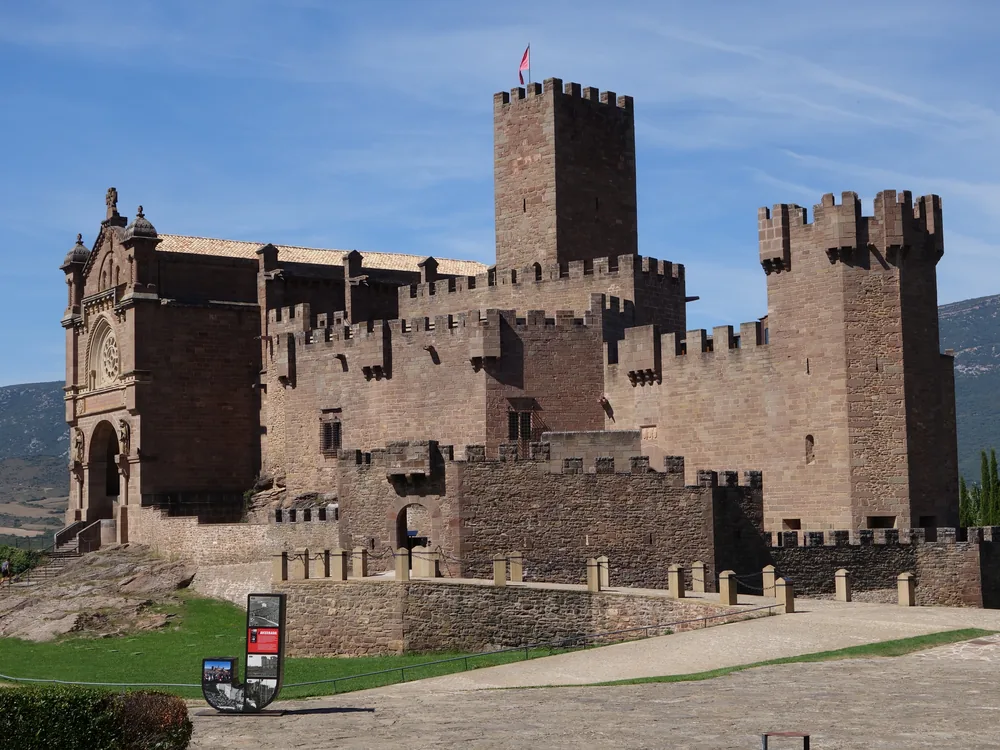
Built 1050 · Medieval Navarrese fortified castle on a hilltop above the Valdorba valley, with origins in the 10th–11th century and principal construction across the 12th–13th centuries; the surviving structure includes the northwest tower (associated with the birth of Francis Xavier in 1506), curtain walls, Gothic residential chambers, and a Romanesque chapel with a documented medieval Christ figure; the castle suffered partial demolition ordered by Cardinal Cisneros in 1516 following Navarre's absorption into the Castilian crown; the Jesuit order acquired the property in the late 19th century and undertook restoration from 1896 through the mid-20th century; a basilica was added to the complex to accommodate pilgrims attending the annual Javierada procession
This page is part of an independent travel guide and is not affiliated with, endorsed by, or operated by Castillo de Javier.
© Castles & Palaces
Quick Facts
- Hours
- Mon 10:30–14:00. Tue–Sun 10:30–18:30
- Day trip from
- €110
- Duration
- 1–1.5 hours
- Best time
- March to October
- Nearest city
- Javier, Navarre
Featured Tour
Medieval Route in Navarre: Olite, Ujué, Castillo de Javier, and Mª de Leire
Cancellation available · Instant confirmation
Highlights
- ✦Francis Xavier — born in this castle in 1506 — was co-founder of the Society of Jesus alongside Ignatius of Loyola and the most geographically ambitious Christian missionary in history, evangelising across Portuguese India, Sri Lanka, Malacca, the Moluccas, and Japan before dying in 1552 on the Chinese island of Shangchuan while attempting to enter China; his body is in the Basilica of Bom Jesus in Goa, the centre of a decennial pilgrimage drawing 100,000 people
- ✦The annual Javierada pilgrimage, held each March since 1940, sees tens of thousands of pilgrims walk from Pamplona to Javier over two days in one of Spain's largest devotional processions, making this a site of living religious practice as much as heritage tourism
- ✦The Romanesque castle chapel contains a documented medieval painted Christ figure whose arm is said to have sweated blood during a plague in 1597 — the relic that transformed the castle from a private noble residence into a pilgrimage destination in the post-Xavier period
- ✦Cardinal Cisneros ordered the partial demolition of Castillo de Javier in 1516 as part of the systematic neutralisation of Navarrese fortresses following the kingdom's absorption into the Castilian crown — the castle's connection to Xavier's birthplace is the reason it wasn't destroyed entirely
- ✦The GetYourGuide day trip combines Javier with the Royal Palace of Olite, the village of Ujué, and the Monastery of Leyre — a full-circuit of Navarre's medieval heritage that puts the pilgrimage castle alongside the secular royal palace already published at spain/palacio-real-de-olite
Skip the queue with a guided tour
Skip-the-line tickets & expert guides
Francis Xavier was born here in 1506, in the castle's northwest tower, to a family of the Navarrese nobility whose fortunes were about to be upended by the same political transformation that would define his century. He died alone on a small island off the coast of China in 1552, having crossed most of the world's known ocean routes in the intervening forty-six years, and never saw Navarre again. The castle where he was born sits on a modest hill above the Valdorba valley, a fortified structure of local stone whose scale gives no indication of the global reach that one of its sons would achieve in the history of Catholicism.
The castle's origins are older than Xavier. The earliest defensible structure on this site dates to around the 10th or 11th century, when the strategic position in Navarre made the hilltop worth fortifying. The complex grew over the 12th and 13th centuries into a fortified residence with a keep, corner towers, curtain walls, and the associated domestic buildings of a working noble household. The Xavier family — specifically the Jasso family on his mother's side — held the castle as part of the Navarrese nobility's hereditary property. The name Javier derives from Etxeberri, meaning new house in Basque, reflecting the bilingual borderland character of Navarre where Basque speakers occupied the mountain country and Romance-language speakers the valley towns. Francesc de Jasso i Azpilicueta took the castle's name as his own when he enrolled at the University of Paris around 1525, a common practice among Navarrese students establishing themselves in the wider world.
In Paris, Xavier encountered Ignatius of Loyola, a Basque nobleman from Azpeitia who had undergone a spiritual conversion after being wounded at the Battle of Pamplona in 1521. Loyola had spent years in prayer and writing that would become the foundation of the Jesuit Spiritual Exercises, and was in Paris assembling a group of companions committed to a reformed religious life. Xavier was initially resistant — by several contemporary accounts he was more interested in academic advancement — but was drawn into the group over the course of several years. On 15 August 1534, in the chapel of Saint Denis in Montmartre, Xavier and five companions took the first vows of what would become the Society of Jesus, committing to poverty, chastity, and obedience, with a specific additional vow of submission to the pope for missionary work wherever directed. Pope Paul III formally approved the Society in 1540.
Xavier sailed from Lisbon for Portuguese India in 1541, arriving in Goa in 1542. His decade of Asian missions was one of the most geographically ambitious in the history of Christian evangelism. He worked along the southwest Indian coast, in Sri Lanka, in Malacca, and in the Moluccas — the Indonesian spice islands where Portuguese commercial networks and Jesuit missionary activity ran in parallel. In 1549 he arrived in Japan, becoming the first Christian missionary to work in Japanese territory. He spent approximately two years there, long enough to recognise that Japan's sophisticated culture required methods different from those deployed elsewhere — he returned toward India in 1551 intending to enter China. He died in December 1552 on the island of Shangchuan, waiting for a boat to the mainland, the last frontier of his itinerary unreached. He was forty-six years old.
His body was returned to Goa, where it rests in the Basilica of Bom Jesus in a silver reliquary. The right forearm was sent to Rome; arm bone fragments went to Japan and to other Jesuit houses. The Goa body is the centre of a decennial public exposition that draws approximately 100,000 pilgrims; the most recent expositions were held in 2014 and 2024. Xavier was canonised in 1622 alongside Ignatius of Loyola and is the patron saint of Goa, Navarre, Japan, the Far East, and all foreign missions — a breadth of patronage that accurately reflects the geographical scope of his eleven active years.
The castle itself suffered a political misfortune tied directly to Xavier's era. When Ferdinand of Aragon absorbed the Kingdom of Navarre into the Castilian Crown in 1512, the Navarrese nobility's old loyalties became suspect in the new political order. Cardinal Cisneros, regent of Castile following Ferdinand's death in 1516, ordered the demolition of Castillo de Javier along with other Navarrese strongholds identified as potential centres of resistance. The northwest tower associated with Xavier's birth and sections of the curtain wall survived; the main residential block was substantially destroyed. The partial ruin stood for several centuries, preserved from complete collapse by its association with the saint but not from progressive deterioration.
The Jesuit order acquired the property in the late 19th century and undertook a restoration programme running from 1896 through the mid-20th century. The result is not a strict archaeological reconstruction of the 16th-century original — missing elements were rebuilt on available evidence, and new construction was integrated with surviving medieval fabric — but it functions as a pilgrimage and educational centre focused on Xavier's life and Jesuit history. A basilica was added to accommodate pilgrims, particularly for the annual Javierada, held each March since 1940: a two-day procession in which tens of thousands walk from Pamplona to Javier in one of Spain's largest devotional events. The Javierada draws pilgrims from across Spain and from Catholic communities internationally, and attending one transforms the scale of the site's significance from local historic interest to active living practice.
The visitor experience today combines medieval rooms with museum content: the Gothic residential chambers, the Romanesque chapel with its venerated painted Christ figure, the northwest tower, and displays covering Xavier's life, the Jesuit missions to Asia, and the political context of early 16th-century Navarre. The site operates as both heritage monument and active pilgrimage destination — the presence of pilgrims, votive offerings, and religious programming distinguishes it from purely secular castle visits in the region.
The GetYourGuide day trip combines Castillo de Javier with the Royal Palace of Olite (already on this site at spain/palacio-real-de-olite), the hilltop village of Ujué, and the Monastery of Leyre in an 11-hour circuit of Navarre's medieval heritage. Olite provides the secular royal architecture; Javier the religious and pilgrimage dimension; Ujué and Leyre the rural sacred landscape that gives Navarre its particular character. Together they give this corner of northern Spain — frequently bypassed for the Basque Country or Castile — a coherent full-day narrative of genuine depth.
History
Castillo de Javier was established as a fortified noble residence on this Navarrese hilltop site in the 10th–11th century, growing through the 12th–13th centuries into a complex with keep, towers, and curtain walls. The Jasso family — maternal family of Francis Xavier, born here in 1506 — held it as Navarrese nobility. Cardinal Cisneros ordered the castle's partial demolition in 1516 following Navarre's absorption into the Castilian Crown; the northwest tower and parts of the walls survived. Xavier went on to co-found the Society of Jesus with Ignatius of Loyola and became the first Christian missionary to Japan before dying in 1552 attempting to enter China. The Jesuits acquired the property in the late 19th century, undertook restoration from 1896 onwards, and added a basilica; the site is now an active pilgrimage destination particularly associated with the annual Javierada march from Pamplona.
How to Visit
Getting there: By car from Pamplona: approximately 55 km east on the A-21 (towards Yesa/Sangüesa) then south toward Javier. From Zaragoza: approximately 110 km northwest via the A-68 and A-21. Public transport is limited; the castle is best reached by car or on the GetYourGuide day trip from Pamplona.
Tickets: Walk-up entry to the castle complex (approximately €4 adult). The GetYourGuide Navarre day trip includes transport and a guide covering all four stops: Javier, Olite, Ujué, and Leyre.
Visit length: 1–1.5 hours for the castle independently. The full day trip runs approximately 11 hours.
Practical tips: March to October.
Combine with: The Royal Palace of Olite (spain/palacio-real-de-olite, approximately 40 km west) is the natural pairing — Navarre's royal secular palace and its primary pilgrimage castle, both on the same GetYourGuide tour.
Frequently Asked Questions
Francis Xavier (1506–1552) was a co-founder of the Society of Jesus (Jesuits) alongside Ignatius of Loyola and the first Christian missionary to Japan. Born at Castillo de Javier in Navarre, he spent twelve years evangelising across Portuguese Asia — India, Sri Lanka, Malacca, the Moluccas, and Japan — before dying in 1552 attempting to enter China. He was canonised in 1622 and is the patron saint of Goa, Navarre, Japan, and foreign missions. His body is in the Basilica of Bom Jesus in Goa and is the centre of a major decennial pilgrimage.
Location
Castillo de Javier, s/n, 31411 Javier, Navarra, Spain
Nearby Castles
Tours & Tickets
Powered by GetYourGuide
From
€110/ person