
Royal Palace of La Almudaina
Palacio Real de la Almudaina
Spain · Mallorca, Balearic Islands · Near Palma de Mallorca
Built 1281 · Gothic royal palace built over a Moorish alcazar and earlier Roman fortification; Levantine Gothic renovation begun in 1281 under Jaume II, retaining visible Moorish arches on the seafront facade
This page is part of an independent travel guide and is not affiliated with, endorsed by, or operated by Royal Palace of La Almudaina.
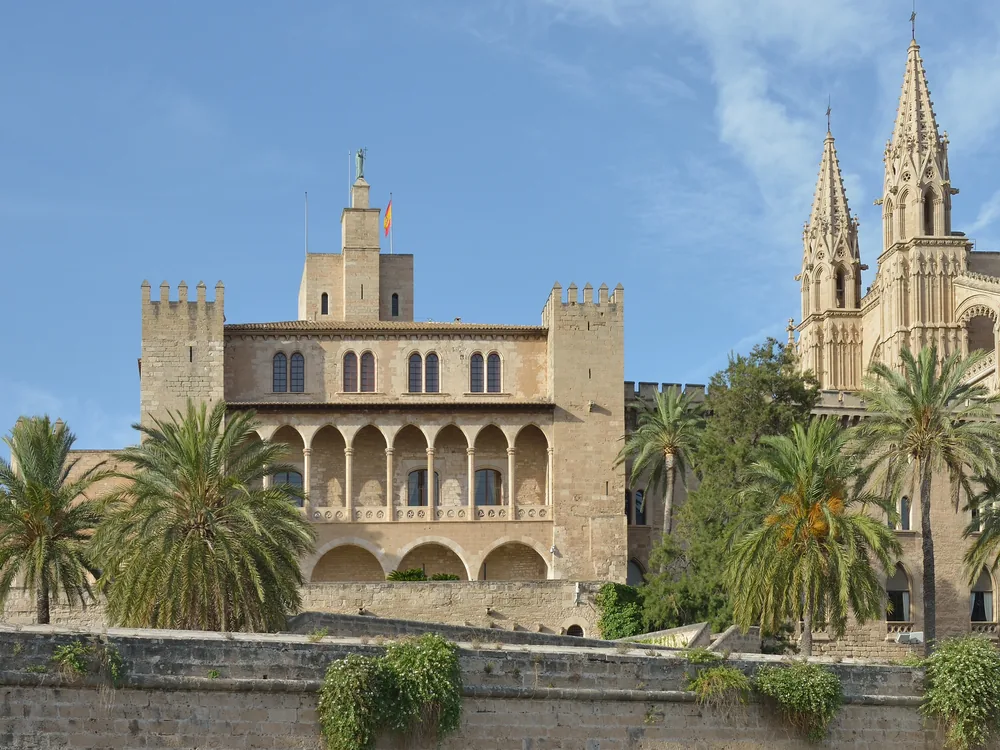
© Castles & Palaces
Quick Facts
- Hours
- Mon–Fri 10:00–18:00. Sat 10:00–14:00. Closed Sun
- Entry via GYG
- €11
- Duration
- 45 minutes to 1 hour (self-guided)
- Best time
- Year-round
- Nearest city
- Palma de Mallorca
Featured Tour
La Almudaina Palace Entry Ticket
Cancellation available · Instant confirmation
Highlights
- ✦Origins as a 1st-century AD Roman fortification, later transformed by the Moors into a fortified alcazar after their conquest of Mallorca in the early 10th century — the name 'Almudaina' comes from the Arabic al-mudayna, 'the citadel'
- ✦Reconquered by Jaume I of Aragon in the 13th century; his grandson Jaume II began a massive renovation in 1281 that converted the Moorish alcazar into a Levantine Gothic royal palace — a transformation spanning more than 60 years across the reigns of Jaume II, Sanç and Jaume III
- ✦Moorish architectural elements survive and remain visible, including horseshoe and pointed arches on the palace's seafront facade, a rare instance of Islamic-era fabric left intentionally exposed within a Gothic royal building
- ✦Still an official residence of the Spanish Royal Family during their visits to Mallorca, alongside its role as a public museum — one of the few palaces in this entire collection with continuous, active royal use into the present day
- ✦Self-guided entry ticket from GetYourGuide (€11 per person) covers the state rooms, the Royal Staircase and the royal apartments when not closed for an official visit
Skip the queue with a guided tour
Skip-the-line tickets & expert guides
The Royal Palace of La Almudaina stands directly on Palma de Mallorca's waterfront, and few palaces anywhere in Europe carry quite so many layers of continuous use packed into a single site. The story begins in the 1st century AD, when the Romans built a fortification here as part of their control of the newly established colony of Palma. That Roman structure did not survive as an independent building, but its ruins provided the foundation on which every later occupier of the site would build, layer after layer, for the next two millennia.
The Moors conquered Mallorca in the early 10th century and transformed the Roman ruins into a fortified alcazar, a walled citadel serving as the seat of Islamic governance on the island. The palace's very name preserves this chapter directly: 'Almudaina' derives from the Arabic al-mudayna, meaning 'the citadel' or 'the small city' — a linguistic fossil embedded in the building's identity that has outlasted the Islamic rule it originally described by more than eight centuries.
The Reconquista brought the site into Christian hands when Jaume I of Aragon reconquered Mallorca in the 13th century, but it was his grandson, Jaume II, who transformed La Almudaina most dramatically. Beginning in 1281, Jaume II initiated a massive renovation programme that converted the Moorish alcazar into a proper Gothic royal palace in the Levantine style characteristic of the Crown of Aragon's Mediterranean territories. This was not a quick project: the renovation took more than 60 years to complete, spanning the successive reigns of Jaume II, his son Sanç, and his grandson Jaume III — three generations of Mallorcan kings overseeing the same extended building campaign.
What makes La Almudaina architecturally distinctive today is the way this Gothic transformation did not erase what came before it. Elements of the original Moorish architecture survive and remain clearly visible, most strikingly the horseshoe and pointed arches still present on the palace's seafront facade — a rare case of a Christian royal palace retaining, rather than demolishing, the visible fabric of the Islamic structure it replaced. Walking the palace today means moving through a genuine architectural palimpsest, Roman foundations beneath Moorish arches beneath Gothic halls, each layer legible rather than erased by the one that followed.
What sets La Almudaina apart from almost every other property in this collection, however, is that its story has never actually ended. The palace remains an official residence of the Spanish Royal Family during their visits to Mallorca, typically in the summer months, continuing an unbroken tradition of royal use that stretches back to the Kingdom of Majorca itself. This means La Almudaina operates on a genuinely different rhythm than a purely historical museum: visitors should be aware that the palace can close to the public without extensive notice when the Royal Family is in residence, a practical quirk that comes directly from the site's continued function as a working royal address rather than a fully retired monument.
For visitors, the self-guided entry ticket covers the palace's main state rooms, the Royal Staircase — the formal route of ascent used for centuries by the Mallorcan and later Spanish court — and the royal apartments themselves when they are open to the public. There is no guided tour or included audio guide with the standard entry ticket, so visitors wanting deeper historical context should plan to arrive with some background reading or a private guide, but the self-guided pace also allows unhurried appreciation of the palace's remarkable layered architecture at one's own speed.
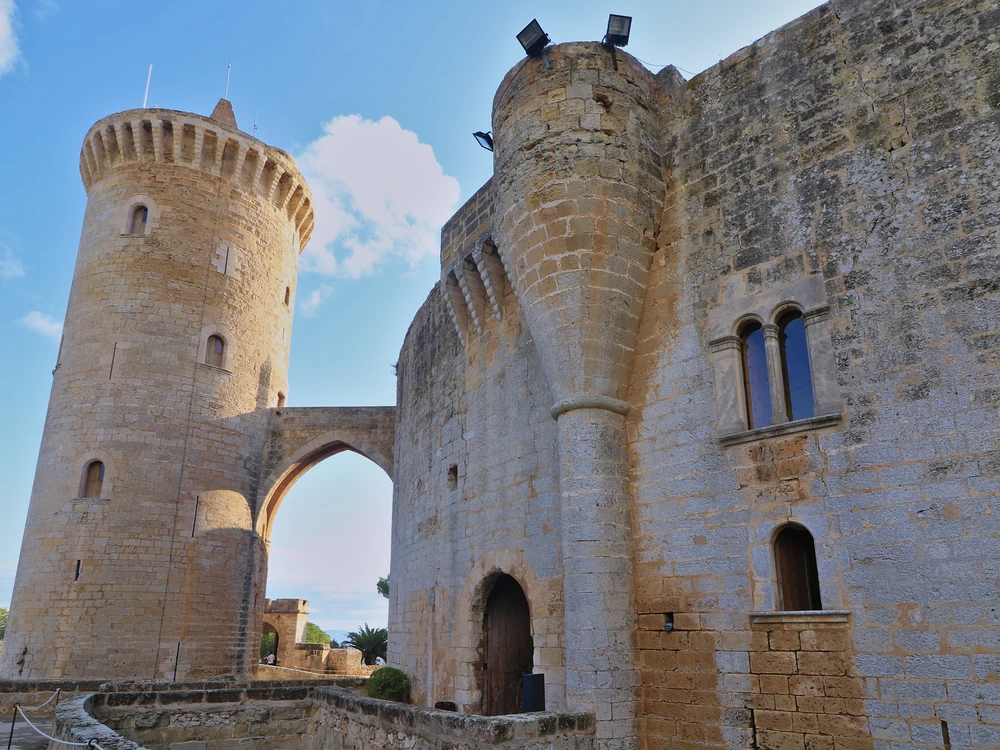
La Almudaina sits within easy walking distance of Palma's cathedral, La Seu, itself begun under the same Jaume II building programme that transformed the palace — the two structures were conceived as part of a single royal vision for Gothic Palma, and visiting them together gives a genuinely coherent sense of what the Kingdom of Majorca's rulers were trying to build in the early 14th century. Mallorca's other major fortification, Bellver Castle, sits on a pine-forested hill on the opposite side of the city, offering a useful contrast between La Almudaina's continuously occupied royal role and Bellver's more purely military and, later, museum history.
History
The site of La Almudaina was first fortified by the Romans in the 1st century AD. The Moors conquered Mallorca in the early 10th century and built a fortified alcazar over the Roman remains, giving the site its name from the Arabic al-mudayna, meaning 'the citadel.' Jaume I of Aragon reconquered Mallorca in the 13th century, and his grandson Jaume II began a major renovation in 1281 that converted the Moorish alcazar into a Levantine Gothic royal palace, a transformation completed over more than 60 years across the reigns of Jaume II, Sanç and Jaume III. Moorish architectural elements, including arches on the seafront facade, survive within the Gothic building. La Almudaina remains an official residence of the Spanish Royal Family during visits to Mallorca, alongside its role as a public museum.
Frequently Asked Questions
The palace remains an official residence of the Spanish Royal Family during their visits to Mallorca, typically in summer, and continues an unbroken tradition of active royal use dating back to the Kingdom of Majorca. Because of this, the palace can close to the public during official royal visits — verifying current opening dates with Patrimonio Nacional before travelling is recommended.
Location
Carrer del Palau Reial, s/n, 07001 Palma, Illes Balears, Spain
Nearby Castles
Tours & Tickets
Powered by GetYourGuide
From
€11/ person