
Castello di Sasso Corbaro
Castello di Sasso Corbaro
Switzerland · Ticino · Near Bellinzona
Built 1479 · Late medieval Sforza castle; built in remarkable speed (6 months, 1479) by order of Ludovico il Moro to defend against Swiss incursions; single compact keep with a residential tower; the most recently built and most isolated of the three Bellinzona castles; UNESCO World Heritage Site (2000)
This page is part of an independent travel guide and is not affiliated with, endorsed by, or operated by Castello di Sasso Corbaro.
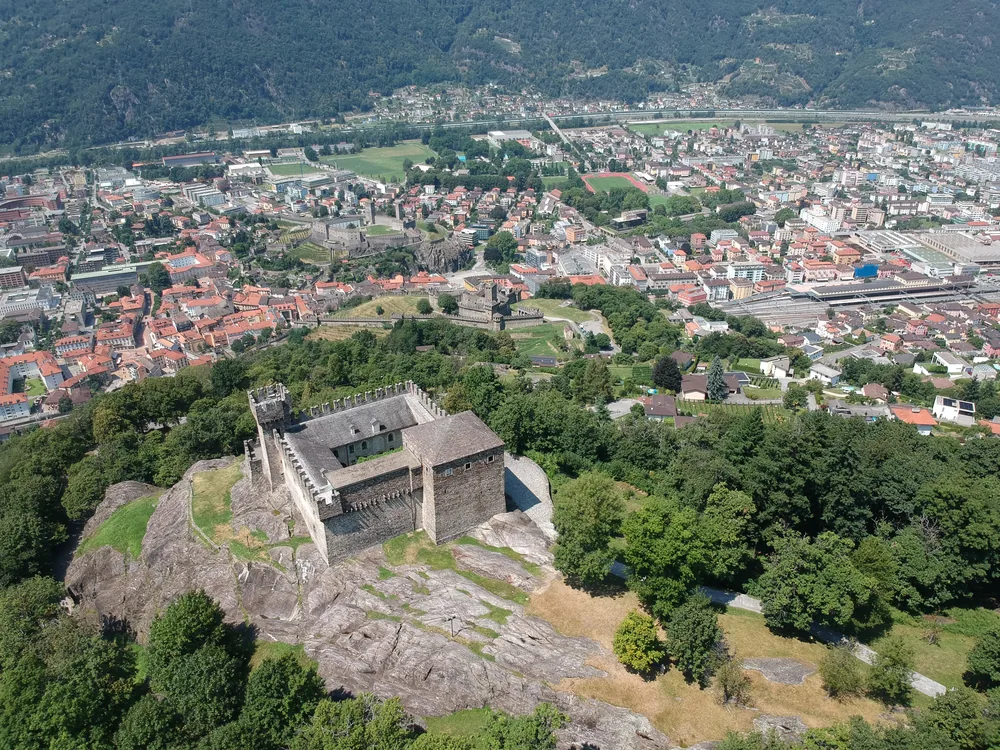
© Castles & Palaces
Quick Facts
- Hours
- Daily 10:00–18:00
- Entry via GetYourGuide
- €16
- Duration
- 1 hour
- Best time
- April to October
- Nearest city
- Bellinzona
Featured Tour
Entrance ticket to Sasso Corbaro Castle
Cancellation available · Instant confirmation
Highlights
- ✦Built in just six months in 1479 by order of Ludovico il Moro, Duke of Milan, as an emergency response after the Swiss briefly seized Bellinzona
- ✦The newest and highest of the three Bellinzona castles, standing 230 metres above the valley floor on its own isolated rock spur
- ✦Commissioned the same year Ludovico il Moro was consolidating the Milanese court that would soon employ Leonardo da Vinci for nearly two decades
- ✦Houses the Cantonal Museum of Ticino, with regional folk art, costumes and tools offering a counterpoint to the castle's purely military history
- ✦Captured by the Swiss within 24 years of its construction, in 1503 — yet maintained by them in excellent condition for five centuries since
Skip the queue with a guided tour
Skip-the-line tickets & expert guides
High above Bellinzona, higher than Montebello, higher than Castel Grande, Sasso Corbaro stands alone on a rock spur with views that encompass the entire Ticino valley. It is the newest of the three Bellinzona castles, built in 1479 in a period of six months by order of Ludovico il Moro, Duke of Milan, after the Swiss had seized Bellinzona briefly and demonstrated that the existing defences were inadequate for the southern flank. Sasso Corbaro was the emergency response: a compact, powerful, rapidly built fortress designed to cover the approach the Swiss had exploited. It has the solitary character of a place built in haste for a specific military purpose.
Contemporary documents record that Sasso Corbaro was built in six months, an extraordinary feat for a stone castle of its size and complexity. Ludovico il Moro, the 'Moor,' nephew of Francesco Sforza and de facto ruler of Milan since 1476, ordered the construction immediately after the Swiss captured Bellinzona in 1478. The military architect, probably the same engineer who had worked on Milan's Castello Sforzesco, designed a compact keep with a residential tower, walls capable of mounting artillery, and a plan that provided overlapping fire coverage of the eastern approach to Bellinzona. The walls are thicker than Montebello's; the towers are positioned more carefully for artillery use.
Ludovico il Moro (1452–1508) was one of the most important patrons of the Italian Renaissance. He employed Leonardo da Vinci at his Milan court for nearly twenty years, from 1482 to 1499; Bramante worked for him; the Last Supper was painted during his patronage. The same year he ordered the emergency construction of Sasso Corbaro, 1479, he was consolidating his grip on the Duchy of Milan and laying the groundwork for the court that would define late 15th-century Italian culture. Sasso Corbaro is therefore a footnote in the biography of one of history's great Renaissance patrons, a military emergency rather than a cultural statement, but connected to the same moment of ambition and power.
Sasso Corbaro's construction was a direct response to Swiss military pressure from the cantons of Uri, Schwyz and Unterwalden, which had been competing with Milan for control of the Gotthard pass for a century. In 1503, despite Sasso Corbaro and the other fortifications, the Swiss captured Bellinzona definitively and it became Swiss territory. The speed with which Ludovico had built Sasso Corbaro was ultimately insufficient; the Swiss took it, along with the rest, within 24 years of its construction. The irony is that the Swiss then maintained it in excellent condition for five centuries.
Sasso Corbaro houses the Cantonal Museum of Ticino, a regional ethnographic and folk art collection that provides a different lens on Ticino's culture than the purely military narrative of the castle's history. The folk art collection, comprising costumes, tools, furniture and ceramics from the Ticino valleys, contextualises the dominant mountain community surrounding the castle, distinct from the urban Lombard culture of Bellinzona's ruling class.
From the towers of Sasso Corbaro, 230 metres above the valley floor, the view north shows the Alpine valleys converging toward the Gotthard, while the view south opens to the full Ticino plain and the distant shimmer of Lake Maggiore. On clear days, the outline of Lugano's hills is visible. The view clearly explains why Ludovico il Moro chose this particular rock spur: the entire military situation, approaches, corridors, defensive positions, is legible from this height.
History
Ludovico il Moro, de facto ruler of Milan, ordered the construction of Sasso Corbaro in 1479 as an emergency fortification following the Swiss Confederation's brief capture of Bellinzona the previous year, which had exposed the inadequacy of the existing defences on the town's eastern approach. Contemporary records indicate the castle was completed in roughly six months, an unusually rapid pace attributed to a military architect likely connected to the engineering team behind Milan's Castello Sforzesco.
Despite the speed and strength of its construction, Sasso Corbaro did not prevent the Swiss Confederation from capturing Bellinzona definitively in 1503, after which the castle, like Castel Grande and Montebello, became Swiss territory. The Swiss subsequently maintained the fortress for five centuries, and in 2000 UNESCO inscribed Sasso Corbaro together with the other two Bellinzona castles as a World Heritage Site. The keep today houses the Cantonal Museum of Ticino, dedicated to the region's folk art and ethnographic heritage.
How to Visit
Getting there: Bellinzona station is on the main Zürich–Lugano–Milan rail line (Zürich ~1h 45min, Lugano ~25min, Milan ~1h 30min). From the station, walk to Castel Grande (10 min), then follow the ridge path uphill to Castello di Montebello (15 min), then continue on a well-marked forest path to Sasso Corbaro (20–25 min further up). A taxi from the station to Sasso Corbaro takes about 5 minutes for visitors who prefer not to hike.
Tickets: Walk-up entry CHF 5 adult, CHF 3 child — the combined three-castle ticket, which covers Castel Grande, Montebello, and Sasso Corbaro, is available at each ticket office and is the most economical approach. The GetYourGuide tour — an advance-purchase admission ticket for Sasso Corbaro — book in advance.
Practical tips: Sasso Corbaro draws significantly fewer visitors than Castel Grande, so the atmosphere here is quieter — worth saving for last as a calmer finish to the three-castle day. Climb the tower for the 230-metre panoramic view over the Ticino valley: to the north the Alpine passes converge, to the south the plain opens toward Lake Maggiore. The Cantonal Museum inside covers Ticino folk art and regional ethnography — a useful counterpoint to the military history of the castle itself.
Combine with: Castel Grande (30–35 minutes downhill, the largest of the three UNESCO castles with the main history museum) and Castello di Montebello (20 minutes downhill, the most architecturally complete of the three with the Civic Museum).
Frequently Asked Questions
Ludovico il Moro, Duke of Milan, ordered Sasso Corbaro built in 1479 as an urgent response after Swiss forces had briefly captured Bellinzona the previous year, exposing weaknesses in the town's existing defences on its eastern flank. Contemporary records indicate the castle was completed in approximately six months, an extraordinary pace for a stone fortification of its size, reflecting the genuine military emergency that prompted its construction.
Location
Via al Castello di Sasso Corbaro, 6500 Bellinzona, Switzerland
Nearby Castles
Tours & Tickets
Powered by GetYourGuide
From
€16/ person