
Castelli di Cannero
Castelli di Cannero
Italy · Piedmont, Lake Maggiore · Near Cannero Riviera
Built 1403 · Twin ruined fortresses on rocky islets in the northern section of Lake Maggiore, approximately 300 metres from the western shore near Cannero Riviera; the first construction (1403–04) was by the five Mazzarditi brothers as a pirate base — a military installation designed for lake control rather than territorial defence, with covered moorings for raiding vessels; destroyed by Filippo Maria Visconti in 1414; a second building campaign (1519–21) by Ludovico Borromeo created the Rocca Vitaliana, a fortified watchtower complex on the same islets designed to control the northern lake approaches against Swiss incursions; abandoned and decaying from the late 18th century; subject to a multi-year restoration totalling approximately €15 million (partly state-funded); reopened to visitors for the first time in the castle's history on 28 June 2025 — genuinely new public access, not a reopening of a formerly-open site
This page is part of an independent travel guide and is not affiliated with, endorsed by, or operated by Castelli di Cannero.
© Castles & Palaces
Quick Facts
- Hours
- Mon–Sun Varies seasonally
- Entry via GetYourGuide
- €26
- Duration
- 1.5–2 hours
- Best time
- May to September
- Booking
- Required — book 3+ days ahead
- Nearest city
- Cannero Riviera
Featured Tour
Castelli di Cannero: Boat Transfer & Audio Guide
Cancellation available · Instant confirmation
Highlights
- ✦The Castelli di Cannero have a founding story unique among Italian lakeside castles: built in 1403–04 by the five Mazzarditi brothers as a deliberate pirate base — not a defensive fortress protecting territorial holdings, but an offensive installation designed for lake raiding, with moorings for armed vessels and the tactical position to intercept traffic on one of northern Italy's most-used trade routes
- ✦The entire Mazzarditi episode lasted just eleven years (1403–1414), during which the brothers effectively turned Lake Maggiore's northern section into a private taxed corridor, before Duke Filippo Maria Visconti dispatched a military expedition that captured, destroyed the fortress, and presumably ended the Mazzarditi as a going concern — one of the more compressed rise-and-fall stories in medieval Italian history
- ✦The Borromeo family's 1519–21 reconstruction on the same islets — the Rocca Vitaliana — was built for a different strategic purpose: controlling the northern end of Lake Maggiore against Swiss incursions from the valleys above, during a period when the Confederation was pushing its influence southward across the Alpine passes; the Borromeo fortification is therefore an Italian response to Swiss military expansion, on islands that had previously served Italian piracy
- ✦The recent restoration, which cost approximately €15 million and took several years to complete, was partly state-funded and returned the ruined masonry to a stable, accessible condition; the June 2025 reopening is genuinely the first time visitors have been admitted to the island fortresses — not a reopening after temporary closure, but the first-ever public access to a site that has been privately owned for centuries
- ✦The GetYourGuide boat transfer and audio guide product (€26) is the only way to access the islands — there is no land connection — making it simultaneously a transport arrangement and an entry ticket; the short crossing from Cannero Riviera is itself part of the experience, approaching the islands from the water as raiding parties and Visconti soldiers approached them six centuries ago
Tickets & tours
Book through GetYourGuide
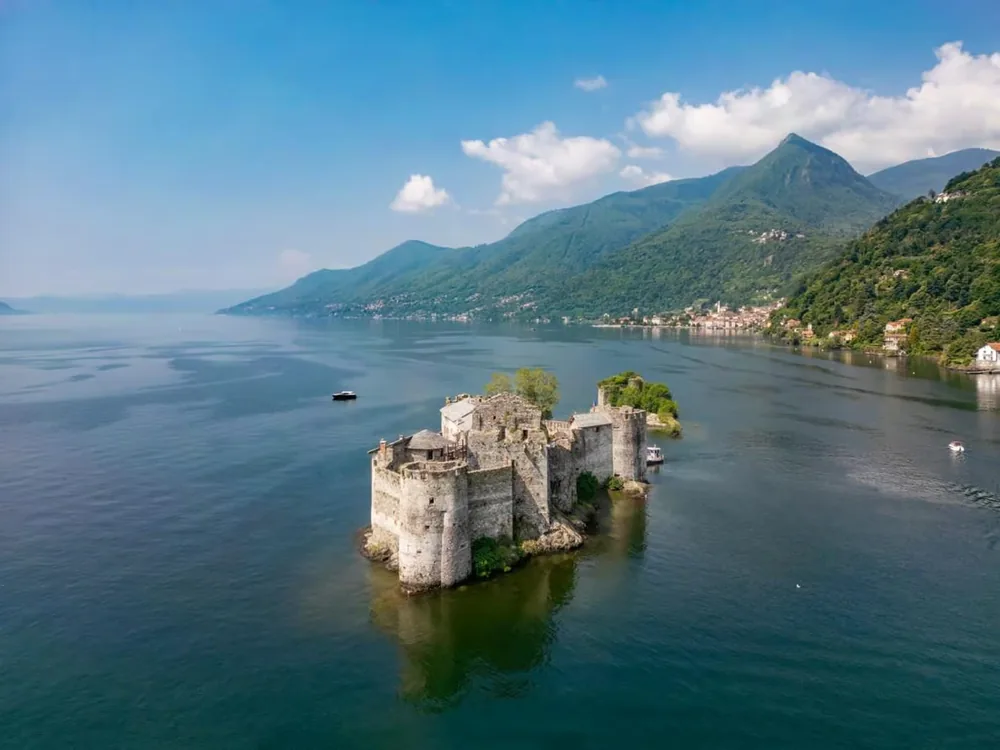
The Castelli di Cannero are two ruined fortresses on rocky islets in the northern section of Lake Maggiore, approximately 300 metres from the western shore near the village of Cannero Riviera. The islets are small — rocky outcrops of the Alpine granite that forms the lake's western shoreline — and the ruined towers and walls that rise from them have the silhouette that makes them one of the most frequently photographed sites on the Italian lake district. The image is familiar from calendar photographs of Lake Maggiore: the two jagged ruins rising from still water at dusk, backed by the mountains of the Swiss border visible immediately to the north. What the photograph doesn't tell you is who built these towers and why.
In 1403, the five Mazzarditi brothers began construction on the two islets that would become known as the Castle of Malpaga — a name whose literal translation, 'bad payment,' gives an adequate indication of the enterprise it housed. The Mazzarditi were pirates. Not metaphorical pirates or commercial raiders operating in some grey zone of medieval commerce, but straightforward lake-based brigands who used the island position to intercept, board, and rob the cargo vessels moving between the northern Alpine valleys and the Po plain via Lake Maggiore's waters. The enclosed moorings they built on the islets housed their armed boats; the towers gave them the visibility to spot approaching targets; the island position made them difficult to dislodge by land-based military force.
For eleven years, the Mazzarditi operated their lake-toll system with the confidence of operators who understood that water is a natural moat. Duke Filippo Maria Visconti, who controlled Milan and the surrounding territory, finally dispatched a military expedition in 1414 — presumably by boat — that captured the islets, destroyed the fortress, and removed the Mazzarditi from the historical record. The violence of this suppression can be inferred from the completeness with which the original structure was destroyed; the Visconti expedition was not interested in taking a usable fortress but in eliminating a base of operations.
A century later, the islets were rebuilt. Ludovico Borromeo, a member of the family that would accumulate a substantial Lake Maggiore property portfolio including the Borromean Islands (Isola Bella, Isola Pescatori, Isola Madre), commissioned a new fortified complex on the Mazzarditi ruins between 1519 and 1521. His motivation was different from his predecessors' — the Rocca Vitaliana (named for his son Vitaliano) was not a pirate base but a military watchtower complex designed to control the northern approaches to Lake Maggiore against Swiss incursions. The early 16th century was a period of Swiss military expansion southward across the Alpine passes, and the Borromeo family, with their lakeside estates in the northern section of the lake, had a direct interest in defending the upper lake corridor.
The Borromeo fortification was abandoned as its military purpose became obsolete and its structural condition deteriorated. By the late 18th century, the complex was a picturesque ruin — the classic fate of Italian lakeside fortifications that survived military destruction but not the passage of time and the indifference of successive owners. For two centuries the ruins were visible from the shore and from passing lake steamers, appearing in countless landscape paintings and early photographs, without anyone admitting visitors to the islands themselves.
The restoration that changed this took several years and cost approximately €15 million, partly funded by public heritage grants. The physical work stabilised the surviving masonry, made the island terrain accessible within the ruins' footprint, and prepared the site for the first-ever public admission — which happened on 28 June 2025. This is worth emphasising because it is unusual: the June 2025 opening was not a reopening after a period of closure. It was the first time, in more than six centuries of the site's documented existence, that visitors have been able to land on the islands and walk among the ruins.
Access is by boat only — there is no land connection to the islets, and the 300-metre crossing from Cannero Riviera is a practical necessity of every visit. The GetYourGuide product provides the boat transfer and an audio guide: the boat crossing is part of the experience rather than a logistical inconvenience, since approaching the islands from the water replicates the only way the Mazzarditi, the Visconti soldiers, and the Borromeo builders could have approached them.
The northern section of Lake Maggiore — the stretch between Cannero Riviera, Cannobio, and the Swiss border at Locarno — is less intensively visited than the more famous southern section around Stresa and the Borromean Islands. This relative quiet means the Castelli di Cannero are currently visited by a smaller crowd than their historical interest and the quality of the restored ruins would merit. The mountain backdrop at the northern end of the lake — the Swiss Alps visible directly north, the Italian Alps on the eastern and western shores — is more dramatically alpine than the landscapes around Stresa, and the overall quality of the light on the northern lake in the early morning and at dusk gives the pirate castles a visual atmosphere that the calendar photographers have not exaggerated.
[Rocca di Angera](/castles/italy/rocca-di-angera), on the southeastern shore of Lake Maggiore near Sesto Calende, is the principal historical counterpart — the Visconti-era fortress that controlled the southern end of the lake in the same period that the Mazzarditi were terrorising the north.
History
Five brothers of the Mazzarditi family built the Castle of Malpaga on the rocky islets of Lake Maggiore in 1403 as an operational base for lake piracy — raiding the trade traffic that moved through the northern section of the lake between Lombardy and Switzerland. Eleven years of piracy followed before Duke Filippo Maria Visconti dispatched a military expedition that destroyed the fortress and suppressed the Mazzarditi in 1414. The islets were left as ruins for just over a century.
In 1519 Ludovico Borromeo, the powerful Lombard noble family already established on Isola Bella to the south, built the Rocca Vitaliana on the ruins — a fortified watchtower complex designed to control the northern lake against Swiss incursions rather than for any domestic purpose. When the strategic pressure eased in the late 18th century, the Borromeo fortification was abandoned, and the islets began their long transition into the picturesque ruin that would make them a landmark of lake steamers and romantic travel writing. For approximately two centuries the castles were visible from the shore and from the water but inaccessible to visitors.
A multi-year restoration programme of approximately €15 million, partly state-funded, stabilised the surviving masonry and made the structures safe for public access. On 28 June 2025, the Castelli di Cannero opened to visitors for the first time in their history.
How to Visit
Getting there: Cannero Riviera is on the western shore of northern Lake Maggiore, accessible by car from Milan (1.5 hours via A8 motorway and Verbania), Lugano (45 minutes), or Locarno (30 minutes), and by lake steamer from Stresa or Verbania-Pallanza. The castles are on islands — all visits depart by boat from Cannero Riviera; no land access exists.
Tickets: Entry costs €20 for adults (children €12); advance booking is required. The GetYourGuide boat transfer and audio guide covers the boat crossing from Cannero Riviera and an audio guide for the 2-hour island visit — since the boat is the only access, this is effectively the combined transport and entry ticket.
Practical tips: The site reopened to visitors for the first time in history on 28 June 2025 — visitor infrastructure and opening schedules may still be evolving; check current status before booking travel. Island terrain is uneven rock with exposed surfaces; not suitable for visitors with significant mobility limitations.
Combine with: Rocca di Angera on the southeastern shore of Lake Maggiore — the Visconti-era fortress that controlled the southern end of the lake in the same period the Mazzarditi terrorised the north.
Frequently Asked Questions
Yes. The five Mazzarditi brothers built the original Castle of Malpaga on these islets in 1403–04 specifically as a pirate base for raiding Lake Maggiore's cargo traffic. Lake piracy on Alpine lakes was not common but was possible when an operator could establish a defensible island position on a main trade route — which the northern section of Lake Maggiore was, connecting the Po plain with the Alpine passes toward Switzerland and Germany. The Mazzarditi operated for eleven years before Duke Filippo Maria Visconti sent a military expedition to destroy the fortress in 1414.
Location
Castelli di Cannero, Lago Maggiore, 28821 Cannero Riviera VB, Italy
Nearby Castles
Tours & Tickets
Powered by GetYourGuide
From
€26/ person