
Ishak Pasha Palace
İshak Paşa Sarayı
Turkey · Ağrı Province — Doğubayazıt, far eastern Anatolia, near the Iranian border, directly facing Mount Ararat · Near Doğubayazıt
Built 1784 · Ottoman-Seljuk-Persian-Armenian-Georgian synthesis with Baroque, Rococo, and Gothic decorative elements; 116 rooms including mosque, audience hall, harem, kitchens, and tombs; one of Anatolia's earliest known central heating systems
This page is part of an independent travel guide and is not affiliated with, endorsed by, or operated by Ishak Pasha Palace.
© Castles & Palaces
Quick Facts
- Hours
- Tue–Sun 08:00–17:00. Closed Mon
- Guided tour from
- €157.98
- Duration
- 75 minutes at the palace (within a 7-hour full-day tour)
- Best time
- May to October
- Nearest city
- Doğubayazıt
Featured Tour
Daily Dogubayezit Tour with Expert Local Guide
Cancellation available · Instant confirmation
Highlights
- ✦Took 99 years to complete — construction began in 1685 under Çolak Abdi Pasha and was finished only in 1784 by his successor Ishak Pasha, making this one of the longest construction timelines of any palace in Anatolia, spanning two full generations of the same family
- ✦One of the first buildings in Anatolia known to incorporate a central heating system — a hypocaust-derived network running beneath the floors, an extraordinary engineering provision for a palace at 1,650 metres altitude in one of Turkey's coldest provinces
- ✦116 rooms behind a single set of walls — a self-contained palace city incorporating a mosque, audience hall, private apartments, harem, kitchen blocks, stables, a bathhouse, and the tombs of the founding family, all within one complex perimeter
- ✦The decorative programme blends Ottoman, Seljuk, Persian, Armenian, Georgian, Baroque, Rococo, and Gothic elements — not a deliberate stylistic synthesis but the natural product of a palace built at a cultural crossroads on the eastern Silk Road over a century, using craftsmen from multiple traditions
- ✦The cliff site positions the palace directly opposite Mount Ararat (5,137 m), the highest peak in Turkey — the view of the snow-capped mountain from the palace courtyard is one of the defining landscape experiences of eastern Anatolia
Skip the queue with a guided tour
Skip-the-line tickets & expert guides
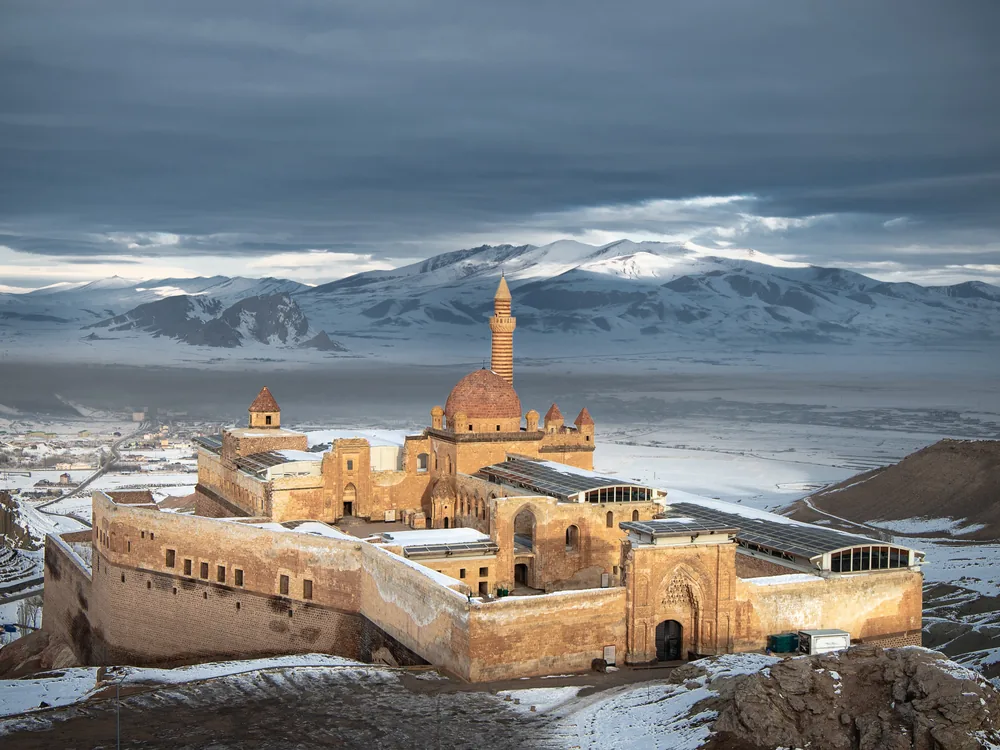
Construction of Ishak Pasha Palace began in 1685 under Çolak Abdi Pasha — and was not completed until 1784 under his successor Ishak Pasha, nearly a century later. Ninety-nine years of building, spanning two generations of the same family, produced a palace that is not the work of a single architectural moment but the accumulated expression of an entire era: a building that changed as the region's politics shifted, as craftsmen came and went, and as the decorative vocabulary available to its builders expanded across a century.
The palace sits at 1,650 metres altitude on a cliff above the town of Doğubayazıt in Ağrı Province, in the far east of Turkey, facing Mount Ararat (5,137 m) directly across the valley. Mount Ararat — the highest peak in Turkey, its snow-capped summit visible on clear days from far across eastern Anatolia — is the dominant presence in the landscape from the palace courtyard. The site was chosen not for comfort but for command: the cliff gives the palace visual and strategic control over the valley and the road east toward Iran.
The 116 rooms within the palace walls function as a self-contained city: a mosque, a selamlık (audience hall and administrative quarter), private residential apartments, a haremlik, kitchen and storage blocks, a bathhouse, and the tombs of the founding family, all contained within a single perimeter. The decorative programme is the most architecturally distinctive feature of the complex — Ottoman, Seljuk, Persian, Armenian, and Georgian ornamental traditions appear alongside Baroque, Rococo, and Gothic decorative elements, not as a deliberate synthesis but as the natural product of 99 years of building by craftsmen drawn from the multiple cultural communities of the eastern Silk Road. The palace is also one of the earliest buildings in Anatolia known to have incorporated a central heating system: a hypocaust-derived network running beneath the floors, an extraordinary engineering investment for a structure at this altitude in one of Turkey's coldest provinces.
A major earthquake in 1840 damaged the structure and the palace was subsequently abandoned, falling into ruin across the following century. A restoration project lasting approximately two decades returned the building to visitable condition, and Ishak Pasha is now managed as a national museum. The palace is a genuine logistical commitment — it is in far eastern Turkey, near the Iranian border, and most visitors reach it as part of a full-day guided tour from Doğubayazıt that also covers the Urartu Castle on the facing cliff, the Mount Ararat viewpoint, and other heritage sites in the valley. The GetYourGuide full-day tour is the most comprehensive way to experience the full Doğubayazıt landscape in a single day.
History
Ishak Pasha Palace was begun in 1685 under Çolak Abdi Pasha, the Ottoman governor of the Beyazıd Sanjak, on a strategic cliff above the town that would become Doğubayazıt. The site commanded the mountain pass toward Persia and served as the administrative seat of a semi-autonomous frontier governance on the border of the Ottoman and Persian empires. Construction continued across the following decades under subsequent members of the Pasha family, who used the palace both as a residential complex and as an administrative and judicial centre for the surrounding region. Ishak Pasha — the building's namesake — oversaw the final phases of construction and completed the palace in 1784, nearly a century after his predecessor had broken ground. The palace functioned as a regional administrative and social centre for the following decades, occupying a position of considerable local authority on the eastern Silk Road. The earthquake of 1840 severely damaged the structure and forced its abandonment; over the following century the building fell into significant ruin. A restoration project conducted across approximately two decades returned the palace to its present condition, and it is now administered as a national museum.
How to Visit
Getting there: Ishak Pasha Palace is above Doğubayazıt in Ağrı Province, approximately 35 km from the Iranian border. Most visitors reach Doğubayazıt by flying into Ağrı or Van, then connecting by car (Ağrı is roughly 95 km west, Van is roughly 200 km southeast). The palace is 6 km from Doğubayazıt town centre, accessible by taxi or on the featured guided tour. This is a genuine logistical commitment — plan Ishak Pasha as part of a broader eastern Anatolian itinerary.
Tickets: Walk-up entry is available at the palace gate. The GetYourGuide full-day guided tour is a 7-hour private guided tour covering Ishak Pasha Palace (75 min), the Mount Ararat panoramic viewpoint, the Doğubayazıt/Urartu Castle, the Ahmed-i Hani Tomb, the Noah's Ark Trace site, a Meteor Crater, and an Ice Cave, with a licensed expert local guide — the most comprehensive way to experience the full Doğubayazıt heritage landscape in a single day. Book in advance.
Practical tips: The altitude (1,650 m) and eastern Anatolian weather mean temperatures can be dramatically cooler than the coast, even in summer — bring a layer. The Mount Ararat view from the palace courtyard is the single most photographed element; plan for morning visits for the best light on the mountain before haze develops. Do not confuse Ishak Pasha Palace with the Doğubayazıt Castle (Urartu Castle) on the opposite cliff — they are two separate structures, both covered on the same GetYourGuide full-day tour.
Combine with: The Doğubayazıt Castle (Urartu Castle) on the facing cliff — a 9th-century BCE Urartian fortification later used by the Romans, Byzantines, Armenians, and Ottomans, covered on the same GetYourGuide full-day tour — and the Mount Ararat panoramic viewpoint, the iconic 5,137-metre peak directly facing the palace.
Frequently Asked Questions
99 years — construction began in 1685 under Çolak Abdi Pasha and was not completed until 1784 under his successor Ishak Pasha. This makes Ishak Pasha one of the longest construction timelines of any palace in Anatolia, spanning two full generations of the same family.
Location
Doğubayazıt, Ağrı, Turkey (on the cliff above the town)
Nearby Castles
Tours & Tickets
Powered by GetYourGuide
From
€157.98/ person