
Departing from Regensburg
Burg Randeck, Burg Prunn & the Danube Limes: Bavaria's Altmühltal Castle Circuit from Regensburg
Four Bavarian castles and a UNESCO Roman frontier wall in one half-day from Regensburg — well off the Neuschwanstein tourist trail
From
€87/ person
Rating
★ 4.9(8)
Duration
3 hours (private limousine transfer with driver-guide)
Rating
4.9 ★ (8 reviews)
Languages
English, German
Group size
Max 4 people
About This Tour
Bavaria's castle landscape is not Neuschwanstein, not the Romantische Straße, and not the handful of sites between Munich and the Austrian Alps that carry the full weight of international castle tourism. The Altmühltal Valley — the limestone river valley that runs northwest from the Danube between Regensburg and Nuremberg — is a different Bavaria: quieter, less visited, and architecturally richer in the particular category of genuinely medieval Bavarian castle-building than the more famous options an hour south. This three-hour private limousine circuit from Regensburg covers four distinct castle or castle-adjacent sites and a UNESCO Roman frontier monument, all within a radius that the average Regensburg day-visitor never considers.
Regensburg itself is one of Germany's most significant medieval cities — its UNESCO World Heritage historic centre (inscribed 2006) covers the old town with its medieval stone tower-houses (unique in Germany), the 13th-century stone bridge over the Danube, and the Cathedral of Saint Peter with its extraordinary twin Gothic towers. The city was a major centre of the medieval Holy Roman Empire and served as the permanent seat of the Reichstag (the Imperial Diet) from 1663 to 1806 — a continuous 143-year parliamentary session. Most visitors to Regensburg, however, do not venture into the surrounding Altmühltal. This tour is built specifically for those who do.
The circuit begins with a pickup from your Regensburg accommodation and proceeds into the Altmühltal Valley. The first stop is the Rosenburg Riedenburg Falconry Center — an operational falconry and bird-of-prey facility set within a medieval castle above the Altmühl River. The falconry demonstration, featuring trained birds of prey in flight demonstrations from the castle ramparts, is optional and carries an additional fee of approximately €12. Visitors who are not interested in the falconry experience can use the time for a walk around the outer castle grounds and the valley views. The Rosenburg stop is included in the circuit as an accessible introduction to the valley's castle landscape before the more historically demanding sites ahead.
Burg Randeck is the first of the tour's purely medieval castles: a ruined but substantially surviving fortification on a limestone cliff above the Altmühl, with intact medieval outer walls, a dungeon, the so-called Hunger Tower (a name that appears across German medieval castle ruins and refers to a tower used for detention of prisoners by starvation), and the main keep with panoramic views across the Altmühltal Valley below. Burg Randeck was a defensive fortification rather than a residential palace — its architecture is functional and austere in the way that medieval military architecture, as opposed to the later romanticised interpretation of the Gothic Revival, actually looks. The ruins are accessible on foot from the road below.
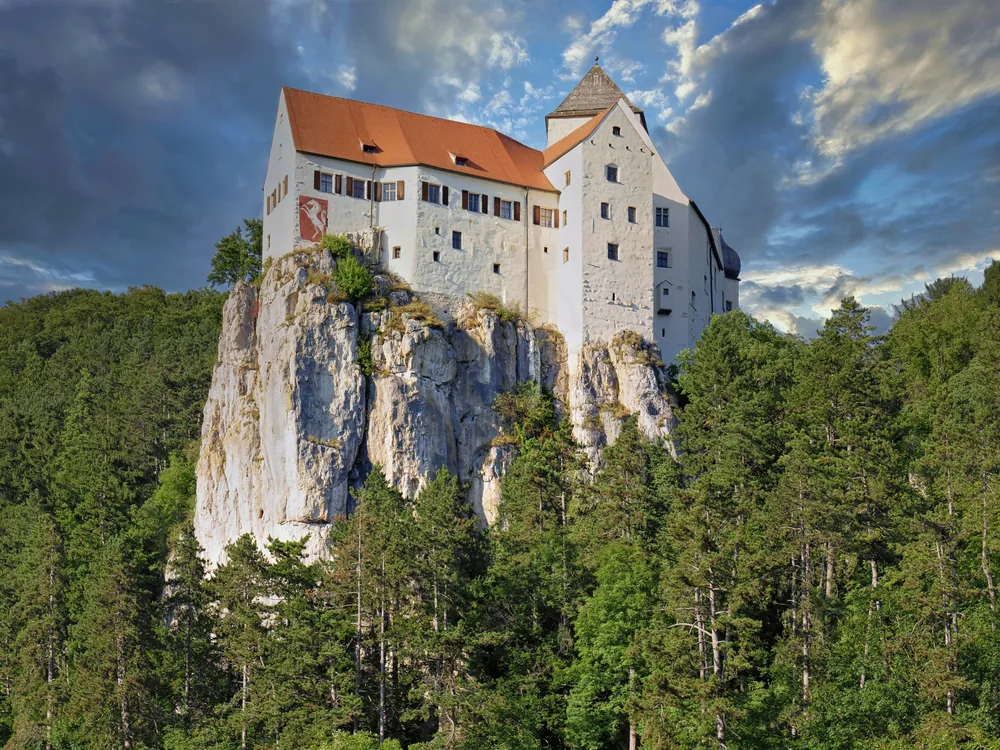
Burg Prunn — also known as Schloss Prunn — is the most architecturally significant stop on the circuit. Rising from a near-vertical limestone crag above the Altmühl River, it is one of the best-preserved medieval castles in Bavaria: a compact fortification with substantial surviving Gothic and early Renaissance architecture, including the main residential tower, a chapel, and the castle's most famous artefact — a parchment manuscript of the Nibelungenlied (the medieval German epic of Siegfried and Kriemhild) was found here in 1575, providing one of the earliest known manuscript versions of the poem. The Nibelungenlied connection gives Burg Prunn a literary resonance that complements its physical drama. The castle is managed by the Bavarian state and is open to visitors; the driver-guide provides context for both the architectural and literary history during the approach.
Schloss Eggersberg, a smaller fortified manor above the valley, follows as a photo stop — a brief pause at a viewpoint that frames the castle against the Altmühl and the limestone bluffs characteristic of the valley's geology. The final element of the circuit is a drive-by of the Danube Limes — the Roman frontier wall that ran along the Danube from Regensburg eastward, now a UNESCO World Heritage property as part of the Frontiers of the Roman Empire transnational nomination (2021). The Limes is not a single dramatic wall like Hadrian's Wall but a system of forts, watchtowers, and ramparts; the Regensburg section and the eastward extension into what is now Bavaria represent the empire's northeastern frontier as it stood in the 2nd century AD. Regensburg itself was the site of the Roman legionary fortress Castra Regina, and the surviving Roman gate (Porta Praetoria) in the city centre bookends the Limes material neatly with the circuit's departure and return.
The tour operates as a private limousine transfer with a driver-guide — there are no other passengers, and the itinerary can be adjusted to some extent based on visitor interest and conditions on the day. The provider, airportLiner, runs private transfer services in the Regensburg area; the castle circuit is a structured itinerary within that private format. The tour is well-reviewed for its size and the Altmühltal Valley circuit specifically is not duplicated by other tour products departing from Regensburg.
None of the four castle sites visited on this circuit — Burg Randeck, Burg Prunn, Rosenburg Riedenburg, Schloss Eggersberg — currently have individual castle pages on this site. Burg Prunn in particular, as one of Bavaria's best-preserved medieval castles with a significant literary and architectural history, is a strong candidate for a future dedicated castle page.
Highlights
- ✓Burg Prunn (Schloss Prunn) — one of Bavaria's best-preserved medieval castles, rising from a vertical limestone crag above the Altmühl River; where the earliest known Nibelungenlied manuscript was discovered in 1575
- ✓Burg Randeck — accessible medieval ruins with a dungeon, Hunger Tower, and panoramic Altmühltal views; functional medieval military architecture without the romanticised Gothic Revival veneer
- ✓Rosenburg Riedenburg Falconry Center — an operational falconry facility within a medieval castle; flight demonstrations from the ramparts are available as an optional extra (~€12, not included in base price)
- ✓Danube Limes — the UNESCO World Heritage Roman frontier system along the Danube (inscribed 2021 as part of Frontiers of the Roman Empire); the northeastern limit of the Roman Empire as it stood in the 2nd century AD
- ✓Private limousine transfer — no group, no schedule sharing, itinerary adjustable; the driver-guide provides context for all four sites and the valley landscape
- ✓Off the main tourist circuit — the Altmühltal Valley's medieval castles are essentially unknown to international visitors focused on Neuschwanstein or the Romantic Road; this circuit offers genuine medieval Bavaria at considerably lower visitor numbers
Ready to book this tour?
Free cancellation · Instant confirmation
Itinerary
The Rosenburg is an operational falconry and bird-of-prey centre set within and around a medieval castle above the Altmühl River at Riedenburg. Falconry demonstration flights from the castle ramparts are available as an optional extra (approximately €12 per person, paid on-site — not included in the base tour price). Visitors who prefer not to add the falconry demonstration can walk the outer castle grounds and take in the valley views below. The Rosenburg serves as an accessible introduction to the Altmühltal's castle landscape before the more historically concentrated stops ahead.
Burg Randeck stands on a limestone cliff above the Altmühl at Essing, its ruined walls, dungeon, Hunger Tower, and main keep surviving as accessible ruins. The castle's military-defensive character — built for control of the valley rather than for residential comfort — is clearly legible in the architecture: thick stone walls, minimal decorative elaboration, and sightlines oriented toward the river crossing below. The Hunger Tower, a common feature of German medieval castles used for prisoner detention, is accessible and gives a visceral sense of the castle's function beyond the Romantic castle aesthetic. Views from the keep across the Altmühltal are extensive.
Burg Prunn rises from a near-vertical limestone crag above the Altmühl River near Riedenburg — one of the most dramatically positioned and best-preserved medieval castles in Bavaria. The site was first fortified in the 11th or 12th century and the current structure preserves substantial Gothic and early Renaissance elements: the main residential tower, a late Gothic chapel, the gate complex, and the inner courtyard. In 1575, a parchment manuscript of the Nibelungenlied — the medieval German epic poem that narrates the story of Siegfried, Kriemhild, and the destruction of the Burgundian court — was discovered in the castle. The manuscript (now in the Bavarian State Library in Munich) is one of the earliest known versions of the poem and established Burg Prunn's literary reputation alongside its architectural significance. Managed by the Bavarian state; interior access depends on opening times.
A photo stop at a viewpoint framing Schloss Eggersberg against the Altmühl valley and the limestone bluffs that define the valley's geology. The castle's position on the escarpment above the river is characteristic of the Altmühltal's fortification pattern: a series of elevated sites exploiting the valley's natural defensibility, now appreciated primarily for the landscape compositions they create.
A drive-by view of surviving elements of the Danube Limes — the Roman frontier system that ran along the Danube from Regensburg eastward, inscribed as UNESCO World Heritage in 2021 as part of the transnational Frontiers of the Roman Empire nomination. The Limes is not a continuous wall but a system of forts, watchtowers, and military roads; Regensburg (Roman Castra Regina) was the principal legionary fortress on this section of the frontier. The drive-by frames the Limes in its landscape context before returning to Regensburg, where the Roman gate Porta Praetoria survives in the city centre.
What's Included
- ✓Private limousine transfer with driver-guide (English/German)
- ✓Pickup and drop-off at your Regensburg accommodation
- ✓Guide commentary for all four sites
- ✓Entry to accessible castle grounds (Burg Randeck, Burg Prunn exterior/grounds; check current opening status)
Not Included
- ✗Rosenburg falconry demonstration (~€12, optional, paid on-site)
- ✗Burg Prunn interior entry fee (if applicable; confirm at booking)
- ✗Gratuities
Insider Tips
The falconry demonstration at Rosenburg is optional and costs approximately €12 per person, paid on-site — it is not included in the €87 base tour price; decide in advance whether to add it so the driver can plan the stop accordingly
Burg Prunn is the most architecturally significant stop and worth allocating the most attention; if time permits, request a slightly longer stop here from your driver-guide
The Altmühltal is best in the late afternoon light (the south-facing limestone cliffs take on a golden tone in the hour before sunset); if the 3-hour tour can be timed for a late-afternoon departure, the visual quality of the valley is considerably higher
Regensburg's own Porta Praetoria (the surviving Roman gate) is a 5-minute walk from the Altstadt and provides a useful context for the Danube Limes drive-by at the end of the tour; consider walking there after returning from the circuit
Frequently Asked Questions
Is the falconry demonstration suitable for children?
The Rosenburg falconry demonstrations are generally suitable for children and families. The birds fly from the castle ramparts and return to the falconer; there is no handling contact with the birds during the demonstration. The extra fee is approximately €12 per person; confirm current pricing with the Rosenburg Riedenburg directly or ask your driver-guide at pickup.
Can the itinerary be adjusted if I want more time at Burg Prunn?
Yes — as a private limousine tour, the itinerary is flexible within the 3-hour window. If you want to skip the Rosenburg falconry stop (or skip the falconry demonstration and minimise time there) to spend more time at Burg Prunn or Burg Randeck, discuss this preference with your driver-guide at pickup. The Schloss Eggersberg stop is a photo stop and can be shortened without significant impact on the circuit.
Why don't these Altmühltal castles appear on the main castle pages of this site?
Burg Randeck, Burg Prunn, Rosenburg Riedenburg, and Schloss Eggersberg are not yet covered as individual pages on Castles & Palaces. Burg Prunn in particular — one of Bavaria's best-preserved medieval castles with the Nibelungenlied connection — is a strong candidate for a future dedicated page. For now, this tour page provides the primary coverage of the Altmühltal castle cluster.
More Tours from Regensburg
Powered by GetYourGuide
From
€87
per person
Free cancellation available on most dates · Secure booking
Meeting point
Pickup from your Regensburg accommodation — confirm exact pickup location with airportLiner at booking
From
€87/ person