
Departing from Luxembourg City
Luxembourg City: Grand Ducal Palace & Royal Heritage Walk
The 16th-century palace that became a royal residence by accident — a street-level guided walk through Luxembourg City's political and royal heart, from the Grand Ducal Palace to the Bock Casemates
From
€161/ person
Duration
1.5 hours
Languages
English, French
Group size
Max 8 people
About This Tour
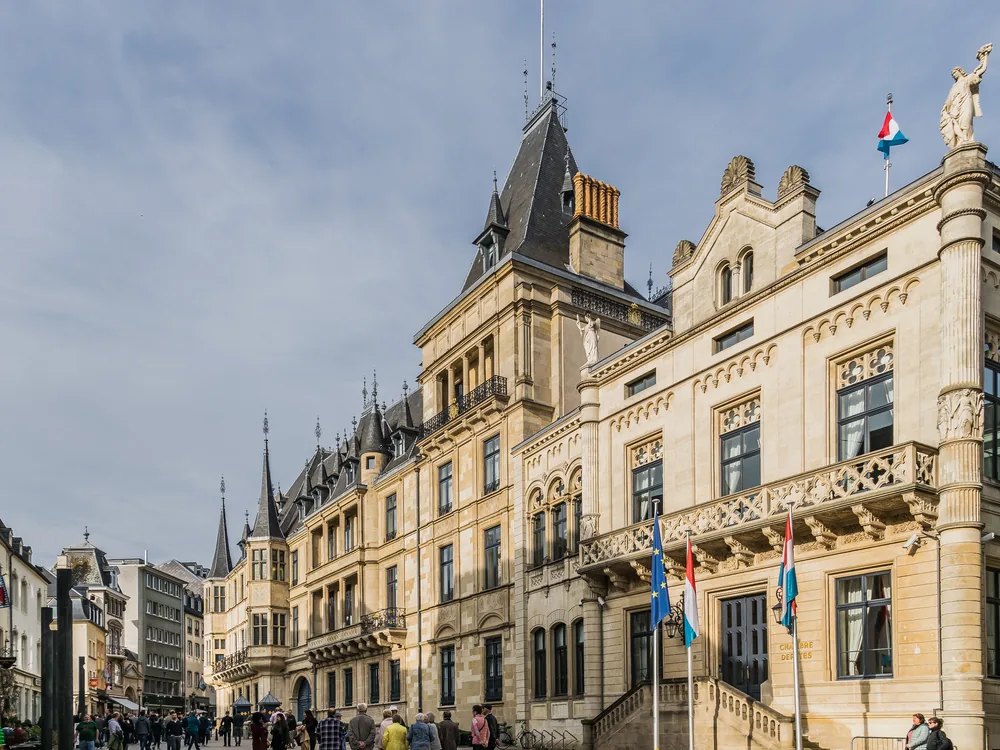
Luxembourg City is one of the few European capitals where the royal family lives in the centre of the old town rather than in a suburban palace complex — and the Grand Ducal Palace stands in the middle of the historic quarter as evidence of how this unusual arrangement came about. It was not purpose-built as a royal residence but built as a city hall in 1572, used as the seat of city administration for three centuries, briefly converted into a hotel, and finally handed over to the grand-ducal family in 1890 when the previous official residence became too expensive to maintain. The result is a compact, almost domestic-scale palace surrounded by the narrow streets of the medieval city — more Italian palace-in-the-piazza than Versailles-on-the-hill, and all the more approachable for it.
This 1.5-hour walking tour with a live English or French guide from LocalBini AG (EU) covers the Grand Ducal Palace's exterior and the political heart of Luxembourg City — the Chamber of Deputies, the Cathedral Notre-Dame de Luxembourg, and the historic districts connecting them — before reaching the Bock Casemates at the cliff edge of the Alzette gorge. The tour is a street-level experience throughout: GetYourGuide's own listing explicitly excludes entry tickets for transportation, museums, and monuments, so the Grand Ducal Palace exterior, the cathedral exterior, and the Bock Casemates viewpoint are all observed from outside. Visitors who want the Bock Casemates interior — the UNESCO-listed tunnel network — should purchase a separate entry ticket at the Bock entrance (approximately €3 per adult, open seasonally).
⚠️ A note on value for the price: at €161 per person for a 1.5-hour exterior walking tour (max 8 guests), this is a premium small-group experience, not a standard city walk. The LocalBini AG format is curated and intimate — the guide covers the Nassau-Weilburg dynasty's history, the political structure of the Grand Duchy, and the UNESCO-inscribed Old Quarter in depth within a short format. The rating so far is based on a single review and should be treated as indicative rather than statistically established. Visitors who prefer a longer, castle-focused day in Luxembourg are well served by the Luxembourg: Vianden Castle, Beaufort Ruins & Medieval Echternach day tour — a full-day alternative that leaves the same city.
The House of Nassau-Weilburg has governed Luxembourg since 1890, when Prince Adolf of Nassau became Grand Duke following the death of William III of the Netherlands without a surviving male heir. The Nassau dynasty's connections run through the Dutch royal family, William the Silent (leader of the Dutch Revolt), and ultimately to the medieval Counts of Nassau whose seat was on the Lahn River in Germany. In Luxembourg, the dynasty has presided over the country's transformation from a heavily fortified Habsburg fortress city — its 23km of walls, casemates, and underground tunnels were among the most formidable in Europe before their demolition was required by the Congress of Vienna in 1867 — into one of the world's wealthiest small states, home to the European Court of Justice and several major EU institutions.
Highlights
- ✓Grand Ducal Palace exterior — a 16th-century city hall turned royal residence, its ornate Spanish Renaissance facade one of the finest in northern Europe, standing in the narrow streets of the medieval quarter rather than in a formal park or esplanade
- ✓The Bock Casemates — the viewpoint above the Alzette gorge where the cliff fortifications were cut into the rock in the 17th century, now UNESCO World Heritage-listed as part of the city's fortification legacy; the exterior and gorge view are included in the walk
- ✓Chamber of Deputies — the parliament of Luxembourg, housed in a 17th-century building adjacent to the palace; the guide covers the Luxembourg political system (constitutional monarchy, proportional representation, three official languages: French, German, Luxembourgish)
- ✓Cathedral Notre-Dame de Luxembourg — the early Baroque Jesuit cathedral (1613–1621), burial place of the grand-ducal family, with a distinctive blend of Gothic spires and Baroque nave that reflects the compressed architectural timeline of the Counter-Reformation
- ✓The House of Nassau-Weilburg — the dynasty whose European connections run from William the Silent and the Dutch Republic through the Prussian Hohenzollern to the current Grand Duke Henri; the guide covers how Luxembourg became a separate grand duchy rather than remaining part of the Netherlands or Belgium after 1839
- ✓Small group, intimate format — maximum 8 guests with a live bilingual guide (English/French); the walk is compact but unhurried, covering the city's UNESCO-inscribed old quarter in depth
Ready to book this tour?
Free cancellation · Instant confirmation
Itinerary
The tour begins at Place Guillaume II — Luxembourg City's central square — where the equestrian statue of William II of the Netherlands (Grand Duke of Luxembourg 1840–1849) gives a visual starting point for the complex entanglement of Dutch and Luxembourgish history. From the square, the guide walks to the Grand Ducal Palace: a building completed in 1572 as the city's administrative centre, modified in 1618 with the addition of a second wing, and converted to residential use only in 1890 when the Nassau-Weilburg family took over the Grand Duchy. The Spanish Renaissance facade — with its ornate window surrounds and stepped gables — reflects the period of Spanish Habsburg rule that dominated Luxembourg until 1714. The palace is the official residence of Grand Duke Henri, but the family uses it primarily for official functions and state ceremonies; their actual residence is the Château de Colmar-Berg, outside the city. The walk covers the palace exterior and the surrounding streets of the medieval quarter.
Moving through the historic centre, the guide covers the Chamber of Deputies — Luxembourg's unicameral parliament, which has 60 members elected by proportional representation from four constituencies; the country's political system is unusual in Europe for having three official languages (French, German, and Luxembourgish) with all parliamentary business conducted in all three — and the Cathédrale Notre-Dame de Luxembourg, the early Baroque cathedral built by the Jesuits between 1613 and 1621. The cathedral is the burial place of the grand-ducal family and home to a revered 17th-century Madonna statue (Our Lady of Luxembourg) that is the object of a major annual octave procession. The architecture mixes Gothic structural traditions (pointed arches, ribbed vaulting in the nave) with the ornamental vocabulary of the Baroque — a combination characteristic of Jesuit churches built during the Counter-Reformation across the Low Countries.
The walk ends at the Bock promontory — the rocky spur above the Alzette River gorge where Count Siegfried of Ardennes built the original fortification in 963 AD, establishing the settlement that grew into Luxembourg City. The guide covers the history of the Bock fortifications from the medieval keep through the successive Habsburg, Spanish, French, and Prussian additions that made Luxembourg one of the most heavily fortified cities in Europe by the 18th century — described by Vauban (who designed improvements in the 1680s) as the 'Gibraltar of the North.' The Bock Casemates — a network of tunnels cut into the sandstone cliff, now UNESCO World Heritage-listed — are visible from the exterior and the cliff-edge viewpoint over the Petrusse valley. Interior access to the tunnel network requires a separate ticket (approximately €3 per adult, open seasonally). The guide concludes here with a summary of the 1867 Treaty of London that required the demolition of Luxembourg's fortifications, transforming the most fortified city in northern Europe into an open capital.
What's Included
- ✓Live bilingual guide (English/French), LocalBini AG
- ✓Small group maximum 8 guests
- ✓Grand Ducal Palace exterior visit
- ✓Cathedral Notre-Dame exterior
- ✓Bock Casemates viewpoint (exterior)
Not Included
- ✗Entry tickets for all museums, monuments, and transportation (per GetYourGuide listing)
- ✗Bock Casemates interior tunnel access (approximately €3 per adult, purchased separately on-site)
- ✗Lunch or refreshments
Insider Tips
This is an exterior-only walking tour — the Grand Ducal Palace, Cathedral, and Bock Casemates are all viewed from outside; budget an additional €3–5 per person for the Bock Casemates interior tunnel access if you want to go underground
The walk is compact at 1.5 hours — pair it with the Bock Casemates interior visit (open approximately March–October) immediately after for a natural morning in the old quarter
The Grand Ducal Palace opens for public tours in late July and August when the family is away — if visiting in summer, check the official palace website for guided interior access dates; these are the only days the state apartments are accessible
For a full Luxembourg day that combines city heritage with countryside castles, see the Luxembourg: Vianden Castle & Beaufort Ruins day tour — the two tours together cover everything the Grand Duchy's heritage has to offer
Parking in Luxembourg City is expensive and the old quarter is compact — arrive by train (Luxembourg's trains and buses are free for all passengers since 2020) rather than by car
Frequently Asked Questions
Is the Grand Ducal Palace interior accessible on this tour?
No — GetYourGuide's own listing explicitly states that entry tickets for transportation, museums, and monuments are not included; this is an exterior walking tour throughout. The palace interior opens to the public for guided tours in late July and August only, when the grand-ducal family is not in residence. Check the palace website (monarchie.lu) for the specific dates in the year you are visiting.
How does this tour differ from the Vianden/Beaufort day trip?
This 1.5-hour city walk focuses on Luxembourg City itself — the Grand Ducal Palace, Chamber of Deputies, Cathedral Notre-Dame, and Bock Casemates viewpoint, all within the UNESCO old quarter. The Vianden Castle, Beaufort Ruins & Echternach day tour is a full 8-hour countryside day visiting two of Luxembourg's finest medieval castle sites in the Mullerthal and Our River valley. The two are complementary: the city walk for royal and political heritage, the day tour for the great medieval castles.
What are the Bock Casemates and why are they UNESCO-listed?
The Bock Casemates are a network of passages cut into the sandstone rock below the Bock promontory — the original 963 AD fortification site of the city — creating approximately 23km of tunnels at multiple levels in the cliff. They were developed by successive rulers (Burgundian, Habsburg, Spanish, French, Austrian, Prussian) over 300 years and at their peak could shelter tens of thousands of soldiers and hundreds of horses. The Congress of Vienna (1867) required most of Luxembourg's fortifications to be demolished, but the casemates survived. They are UNESCO World Heritage-listed as part of the 'City of Luxembourg: its Old Quarters and Fortifications' inscription (1994).
More Tours from Luxembourg City
Powered by GetYourGuide
From
€161
per person
Free cancellation available on most dates · Secure booking
Meeting point
Luxembourg City centre — exact meeting point confirmed at booking by LocalBini AG.
From
€161/ person