
Departing from Faro
Tavira, Cacela Velha & Castro Marim: East Algarve Castles Tour
Three medieval fortresses along Portugal's least-visited coastline — ending with a ferry crossing into Spain
From
€337/ group (up to 4)
Rating
★ 4.6(3)
Duration
6 hours (private group)
Rating
4.6 ★ (3 reviews)
Languages
English
Group size
Max 4 people
About This Tour
The eastern Algarve between Tavira and the Spanish border is one of the most historically intact stretches of the Portuguese coast — a region of salt pans, lagoon islands, and whitewashed towns that mass tourism largely skipped in favour of the western beaches. It also contains three medieval fortifications that tell the entire arc of the Algarve's history: the Moorish hilltop castle of Tavira, reconstructed after the Christian reconquest of 1242; the small cliff-top fortaleza of Cacela Velha, one of the most perfectly preserved and least-visited fortifications on the Portuguese coast; and the great frontier castle of Castro Marim, where the Order of Christ — successor to the Knights Templar in Portugal — established its first headquarters after the Templars were dissolved. This private six-hour tour visits all three in sequence before crossing the River Guadiana by ferry into Ayamonte, Spain — a genuinely rare Algarve experience that puts you briefly on the other side of the historical frontier. Note: this is a small-operator private tour priced per group (up to four people) at €337, and with only three reviews to date (two five-star, one one-star), experiences have been mixed; the content below reflects the castles honestly rather than the operator's marketing.
Highlights
- ✓Castelo de Tavira — the Moorish-origin hilltop castle above Tavira's old town, with views over the Ria Formosa lagoon and the offshore barrier islands
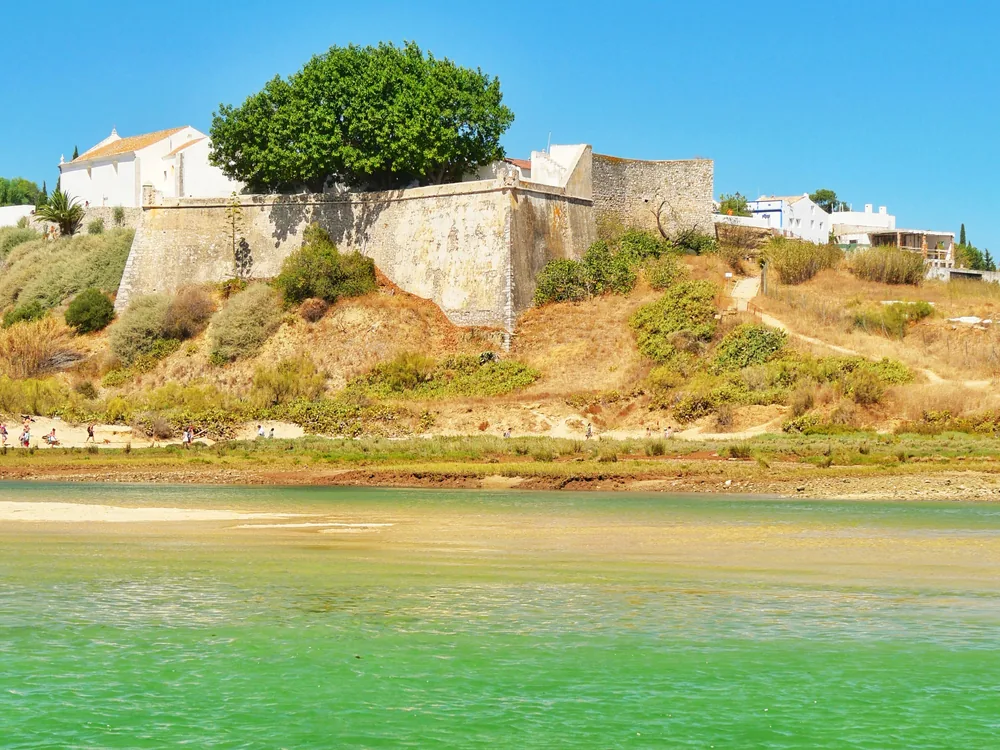
- ✓Fortaleza de Cacela Velha — a 17th-century Portuguese cliff-top fortress above one of the most unspoilt coves on the Algarve coast; the village of Cacela Velha has barely changed in 200 years
- ✓Castelo de Castro Marim — the most important medieval fortification in the Eastern Algarve, first headquarters of the Order of Christ in 1319, overlooking the Portuguese-Spanish border on the Guadiana
- ✓River Guadiana ferry crossing into Spain — a genuine border crossing on the water, arriving in Ayamonte (Andalusia) for a brief market stop
- ✓Private group experience (up to 4 people, €337 total) — not a shared coach tour
Ready to book this tour?
Free cancellation · Instant confirmation
Itinerary
Tavira is the most architecturally distinctive town in the Algarve — a city of Roman bridges, Moorish streets, and a proliferation of churches that earned it the nickname 'the city of a hundred churches' (the actual count is 21, still remarkable for a town of this size). The castle occupies the highest point of the old town on a hill above the River Gilão. It was built by the Moors and held by them until 1242, when the Portuguese knight Paio Peres Correia took Tavira from the Marinid dynasty — a campaign that effectively completed the Christian reconquest of the Algarve. The walls enclose a garden of citrus trees and bougainvillea; the remains of the original Moorish towers rise above the perimeter. The views from the battlements extend over Tavira's distinctive scissor-hip (tesoura) rooflines — a unique local architectural tradition — and south across the salt pans and barrier islands of the Ria Formosa Natural Park.
Cacela Velha is the most perfectly preserved and least-visited village in the Algarve — a hamlet of whitewashed houses, an 18th-century church, and a cluster of buildings on a cliff above a lagoon channel, with no hotels, no restaurants at scale, and no development visible from the cliff. The Fortaleza de Cacela Velha sits at the cliff edge: a small 17th–18th century Portuguese coastal fortress whose walls command the channel between Cacela Velha's beach and the open Atlantic. The fort was built to defend against North African corsair raids along this stretch of coast — a persistent threat throughout the 16th and 17th centuries. Its bastions and sentry posts are accessible, and the view from the walls — across the lagoon channel to the barrier beach and south to the Atlantic — is one of the finest and least-photographed in the Algarve.
Castro Marim's castle dominates a hill above the town at the mouth of the River Guadiana — the natural border between Portugal and Spain. The site was fortified by the Romans and held by the Moors until the Christian reconquest of the Algarve in 1242–1249. In 1319, when Pope John XXII dissolved the Order of the Knights Templar in Portugal, King Dinis I reconstituted the Templars as the Order of Christ and established Castro Marim as its first headquarters — the most strategically positioned fortress on Portugal's southern frontier. The Order relocated to Tomar in 1357, but Castro Marim's castle remained a key garrison position throughout the Age of Discovery, when the nearby port was used by Vasco da Gama and other explorers. The 13th–14th century walls, inner keep, and the later Forte de São Sebastião (17th century, built directly opposite) together form one of the most complete medieval and early modern fortification complexes in the Algarve.
The River Guadiana forms the natural boundary between Portugal and Spain for much of its length, and Castro Marim sits directly on the Portuguese bank opposite the Andalusian town of Ayamonte. The tour crosses via ferry — a brief passage on the water that delivers you into Spain without the motorway detour required by the bridge further upstream. Ayamonte is a market town with a fish market and a plaza mayor of faded Andalusian grandeur. This is a non-castle stop, included as a genuine border-crossing experience rather than a historical detour; no castle or fortification is visited on the Spanish side.
What's Included
- ✓Private vehicle and driver/guide
- ✓Personalised tour for your group (up to 4)
- ✓Pickup from accommodation in the Faro/Tavira area (confirm at booking)
- ✓Ferry crossing to Ayamonte, Spain
Not Included
- ✗Castle entry fees (paid on-site — Castelo de Tavira and Castro Marim charge modest admission)
- ✗Meals and refreshments
- ✗Tips for driver/guide
Insider Tips
Castro Marim's castle is the highlight from a historical standpoint — allow the full 45 minutes and climb to the keep's upper level for the view over the Guadiana delta. The fortress's connection to the Order of Christ (and through them to the Knights Templar) is one of the lesser-known stories of the Algarve.
Cacela Velha is best experienced slowly — the village is tiny and the fort is compact, but the cliff-top setting above the lagoon is genuinely beautiful and almost never crowded. This is one of the few spots on the Algarve coast that still looks as it did in the 18th century.
With only three GYG reviews at time of writing (two five-star, one one-star noting a late guide and language difficulties), this is a small-operator product. Confirm guide language and pickup time explicitly in your booking notes.
The Ria Formosa lagoon visible from both Tavira and Cacela Velha is one of the most important wetland ecosystems in Europe — a UNESCO Biosphere Reserve and the habitat of the purple gallinule (caimão), one of Portugal's rarest birds. Bring binoculars if you're interested in wildlife.
Tavira's old town is worth exploring beyond the castle — the Roman bridge, the Church of Santa Maria do Castelo (where Paio Peres Correia and his knights are buried), and the riverside market are all within easy walking distance.
Frequently Asked Questions
Is the €337 price per person or for the whole group?
€337 is the total price for the private group — not per person. The tour accommodates up to four people, so for a full group of four the per-person cost is approximately €84. For a solo traveller or a couple, the full group price still applies since the vehicle and guide are private. This pricing structure is typical of small-group private day tours in the Algarve.
Do I need a passport for the Spain crossing?
Portugal and Spain are both Schengen Area countries, so no passport check takes place at the Guadiana crossing. EU/EEA citizens do not need any documentation; non-EU visitors who have already entered the Schengen Area do not require a separate visa for this crossing. However, carrying your passport or national ID is always recommended when crossing an international border.
Are the castle entry fees included?
No — castle admission fees are paid on-site and are not included in the €337 group price. Entry to Castelo de Tavira and Castelo de Castro Marim both charge modest admission (typically a few euros per adult). The Fortaleza de Cacela Velha is accessible without a separate entry fee. Confirm current prices at the sites on the day.
More Tours from Faro
Powered by GetYourGuide
From
€337
per group (up to 4 people)
Free cancellation available on most dates · Secure booking
Meeting point
Pickup from your accommodation in the Faro/Tavira area — address confirmed at booking
From
€337/ group (up to 4)