
Departing from Brașov
Transylvania Saxon Villages: Rupea Fortress, Viscri & Saschiz
Four UNESCO and heritage-listed Saxon villages in a single day from Brașov — the volcanic fortress of Rupea, Criț's preserved streetscape, Viscri's fortified church, and Saschiz's clock tower
From
€99/ person
Duration
7 hours
Languages
English
Group size
Max 7 people
About This Tour
The Transylvanian Saxons were German-speaking settlers brought to Transylvania by Hungarian kings in the 12th and 13th centuries to colonise and defend the southeastern frontier of the Kingdom of Hungary. They established a dense network of fortified towns and villages across the Burzenland and the Königsboden — the 'King's Land' they held under a direct charter from the Crown, with rights of self-governance, trade monopolies, and military obligation. Their fortified churches became the signature architectural achievement of the region: each village built a church on its highest point, enclosed it with a thick defensive wall and towers, and created a structure that functioned simultaneously as place of worship, community storehouse (each family had a numbered storage chamber in the wall towers), and last-resort refuge when Ottoman and Tatar raiding parties passed through the valley below.
Seven of these fortified church complexes are UNESCO World Heritage-listed (1993, extended 1999). Two of them — Viscri and Saschiz — are on this tour's itinerary. The Saxon village culture persisted for eight centuries, through Hungarian, Ottoman, Habsburg, and Romanian governance, until the communist period (when most Saxons were deported to Soviet labour camps between 1945 and 1949) and the post-1989 emigration to Germany reduced the Saxon population of Transylvania from hundreds of thousands to approximately 12,000 today. What remains is the built fabric: villages whose architecture, church towers, and agricultural landscapes were shaped by Saxon hands over 700 years and have been largely preserved because the villages were too remote and too poor to be modernised.
This 7-hour tour (provider: Transylvania-Tours, hotel pickup and drop-off in Brașov, English-speaking live guide, max 7 guests) covers four Saxon heritage sites in a single day: Rupea Fortress, Criț village, Viscri (UNESCO), and Saschiz (UNESCO).
⚠️ Entrance fee ambiguity: GetYourGuide's 'Includes' list states 'Entrance fees' but the itinerary itself marks each village stop (Rupea Citadel, Criț, Saschiz, Viscri) with an 'Extra fee' note. The most likely explanation is that general village and fortress access is included but specific add-ons — museum rooms, the King's House at Viscri, church tower climbs — carry a small additional charge. Write this as: main site access is included; budget a small amount (approximately €2–5 per person per stop) for optional interior features.
No verified public reviews yet: the GetYourGuide listing shows a provider rating with no verified public review count. This is a new or thin-reviewed listing. The operator (Transylvania-Tours) is an established Brașov-based company. For another Brașov-based departure covering the mountains rather than the villages, see the Făgăraș Fortress & Transfăgărășan Highway tour.
Highlights
- ✓Viscri (Weisskirch) — UNESCO World Heritage-listed fortified Saxon church village, notable for its 12th-century white church and fortified enclosure; supported by the conservation work of King Charles III (then Prince of Wales), who purchased and restored a traditional Saxon house here in 2006; the village is one of the most authentically preserved Saxon communities in Transylvania
- ✓Saschiz (Keisd) — UNESCO World Heritage-listed village with a 15th-century fortified church and a distinctive free-standing Clock Tower (Turnul cu ceas) above the village square; the Clock Tower is separate from the church complex and gives the village its distinctive skyline
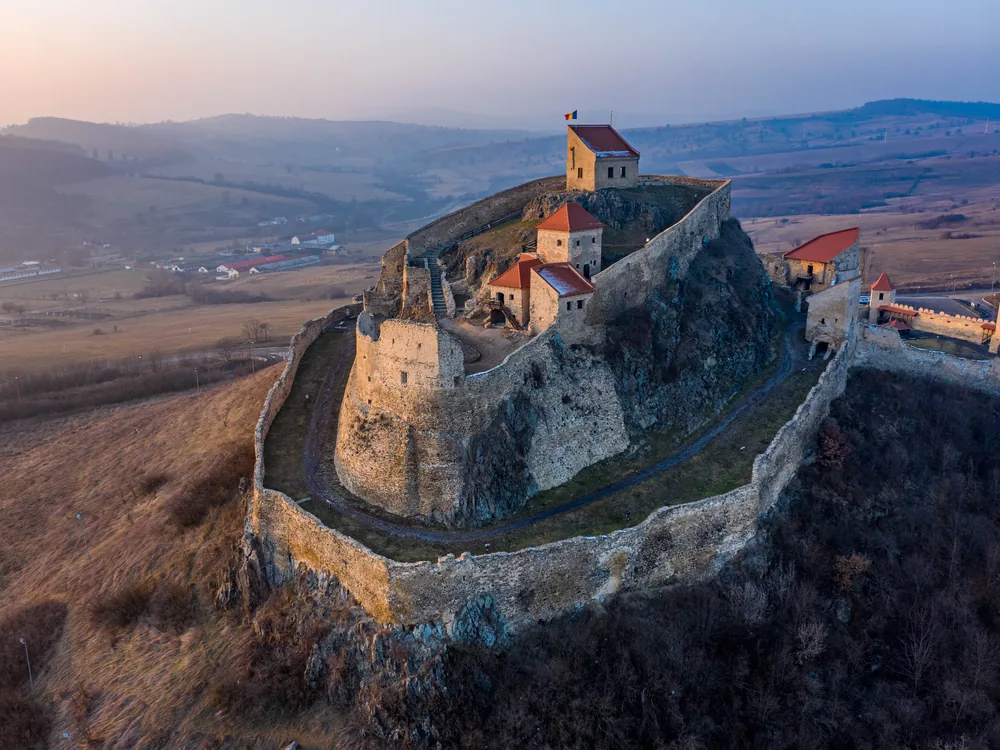
- ✓Rupea Fortress (Cetatea Rupea) — one of the oldest and best-preserved fortresses in Transylvania, built on a volcanic basalt hill above the Repede valley; first documented in 1324, though occupation of the rock dates to the Bronze Age; extensively restored in 2013–2014; the views from the basalt spur extend over the Transylvanian plateau in every direction
- ✓Criț (Deutsch-Kreuz) — a traditional Saxon village with well-preserved 18th and 19th-century agricultural architecture, less touristed than Viscri; the village church, Saxon farmhouses, and the traditional village layout of a single street with fortified farmyards are intact; a quiet contrast to Viscri's now-established heritage tourism
- ✓Hotel pickup and drop-off in Brașov, English-speaking live guide, small group max 7 — an intimate, specialist day with no large-coach format
- ✓No overlap with existing Romania castle pages — this tour's Saxon village/fortified church content is entirely different from the royal castles and palaces already on the site (Bran, Peleș, Corvin, Mogoșoaia)
Ready to book this tour?
Free cancellation · Instant confirmation
Itinerary
The tour begins with hotel pickup in Brașov and drives northeast along the Transylvanian plateau road to Rupea, approximately 55km from Brașov. Rupea Fortress (Cetatea Rupea) stands on a volcanic basalt spur — a lava plug left by ancient volcanic activity — above the modern town, giving it a natural defensive position with views extending in every direction across the flat Transylvanian plateau. The site has been occupied since the Bronze Age; the Dacians used it, the Romans may have, and the Saxons built the medieval fortification documented from 1324. The fortress consists of three enclosures at different levels of the basalt spur — the upper citadel (a last-resort refuge with a cistern), the middle fortress (where the garrison lived), and the lower courtyard (where villagers and livestock sought shelter during raids). The fortress fell out of military use in the 18th century and became a ruin; a major restoration in 2013–2014, funded by a European Union heritage program, rebuilt most of the circuit walls and towers and opened the site as a public heritage attraction. It is now one of the most visited non-urban fortress sites in Transylvania. The guide covers the fortress's architectural history and its role in the Saxon defensive network. Access fees: general access included, specific interior features may carry a small additional charge.
From Rupea, the tour continues to Criț (in German: Deutsch-Kreuz, or German Cross), a smaller Saxon village between Rupea and Viscri. Criț is less visited than its UNESCO-listed neighbours, which gives it a quality of genuinely unhurried daily life — residents still work the agricultural land using traditional methods, the Saxon farmhouses are occupied rather than museum-converted, and the village maintains the architectural character of the 18th–19th century Saxon settlement pattern: a single street, with farmyards behind tall wooden gates, the church at the elevated centre, and the landscape of fields and orchards extending to the forested hills. The guide uses Criț as a contrast point to explain what the Saxon villages looked like before heritage tourism arrived — the traditional house form (with gate, courtyard, stables, and living quarters arranged in a sequence rather than a freestanding house in a garden), the fortified church's role in village life, and the history of the Saxon emigration that has left many farmhouses empty or sold to urban buyers. The fortified church at Criț is small and visits depend on current access; budget a small amount for any optional interior.
Viscri — in German, Weisskirch (White Church), the name derived from the whitewashed church that was visible from the valley for miles — is the most internationally recognised of the Transylvanian Saxon villages, partly because of its UNESCO listing (since 1999) and partly because King Charles III (then Prince of Wales) purchased and restored a traditional Saxon farmhouse here in 2006, bringing global attention to the Transylvanian Saxon heritage conservation cause and supporting the Mihai Eminescu Trust's village revival programs. The fortified church at Viscri is the oldest in the tour's itinerary — a Romanesque church (12th century) that was progressively enclosed and fortified between the 14th and 17th centuries, with a defensive wall, towers, and a gallery of numbered family storage chambers on the wall's interior face, each belonging to a specific Saxon family. The church itself retains medieval frescoes and the traditional Saxon interior arrangement. The village's main street is cobbled, lined with restored Saxon farmhouses (some available as guest accommodation), and the 'King's House' — the house Prince Charles purchased, now restored and available to rent — is on the lane descending to the lower village. Access to the fortified church includes a small entry charge; the King's House is separate. The guide covers the Saxon migration of 1162–1211, the UNESCO listing, and the conservation work.
The final stop is Saschiz (in German: Keisd), a UNESCO World Heritage-listed village whose fortified church dates to the 15th century and whose separate Clock Tower (Turnul cu ceas) gives the village its distinctive skyline above the main square. The Clock Tower is unusual: unlike most Transylvanian Saxon villages, where the tower is integrated into the church complex, Saschiz's tower stands free in the village square — an independent civic monument more reminiscent of an Italian campanile than a typical Saxon defensive tower. The fortified church itself is a three-nave Gothic hall church enclosed by a defensive wall with corner towers; the fortification system was tested during the Ottoman period but the village was never captured. Saschiz has been less commercially developed than Viscri — fewer tourism facilities, but a more complete sense of the unchanged village fabric. The access question applies here as well: main site access is included, but specific features (tower climb, museum rooms) may carry a small additional fee. The guide covers the UNESCO listing, the village's agricultural history, and the story of the Saxon population's emigration. Return drive to Brașov follows the tour.
What's Included
- ✓Private vehicle with English-speaking guide (Transylvania-Tours)
- ✓Hotel pickup and drop-off in Brașov
- ✓Main access to Rupea Fortress, Criț village, Viscri, and Saschiz
- ✓Small group max 7
Not Included
- ✗⚠️ Some individual site features may carry a small additional charge (museum rooms, the King's House at Viscri, church tower climbs, specific Saschiz interior access) — budget approximately €2–5 per person per stop for optional extras
- ✗Lunch (natural break between sites; the guide can recommend local options)
- ✗Personal expenses and tips
Insider Tips
The four stops are spread across a 90km circuit northeast of Brașov — the drive itself is pleasant (rolling Transylvanian plateau, village roads, no major highways) but cumulative; pace the photography time at each stop to avoid exhaustion at Saschiz
Viscri's fame has brought tourism infrastructure (craft shops, guesthouses, tours) but also limited parking and a sometimes-crowded main street in July–August; the early-morning start typical for this tour format means arriving before the large coaches
The 'King's House' at Viscri (restored by King Charles III, now available to rent through the Mihai Eminescu Trust) can be viewed from the outside on the village lane; interior access requires a separate booking through the Trust
Budget an additional €5–10 per person for optional site access fees throughout the day (fortified church interiors, tower climbs, museum rooms); the GetYourGuide listing is ambiguous on what exactly is included vs. extra
For a complementary Brașov-based day in the opposite direction (southwest, toward the Fagaraș Mountains and high-alpine scenery), see the Făgăraș Fortress & Transfăgărășan Highway tour
Frequently Asked Questions
Why are some village stops marked 'Extra fee' in GetYourGuide's itinerary even though entrance fees are listed as included?
GetYourGuide's listing has an internal inconsistency: entrance fees are listed as included overall, but each individual village stop in the itinerary is tagged with an 'Extra fee' note. The most likely explanation: general access to the village and fortress areas is included, while specific paid features within each stop (museum rooms, church tower climbs, the King's House at Viscri, specific Saschiz exhibits) carry an additional per-person charge of approximately €2–5 — don't expect blanket free access to every interior. Confirm with Transylvania-Tours at booking if any specific feature is particularly important to your visit.
What is the UNESCO World Heritage status of Viscri and Saschiz?
Seven fortified Saxon church villages in Transylvania are collectively inscribed on the UNESCO World Heritage List — first inscribed in 1993 (Biertan, Câlnic, Dârjiu, Prejmer, Saschiz, Sibiu, Valea Viilor) and extended in 1999 to include Viscri. The inscription recognises the villages as 'outstanding examples of the cultural landscape of the Transylvanian Saxons,' with the fortified churches as the defining architectural achievement. The inscription covers each village's church complex, fortifications, and immediate setting, but not the entire village landscape.
Who were the Transylvanian Saxons and where are they now?
The Transylvanian Saxons were German-speaking settlers brought to Transylvania by Hungarian kings in the 12th and 13th centuries to settle the southeastern frontier zone and defend it against nomadic incursions. They were not from Saxony specifically — they came from the Moselle and Rhine regions of medieval Germany — but were called 'Saxons' by their Hungarian hosts. They established self-governing towns (Sibiu, Brașov, Sighișoara, Bistrița) and a network of fortified villages under a royal charter. The Saxon community persisted through eight centuries of changing sovereignty (Hungarian, Ottoman, Habsburg, and Romanian). The communist regime's deportation of Saxons to Soviet labour camps in 1945–1949 and the subsequent economic hardship drove a massive emigration; after 1989, the Romanian government granted ethnic Germans the right to German citizenship and most remaining Saxons emigrated. The Saxon population of Transylvania, which numbered approximately 800,000 in 1930, is today approximately 12,000.
More Tours from Brașov
Powered by GetYourGuide
From
€99
per person
Free cancellation available on most dates · Secure booking
Meeting point
Hotel pickup in Brașov — confirm exact pickup point with Transylvania-Tours at booking.
From
€99/ person