Departing from Bratislava
Beckov Castle, Červený Kameň & Bratislava Castle Day Trip
The cliff-top ruin no other Slovakia tour visits — Beckov Castle, Červený Kameň, Čičmany village, and a Bratislava Castle finale, in a 12-hour private day from Bratislava or Vienna
From
€203/ person
Rating
★ 5(4)
Duration
12 hours
Rating
5 ★ (4 reviews)
Languages
English, Slovak
Group size
Max 7 people
About This Tour
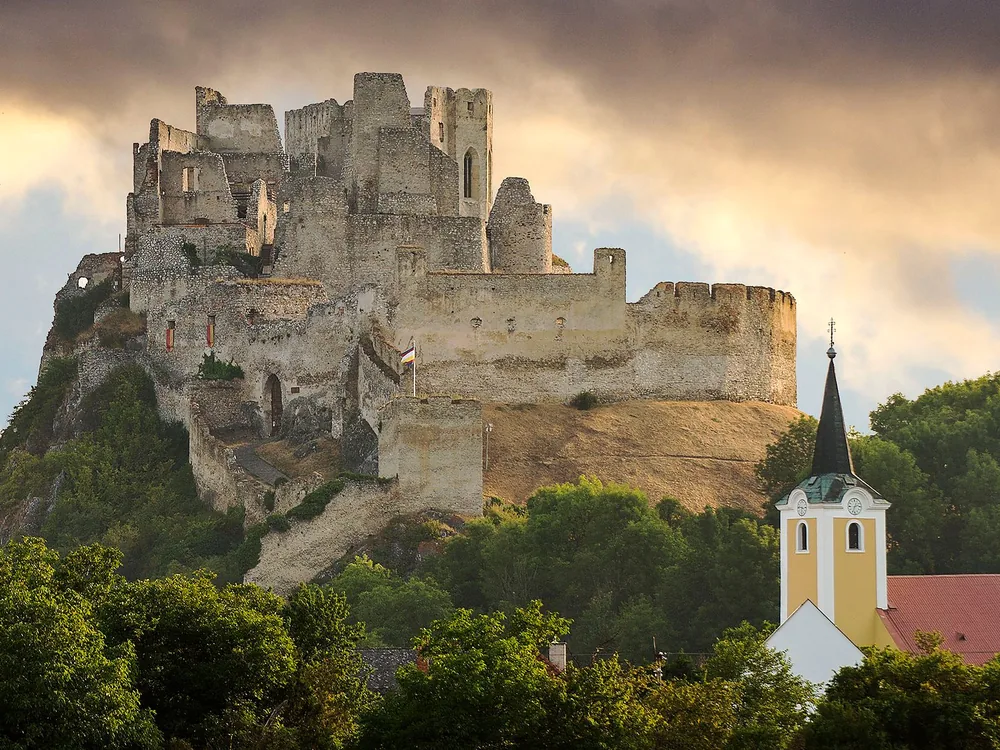
Beckov Castle is the most dramatically ruined castle in Slovakia — a clifftop stronghold perched on a 50-metre vertical volcanic rock above the Váh River valley, with the village of Beckov clustered at its base, and the roofless shell of the fortified palace still standing above the outer walls. It was founded in the 12th century as a royal frontier castle controlling the Váh valley trade route and, more importantly, the mountain passes northwest into Moravia — the same strategic corridor that would become the primary invasion route for enemies of the Kingdom of Hungary for three centuries. By the 14th century it passed to the Stibor family (the most powerful noble family in 15th-century Hungary), who transformed it from a garrison into a noble residence-fortress of the first order, with a palace block, chapel, and a household large enough to rival the royal court. It burned in 1729 and was never rebuilt. The ruin today is skeletal, dramatic, and entirely unlike the neat château-castle of Smolenice or the trading-fortress of Červený Kameň.
This 12-hour private day tour (provider: DRL business, from Bratislava or Vienna pickup, English and Slovak bilingual guide, maximum 7 guests) is the site's only tour with Beckov Castle as a primary stop — and the differentiation is deliberate. The site already has the Bratislava, Smolenice & Červený Kameň Folk Culture Tour, which shares four stops with this tour. The two tours are different in character: the folk tour goes deeper into Smolenice Castle's château interior, Čičmany's painted architecture, and the Rajecká Lesná Slovak Bethlehem; this tour replaces Smolenice with the dramatic Beckov ruins and adds Bratislava Castle as its climax, making it the better choice for visitors who prioritise castle architecture over folk culture and who want to end the day with a proper visit to Bratislava Castle itself.
Seasonal note: in the off-season (November–April), GetYourGuide's own listing states that the Beckov Castle section is replaced by Smolenice Castle — which would reduce the differentiation with the existing folk tour. If booking between November and April, confirm the current itinerary with the provider before departure, as the Beckov substitution directly affects the tour's key selling point.
The day begins with pickup, visits Červený Kameň Castle first (a 16th-century fortified trading depot, one of the best-preserved Renaissance military-commercial complexes in Central Europe), moves to Beckov (or Smolenice, off-season), continues to Trenčín (city walk with views of Trenčín Castle on its dolomite cliff above the city), Čičmany village (one of Europe's most distinctive folk-architecture villages, log houses decorated with traditional geometric white patterns), optionally Rajecká Lesná's Slovak Bethlehem (the largest mechanical wooden nativity scene in Central Europe, worth 30 minutes), and ends at Bratislava Castle for the day's architectural finale before drop-off.
Highlights
- ✓Beckov Castle — the definitive reason to choose this tour over the existing folk-culture Slovakia day trip: a 12th-century royal frontier castle on a 50-metre volcanic cliff above the Váh River valley, ruined by fire in 1729 and left as one of the most dramatic castle ruins in Central Europe; the Stibor noble family's palace block still stands within the outer walls; not on any other Slovakia tour page on this site; NOT AVAILABLE in off-season (November–April), when the itinerary substitutes Smolenice Castle
- ✓Bratislava Castle — the tour's finale: the city's dominant medieval castle (9th-century origins, rebuilt as a Renaissance royal seat in the 16th century, royal coronation town until 1830, burned 1811, reconstructed 1950s–2010s), with its distinctive four-towered rectangular plan and 360-degree views across the Danube to Austria and Hungary; not covered by the existing folk-culture tour, which ends at a city viewpoint rather than the castle itself
- ✓Červený Kameň Castle — the Fugger banking family's Central European fortified depot, built in the 1530s as a warehouse for trade goods and a private military stronghold; one of the best-preserved Renaissance castle complexes in Slovakia, with a working wine cellar and a museum of period furnishings and weapons; appears in both the folk-culture tour and this tour, covered in guided depth here
- ✓Čičmany village — a UNESCO Intangible Heritage candidate village of log houses decorated with white geometric folk patterns (spirals, diamonds, crosses) that have been applied to every building exterior for centuries; first documented in the 13th century, rebuilt in a unified style after a 1921 fire; the most immediately recognisable example of Carpathian folk architecture in Slovakia
- ✓Trenčín city walk — a stop at the historic centre of Trenčín, with views of Trenčín Castle (11th-century stronghold above the city, the largest castle complex in Slovakia by area, home to a famous 2nd-century Roman military inscription) and a walk through the medieval town square; Trenčín Castle is visible from the city but not entered on this tour
- ✓Small group private format, max 7 guests, pickup from Bratislava or Vienna — a genuinely intimate day with an English/Slovak bilingual guide and no large-group coach format
Ready to book this tour?
Free cancellation · Instant confirmation
Itinerary
The day begins with pickup from the Bratislava or Vienna meeting point and a drive southwest into the Little Carpathians wine country. Červený Kameň (Red Stone Castle) was built in the 1530s by the Fugger banking dynasty — the Augsburg family whose credit operations financed the Habsburg empire and whose commercial reach extended from Lisbon to Kraków — as a fortified storage depot for luxury trade goods passing through Central Europe. The castle's commercial origins give it a different character from the defensive frontier castles that dominate Slovak heritage: it was designed for maximum internal storage volume (the ground-floor vaulted storerooms are enormous) with a secondary requirement for military resilience. The Pálffy family, who acquired the castle in the 1590s, added a residential palace wing and maintained the castle as a noble residence until the 20th century. The guided tour covers the palace interiors, the weapons and furnishings collection, and the castle's wine cellar (the Little Carpathians region is the country's principal wine-producing area). The external circuit gives views of the Italian-influenced Renaissance bastion system.
Beckov Castle is the tour's unique element — and the most visually arresting castle ruin in Slovakia. The volcanic rock on which it stands rises almost vertically 50 metres above the Váh River valley; the village of Beckov sits at its foot, and the castle's outer walls and the surviving palace block of the Stibor family climb the rock face from the village level to the summit. The castle's strategic importance was the Váh valley road and the Moravian passes — it controlled the primary corridor between Hungary proper and Moravia, the same route armies used for centuries. The Stibor of Stiboricz (Stibor ze Stiboříc), the most powerful noble in 15th-century Hungary, made Beckov his primary residence and invested in the palace and chapel that give the upper castle its residential character. The castle burned in 1729 when a fire started by soldiers was not controlled; the noble family relocated, and the ruin has remained uninhabited since. **In the off-season (November–April), GetYourGuide substitutes Smolenice Castle** for this stop — a 19th-century neo-Gothic château in the Little Carpathians that is beautiful but lacks Beckov's drama and historical depth; confirm the current itinerary with the provider before booking in winter.
The tour moves north along the Váh to Trenčín — a city with a 2,000-year urban history, from the Roman military camp (a 2nd-century inscription carved into the castle rock records a Roman victory in 179 AD, one of the northernmost Roman inscriptions in Central Europe) through medieval Hungarian royal administration to a 19th-century textile and industrial hub. Trenčín Castle, which sits on a dolomite cliff directly above the city's main square, is one of the largest castle complexes in Slovakia but is not entered on this tour — the guide covers the city's history during a walk through the medieval centre and the square below the castle, with views up to the clifftop fortifications. Trenčín was a royal town and administrative centre of the Trenčín County from the 13th century and preserves a well-maintained historic centre with Baroque churches and the city tower (Mestská veža) opening directly onto the main square.
From Trenčín, the tour turns into the Rajčanka valley for Čičmany — a village of log houses decorated with white geometric folk patterns that have made it the most recognisable example of Carpathian folk architecture in Slovakia. The patterns (spirals, crosses, suns, diamond grids) are painted in white on dark log walls; every building carries them, giving the village an almost surreal visual coherence. The village is first documented in the 13th century; after it burned in 1921, it was rebuilt in a unified traditional style rather than modernised, preserving (and in some cases formalising) the decorative tradition. The geometric patterns are related to but distinct from folk embroidery patterns used in the same region, and their exact origin and symbolic meaning is debated — the guide covers the village's history and the different interpretations. Rajecká Lesná, 10km further along the valley, houses the Slovak Bethlehem — the largest mechanical wooden nativity scene in Central Europe, carved over 40 years by a single craftsman. This stop is optional (approximately 30 minutes) and may be adjusted based on the day's schedule.
The day ends at Bratislava Castle — the tour's architectural finale and the one element that fully distinguishes this tour from the folk-culture Slovakia day trip (which ends at a Bratislava viewpoint rather than the castle itself). Bratislava Castle (Bratislavský hrad) is the dominant medieval structure above the Slovak capital, a 9th-century Great Moravia fortification that became the royal castle of the Hungarian Kingdom from the 16th century when the Ottomans captured Buda in 1541 and forced the relocation of the royal court to Bratislava (then called Pozsony). The city served as the capital of the Kingdom of Hungary for nearly three centuries (1536–1830); Hungarian kings were crowned in St. Martin's Cathedral at the castle's foot throughout that period; the castle housed the Crown of St. Stephen and the Hungarian royal archives. The castle burned in 1811 following an accidental fire started by Austrian soldiers and stood as a ruin for 140 years. Reconstruction began in the 1950s and continued through the 2010s, restoring the castle's distinctive 18th-century plan — a rectangular block with a circular tower at each corner, nicknamed the 'upturned table' by locals — and creating the Slovak National Museum's collections inside. The terraces give 360-degree views across the Danube to Austria and Hungary. Drop-off in Bratislava follows.
What's Included
- ✓Private vehicle with English/Slovak bilingual guide (DRL business)
- ✓Pickup from Bratislava or Vienna
- ✓Červený Kameň Castle guided tour
- ✓Beckov Castle visit (or Smolenice Castle substitute in off-season, November–April)
- ✓Trenčín city walk with castle views
- ✓Čičmany village
- ✓Rajecká Lesná Slovak Bethlehem (optional)
- ✓Bratislava Castle
- ✓Small group max 7
Not Included
- ✗Lunch (the day includes natural breaks for independent restaurant stops)
- ✗Personal expenses
- ✗Tips
Insider Tips
⚠️ Seasonal itinerary change: if booking November–April, confirm with the provider whether the Beckov Castle stop is active or replaced by Smolenice Castle — the substitution significantly changes the tour's character and reduces its differentiation from the existing folk-culture Slovakia tour
Trenčín Castle is visible from the city walk below but not entered — if you want a full guided visit to Trenčín Castle itself, it is accessible independently; the castle's Roman inscription (the northernmost Roman inscription in Central Europe, carved in 179 AD) is readable from below with good eyesight or binoculars
The tour's Bratislava Castle finale offers the best views of the city at late-afternoon light — the southwest-facing terraces look toward the Danube and Austria as the sun descends; worth lingering if the schedule allows
If you want to go deeper into Smolenice Castle's château interior and Čičmany's folk culture with more time at each stop, see the Bratislava, Smolenice & Červený Kameň Folk Culture Tour — the complementary tour that prioritises folk heritage and château interiors over Beckov's dramatic ruins and the Bratislava Castle finale
Vienna pickup is available — the tour is marketed to visitors staying in Vienna who want a full-day Slovakia castle experience without relocating; the drive from Vienna to Červený Kameň is approximately 1 hour
Frequently Asked Questions
How is this different from the Smolenice/Červený Kameň folk tour on this site?
The site's existing Bratislava, Smolenice & Červený Kameň Folk Culture Tour shares four of this tour's main stops: Červený Kameň Castle, Trenčín, Čičmany village, and Rajecká Lesná's Slovak Bethlehem. The differences are in the two unique stops of each tour. The folk tour visits Smolenice Castle (a neo-Gothic château with a guided interior, not available on this tour) and gives deeper time at Čičmany and Rajecká Lesná for folk-culture content. This tour visits Beckov Castle (the dramatic cliff-top ruin, not on the folk tour) and ends at Bratislava Castle (the medieval royal residence, not visited on the folk tour). Choose the folk tour for Smolenice's château interior and deeper folk-heritage coverage; choose this tour for Beckov's ruins and the Bratislava Castle finale. Note: in the off-season (November–April), this tour substitutes Smolenice for Beckov, making the two tours nearly identical — confirm the itinerary before booking in winter.
Is Beckov Castle accessible inside or viewed from outside?
Beckov Castle is open for entry and the interior ruins are accessible. The site includes the outer ward, the surviving walls and palace block ruins of the Stibor period, and the views from the summit rock. There is no museum inside and no guided installation — it is an atmospheric ruin with a gravel path and open access to the surviving structures. The approach from the village involves a short steep climb (10–15 minutes from the village level to the main gate); the guide accompanies visitors throughout.
What is the best time of year for this tour?
Late spring and early autumn (May–June, September–October) are the best months — the castle ruins are most dramatic in clear weather with some foliage, the Váh valley is at its greenest, and the heat is manageable. Summer (July–August) is pleasant but can be hot at the exposed Beckov summit. Winter (November–April) brings the itinerary change — Beckov is replaced by Smolenice — so if Beckov Castle is your reason for choosing this tour over the folk-culture alternative, avoid November–April bookings.
More Tours from Bratislava
Powered by GetYourGuide
From
€203
per person
Free cancellation available on most dates · Secure booking
Meeting point
Pickup from Bratislava or Vienna — confirm exact meeting point with DRL business at booking.
From
€203/ person