
Departing from Bellinzona
Bellinzona: Castelgrande, Montebello & Sasso Corbaro Three-Castle Pass
Three UNESCO World Heritage castles on a single self-guided pass — the complete circuit of Bellinzona's fortified medieval hilltops, from the ancient Castelgrande to the mountain-top Sasso Corbaro
From
€35/ person
Rating
★ 5(3)
Duration
Self-guided, full day
Rating
5 ★ (3 reviews)
Languages
English, Italian, German, French
About This Tour
Bellinzona is one of the best-preserved medieval fortified cities in the Alps — a place where three hilltop castles, connected by a circuit of walls that once crossed the entire valley floor, form a unified defensive system that UNESCO inscribed as a World Heritage Site in 2000. The three castles — Castelgrande in the city centre, Montebello on the hill above it, and Sasso Corbaro on the highest and most isolated spur — were never individual noble residences in the conventional sense. They were components of a single strategic installation: the military control point of the most important crossing of the central Alps, the route that connected the Po plain (and Venice, and Milan) with the transalpine passes leading north to Germany and the Low Countries.
The Fortezza Pass — the official self-guided combo ticket issued by the Fortezza di Bellinzona authority — covers all three castles, all three indoor museums and permanent exhibitions, and all outdoor spaces including the fortified walls (the 'Murata') connecting the castle complex. It is valid on a single calendar day from March 28 to November 8, 2026 (10:00–18:00). The rating comes from the official site operator, based on a small review base so far; the individual castle sites themselves have been visited and reviewed by far more visitors over many years. The recommended visiting order is Sasso Corbaro first (highest and most remote — take a taxi or walk up; 30–40 minutes on foot), then Montebello (mid-hill, descend by foot or path), then Castelgrande last (city level, easy access via rock-cut elevator from the old town).
This is the site's first entry for Bellinzona and for the canton of Ticino, and each of the three castles is a substantial site in its own right. This tour page covers all three within the combo-pass format. For other Swiss castle tours on the site, see the Geneva–Chillon–Montreux tour, the Zurich–Rhine Falls–Stein am Rhein–Munot tour, and the Interlaken–Lake Thun Castles tour — all different regions of Switzerland, no content overlap.
Highlights
- ✓Three UNESCO World Heritage castles on one pass — Castelgrande, Montebello, and Sasso Corbaro together form the most complete surviving medieval castle-fortification system in the Alps; the Fortezza Pass covers all three castles, all three museums, and all outdoor spaces including the Murata walls
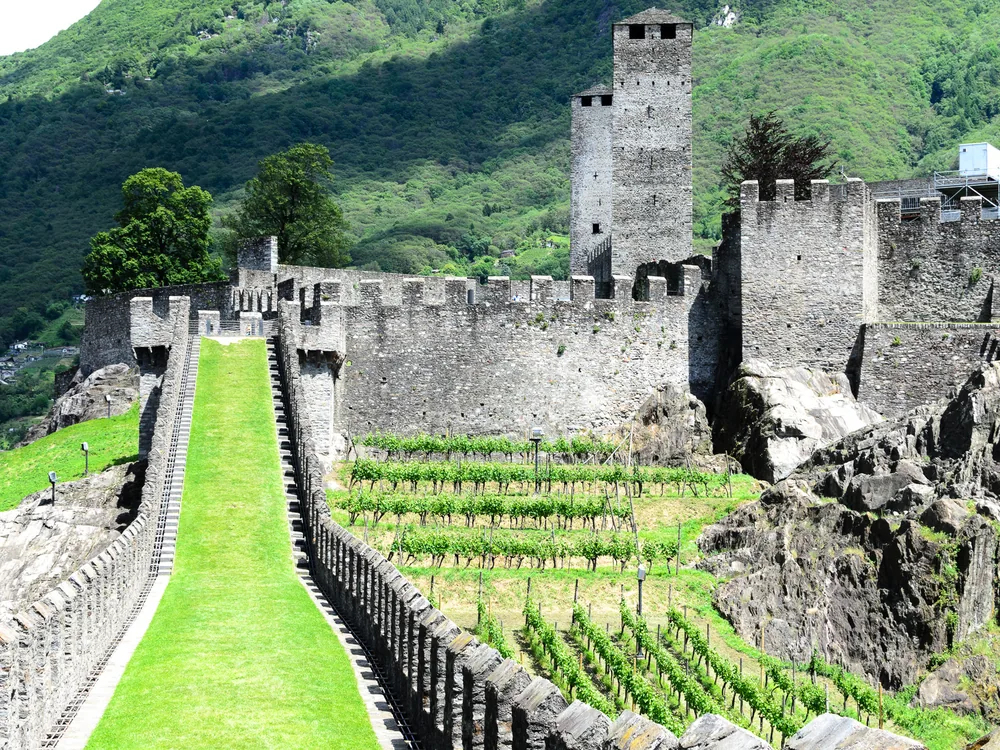
- ✓Castelgrande — the oldest and largest of the three, occupying the rocky spur that rises directly from Bellinzona's city centre; the castle's origins go back to the 6th century BC (Bronze Age) and Iron Age occupation, with Roman fortifications followed by medieval construction from the 11th century onward; the two surviving towers (the White Tower and the Black Tower) are the most photographed elements of the Bellinzona skyline
- ✓Montebello — the 'beautiful mountain' castle, built in the 13th–15th centuries on the hill between Castelgrande and Sasso Corbaro; a more compact, residential-scale castle with a well-preserved residential palace block, cylindrical towers, and the best views of Castelgrande's profile and the valley floor; the museum here covers Bellinzona's medieval history and the Visconti and Sforza period of Milanese control
- ✓Sasso Corbaro — the most dramatically isolated of the three, built in 1479 in a single six-month construction campaign by the Duke of Milan to close a gap in the city's defences revealed by the Ottoman invasion of the Friuli region; it stands on the highest spur, separated from the other two castles and accessible only by a steep path or taxi; the most intact and least touristed of the three
- ✓The Murata walls — the circuit of fortified walls that connected all three castles and extended across the valley floor, effectively turning the entire Bellinzona valley into a fortified system; sections of the Murata are walkable and included in the Fortezza Pass
- ✓First Bellinzona / Ticino / Italian-speaking Switzerland entry on this site — Bellinzona is Switzerland's most castle-rich city; each of the three castles merits its own page and is flagged as a future priority
Ready to book this tour?
Free cancellation · Instant confirmation
Itinerary
Begin at Sasso Corbaro — the highest and most remote castle, 230 metres above the valley floor and approximately 1.5km from the other two castles — for two practical reasons: the ascent is the most strenuous part of the day, and the castle is the most intact and least visited of the three, making it the most rewarding to explore without crowds. Sasso Corbaro was built in 1479 in a single construction campaign of only six months — an extraordinary speed made possible by the Milanese Duke Galeazzo Maria Sforza's strategic urgency after the Ottomans invaded Friuli that year, revealing that the northern end of Bellinzona's defensive system was unprotected. The architect Francesco di Giorgio Martini (the same Sienese engineer who designed San Leo Fortress, Urbino's fortifications, and several other key late 15th-century military installations) designed the castle; its quadrilateral plan with round corner bastions reflects his synthesis of medieval tower-castle tradition with emerging artillery-era military thinking. The museum inside covers the Milanese period of Bellinzona (1422–1499), when the Visconti and then the Sforza controlled the city and invested heavily in the castle system.
Descend from Sasso Corbaro (on foot via path or by taxi to the city, then walk up the Montebello approach) to the mid-hill castle. Montebello is the most 'complete' of the three in the sense of preserving a full residential palace block alongside its military towers — it served as a noble residence as well as a fortress, and the two functions are visible in its architecture: a cylindrical residential tower, a palace range around a courtyard, and a defensive circuit with arrow slits and battlements. The castle's name ('beautiful mountain') was not ironic — from Montebello's terraces you have the finest aerial view of Castelgrande's twin towers rising from the city below, and of the Ticino River valley stretching south toward the Lombard plain. The museum at Montebello focuses on medieval Bellinzona from the Lombard period through the Swiss Confederation's acquisition of the city in 1503 — the moment when the three castles passed from Milanese control to the Swiss Cantons and began their long post-military life.
Castelgrande is the centrepiece of the three — the oldest, largest, and most archaeologically layered. The rock spur it occupies has been fortified since at least the Bronze Age; Roman fortifications followed, then early medieval structures, and the castle as it currently stands developed primarily from the 12th century under a sequence of owners: the Bishops of Como, the Visconti of Milan (who controlled the city from 1340 to 1419), and the Swiss Confederation (from 1503 onward). The two surviving towers — the White Tower (Torre Bianca, built 1340) and the Black Tower (Torre Nera, built 1420) — stand at opposite ends of the castle's elongated plan, giving the Bellinzona skyline its defining silhouette. Access from the city is via a rock-cut elevator (the Salita al Castelgrande) that cuts through the cliff from the old town piazza — an elegant modern addition that makes the castle genuinely accessible without a strenuous climb. The museum at Castelgrande is the most comprehensive of the three, covering the site's archaeology from the Bronze Age through the Roman period and the entire medieval sequence, with artefacts excavated from the castle rock. The great hall and the terraces above the city are among the finest spaces in Swiss heritage.
What's Included
- ✓Self-guided admission to all three castles (Castelgrande, Montebello, Sasso Corbaro)
- ✓All three castle museums and permanent exhibitions
- ✓Outdoor castle spaces and fortified wall sections (Murata)
- ✓Castelgrande rock-cut elevator access
- ✓Valid March 28–November 8, 2026 (10:00–18:00)
Not Included
- ✗Transport to/from Bellinzona
- ✗Transport between Sasso Corbaro and the other two castles (taxi recommended for the ascent; approximately CHF 10–15)
- ✗Lunch and refreshments (café at Castelgrande; options in Bellinzona town)
- ✗Optional audio guide (available at site, own cost)
Insider Tips
Visit Sasso Corbaro first (highest, most remote) before crowd density builds at the more accessible Castelgrande; descend to Montebello and Castelgrande progressively through the day
The rock-cut elevator at Castelgrande (accessible from the old town piazza) is the only component of the circuit that makes the castle genuinely wheelchair-accessible — Sasso Corbaro and Montebello involve steep walking; plan accordingly
The Fortezza Pass ticket is valid for a single calendar day only — if arriving by train, Bellinzona train station is 10 minutes walk from Castelgrande; allow the full day from 10:00 to get the best from all three castles
For other Swiss castle tours in different regions, see the Geneva–Chillon tour, the Zurich–Rhine Falls–Munot Fortress tour, and the Interlaken–Lake Thun tour
Bellinzona is in the Italian-speaking canton of Ticino — the architecture, food, and street signs are Italian, but the Swiss infrastructure (trains, franc currency, ATMs) is fully present; it is an unusual and rewarding cultural hybrid
Frequently Asked Questions
Why were three separate castles needed in one city?
Bellinzona's three castles were not competing noble seats but components of a single unified defensive system for the control of the Ticino valley crossing — the most important transalpine route in the central Alps. Castelgrande controlled the rock spur directly above the road through the valley. Montebello controlled the hill above Castelgrande, preventing attackers from gaining higher ground. Sasso Corbaro was added in 1479 to cover a gap at the northern end of the system, revealed as a vulnerability when Ottoman forces invaded the neighbouring Friuli region. The Murata walls connecting all three closed the valley floor between the hills. Together they formed a single installation; separated, any one castle could be flanked.
When did Switzerland take control of Bellinzona and the castles?
The Swiss Confederation captured Bellinzona from the Duchy of Milan in 1500 during a period of Italian Wars, and formal Swiss control was established by 1503. The city was subsequently governed jointly by the three forest cantons of Uri, Schwyz, and Nidwalden as a 'common lordship' (Gemeine Herrschaft). When the Helvetic Republic was established during the French Revolutionary period (1798), Ticino became a canton in its own right. The castles served as administrative centres under Swiss rule but never again as active military fortifications; by the 19th century they were recognised as historic monuments.
Is this the site's first Bellinzona or Ticino page?
Yes — this tour page is the site's first entry for Bellinzona, the canton of Ticino, and Italian-speaking Switzerland. Each of the three castles — Castelgrande, Montebello, and Sasso Corbaro — is a substantial site in its own right and does not yet have an individual castle page on this site. The UNESCO World Heritage status, the archaeological depth at Castelgrande (Bronze Age through medieval), and the completeness of the defensive system together make Bellinzona one of the most under-represented castle destinations on any international heritage tourism site.
More Tours from Bellinzona
Powered by GetYourGuide
From
€35
per person
Free cancellation available on most dates · Secure booking
Meeting point
Self-guided — activate the GetYourGuide ticket at any of the three castle entrances (Castelgrande, Montebello, or Sasso Corbaro). GetYourGuide confirms ticket details at booking.
From
€35/ person