
Departing from Istanbul
Istanbul: Byzantine Walls, Yedikule & the Fener-Balat Quarters
A private door-to-door journey through Byzantine Istanbul — the Theodosian Walls, Yedikule, and the historic Greek Orthodox and Jewish quarters of Fener and Balat along the Golden Horn
From
€193/ person
Rating
★ 4.5(13)
Duration
6 hours
Rating
4.5 ★ (13 reviews)
Languages
English
Group size
Max 8 people
About This Tour
Fener and Balat are the two neighborhoods that together contain more layers of Byzantine, Ottoman, and multi-faith Istanbul than almost anywhere else in the city — and they almost never appear on a standard Istanbul itinerary. Fener (Phanar in Greek) is the historic quarter of Istanbul's Greek Orthodox community, home to the Ecumenical Patriarchate of Constantinople — the global spiritual center of Eastern Orthodox Christianity — since 1601. Balat, immediately south of Fener along the Golden Horn, is the historic Jewish quarter, settled by Sephardic Jews expelled from Spain in 1492 under Ferdinand and Isabella's edict and invited by the Ottoman Sultan Bayezid II, who reportedly said that Ferdinand had impoverished Spain by expelling its most productive subjects. The streets of both neighborhoods run steep and narrow down to the Golden Horn waterfront, lined with 19th-century wooden konak houses in various states of photogenic decay and restoration.
This 6-hour private tour with hotel pickup and drop-off (provider: layover in Istanbul) pairs the Walls of Constantinople, the Palace of the Porphyrogenitus (Blachernae), and Yedikule Fortress with a neighbourhood walk through Fener and Balat — combining the military and political architecture of Byzantine Constantinople with the living cultural geography of the communities that have persisted in these neighbourhoods since the Byzantine era through the Ottoman centuries and into the present. The private format (up to 8 guests, hotel pickup/drop-off, lunch included) is the defining difference from the site's existing Theodosian Walls tour: this is a longer, immersive private day rather than a focused half-day group walk.
For visitors who want deep specialist coverage of the Walls' military history — the 23 failed sieges, the 1453 breach, the function of the moat and tower system, the Golden Gate in detail — the site's focused Istanbul: Theodosian Walls, Yedikule Fortress & the Golden Gate tour (4 hours) is the dedicated specialist option. This tour covers the same walls and Yedikule but treats them as the entrance to a wider neighbourhood exploration — a complementary approach rather than a competing one.
Highlights
- ✓Private door-to-door format with hotel pickup and drop-off — the private vehicle and personalised pace distinguish this from the existing group walking tour; lunch is included
- ✓Fener (Phanar) — the historic Greek Orthodox quarter, home to the Ecumenical Patriarchate of Constantinople since 1601; the Patriarchate is the spiritual center of Eastern Orthodox Christianity and has maintained an unbroken presence in Istanbul since the Byzantine period through all subsequent changes of political authority
- ✓Balat — the Sephardic Jewish quarter settled since 1492 when Sultan Bayezid II invited the Jews expelled from Spain by Ferdinand and Isabella; the neighbourhood retains synagogues, 19th-century wooden houses, and a streetscape that carries the layered identity of five centuries of Sephardic Istanbul life
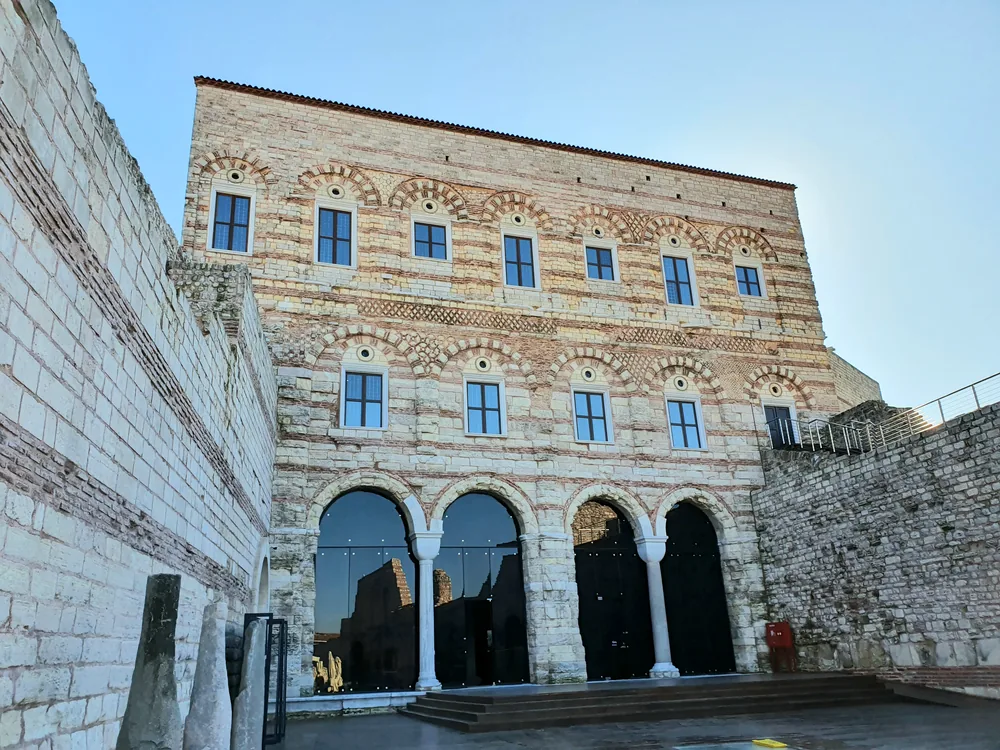
- ✓Palace of the Porphyrogenitus (Tekfur Sarayı) — one of the only standing secular Byzantine palace structures surviving above ground in Istanbul, built in the late 13th to early 14th century and named for the Byzantine practice of designating heirs 'born in the purple' (porphyrogennetos); the ornate brick-and-stone facade is one of the most photographed Byzantine survivals in the city
- ✓Yedikule Fortress — the Seven Towers fortress built by Mehmed II in 1457 into the Byzantine Golden Gate complex; the Golden Gate was the triumphal arch through which Byzantine emperors processed for a thousand years; Mehmed sealed it in 1453 and the fortress became a treasury and state prison
- ✓Walls of Constantinople — the Theodosian triple defensive system (412 AD) that held the city for 1,041 years; visited as context for the neighbourhood exploration rather than as the tour's sole focus
Ready to book this tour?
Free cancellation · Instant confirmation
Itinerary
The day begins with a hotel pickup in the private vehicle and a drive to the Walls of Constantinople — the Theodosian triple defensive system built between 408 and 413 AD and extended to the Golden Horn sea walls in the 5th and 6th centuries. The guide covers the system's structure (inner wall 12m high, outer wall, terrace, and 20m moat) and the key episodes of its history — the 23 failed sieges, the Crusader Fourth Crusade that chose to attack by sea rather than face the land walls, the 1453 breach in the Lycus valley depression where Sultan Mehmed II's Hungarian-made cannon finally created the opening that ended the Byzantine Empire. From the wall section, the tour moves north along the walls to Blachernae, where the Theodosian land walls meet the Golden Horn sea walls: the complex includes the ruins of the Blachernae Palace (the Byzantine imperial residence from the 11th century) and the Anemas Prison tower, where Byzantine emperors were sometimes held by their own families during court coups. The Blachernae section is less visited than the central wall stretches and gives a quieter, more atmospheric encounter with the surviving fabric.
The Palace of the Porphyrogenitus — known in Turkish as Tekfur Sarayı, 'the emperor's palace' — is one of the most remarkable survivals of Byzantine secular architecture in Istanbul. Built in the late 13th to early 14th century as part of the Blachernae palace complex, it stands three stories high with an elaborate decorative facade of alternating red brick and limestone in geometric patterns — an architectural signature of the late Byzantine Palaeologos dynasty. The name 'Porphyrogenitos' (born in the purple) refers to the Byzantine imperial practice of designating legitimate heirs as those born in a special purple-walled room of the imperial palace; the designation was both a literal (the room's walls were faced with porphyry stone) and symbolic statement of dynastic legitimacy. After 1453, the building was used successively as a menagerie, a pottery workshop, and a poorhouse before falling into disuse. A restoration and museum installation completed in the 2010s has stabilised the structure and created an interpretive presentation of Blachernae palace history.
Yedikule — the 'Fortress of Seven Towers' — was built by Mehmed II between 1457 and 1458, four years after the conquest of Constantinople, by incorporating the Byzantine Golden Gate into a new fortress complex. The Golden Gate was a Roman triumphal arch built by Emperor Theodosius I in 388 AD; it became the ceremonial main entrance to Constantinople through which Byzantine emperors processed after military victories for over a thousand years. Mehmed sealed the gate in 1453 and enclosed the existing two Byzantine flanking towers with three additional towers of his own construction, creating a seven-towered fortress that served as treasury, prison, and administrative stronghold. The fortress prison held foreign ambassadors who arrived to negotiate ransom, deposed sultans, and political prisoners of various eras; inscriptions and graffiti carved by prisoners survive on some tower walls. The tour enters the fortress — entry is included — and the guide covers both the Byzantine Golden Gate's ceremonial history and the Ottoman fortress's subsequent role.
From Yedikule, the private vehicle takes the group north along the Golden Horn to Fener (Phanar in Greek), the historic quarter of Istanbul's Greek Orthodox community. The Ecumenical Patriarchate of Constantinople has been based in Fener since 1601, when the Greek Orthodox community was granted the Church of St George by Ottoman authorities. The Patriarchate is the 'first among equals' in global Eastern Orthodox Christianity — not a pope-equivalent with universal jurisdiction, but the historical see of the Archbishop of Constantinople and a globally significant spiritual institution. Its continuation in Istanbul across five centuries of Ottoman and then Turkish Republican authority is a story of extraordinary institutional persistence under consistently difficult political conditions. The neighbourhood itself preserves the texture of late Ottoman and early Republican Istanbul: steep cobbled streets, 19th-century wooden konak houses (many now under restoration), the Greek Orthodox schools and churches that served the community at its historic peak of population, and the waterfront below the Fener hill where fishermen have been docking since the Byzantine era.
Balat, immediately south of Fener along the Golden Horn, is the historic Jewish quarter of Istanbul. Its Sephardic identity dates to 1492, when Sultan Bayezid II invited the Jews expelled from Spain by Ferdinand and Isabella's Alhambra Decree. The Sultan's invitation was both humanitarian and economically calculated — the expelled Spanish Jews brought professional skills, capital, and commercial networks that had made them indispensable in Spain; Bayezid reportedly said that Ferdinand of Aragon had impoverished his own kingdom by expelling its most capable inhabitants. The Sephardic community that settled in Balat and other Istanbul neighbourhoods established a rich culture whose primary language remained Ladino (Judeo-Spanish, a form of 15th-century Castilian) well into the 20th century; Ladino newspapers were published in Istanbul until 1971. The neighbourhood today contains synagogues (including the Ahrida Synagogue, one of the oldest in Istanbul, dating to the pre-1492 community), 19th-century wooden houses, and a street life that has been reinvigorated in recent years by café and restaurant openings that have made Balat one of Istanbul's most sought-after neighbourhoods.
What's Included
- ✓Private vehicle with hotel pickup and drop-off
- ✓Live English-speaking guide
- ✓Yedikule Fortress entry
- ✓Lunch
- ✓Private group (max 8)
Not Included
- ✗Personal expenses and optional purchases in Fener/Balat
- ✗Tips for guide and driver
Insider Tips
Wear comfortable shoes for the entire 6-hour circuit — the Blachernae and Fener/Balat sections involve steep, uneven streets; the Theodosian Walls involve rough terrain
Fener and Balat are both in active neighbourhood regeneration — some streets are beautifully restored, others are working-class residential areas; the mix is part of the authenticity
The Ahrida Synagogue in Balat is one of Istanbul's oldest but has irregular opening hours for non-religious visitors; confirm at the Patriarchate's recommended contact or with the tour guide in advance if visiting the interior is important to you
The Golden Horn waterfront between Fener and the Atatürk Bridge has some of Istanbul's best fish restaurants — if the tour's lunch timing allows, the waterfront is the natural choice
Visitors who want deeper specialist coverage of the Theodosian Walls' military history should consider pairing this private tour with the dedicated Theodosian Walls, Yedikule & the Golden Gate walking tour on a separate day
Frequently Asked Questions
How is this different from the Theodosian Walls walking tour on this site?
The site's existing Istanbul: Theodosian Walls, Yedikule Fortress & the Golden Gate tour (4 hours) is a focused specialist walk dedicated to the walls' military history — the 23 failed sieges, the 1453 breach, the triple defensive system in detail, the Golden Gate's ceremonial function. It is a group walking tour that meets at Yedikule; no pickup or lunch. This 6-hour private tour covers the same walls, Blachernae, and Yedikule as one component of a broader day, then moves into Fener and Balat — two historic neighbourhoods the walking tour does not visit at all. Choose the walking tour if the walls' military-architectural history is your primary interest; choose this private tour if you want the combination of Byzantine military heritage with the living cultural landscape of the Golden Horn's historic communities, in a private format with hotel pickup and lunch.
What is the Ecumenical Patriarchate and why is it still in Istanbul?
The Ecumenical Patriarchate of Constantinople is the oldest Christian institution still operating continuously from its original city — established in Constantinople in the 4th century, it has maintained an unbroken presence in Istanbul (through Ottoman and then Turkish Republican governance) since. The Patriarch of Constantinople holds the title 'first among equals' in Eastern Orthodox Christianity, a position of historic precedence rather than universal jurisdiction. The Patriarchate has remained in Fener despite the near-total emigration of Istanbul's Greek Orthodox population (reduced from approximately 100,000 in 1950 to fewer than 2,000 today, following the 1955 Istanbul Pogroms and subsequent emigration pressure). Its continuation is the result of deliberate institutional commitment rather than demographic survival.
Can I visit the Ecumenical Patriarchate on this tour?
The Patriarchate's Church of St George in Fener is generally open to visitors on weekdays during office hours; the guide will advise on current access. Interior visits are possible and respectful dress (covered shoulders and knees) is required. The Patriarchate compound also houses the Patriarchal offices, which are not open to general visitors. The tour covers the Fener neighbourhood and the exterior of the Patriarchate; any interior visit is at the guide's discretion based on the day's schedule.
More Tours from Istanbul
Powered by GetYourGuide
From
€193
per person
Free cancellation available on most dates · Secure booking
Meeting point
Hotel pickup — the guide collects guests from their accommodation; confirm hotel address at booking.
From
€193/ person