
Departing from Istanbul
Istanbul: Topkapi Palace & Dolmabahçe Palace Combo Ticket
From the fortress on the Byzantine promontory to the Bosphorus waterfront — Ottoman imperial history across four centuries, two palaces, one day
From
€125/ person
Rating
★ 4.8(19)
Duration
Full day (self-paced, 5–7 hours total)
Rating
4.8 ★ (19 reviews)
Languages
English
About This Tour
The Ottoman Empire lasted over six centuries, and Istanbul contains the physical record of almost all of it. At one end of that record stands Topkapi Palace — a fortified palace complex built on the Byzantine city's highest promontory in 1459, six years after Mehmed II's conquest of Constantinople, from which the empire was governed for 400 years. At the other end stands Dolmabahçe Palace — a Neo-Baroque waterfront palace built in 1843 on the European shore of the Bosphorus, where the Ottoman sultans spent their last decades attempting to Westernise an empire that was visibly failing. Together, the two palaces bracket the full arc of Ottoman imperial rule: the confident fortress-palace of conquest and expansion, and the glittering but hollowed-out palace of reform and decline.
This GetYourGuide combo ticket provides skip-the-line access to both palaces on a single self-paced day — the most direct way to see both without standing in the long summer queues at each gate separately. An optional audio guide can be added at booking to supplement the visit at both sites.
The two palaces are approximately 4km apart on the European shore of Istanbul: Topkapi sits in the Sultanahmet district at the tip of the historic peninsula, while Dolmabahçe is in Beşiktaş, accessible by taxi, tram, or the Bosphorus ferry from Eminönü. The suggested sequence is Topkapi first (the queues are worst in late morning) and Dolmabahçe in the afternoon (the palace's ceremonial halls are most dramatically lit after midday).
Highlights
- ✓Skip-the-line access at both palaces — single combo ticket valid across Topkapi Palace and Dolmabahçe Palace, avoiding the separate queues that regularly exceed 45 minutes at each site in summer
- ✓Topkapi Palace Treasury — the crown jewels of the Ottoman Empire: the Topkapi Dagger (emerald-encrusted, the object of the Rififi of the East 1964 film), the Spoonmaker's Diamond (49 carats, surrounded by 49 smaller diamonds), the Holy Relics of the Prophet Muhammad
- ✓Dolmabahçe's Ceremonial Hall — the largest room in any Ottoman palace, covered by a 2,000m² ceiling under which hangs a 4.5-tonne Bohemian crystal chandelier, a gift from Queen Victoria; the room hosted the sultans' formal receptions and the early sessions of the Turkish Grand National Assembly
- ✓The Crystal Staircase at Dolmabahçe — a double-winged staircase with banisters made entirely of Baccarat crystal, considered one of the finest examples of 19th-century decorative craftsmanship in Turkey
- ✓Atatürk's Room at Dolmabahçe — the bedroom where Mustafa Kemal Atatürk, the founder of the Turkish Republic, died on 10 November 1938 at 9:05am; all clocks in the palace are stopped at that time
- ✓The architectural contrast — Topkapi's organic, incrementally built pavilion complex versus Dolmabahçe's unified Neo-Baroque facade designed by Armenian architect Nikoğos Balyan; the contrast of the two buildings' approaches to power is the central argument of the double visit
Ready to book this tour?
Free cancellation · Instant confirmation
Itinerary
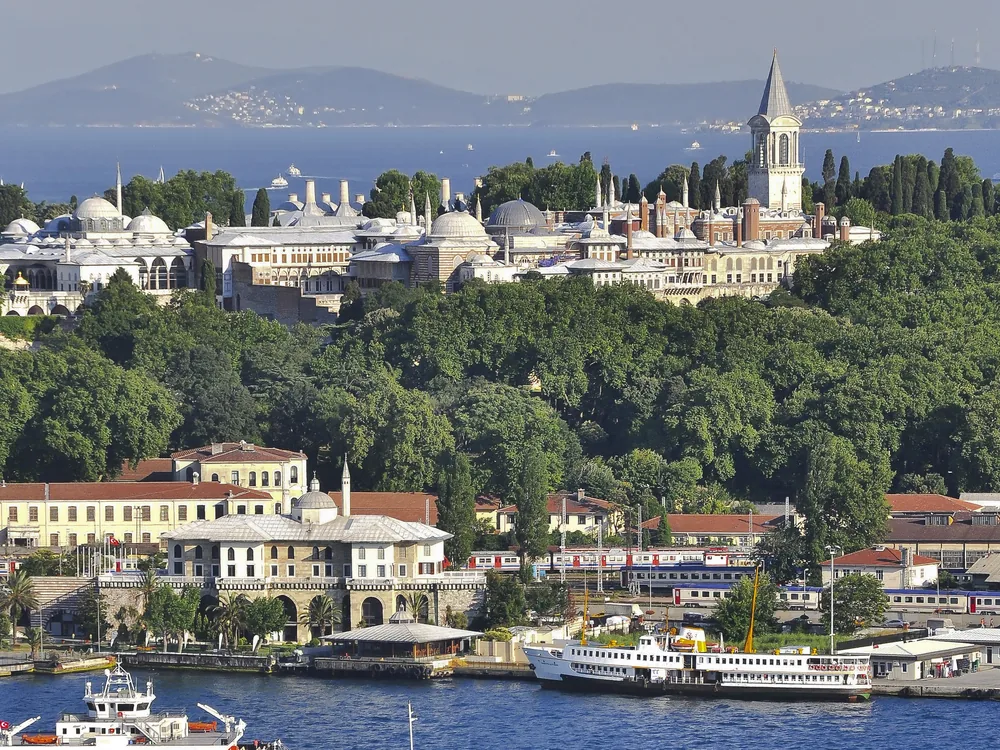
[Topkapi Palace](/castles/turkey/topkapi-palace) was built from 1459 on the promontory where the ancient city of Byzantium had placed its acropolis — the highest point on the triangular peninsula where the Golden Horn, the Sea of Marmara, and the Bosphorus all meet. Mehmed II chose the site deliberately: the palace would stand where the Byzantine emperors had stood, visible from every approach to the city by land and sea. The complex grew over 400 years as successive sultans added pavilions, courts, and gardens without demolishing what predecessors had built — the result is not a unified architectural statement but a layered accumulation that reflects the full duration of Ottoman rule. The visitor circuit passes through four courts in sequence. The First Court is public, accessible without a ticket, and leads through the Gate of Salutation into the Second Court, where the Imperial Council (Divan) met and where the palace kitchens produced the food for a household of thousands. The Third Court, entered through the Gate of Felicity (which only the sultan could cross on horseback), contains the Audience Chamber and the Treasury: four rooms with glass cases holding the empire's most valued objects. The Topkapi Dagger — three large emeralds set into the handle of a gold-and-enamel blade, originally commissioned as a gift for the Persian Shah who died before receiving it — is here. So is the Spoonmaker's Diamond, one of the world's ten largest, set in a ring of 49 smaller stones. The Fourth Court's pavilions give the best views over the Bosphorus. If you want to visit the Harem — the palace's most famous section — note that this requires a separate ticket on top of the combo entry; plan an extra hour and an additional fee of approximately €10–15. The Harem ticket can be bought at the Harem gate inside the Second Court.
From Topkapi, take the tram T1 from Sultanahmet or Gülhane to Kabataş (approximately 20 minutes), then walk 10 minutes along the waterfront to Dolmabahçe — or take a taxi (approximately 20 minutes, depending on traffic). Alternatively, a Bosphorus ferry from Eminönü pier to Beşiktaş gives a slower but more atmospheric crossing (roughly 30 minutes) with views of both the historic peninsula and the Asian shore.
[Dolmabahçe Palace](/castles/turkey/dolmabahce-palace) was completed in 1856 by Sultan Abdülmecid I on reclaimed land (Dolmabahçe means 'filled-in garden' in Ottoman Turkish — the Bosphorus cove that existed here was filled to create the building's foundations). The architect was Nikoğos Balyan of the Armenian Balyan family, the dynasty of Armenian court architects who designed most of Istanbul's 19th-century imperial commissions. The building is a frank statement of Ottoman intent to match European architectural prestige: a 600-metre Bosphorus facade in the Italian Neo-Baroque style, with 285 rooms, 44 halls, 68 toilets, and a ceremonial heart that draws no self-conscious distinction between Ottoman and European forms. The visitor route through Dolmabahçe is divided into the Selamlık (State Apartments, where the sultan received guests and conducted business) and the Harem (included in the standard visit here, unlike Topkapi). The Ceremonial Hall at the heart of the Selamlık is the building's climax: a room 44 metres high beneath a domed ceiling, hung with the largest Bohemian crystal chandelier in the world — 4.5 tonnes, a gift from Queen Victoria. The Crystal Staircase, connecting the two levels of the reception wing, uses Baccarat crystal for its banisters in a display of decorative confidence that deliberately invites comparison with Versailles. The final stop on the circuit — and the most emotionally freighted room in the palace — is the bedroom where Mustafa Kemal Atatürk died on 10 November 1938, having made Dolmabahçe his Istanbul residence after the Republic replaced the sultanate. Every clock in the palace shows 9:05am: the moment of his death. The room is preserved exactly as it was that morning.
What's Included
- ✓Skip-the-line combo entry ticket to both Topkapi Palace and Dolmabahçe Palace
- ✓Optional audio guide (available at booking — covers both sites)
- ✓Valid on the same day at both palaces
Not Included
- ✗Topkapi Harem section (requires a separate ticket, ~€10–15, purchased at the Harem gate inside Topkapi)
- ✗Transport between the two palaces (tram, ferry, or taxi — see itinerary step 2)
- ✗Food and drinks
- ✗Tips
Insider Tips
Visit Topkapi first and Dolmabahçe in the afternoon — Topkapi's queues are worst between 10:00 and 14:00 even with skip-the-line; the combo gets you past the gate queue but not internal bottlenecks at the Treasury or Harem
The Topkapi Harem requires a separate ticket (not included) — decide in advance whether you want to visit, as the queue for Harem tickets is separate and can add 30–45 minutes
Dolmabahçe has a strict dress code: shoulders covered, no shorts above the knee for men or women. The palace staff enforce this at the gate; a light layer for shoulders is enough
Photography is generally permitted throughout Dolmabahçe but not in all rooms; check the posted signs. Photography at Topkapi is permitted in the courtyards and most rooms including the Treasury
Allow at least 3–4 hours at Topkapi and 2 hours at Dolmabahçe — most visitors underestimate Topkapi's scale. Rushing either palace is a waste of the combination ticket
Frequently Asked Questions
What is the key difference between Topkapi and Dolmabahçe?
Topkapi (built from 1459) is a fortress-palace: a walled compound with pavilions, courtyards, and gardens built incrementally over 400 years, its architecture expressing Ottoman power through accumulation, enclosure, and the layering of private and public space. Dolmabahçe (completed 1856) is a European-style palace: a unified Neo-Baroque building on the Bosphorus waterfront, its 600-metre facade designed to be seen from the water, its interiors calibrated to impress European visitors and ambassadors. The comparison is one between Ottoman self-sufficiency and Ottoman self-doubt: Topkapi looks inward; Dolmabahçe looks westward. Visiting both on the same day is the most efficient way to understand the full arc of Ottoman imperial architecture and the cultural shift it reflects.
Does the combo ticket include the Topkapi Harem?
No — the Harem at Topkapi requires a separate ticket on top of the combo entry, available at the Harem gate inside the Second Court (approximately €10–15, confirm current price at the gate). The Dolmabahçe Harem IS included in the standard Dolmabahçe entry — the two palaces handle their Harems differently. If seeing the Topkapi Harem is important to you, budget an extra 45–60 minutes and the additional fee on top of the combo ticket price.
In what order should I visit the two palaces?
Topkapi first, Dolmabahçe second. Topkapi is in Sultanahmet (the historic peninsula) where you'll likely be staying or starting your day; Dolmabahçe is in Beşiktaş, 4km north along the European Bosphorus shore. Doing Topkapi in the morning (arrive as early as possible) and Dolmabahçe in the afternoon also means you hit the Ceremonial Hall's best light after midday. The journey between the two takes 30–45 minutes by tram or taxi.
More Tours from Istanbul
Powered by GetYourGuide
From
€125
per person
Free cancellation available on most dates · Secure booking
Meeting point
This is a combo ticket, not a guided tour — collect your tickets as directed in the GetYourGuide booking confirmation. The ticket is valid self-paced across both palaces on the same day.
From
€125/ person