
Himara Castle
Kalaja e Himarës
Albania · Himarë, Albanian Riviera, Albania · Near Himarë
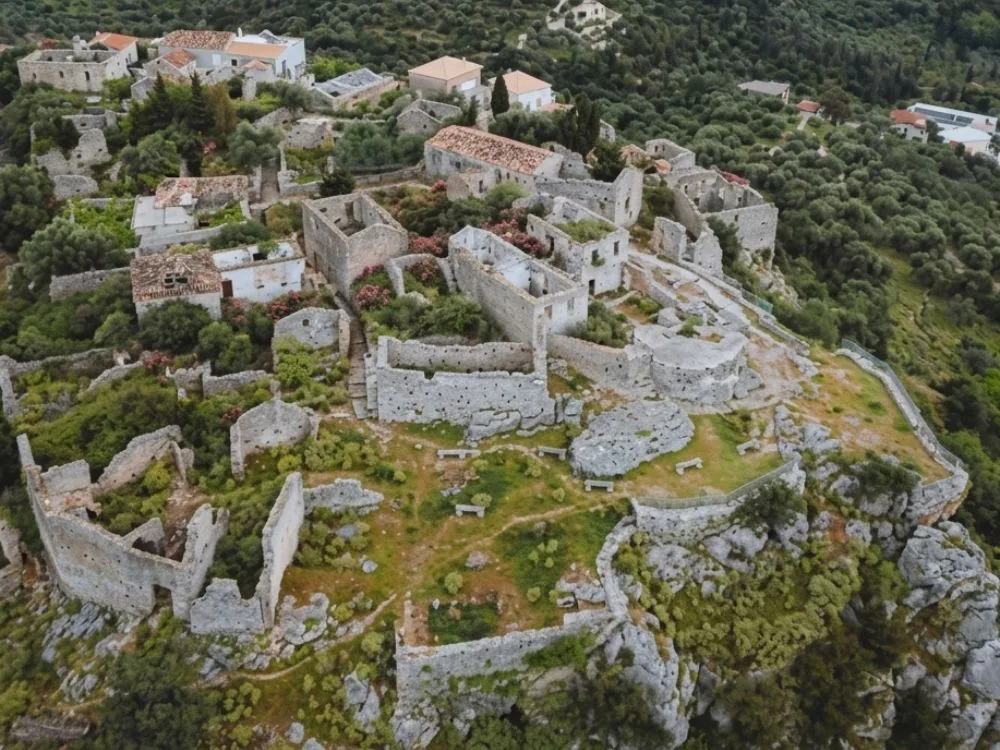
Built 600 · Multi-period hilltop castle-town on Barbaka hill above the Albanian Riviera; the site has been continuously fortified for approximately 2,600 years, with visible remains spanning the ancient Greek, Byzantine, and Ottoman periods; the circuit walls incorporate Byzantine and later Ottoman reconstruction, while the interior of the old town retains inhabited stone houses, churches, and castle structures on the hilltop promontory with 360-degree views over the Ionian Sea
This page is part of an independent travel guide and is not affiliated with, endorsed by, or operated by Himara Castle.
© Castles & Palaces
Quick Facts
- Hours
- Daily 09:00–19:00
- Guided tour from
- €20
- Duration
- 2 hours on the GetYourGuide guided tour; 1–1.5 hours self-guided
- Best time
- June to September
- Nearest city
- Himarë
Featured Tour
Let's Explore the 2600 Year Old Castle Town of Himara
Cancellation available · Instant confirmation
Highlights
- ✦2,600 years of continuous habitation — the hilltop fortification at Himarë has been occupied since approximately the 6th century BCE, making it among the oldest continuously fortified sites on the Adriatic-Ionian coast; the site was a settlement of the ancient Chaonian Greeks, later adapted under Byzantine and then Ottoman rule; the current circuit walls incorporate construction from multiple periods visible in different building techniques and stone types
- ✦The Ionian Sea panorama and views to Corfu — Himara Castle's hilltop position on Barbaka hill gives unobstructed views over the Albanian Riviera coast, the open Ionian Sea, and on clear days the mountains of Corfu clearly visible to the southwest; this is among the finest coastal viewpoints in Albania and arguably in the entire eastern Mediterranean
- ✦A living castle-town — unlike most Albanian medieval fortresses, which are essentially empty archaeological sites, Himara's old town within the castle walls has been continuously inhabited; a small community of residents has lived inside the walls for centuries, maintaining a vernacular stone-house settlement alongside the castle's visible remains, churches, and defensive structures
- ✦Reserved entry with the GetYourGuide guided tour — the GetYourGuide tour includes reserved entry tickets; the 2-hour walking tour covers the main castle structures, the viewpoints over the Riviera coast, and the old town's interior monuments
- ✦The Albanian Riviera context — Himara is the central settlement on the Albanian Riviera, the coastline between Vlorë in the north and Sarandë in the south that has become one of the Mediterranean's most-discussed emerging destinations; the castle above the modern town gives the Riviera's most dramatic elevated perspective and places the coast's long history in physical context
Skip the queue with a guided tour
Skip-the-line tickets & expert guides
Himarë sits at the southern end of the Albanian Riviera, where the mountains of the Ceraunian range drop sharply into the Ionian Sea. The modern town occupies a small coastal plain; above it, on the steep limestone Barbaka hill, stands the old castle-town — Kalaja e Himarës — whose visible remains span 2,600 years of continuous occupation.
The site was first fortified by the ancient Chaonian Greeks, one of the Epirote tribal peoples of the western Balkans, in approximately the 6th century BCE. This places Himara among the oldest documented fortified settlements on the eastern Adriatic-Ionian coast, predating the Roman conquest of Illyria, the Byzantine administration that followed, the medieval Byzantine period, and the Ottoman conquest of Albania in the 15th century — all of which left physical traces in the walls and buildings still visible on the hilltop. The circuit walls incorporate construction from at least three distinct periods, recognisable in the different stone-cutting techniques and mortar compositions as you move around the perimeter.
What distinguishes Himara from most Albanian medieval fortresses is that it has never been fully abandoned. While sites like Gjirokastra and Krujë have substantial castle structures that function as archaeological monuments with depopulated interiors, Himara's old town within the walls has been continuously inhabited; a small resident community maintains stone houses alongside the castle's churches and defensive remains. Walking through the interior is less like visiting an archaeological site than like entering a very old village that happens to be enclosed by medieval walls on a hilltop above the sea.
The views are the other thing. Himara Castle's position on Barbaka hill gives a 360-degree panorama that takes in the full arc of the Albanian Riviera coast from north to south — the beach strips below, the turquoise water of Himarë Bay, and the open Ionian Sea stretching southwest to Corfu, visible as a clear landmass on calm days. This coastal panorama, combined with the mountain backdrop of the Ceraunian range to the east, gives one of the most compositionally striking views in the entire eastern Mediterranean.
The GetYourGuide guided tour covers the castle and old town over 2 hours, with reserved entry tickets included. The 2-hour format is enough to cover the main structures, the principal viewpoints, and the key interior monuments.
History
The Himara hilltop has been occupied since approximately the 6th century BCE by the ancient Chaonian Greeks of Epirus. The site developed through the Hellenistic period and was incorporated into the Roman Province of Epirus; the lower town by the coast grew during this period while the hilltop retained its fortified character. Byzantine administration maintained and rebuilt the walls over several centuries; the Byzantine period left the most substantial surviving wall sections. Ottoman forces captured Himara in 1479, the same year as much of the Albanian coast; the hilltop remained inhabited through the Ottoman period and into the 20th century. Albania's communist period (1944–1990) placed the largely Greek-speaking Himarë community under particular pressure; the region's Greek population was subject to restrictions on language use and movement. Himara became a site of ethnic and cultural significance in the post-communist period. The castle-town has been partially restored and opened to tourism in the 21st century.
How to Visit
Getting there: Himara is on the Albanian Riviera, approximately 90 km south of Vlorë and 60 km north of Sarandë. The town is served by buses from Vlorë, Sarandë, and (indirectly) Tirana; the journey from Sarandë takes approximately 1.5 hours. The castle hilltop is reached by a steep footpath from the modern town centre — the ascent takes approximately 20–30 minutes on foot. The GetYourGuide guided tour handles the logistical details and includes reserved entry.
Tickets: Walk-up entry to the castle grounds is approximately €5 per adult (confirm locally). The GetYourGuide guided tour (2 hours) includes reserved entry tickets and covers the castle structures, viewpoints, and old-town monuments with a guide. Advance booking is recommended as the tour's small-group capacity fills quickly.
Practical tips: The ascent to the castle from the modern town takes 20–30 minutes on a steep path — comfortable shoes with grip are essential, and the path is slippery after rain. Morning visits avoid the midday heat (Albania's summer temperatures regularly reach 35–40°C on the Riviera) and give the best light for photography looking west over the sea. The views to Corfu are clearest in the early morning before heat haze builds. Allow time after the tour to walk the town walls at your own pace.
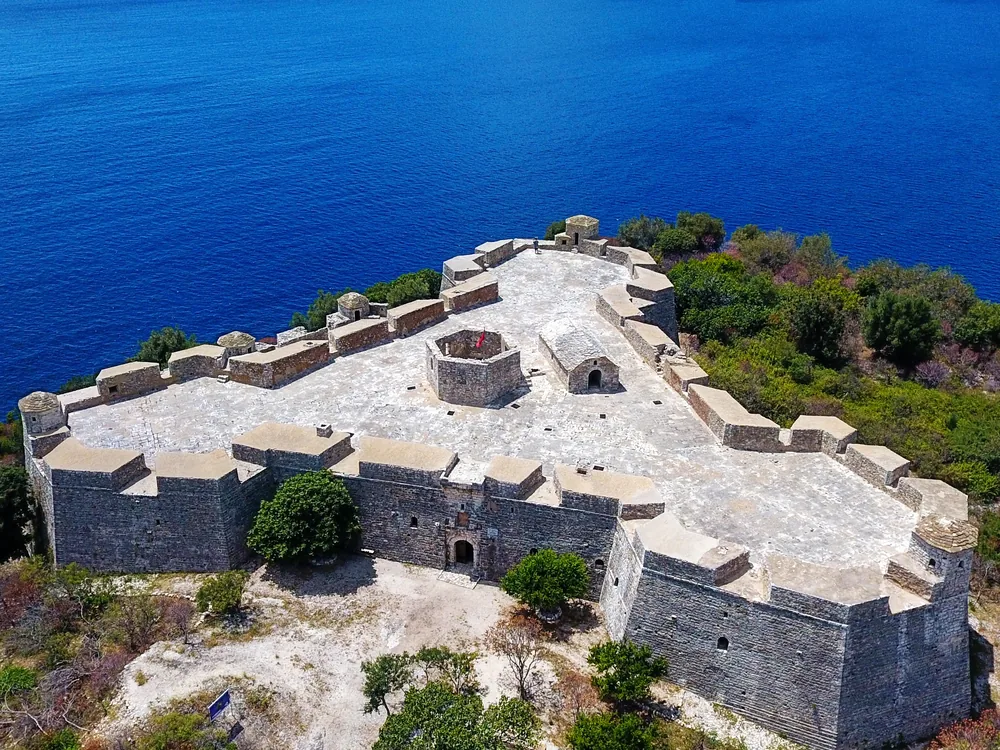
Combine with: Porto Palermo Castle (~30 km north along the Riviera coast — the Ottoman-era triangular island fortress at the entrance to Porto Palermo bay, one of Albania's most dramatically positioned military sites, accessible by water taxi or a short drive; do not confuse with the Sicilian Porto Palermo) and Lekuresi Castle (~45 km south above Sarandë — the 16th-century Ottoman hilltop fortress with panoramic views over Sarandë bay and Corfu, a natural complement to Himara for an Albanian Riviera hilltop-castles loop).
Frequently Asked Questions
The Himara hilltop has been continuously occupied for approximately 2,600 years — since roughly the 6th century BCE, when it was a settlement of the ancient Chaonian Greeks. The visible remains reflect multiple successive periods: the oldest sections of the circuit walls date to the Byzantine period (roughly 6th–13th century CE), with earlier foundations below that have been archaeologically investigated but are not always visible to casual visitors. Ottoman construction and rebuilding after the 15th-century conquest are also visible in the wall fabric. The interior old town's stone houses range from Ottoman-era through 19th and early 20th century construction. The result is a site where different historical periods are layered rather than a single coherent medieval fortress: walking the walls involves moving through construction from three or four distinct civilisations.
Location
Kalaja, Himarë, Albania
Nearby Castles
Tours & Tickets
Powered by GetYourGuide
From
€20/ person