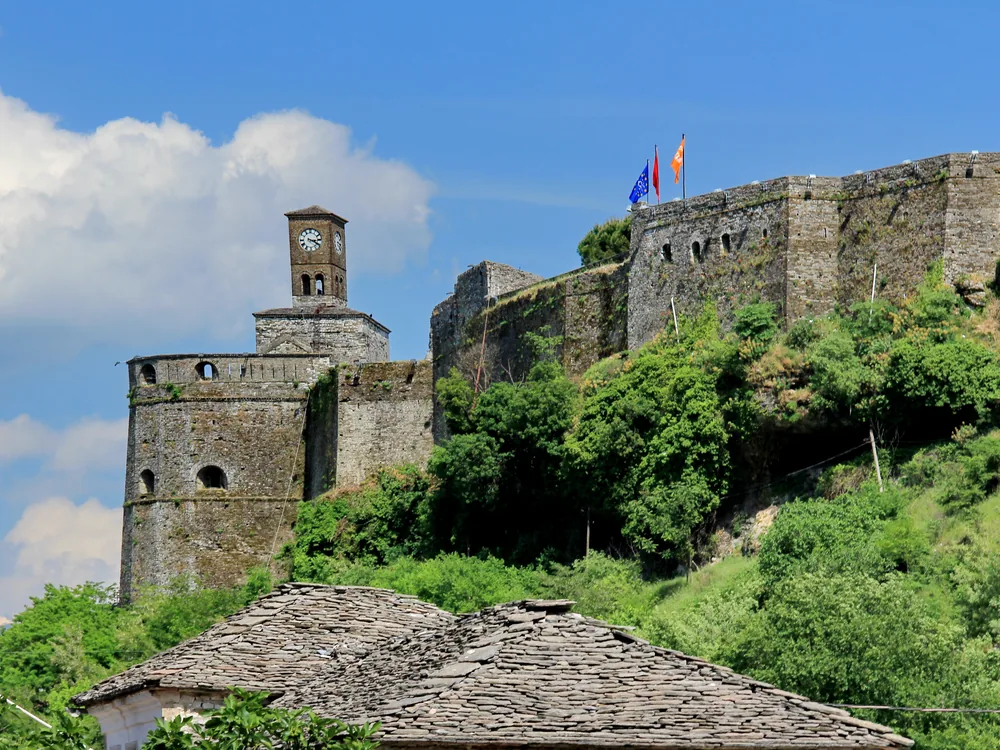
Gjirokastra Castle
Kalaja e Gjirokastrës
Albania · Gjirokastër County · Near Gjirokastër
12th century · Ottoman-era hilltop fortress with origins in the 12th century, massively expanded in the early 19th century under Ali Pasha of Tepelena into a multi-towered defensive complex dominating the UNESCO-listed old town of Gjirokastër below; the surviving structures include a clock tower, water cisterns, a theatre space used for the National Folklore Festival, the Museum of Armaments, and the vaulted underground passages associated with its use as a communist-era political prison
This page is part of an independent travel guide and is not affiliated with, endorsed by, or operated by Gjirokastra Castle.
© Castles & Palaces
Quick Facts
- Hours
- Daily 09:00–17:00
- Entry via GetYourGuide
- €14
- Duration
- 1.5–2 hours
- Best time
- April to October
- Nearest city
- Gjirokastër
Featured Tour
Gjirokastra Castle Entry Ticket
Cancellation available · Instant confirmation
Highlights
- ✦Dominating the UNESCO-listed old town of Gjirokastër — one of Albania's best-preserved Ottoman-era towns, with its distinctive stone-roofed houses and steep, cobbled bazaar streets climbing the hillside below the castle walls
- ✦Expanded in the early 19th century by Ali Pasha of Tepelena, the formidable Albanian warlord who briefly created an effectively independent state within the Ottoman Empire and received Byron as a guest — one of the more colourful figures in Balkan history
- ✦Used as a political prison under Enver Hoxha's communist regime: dissidents and political prisoners were held in the castle's underground passages during the decades of the regime's harshest repressions, making it a site of 20th-century significance as well as medieval history
- ✦The Museum of Armaments includes a downed American aircraft from the Cold War era — its presence inside an Albanian castle is exactly as unexpected as it sounds, and worth the side visit on its own
- ✦The National Folklore Festival, one of Albania's largest cultural events, is held at the castle every four to five years — when the schedule coincides, the setting is remarkable
Skip the queue with a guided tour
Skip-the-line tickets & expert guides
The castle at the top of Gjirokastër is impossible to ignore. It sits on a ridge above the town at a height that makes every other structure in the city look deliberately subordinate — the stone-roofed Ottoman houses, the minaret of the bazaar mosque, the long diagonal of the covered market street all point upward toward walls that have commanded this hillside since the 12th century. The relationship between castle and town is immediate and legible in a way that more touristically developed Ottoman hilltop sites sometimes lose: Gjirokastër has remained, for a range of reasons including decades of enforced isolation under communism, relatively intact and relatively uncommercialized, which means the experience of looking up from the bazaar to the castle walls carries something of the spatial relationship that would have been felt here two hundred years ago.
Gjirokastër is a UNESCO World Heritage Site — listed alongside Berat as one of the two exceptional examples of Albanian Ottoman-era urban architecture. The old town below the castle is remarkable on its own terms: grey stone roofs, house-towers of considerable height built by competing noble families asserting status in a dangerous hillside environment, a covered market street, and a texture of domestic architecture that survived the communist period largely intact because Hoxha, despite his systematic destruction of religious and civic life, found the town politically useful as a model of Albanian heritage. The castle is inseparable from this urban context — it makes sense only in relationship to the town it dominates.
The fortress in its current form was substantially expanded by Ali Pasha of Tepelena in the early 19th century. Ali Pasha was one of the most formidable political operators in the late Ottoman Balkans — an Albanian warlord who built, through a combination of military prowess, political manipulation, and selective brutality, an effectively autonomous state within the Ottoman framework centred on Ioannina (now in northern Greece) and extending across what is now southern Albania. He was, briefly, one of the most powerful men in southeastern Europe, receiving the young Lord Byron as a guest in 1809 at his court in Ioannina; Byron's account of the visit captures something of Ali Pasha's combination of personal charm and political ruthlessness. Ali Pasha enlarged Gjirokastra Castle with the towers, cisterns, and defensive systems that define its current silhouette.
The 20th-century chapter is the one that requires the most careful attention. Under Enver Hoxha's communist regime — which isolated Albania more completely from the rest of the world than almost any other government in modern European history — the castle served as a political prison. Dissidents, perceived class enemies, and individuals caught in the shifting purges of the party leadership were held in its underground passages. The castle's walls had contained prisoners before, under Ottoman and earlier regimes; the communist use continued a pattern while adding the specific character of 20th-century political violence. Walking through those passages now, the Museum of Armaments occupying nearby halls, requires holding both the fortress's long history and its recent use in the same frame.
The Museum of Armaments inside the castle is worth visiting for one specific reason: it contains a downed American aircraft from the Cold War era, displayed in the courtyard. Its presence there — a physical remnant of the long, paranoid confrontation between Hoxha's Albania and the outside world — is one of those details that rewards visitors who pay attention to what is actually in front of them rather than what the guide book told them to expect.
A practical note on the GetYourGuide ticket: after booking, the ticket is delivered via WhatsApp. This is the standard delivery method used by this provider and reflects the informal but functional ticketing infrastructure common at Albanian cultural sites. The ticket is valid for 30 days from purchase and includes a guided walkthrough of the castle and its collections. First-time visitors often express surprise at the WhatsApp delivery — it is not an error or a scam, just a different system.
History
The castle at Gjirokastër has 12th-century origins, associated with the medieval Albanian nobility who held this strategic hilltop above the Drino valley. It was expanded repeatedly through the Ottoman period, with the most significant enlargement carried out by Ali Pasha of Tepelena in the early 19th century, when it became a major fortification and administrative centre for his semi-autonomous Pashalik.
The castle's most recent historical chapter is its use as a political prison under the communist regime of Enver Hoxha (1944–1985). Political dissidents were held in the castle's underground passages during the decades of the regime's harshest repressions. Today the castle houses the Museum of Armaments, a theatre space that hosts Albania's National Folklore Festival every four to five years, and the physical evidence of its layered history — from medieval fortress to Ottoman expansion to Cold War-era repression.
How to Visit
Getting there: Gjirokastra Castle stands at the top of Gjirokastër's UNESCO-listed old town. From the main bazaar area, the castle is a steep 10–15 minute walk uphill on cobbled streets. Gjirokastër is 230 km south of Tirana; most visitors arrive by bus (3.5–4 hours) or by car via the SH4 national road.
Tickets: Walk-up entry is €16. The GetYourGuide entry ticket is delivered via WhatsApp after booking — this is the standard delivery method used by this provider, not a technical problem. The ticket is valid for 30 days and includes a guided walkthrough of the castle and Museum of Armaments.
Practical tips: Budget 1.5–2 hours for the castle, but Gjirokastër old town deserves equal time — the bazaar street, the National Ethnographic Museum (housed in the Hoxha family birthplace), and the stone-roofed residential architecture are substantial draws. Do not skip the Museum of Armaments courtyard: the downed US Cold War aircraft on display there is one of the more unexpected objects in any Albanian museum and warrants the short detour.
Combine with: Berat Castle — the UNESCO-listed hilltop fortress 80 km north, above an equally well-preserved Ottoman town, and the natural pairing on a southern Albania itinerary.
Frequently Asked Questions
Ismail Kadare — Albania's most internationally recognised novelist, and a writer repeatedly nominated for the Nobel Prize in Literature — was born in Gjirokastër in 1936 and grew up with the castle as the defining physical backdrop of his childhood. His novel Chronicle in Stone (1971) is set in an unnamed Albanian hilltop town during the Italian and German occupations of World War II that is transparently Gjirokastër, with the castle a constant presence. Kadare's work gave Gjirokastër an international literary identity it retains; the castle appears in several of his works as both literal setting and symbol of historical weight.
Location
Gjirokastër, Albania
Nearby Castles
Tours & Tickets
Powered by GetYourGuide
From
€14/ person