Lezhë Castle
Kalaja e Lezhës
Albania · Lezhë County · Near Shkodër
Built 1440 · Layered Illyrian, Byzantine, Venetian, and Ottoman construction; the Venetian phase (c. 1440) produced the surviving curtain walls and gatehouse; Ottoman domed structures added after 1506; the underlying Illyrian acropolis dates to the 4th–3rd century BC
This page is part of an independent travel guide and is not affiliated with, endorsed by, or operated by Lezhë Castle.
© Castles & Palaces
Quick Facts
- Hours
- Daily 08:00–17:00
- Day trip from
- €97.9
- Duration
- 45 minutes–1.5 hours (castle ruins and hilltop views); the GetYourGuide nature walk tour is 6.5 hours covering castle, museum, and surrounding landscape
- Best time
- April to October
- Nearest city
- Shkodër
Featured Tour
Lezhë: Guided Nature Walk, Castle Visit, and City Tour
Cancellation available · Instant confirmation
Highlights
- ✦The League of Lezhë (1444) — Skanderbeg gathered Albania's regional princes here to form the first unified Albanian alliance against Ottoman expansion; the castle served as the administrative base of operations for a 24-year resistance
- ✦Skanderbeg's death and burial — Gjergj Kastrioti died at Lezhë in January 1468 and is buried in the Church of St Nicholas in the town below; the castle and tomb together make Lezhë the foremost Skanderbeg memorial site in Albania
- ✦2,400 years of continuous fortification — Illyrian acropolis (4th–3rd c. BC), Byzantine rebuilding (8th–9th c.), Venetian curtain walls (c. 1440), Ottoman additions (post-1506); the hill has been fortified under five successive powers
- ✦Panoramic views — the hilltop commands the Adriatic coastal plain, the Drin valley, and the northern Albanian hills; the strategic logic of the position is immediately clear from the summit
- ✦Venetian military architecture — the main surviving curtain walls and gatehouse are Venetian work of c. 1440, characteristic of the Republic's systematic coastal fortification programme along the Adriatic
Tickets & tours
Book through GetYourGuide
The hilltop above Lezhë, on the Adriatic coastal plain of northern Albania, has been fortified for well over two thousand years. The earliest recorded settlement here was an Illyrian oppidum, the acropolis of a city whose name shifted between Illyrian, Greek, and Latin traditions — Lissos, Lissus, Lissiae — and whose position above the confluence of the Drin River and the Adriatic plain gave it strategic command over the coastal road between Epidamnos (modern Durrës) to the south and the Drin delta to the north. The acropolis walls date to the 4th and 3rd centuries BC; coins minted at Lissos survive in Albanian collections and in several European museum inventories. The city was occupied by Rome in 168 BC, passed through Byzantine hands, and was rebuilt as a Byzantine fortification in the 8th or 9th century, when the threat of incursions from the north made the coastal hilltops worth refortifying.
The Venetians acquired Lezhë in 1386 as part of their systematic consolidation of the Adriatic coast, which gave Venice control of the key ports from Durrës northward. The Venetian administration rebuilt the castle walls around 1440, creating the most substantial phase of the visible fortification: the curtain walls that now surround the hilltop summit and the principal gatehouse are largely Venetian in their surviving fabric, built in the characteristic Venetian military style of the period — thick masonry, a limited number of tower projections, and a gate complex designed to funnel attackers into a controlled approach.
The year 1444 gave Lezhë its definitive historical identity. Gjergj Kastrioti — Skanderbeg — had been a janissary commander in Ottoman service before defecting to the Albanian cause in 1443 and seizing his ancestral seat at Krujë. In 1444 he summoned the lords and princes of the Albanian highlands and coastal regions to a council at Lezhë. The gathering produced the League of Lezhë — the first unified Albanian military alliance, a formal agreement among previously competing regional lords to coordinate their resistance against Ottoman expansion under Skanderbeg's leadership. The assembly was held in what is now the Church of St Nicholas in the town below the castle; the castle itself served as the administrative base and defensive anchor of the league's operations. The League of Lezhë, while it survived primarily as an agreement held together by Skanderbeg's personal authority, represents the earliest moment of Albanian political unification and remains one of the foundational events in Albanian national history.
Skanderbeg held the Ottomans back for twenty-four years — a resistance that drew admiring commentary from the papacy, from Naples, from Hungary, and from Venice, all of whom supplied varying degrees of material and diplomatic support. His military campaigns ranged across the Albanian highlands, using Krujë as his primary mountain fortress (40 kilometres south of Lezhë, now separately accessible as a castle site on this website) and Lezhë as a coastal base and diplomatic centre. He died at Lezhë in January 1468, succumbing to malaria at the age of around 63. He is buried in the Church of St Nicholas in the town centre — a building that was converted to a mosque under Ottoman rule and converted back to a church during the communist period; the tomb is maintained as a national monument and is accessible a short walk from the base of the castle hill.
The Ottomans captured Lezhë Castle in 1506, thirty-eight years after Skanderbeg's death, having maintained a campaign of attrition against the remaining Albanian lords. During the Ottoman occupation they added domed storage chambers and what are believed to be the remains of a small prayer space to the hilltop complex — evidence of the Ottoman practice of functionally adapting rather than demolishing the structures they captured. The castle remained under Ottoman administration until the 19th century; Albanian independence in 1912 brought the hilltop under national management.
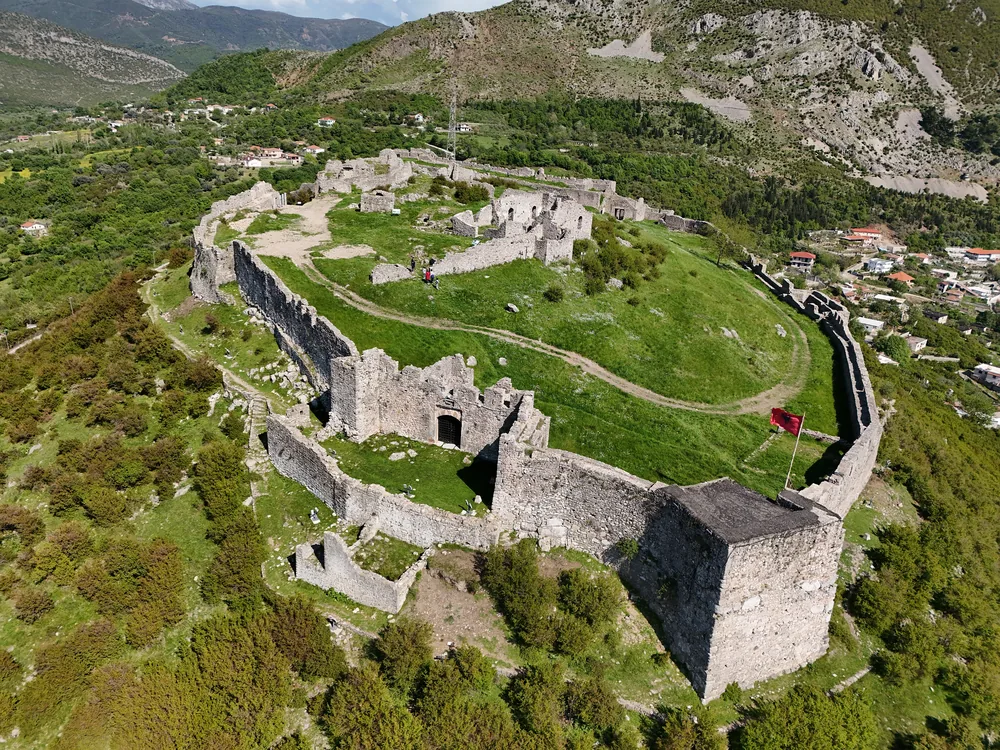
Today's visitors ascend to the castle via a path from the town centre — approximately a 20-minute walk on a moderately steep slope. The hilltop presents the ruined walls and towers of the Venetian-period fortification, with traces of earlier and later phases visible in the varied masonry. The commanding views from the summit cover the Adriatic coastal plain to the west, the Drin valley to the north, and the lower slopes of the northern Albanian hills in all other directions. The scale of the site — a large, well-defended hilltop enclosure rather than a compact tower — conveys something of its importance as a regional administrative and military centre across more than two millennia. The castle is accessible free of charge as an archaeological site.
The GetYourGuide guided tour (€98, was €98) covers the castle, the Skanderbeg context, the Church of St Nicholas tomb site in the town, and a nature walk through the surrounding Lezha landscape, available with local pickup. The tour is 6.5 hours and provides guide-led historical context for the League of Lezhë, Skanderbeg's campaigns, and the castle's Ottoman-era history. The listed rating is a provider rating (4.6) with no verified individual GetYourGuide review count; actual star display cannot be confirmed under the site's review accuracy standard.
Lezhë is located 55 kilometres north of Tirana on the SH1 highway, accessible from the capital in under an hour by car. Shkodër, which holds Rozafa Castle on a hilltop above the Buna River, is 30 kilometres to the north. Krujë, Skanderbeg's primary mountain fortress, is 40 kilometres south. Lezhë and Krujë are connected by the League of Lezhë narrative — the alliance built through Lezhë and defended from Krujë — making the two sites a natural pairing for visitors tracing the Skanderbeg story across northern Albania.
History
Illyrian acropolis (Lissos) from 4th–3rd century BC; Roman occupation 168 BC; Byzantine fortification 8th–9th century. Venetians acquired Lezhë 1386, rebuilt castle walls c. 1440. League of Lezhë formed 1444 under Skanderbeg; castle served as base of 24-year resistance against Ottoman expansion. Skanderbeg died at Lezhë January 1468; buried in Church of St Nicholas in town. Ottomans captured castle 1506; added structures during occupation. Albanian independence 1912.
How to Visit
Getting there: Lezhë is 55 km north of Tirana on the SH1 highway, approximately 1 hour by minibus with frequent departures from Tirana. From Lezhë town centre, the castle hilltop is a 20-minute uphill walk on a moderately steep path.
Tickets: Entry is free. The GetYourGuide guided tour is a 6.5-hour excursion covering the castle, Skanderbeg's tomb at the Church of St Nicholas in the town, and a nature walk through the surrounding landscape; pickup from Lezhë is included.
Practical tips: Carry water for the summit walk — the hilltop is exposed and temperatures are high in summer. Do not skip the Church of St Nicholas in the town (5 minutes from the base of the hill): Skanderbeg's tomb is there, not in the castle, and most visitors who come only for the ruins miss the site that gives Lezhë its primary historical significance.
Combine with: Rozafa Castle (Shkodër, 30 km north) and Krujë Castle (40 km south) form a natural Skanderbeg heritage trail across northern Albania.
Frequently Asked Questions
The League of Lezhë (Lidhja e Lezhës) was a military and political alliance formed in March 1444 among the princes and lords of the Albanian highlands, convened by Skanderbeg at Lezhë. It was the first unified Albanian political structure — an agreement among previously competing regional lords to coordinate resistance against Ottoman expansion under a common leader. The league lasted until Skanderbeg's death in 1468 and is the foundational event in Albanian national historiography, representing the earliest concept of Albanian collective political identity.
Location
Kalaja e Lezhës, Lezhë, Albania
Nearby Castles
Tours & Tickets
Powered by GetYourGuide
From
€97.9/ person