Tratzberg Castle
Schloss Tratzberg
Austria · Inn Valley, Schwaz District, Tyrol — Stans, between Innsbruck and Schwaz · Near Innsbruck
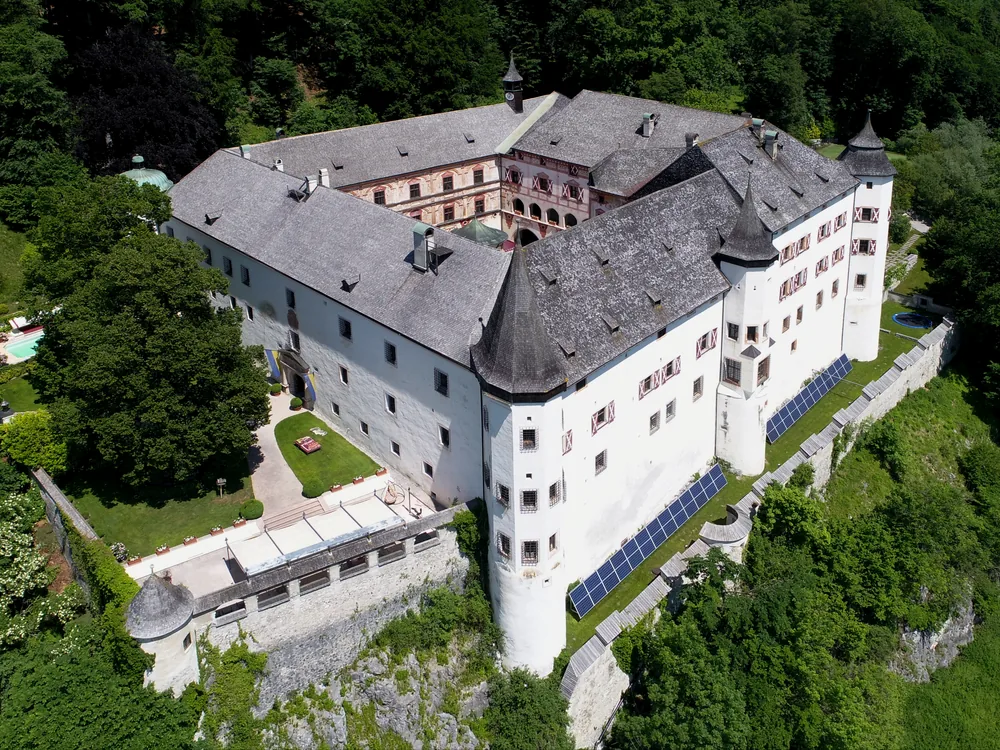
Built 1500 · Renaissance castle rebuilt after 1499 fire — the current structure was built primarily between 1500 and 1570 by successive owners (Tänzl, Haller, and Spaur families) on the foundations of an earlier medieval castle destroyed by fire in 1499; the exterior presents Tyrolean late-Gothic and early Renaissance elements including corner turrets and stepped gables; the interior contains outstanding original furnished state rooms of the 16th and 17th centuries, a Gothic chapel, and the Habsburgersaal whose walls carry a painted genealogical tree fresco of 148 Habsburg ancestors — one of the most elaborate dynastic fresco programmes surviving in Austria; the castle has been in continuous private ownership by the Goëss-Enzenberg family of counts for several hundred years
This page is part of an independent travel guide and is not affiliated with, endorsed by, or operated by Tratzberg Castle.
© Castles & Palaces
Quick Facts
- Hours
- Daily 10:00–16:00
- Entry via GYG
- €25.5
- Duration
- 1–1.5 hours (castle interior with radio-play adventure tour); allow 30 additional minutes for the Tratzberg Express train ride and forest walk
- Best time
- May to September
- Nearest city
- Innsbruck
Featured Tour
Tratzberg Castle: Entry including adventure castle tour in 9 languages
Cancellation available · Instant confirmation
Highlights
- ✦Habsburgersaal — 148-portrait Habsburg genealogical fresco — the Habsburg Hall's walls carry an elaborate painted family tree depicting 148 portraits of Habsburg ancestors tracing the dynasty back through the medieval centuries; commissioned as deliberate political alignment with the most powerful ruling house in Europe, it is one of the most extensive surviving dynastic fresco programmes of its kind in Austria
- ✦A privately inhabited family seat for several hundred years — Tratzberg has been owned by the Goëss-Enzenberg family of counts continuously for centuries; it is not a museum or state property but a genuine private residence that opens to visitors, giving the furnished state rooms a character of continuous habitation rather than curatorial arrangement
- ✦Radio-play adventure tour in 9 languages — rather than a standard audio guide, the castle visit is structured around an adventure story told across the rooms in nine languages; separate fairy-tale tour versions for young children and a knight-themed quiz trail for older children make this one of the most family-oriented castle visits in Tyrol
- ✦Tratzberg Express scenic railway — a small scenic train runs through the castle's forested grounds from the valley below to the castle entrance, adding a theatrical dimension to the approach that most Tyrolean castle visits do not provide
- ✦Outstanding private armory and Gothic chapel — the 15th- and 16th-century weapons and armor assembled across generations of ownership form one of the more significant private armory collections in Tyrol; the Gothic chapel retains its original late-medieval character and is integrated into the visit
Skip the queue with a guided tour
Skip-the-line tickets & expert guides
The Inn Valley between Innsbruck and Schwaz carries some of the most layered medieval history in Tyrol. The valley corridor was the primary route connecting the Bavarian lowlands to the north with the Brenner Pass to the south — the most historically important of the main Alpine crossings into Italy — and the fortified positions above it controlled the movement of armies, merchants, and pilgrims along one of the most trafficked routes in medieval Europe. Tratzberg Castle occupies one of these commanding positions: a wooded limestone terrace above the Inn near Stans, sitting high enough above the valley floor to observe the road for kilometres in either direction.
The site has been fortified since at least the 13th century. The first documented mention of a castle at Tratzberg dates to 1296, though the strategic hillside had almost certainly been used as a defensive position before that. In 1499, the castle was destroyed by fire. The catastrophe might have ended Tratzberg as a significant residence, but instead it gave the incoming owners — the Tänzl family, and after them the Haller family — the opportunity to rebuild from the foundations up in the architectural style then fashionable among the Habsburg-aligned nobility of the Austrian lands. The Renaissance castle that rose after 1500 was a deliberate statement of status, cultural alignment, and political identity.
The Habsburgersaal — the Habsburg Hall — is the most remarkable room at Tratzberg, and among the most remarkable rooms in Tyrol. Its walls carry an elaborate painted genealogical tree fresco depicting 148 Habsburg ancestors, tracing the dynasty's lineage back through the medieval centuries in a single sweeping visual argument. The fresco was political as much as decorative: by commissioning a dynastic portrait gallery of the Habsburgs within a private hall, the castle's owner publicly aligned himself with the most powerful ruling house in Europe. The Habsburg genealogical fresco at Tratzberg is one of the most extensive surviving examples of its kind in Austria, and the Habsburgersaal carries a specific weight that the castle's other impressive rooms do not quite match.
The castle passed through several ownership families before coming into the possession of the Goëss-Enzenberg family of counts, who have held it continuously for several hundred years. This unbroken private ownership is among the most distinctive facts about Tratzberg: the castle is not a museum, not state property, not a heritage-authority restoration. It is a house that a family has lived in for centuries, and the furnished rooms reflect continuous habitation rather than curatorial arrangement. The distinction is perceptible to any visitor who has spent time in both kinds of castle: rooms occupied across generations have a different character from rooms assembled for display. The furniture is where it has been used; the objects reflect the specific accumulation of a family's history rather than a reconstructed period moment.
The Goëss-Enzenberg counts have maintained the castle's state rooms, armory collection, and the Gothic chapel, which retains its original late-medieval character. The armory — with weapons and armor from the 15th and 16th centuries accumulated across generations — is one of the more significant private collections of its kind in Tyrol. Across the main residential rooms, portraits, furnishings, and objects from several centuries of continuous occupation give the visit a quality that institutional castle museums rarely achieve: the sense of a place cared for by people who consider it home.
The tour format at Tratzberg is also genuinely unusual. Rather than a standard audio guide or live guided group, the visit is built around a radio-play adventure: a story told across the rooms of the castle in nine languages, connecting the spaces the visitor walks through to the historical events and characters associated with each. The format works for varying levels of prior historical knowledge and engages children alongside adults. A fairy-tale version is available for younger children; a knight-themed quiz trail gives older children a structured path through the rooms. The Tratzberg Express — a small scenic railway running through the castle's forested grounds from the valley below — is the recommended approach to the castle, adding a theatrical element to the arrival that a car-park approach would not provide.
The GYG ticket at approximately €26 (discounted from €26) includes castle entry, the radio-play tour in nine languages, and the Tratzberg Express train ride. The castle is family-operated by the Goëss-Enzenberg family and the quality of maintenance is high — the investment in the radio-play format and the condition of the rooms both reflect an owner who takes the visitor experience seriously.
Tratzberg is most conveniently visited as a day trip from Innsbruck or as a stop on a route through the Inn Valley. The castle sits above the Innsbruck–Salzburg railway corridor; Jenbach station (approximately 20 minutes by train from Innsbruck) is the nearest stop, and the Tratzberg Express runs from the valley base through the forest to the castle entrance. The Inn Valley — with the Nordkette mountains rising sharply above Innsbruck and the Zillertal Alps beginning south of Jenbach — provides a landscape backdrop of considerable quality.
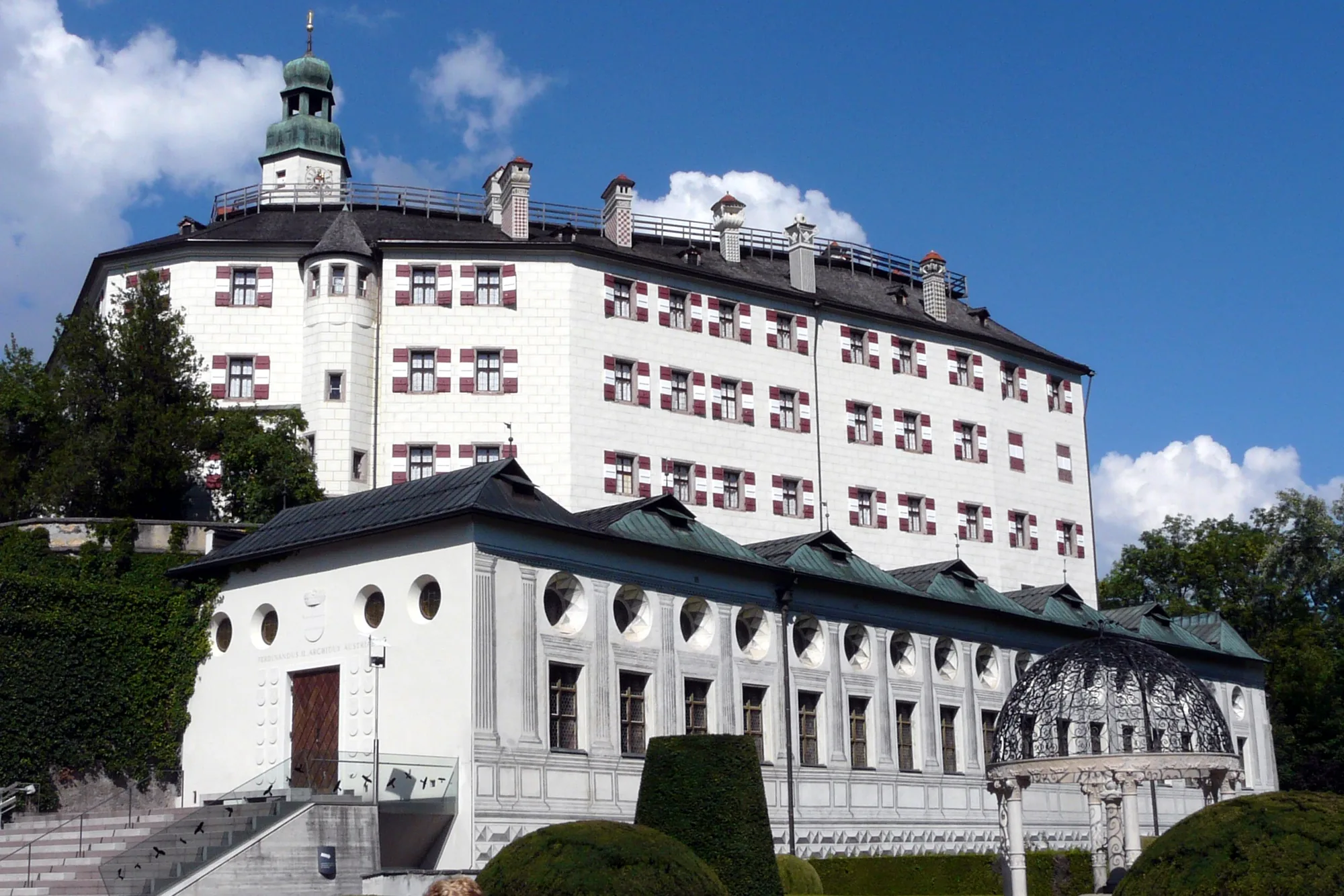
[Schloss Ambras](/castles/austria/schloss-ambras) — the Renaissance pleasure palace built above Innsbruck by Archduke Ferdinand II of Habsburg in the 1560s, now a major museum housing one of the most important armory and portrait collections in Central Europe — is approximately 25km west in the Inn Valley. Ambras and Tratzberg are both Renaissance-era Tyrolean castle estates with strong Habsburg connections and outstanding armory collections, but they represent opposite trajectories: Ambras has been a state museum for over a century, while Tratzberg remains in private family ownership. Both are worth visiting on any tour of Tyrolean castle architecture and Habsburg material culture.
History
1296: first documented mention of a castle at Tratzberg. 1499: castle destroyed by fire. 1500 onwards: rebuilt in Renaissance style by the Tänzl family, then the Haller family; the Habsburgersaal with its 148-portrait dynastic fresco commissioned in this period. 16th century: state rooms, armory, and Gothic chapel completed or expanded by successive owners. 17th century onwards: castle passes to the Goëss-Enzenberg family of counts; continuous private family ownership begins. 18th–19th century: maintained as a private family residence; state rooms preserved rather than remodelled. 20th century: castle opened to visitors; radio-play tour format and Tratzberg Express scenic railway added as part of family-operated visitor programme. Present day: open April to October; the Goëss-Enzenberg family continues to operate and inhabit the castle.
How to Visit
Getting there: Tratzberg sits above the Inn Valley near Stans, close to Jenbach. By train from Innsbruck, take the Innsbruck–Salzburg line to Jenbach (approximately 20 minutes), then walk or shuttle to the Tratzberg Express lower station. By car, exit the A12 at Jenbach and follow signs to Stans (approximately 5 km); parking at the Tratzberg Express lower station. Open April to October; closed November to March.
Tickets: Walk-up entry is €22 adults, €11 children, covering the radio-play adventure tour in 9 languages and the Tratzberg Express train ride. The GYG entry ticket (t1398953, from €26, no reviews yet) provides the same access via online booking.
Practical tips: Take the Tratzberg Express scenic train through the castle forest rather than driving to the gate — it is the recommended approach and adds a theatrical arrival that most castle visits cannot match. The Habsburgersaal is the must-see room; budget time there and look for all 148 Habsburg ancestor portraits in the dynastic fresco before moving on to the other state rooms.
Combine with: [Schloss Ambras](/castles/austria/schloss-ambras) — Archduke Ferdinand II's Renaissance castle above Innsbruck with the world's oldest surviving public museum collection, approximately 25 km west in the Inn Valley.
Frequently Asked Questions
Yes — Tratzberg Castle has been owned and inhabited by the Goëss-Enzenberg family of counts for several hundred years without interruption. The castle is not a state museum or heritage-authority property: it is a private residence that opens to visitors during the season (April to October). This gives the furnished state rooms a character of continuous habitation rather than museum arrangement — the furniture is where it has been used, the rooms feel lived in rather than staged. The castle visit is run by the family directly, and the quality of maintenance reflects private rather than institutional management.
Location
Schloss Tratzberg, Stans 21, 6135 Stans, Austria
Nearby Castles
Tours & Tickets
Powered by GetYourGuide
From
€25.5/ person