
Schloss Ambras
Schloss Ambras Innsbruck
Austria · Tyrol · Near Innsbruck
Built 1563 · Renaissance; originally a medieval castle; transformed 1563–1589 by Archduke Ferdinand II of Austria into a Renaissance palatial complex; the Lower Castle houses the Spanish Hall (Spanischer Saal), the first German-language Renaissance hall (1570–1571); upper castle contains collections of armour, portraits, and the Kunst- und Wunderkammer (Cabinet of Curiosities)
This page is part of an independent travel guide and is not affiliated with, endorsed by, or operated by Schloss Ambras.
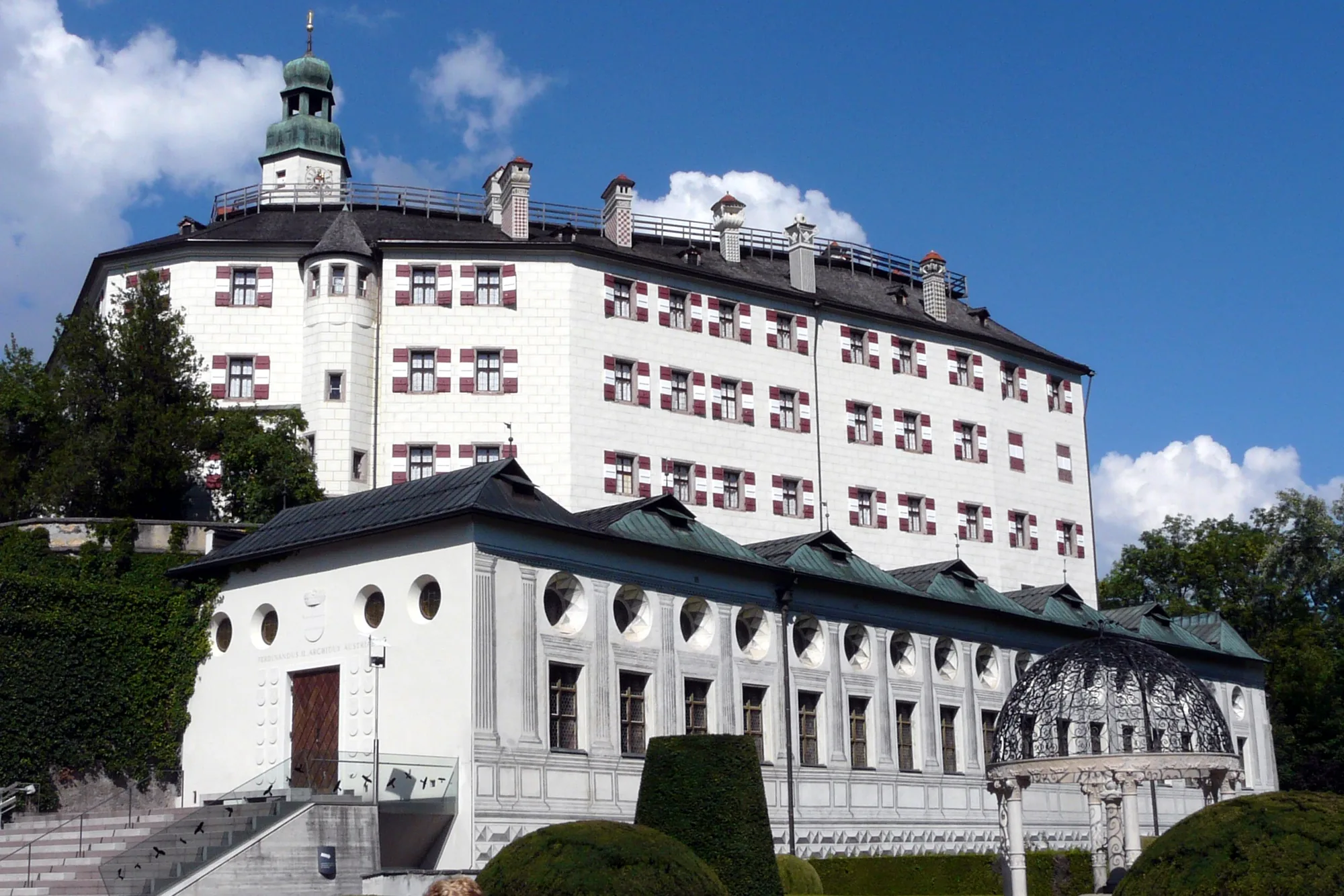
© Castles & Palaces
Quick Facts
- Hours
- Daily 10:00–17:00
- Entry via GetYourGuide
- €16
- Duration
- 2–3 hours
- Best time
- April to November
- Nearest city
- Innsbruck
Featured Tour
Innsbruck: Tickets for Schloss Ambras
Cancellation available · Instant confirmation
Highlights
- ✦The Kunst- und Wunderkammer of Ferdinand II, assembled from the 1560s onward and never dispersed, making Ambras the oldest continuously surviving public museum in the world
- ✦The Spanish Hall (1570–1571), the first large secular Renaissance hall built anywhere in the German-speaking world, still used today as a concert venue
- ✦The oldest continuous portrait gallery in the world, with hundreds of paintings of European rulers and notable figures assembled by Ferdinand II
- ✦An armour collection of international significance, including parade armour, tournament armour, and pieces made for individuals of extraordinary stature
- ✦The preserved chambers of Philippine Welser, Ferdinand's commoner wife, whose secret marriage scandalised the Habsburg court
Skip the queue with a guided tour
Skip-the-line tickets & expert guides
On a forested hill above Innsbruck, at 600 metres above sea level where the Inn valley begins to narrow toward the Alps, stands a castle unlike any other in Austria. Schloss Ambras is not primarily a military fortress or a royal residence — at its core, it is a collector's palace. Archduke Ferdinand II of Austria spent four decades assembling one of the greatest personal collections in Renaissance Europe and built a castle specifically to house and display it. What he created has a fair claim to being the world's oldest public museum: the Kunst- und Wunderkammer of Ambras, begun in the 1560s, has never been dispersed.
Ferdinand II, Archduke of Austria, received Tyrol as his domain in 1563. He was also, at that point, secretly married to Philippine Welser — a commoner, the daughter of an Augsburg merchant family, whose beauty and intelligence were celebrated throughout Europe but whose birth made her, by the rigid standards of the Habsburg court, an unacceptable consort. Ferdinand kept the marriage secret for years. Ambras, which had been a medieval fortress in a state of near-ruin, became the place he could build and curate on his own terms, away from the scrutiny of Vienna. Between 1563 and 1589, he transformed it into a Renaissance compound of extraordinary sophistication.
The architectural centrepiece of the Lower Castle is the Spanish Hall, completed between 1570 and 1571. It is the first large secular Renaissance hall built anywhere in the German-speaking world — a long, frescoed room of exceptional elegance, with 27 portrait medallions of Tyrolean rulers running around the upper walls beneath an ornately carved, coffered wooden ceiling. The hall was built for Ferdinand's own use; he held concerts here, and it remains one of the most perfect small concert venues in Austria. The Innsbruck Festival of Early Music uses the Spanish Hall as its principal venue every summer, a use that connects the room directly back to its original Renaissance function.
Ferdinand's Cabinet of Curiosities, his Kunst- und Wunderkammer, is one of the genuine wonders of the Renaissance collecting impulse. He assembled it systematically across four recognised categories: naturalia, objects from nature such as coral, shells, minerals and exotic animal specimens; artificialia, objects made by human hands, including carved ivory, turned wood, automata and clockwork; scientifica, instruments of measurement and observation; and exotica, objects brought from cultures outside Europe. By the time of his death in 1595, the collection numbered thousands of objects. It remained at Ambras until 1806, when the threat of Napoleon's invasion forced its removal to Vienna, where the core collection now resides in the Kunsthistorisches Museum. What remains at Ambras today, still formidable in its own right, includes armour, portraits and a representative selection of the original curiosities.
Ferdinand was also an obsessive collector of portraits, assembling likenesses of nearly every European ruler and notable person of his era — hundreds of paintings in total. The portrait gallery at Ambras is, on this basis, considered the oldest continuous portrait gallery in the world. His armour collection, similarly significant, includes tournament armour, ceremonial parade armour, and the armour of individuals of extraordinary physical characteristics, among them a suit made for an Irish giant in Ferdinand's service — one of the more poignant objects on display, a record of a real person reduced to a curiosity by the collecting habits of his era.
Philippine Welser remained at Ambras throughout her marriage to Ferdinand — the castle was her home and her retreat from a court that never fully accepted her. She was by all accounts an accomplished woman: a skilled herbalist and a physician of genuine ability, whose surviving manuscript cookbook includes medical recipes alongside culinary ones, and the subject of a popular cult of admiration in Tyrol that has never entirely faded. She died in 1580; Ferdinand survived her by fifteen years and, according to several contemporary accounts, never fully recovered from the loss. Her chambers in the Upper Castle have been preserved and are open to visitors today, offering a more intimate counterpoint to the grandeur of the Spanish Hall and the Wunderkammer.
History
Archduke Ferdinand II of Austria received Tyrol as his domain in 1563 and began transforming the existing medieval fortress at Ambras, then largely ruined, into a Renaissance residence and showcase for his growing collections. Construction and decoration continued until 1589, with the Spanish Hall, completed in 1570–1571, standing as the project's architectural high point — the first large secular Renaissance hall built in the German-speaking world. Ferdinand used Ambras partly to escape the scrutiny that followed his secret marriage to Philippine Welser, a commoner whose social standing made her an unacceptable consort by Habsburg court convention.
Ferdinand's Kunst- und Wunderkammer, assembled over four decades according to the systematic Renaissance taxonomy of naturalia, artificialia, scientifica and exotica, remained intact at Ambras from the 1560s until 1806, when the threat of Napoleonic invasion forced the collection's removal to Vienna. The core holdings are now part of the Kunsthistorisches Museum, while Ambras retains a significant remainder, including its armour and the world's oldest continuous portrait gallery. The castle continues to operate as a museum today, administered as part of the Kunsthistorisches Museum Vienna's network of sites.
How to Visit
Getting there: Schloss Ambras is 6 km from central Innsbruck, served by bus 4134 from Maria-Theresien-Straße (approximately 15 minutes). By car, parking is available at the castle.
Tickets: Walk-up entry is €18 adults, children free. The GetYourGuide entry ticket covers all areas of the castle. The Upper Castle closes approximately November to mid-December and in January — verify at schlossambras-innsbruck.at before visiting in those months; the Lower Castle and Spanish Hall remain open year-round.
Practical tips: Start with the Spanish Hall in the Lower Castle — the first large secular Renaissance hall in the German-speaking world, and worth 15 minutes alone for the frescoed upper walls and coffered ceiling before entering the collection rooms. Philippine Welser's preserved chambers in the Upper Castle are the most human-scaled and intimate space in the complex; the contrast between them and the Wunderkammer's vast systematic assembly is part of what makes Ambras unusual among Austrian castle museums.
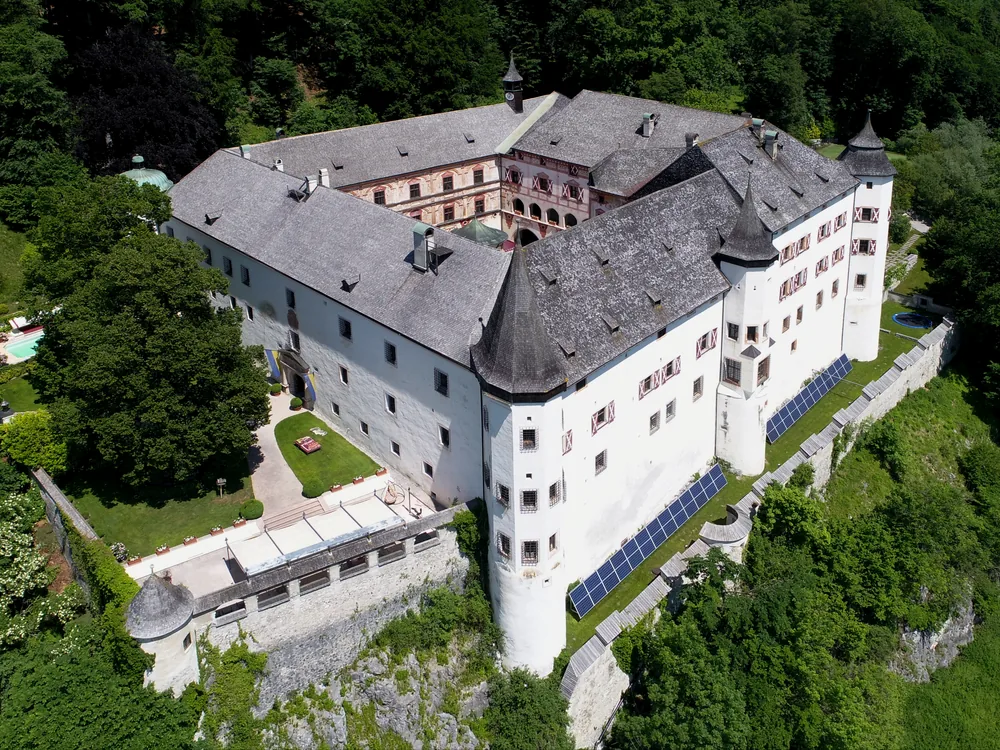
Combine with: Tratzberg Castle — the Renaissance fortress in the Inn valley approximately 40 km east of Innsbruck, and a natural Tyrolean castle pairing on the same road.
Frequently Asked Questions
Archduke Ferdinand II began systematically assembling his Kunst- und Wunderkammer, or Cabinet of Curiosities, at Ambras in the 1560s, organising it into clear categories and displaying it for visiting scholars and dignitaries. Unlike most princely collections of the era, which were eventually broken up, sold, or absorbed piecemeal into other collections, the core of Ferdinand's collection survived as a coherent unit, moved to Vienna only in 1806 under threat of Napoleonic invasion. The continuity of the collection's display, even after that move, supports Ambras's claim to having functioned as a public museum earlier than any other comparable institution in Europe.
Location
Schlossstraße 20, 6020 Innsbruck, Austria
Nearby Castles
Tours & Tickets
Powered by GetYourGuide
From
€16/ person