
Hohensalzburg Fortress
Festung Hohensalzburg
Austria · Salzburg · Near Salzburg
Built 1077 · Romanesque and Gothic fortress
This page is part of an independent travel guide and is not affiliated with, endorsed by, or operated by Hohensalzburg Fortress.
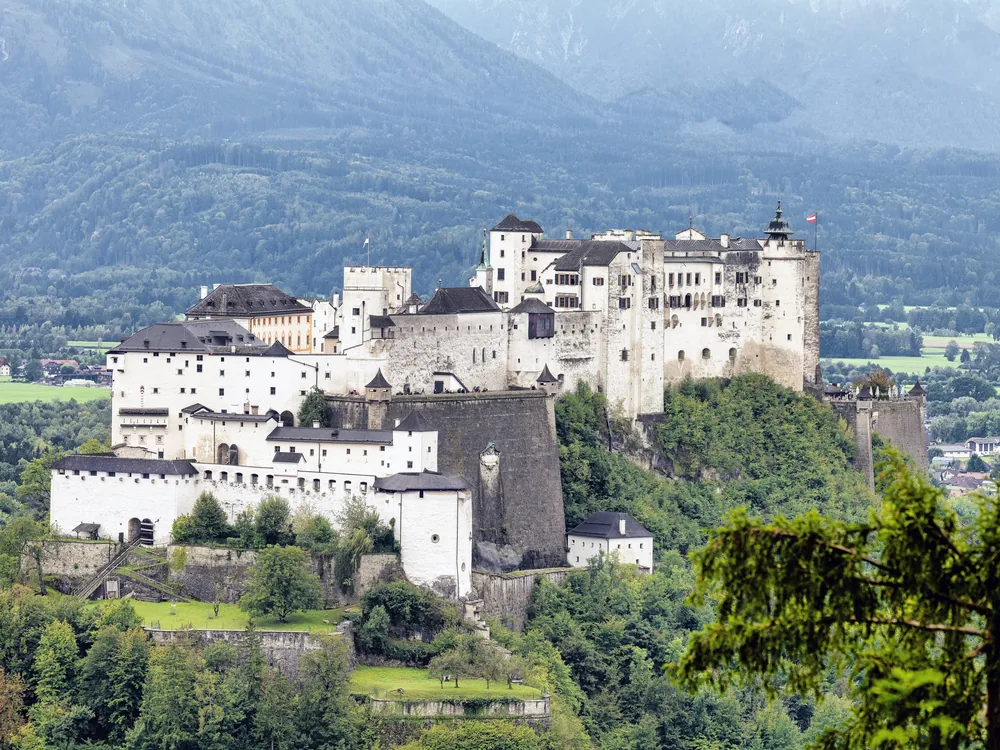
© Unsplash
Quick Facts
- Hours
- Daily 09:00–17:00
- Entry via GetYourGuide
- €19
- Duration
- 2 hours
- Best time
- Year-round
- Nearest city
- Salzburg
Featured Tour
Salzburg: Hohensalzburg Fortress Admission Ticket
Cancellation available · Instant confirmation
Highlights
- ✦One of the largest and best-preserved medieval fortresses in Europe, founded in 1077
- ✦Panoramic views of Salzburg, the Salzach valley and the Alps from the ramparts
- ✦The Golden Room — a late Gothic state room with original gilded wood carvings and stove
- ✦Never been taken by an enemy — one of the few great European fortresses to remain unconquered
- ✦A funicular railway (Festungsbahn) runs from the old city to the fortress gate
Tickets & tours
Book through GetYourGuide
Hohensalzburg Fortress has watched over Salzburg from its rocky perch above the Salzach river since 1077 — and in nearly a thousand years, no enemy has ever taken it. This is not a ruin, not a reconstruction, not a romantic 19th-century confection: it is a fully intact medieval fortress that has been in continuous use since its foundation, its massive walls and round towers defining the Salzburg skyline as recognisably as the Baroque cathedral spires below.
The fortress was built by Archbishop Gebhard von Helffenstein during the Investiture Controversy — the conflict between Pope Gregory VII and Holy Roman Emperor Henry IV over the right to appoint bishops. Gebhard sided with the Pope and needed a stronghold. What he built, and what his successors expanded over the following four centuries, became the largest fully preserved medieval castle in the German-speaking world.
The interior today divides into the fortress proper — walkways, towers, ramparts and the Marionette Museum — and the Prince's Chambers, which contain some of the finest surviving late Gothic secular interiors in Austria. The Golden Room (Goldene Stube), with its original gilded wood carvings and tiled stove from around 1500, and the Golden Hall (Goldener Saal), which still hosts concerts, represent the residential ambition of the Prince-Archbishops who ruled Salzburg as an independent ecclesiastical state for nearly 800 years.
From the ramparts, the views justify the climb alone: the Baroque city compressed below, the Salzach river catching the light, the Alps rising to the south in a panorama that makes clear why Salzburg has been called the most beautiful city in Central Europe.
History
Archbishop Gebhard founded the fortress in 1077 on the Festungsberg — a steep dolomite hill south of the old city — during the Investiture Controversy, the defining political crisis of medieval Europe. Gebhard was forced into exile shortly after and the fortress passed to successive archbishops, each adding to its structures as their power and resources grew.
The most significant expansion came under Archbishop Leonhard von Keutschach, who ruled Salzburg from 1495 to 1519. Keutschach transformed the medieval defensive structure into a palatial residence of considerable sophistication, adding the Golden Room and Golden Hall, a new round tower, and the distinctive round emblem of his radish heraldic symbol (the 'Keutschach Rübe') that appears throughout the fortress's carved decorations.
Hohensalzburg's strategic impregnability meant that it weathered the upheavals of the Reformation, the Thirty Years' War and the Peasants' Uprising of 1525 without being taken. The archbishop who commissioned Mozart to work in the court — Hieronymus Colloredo, whom Mozart famously loathed and eventually defied — used the fortress as his residence. Mozart was born in the city below and grew up in the shadow of these walls.
Napoleon's campaigns ended Salzburg's status as an independent ecclesiastical state in 1805; the city was absorbed first by Bavaria, then by Austria. The fortress passed to the Austrian military, then was converted to a museum in 1861. Salzburg's historic old town was designated a UNESCO World Heritage Site in 1997, with the fortress as its defining monument.
How to Visit
Getting there: The Festungsbahn funicular runs from the old city (Festungsgasse, near St. Peter's Abbey) directly to the fortress gate; it is included in the ticket price and is the standard approach. Alternatively, walk up the Festungsgasse path in approximately 20 minutes on a steep climb. Salzburg Hauptbahnhof is a 20-minute walk from the old city; trains arrive from Vienna in 2.5 hours and Munich in 1.5 hours.
Tickets: Walk-up entry is €16 adults, €10 children, including the funicular. The GetYourGuide admission ticket is the same self-guided entry via online pre-booking.
Practical tips: Arrive at opening (09:00 in summer, 09:30 in winter) to avoid the tour group rush that builds from 10:30. The Golden Room in the Prince's Chambers section is the finest interior — the original late Gothic carved gilded wood and tiled stove from c.1500 are intact. Evening chamber concerts in the Golden Hall (Hohensalzburg Concerts, May–September, ticketed separately) are a distinct experience from the daytime visit and worth checking in advance.
Combine with: Hellbrunn Palace — the 1619 Archbishop's trick-fountain pleasure palace, 4 km south of Salzburg, and a perfect contrast to Hohensalzburg's medieval military character.
Frequently Asked Questions
The most comfortable way is the Festungsbahn funicular railway, which runs from Festungsgasse in the old city (near St. Peter's Abbey) directly to the fortress gate. The funicular is included in the fortress ticket price and runs from 09:00 (09:30 in winter). You can also walk up via the Festungsgasse path in about 20 minutes — steep but scenic.
Location
Mönchsberg 34, 5020 Salzburg, Austria
Nearby Castles
Tours & Tickets
Powered by GetYourGuide
From
€19/ person