
Barone Fortress
Tvrđava Barone
Croatia · Šibenik-Knin County, Šibenik · Near Šibenik
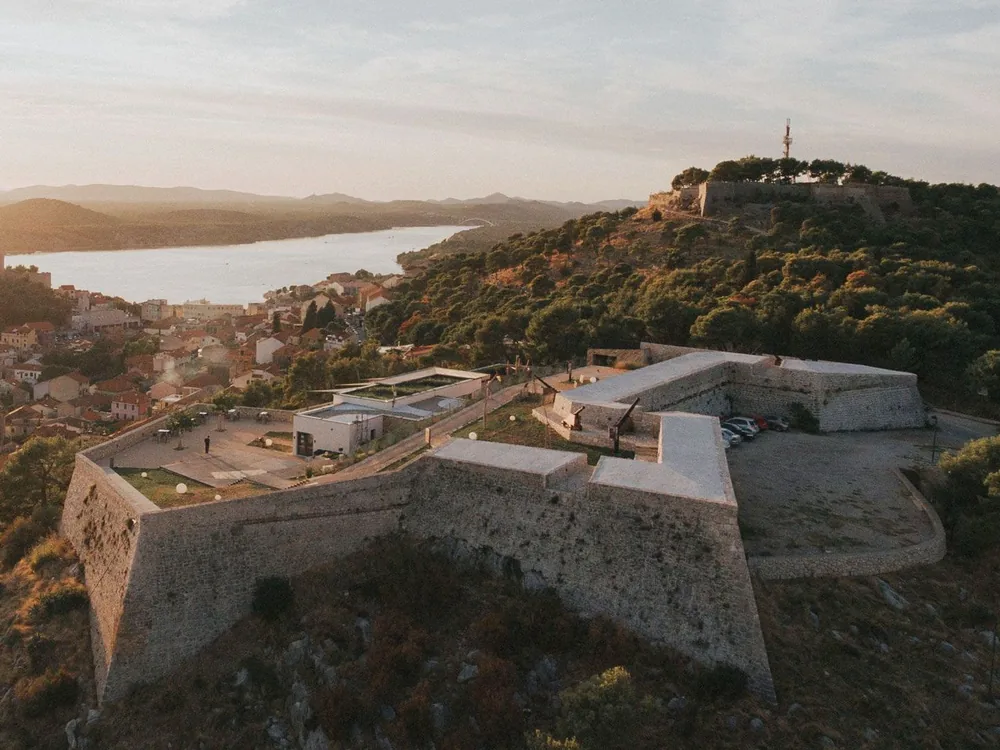
Built 1646 · 17th-century Venetian artillery-era bastioned fortress — designed by the military engineer Antonio Leni in the summer of 1646 as an emergency response to the Ottoman threat during the War of Candia (1645–1669); the design follows the principles of post-medieval artillery fortification: a bastioned trace with earthwork ramparts that absorb rather than shatter under cannon shot, with the bastions angled to eliminate dead ground and provide mutually supporting fields of fire between the fortress and the simultaneously-built St. John's Fortress on the adjacent hilltop; the earthwork-and-masonry construction was chosen partly for speed — the entire fortress was completed in approximately seven months — and partly because earthwork absorbs artillery impact more effectively than dressed stone; the fortress plan is compact and functional rather than monumental, a product of emergency military engineering rather than aristocratic display
This page is part of an independent travel guide and is not affiliated with, endorsed by, or operated by Barone Fortress.
© Castles & Palaces
Quick Facts
- Hours
- Daily 09:00–22:00
- Guided tour from
- €57.6
- Duration
- 45 minutes–1 hour (AR exhibit and ramparts); 2 hours (electric tuk-tuk circuit of all three fortresses)
- Best time
- May to October
- Nearest city
- Šibenik
Featured Tour
Šibenik: 3 Fortresses & Panorama Tour — All Fees Included
Cancellation available · Instant confirmation
Highlights
- ✦Built in seven months in 1646 — the Venetian Senate commissioned Barone in emergency response to Ottoman advances into the Dalmatian hinterland during the War of Candia (1645–1669); engineer Antonio Leni completed the bastioned earthwork fortress from scratch in approximately seven months, one of the fastest significant fortification projects in the history of Venetian Dalmatia
- ✦The 1647 Ottoman assault and its failure — in September 1647, an Ottoman force under Yusuf Pasha attacked Šibenik; the interlocking fields of fire between Barone and St. John's Fortress on the adjacent hilltop left the attackers with no safe approach angle; the assault failed and the Ottomans withdrew; Šibenik remained Venetian while the broader War of Candia ended in the fall of Crete
- ✦Augmented-reality exhibit reconstructing the 1646 construction and 1647 battle — the 2016 restoration of the fortress installed a screen-based AR experience that allows visitors to see the fortress as it looked during the emergency construction, during the Ottoman attack, and during the moments of critical defense; the most technologically ambitious interpretive installation in Šibenik's fortress circuit
- ✦Croatia's Cultural Attraction of the Year 2018 — the restoration and AR exhibit were awarded Croatia's highest annual tourism recognition two years after the fortress opened, validating the investment in interpreting a ruin that most visitors had previously walked past without understanding
- ✦Open-air café with views over Šibenik — the interior of the restored fortress houses an open-air café that becomes a popular evening destination during summer, with views across the city rooftops to the Šibenik channel and the sea beyond
- ✦GetYourGuide electric tuk-tuk panorama tour — 2-hour circuit of all three Šibenik fortresses; 'All Fees Included' confirmed in product title and FAQ
Skip the queue with a guided tour
Skip-the-line tickets & expert guides
In the summer of 1646, news reached Šibenik that the Ottomans were advancing through the Dalmatian hinterland and that the city's existing defenses were inadequate to resist a siege conducted with artillery. The Venetian Senate's response was to dispatch the military engineer Antonio Leni and authorize the construction of a new fortress on the hills southeast of the city — to be completed before the Ottomans arrived. What followed was one of the most compressed major construction projects in the history of Venetian Dalmatia: a bastioned fortress built from scratch in approximately seven months, operational before the summer of 1647.
The context was the War of Candia (1645–1669), Venice's last major conflict with the Ottoman Empire, fought primarily over the island of Crete (known to Venetians as Candia). The war's opening years had destabilized the entire eastern Adriatic as the Ottomans tested the perimeter of Venetian Dalmatia with a series of probing incursions into the interior. Šibenik, positioned at the mouth of the Krka River estuary and controlling the central Dalmatian coast, was both strategically important and vulnerable. Its existing fortifications — principally St. Michael's Fortress above the harbor entrance, a structure of medieval origin — had been built for an era of siege warfare before reliable artillery changed the calculus of fortification design.
The new approach to fortress building, developed in Italy and formalized by French engineers in the early modern period, recognized that the traditional high stone wall was a liability against cannon: it shattered under bombardment, producing lethal stone fragments and breach points. The solution was the bastioned trace: low, thick earthwork ramparts that absorbed shot, with angled bastions projecting from the corners so that every face of the curtain wall was covered by flanking fire from the adjacent bastion. Dead ground — the area immediately beneath the walls where attackers could shelter from fire — was eliminated. An attacker approaching any face of the fortress would be exposed to fire from multiple angles simultaneously.
Leni applied these principles at Barone with the additional constraint of extreme speed. The fortress is compact and functional rather than elaborate: its purpose was not to be impressive but to be effective within the window the emergency gave. The name came from the Venetian provveditore (military governor) of Dalmatia at the time of construction — Marino Zane, whose family title was Barone — rather than from any saint or topographic feature.
The test came in September 1647. An Ottoman force under Yusuf Pasha attacked Šibenik in what its commanders expected to be a successful assault on a city not fully prepared for siege. What they encountered instead was the combined defensive system of Barone and St. John's Fortress — the second fortress built simultaneously on the highest hill of Šibenik's defensive ring, positioned to interlock its fields of fire with Barone's so that no approach line was free of cannon coverage. The assault failed. The Ottomans withdrew. It was one of the few clear Venetian military successes in a war that ended, twenty-two years later, with the loss of Crete. Šibenik, protected by seven months of emergency engineering, remained Venetian.
For the following century and a half the fortresses held their positions without being tested again. Venice's cession of Dalmatia to Austria in the Treaty of Campo Formio in 1797 transferred the entire Dalmatian administration to the Habsburgs, who had no particular interest in maintaining artillery fortifications designed by the Venetian military engineering tradition. Through the 19th and most of the 20th century, Barone deteriorated as a ruin on the hillside above Šibenik — visible from the city, structurally present, but not accessible or interpreted.
The restoration that opened in 2016 changed the situation comprehensively. The consolidation of the walls and bastions was accompanied by the installation of an augmented-reality exhibit — a screen-based system that allows visitors to see the fortress in its 1646 construction phase and during the 1647 Ottoman assault, overlaying the current ruin with the populated military installation of its moment of use. The exhibit was awarded Croatia's Cultural Attraction of the Year in 2018. An open-air café installed in the fortress interior became, in the seasons that followed, a popular evening destination for Šibenik residents and visitors seeking views across the city rooftops to the channel and the sea beyond.
The electric tuk-tuk tour operated by Eco Tuk Tuk Šibenik covers all three Šibenik fortresses on a two-hour panoramic circuit, with all entry fees included in the product title and a FAQ that addresses the question directly.
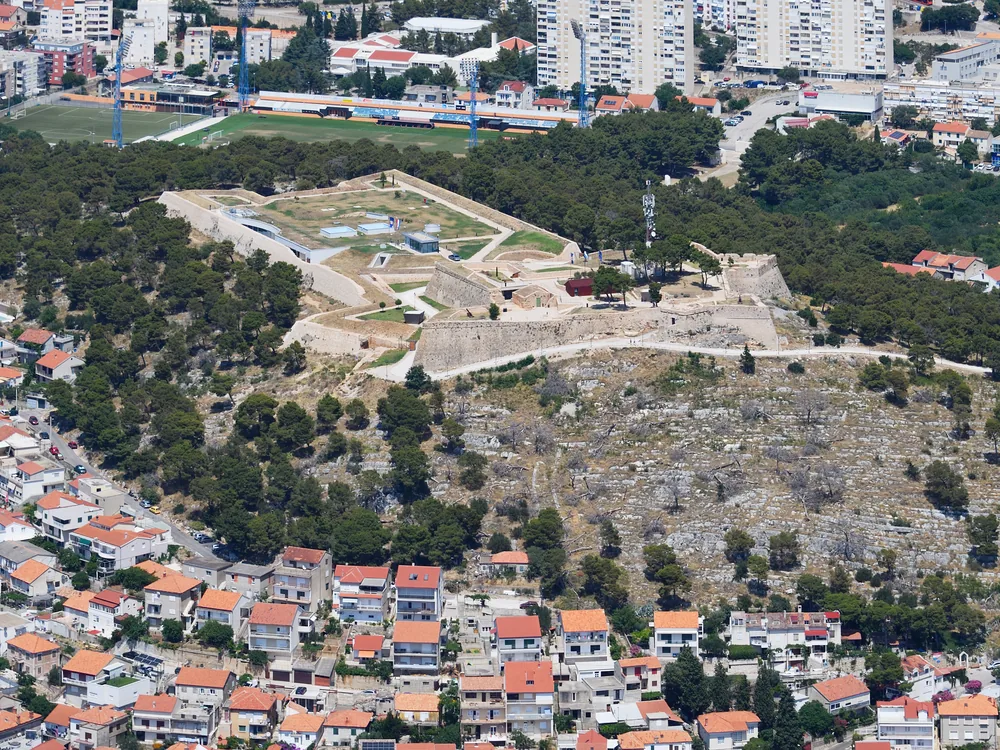
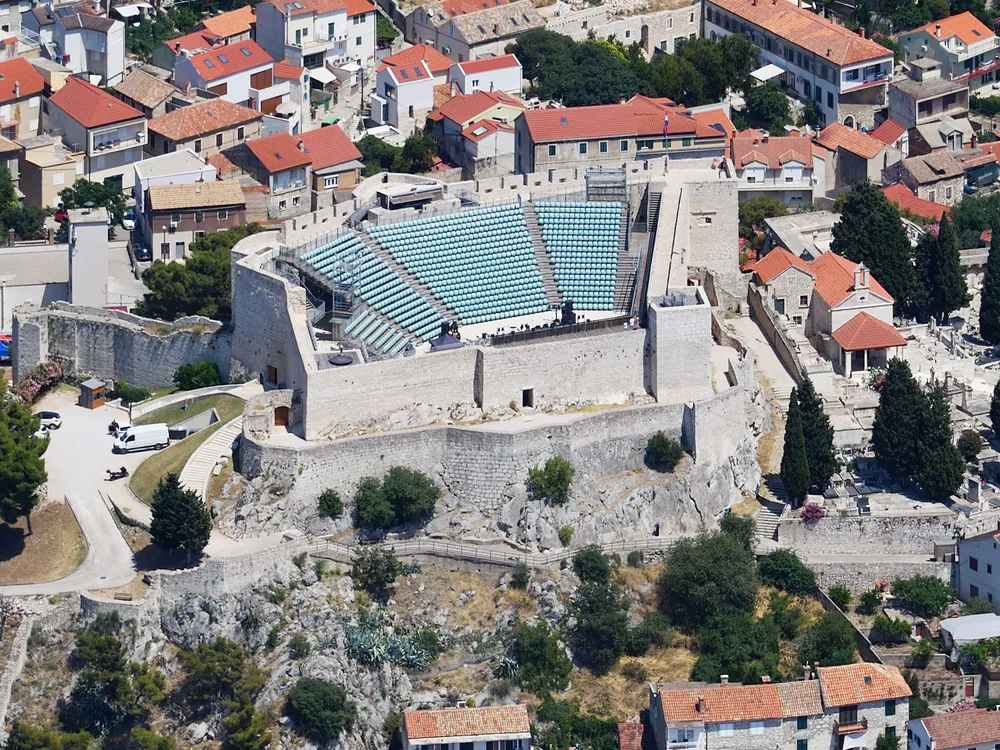
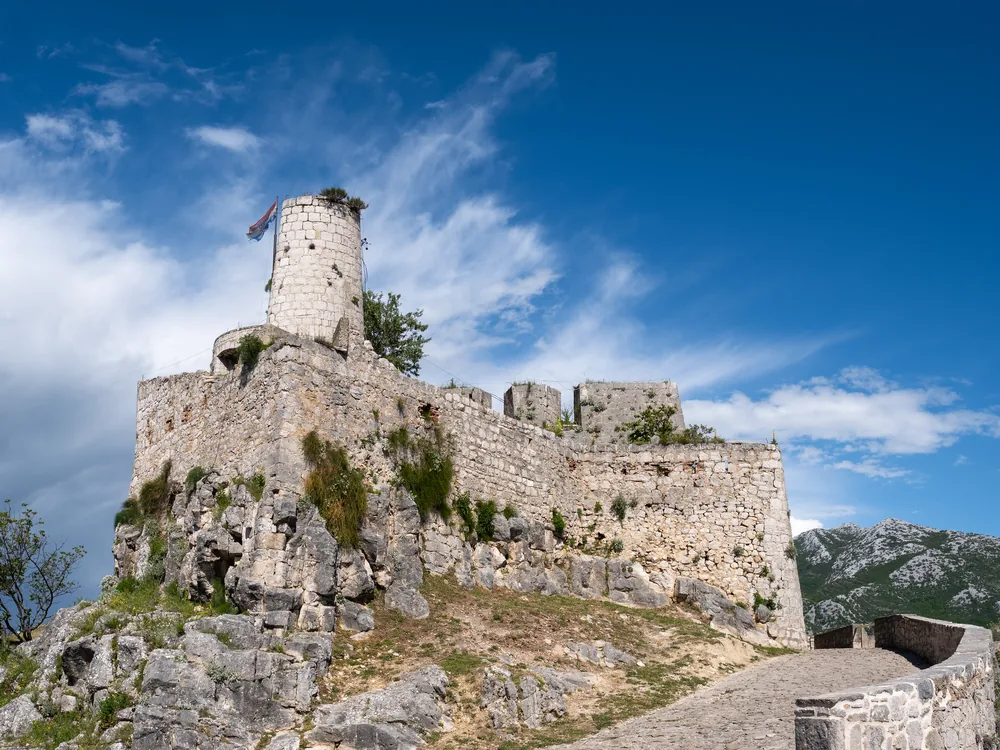
[St. John's Fortress](/castles/croatia/st-johns-fortress-sibenik), built simultaneously with Barone on the highest hill in the defensive ring, is the second element of the 1647 defensive combination — the fortress whose fields of fire interlocked with Barone's to stop the Ottoman attack; its semi-ruined, unexhibited state offers a different atmospheric character than Barone's restored interior. [St. Michael's Fortress](/castles/croatia/st-michaels-fortress-sibenik), the oldest of the three, predates the Venetian period and now functions as Šibenik's primary summer festival venue, directly above the UNESCO Cathedral of St. James. [Klis Fortress](/castles/croatia/klis-fortress), the medieval Croatian royal stronghold above Split, offers the inland Dalmatian fortress experience — a dramatically sited hilltop castle above the coastal plain.
History
The War of Candia — the long Ottoman-Venetian conflict over Crete that began in 1645 — brought the threat of Ottoman attack to every Venetian city on the Dalmatian coast, and Šibenik was among the most exposed. When the Venetian Senate received intelligence in 1646 that Ottoman forces were moving through the Dalmatian hinterland, the existing medieval defenses of the city were clearly inadequate for the artillery-equipped army approaching from the east. The Senate dispatched the military engineer Antonio Leni and authorised emergency construction of new outer fortifications. Working with extraordinary speed, Leni designed and built Barone Fortress — the bastioned earthwork fort on the hill above the town — in approximately seven months, simultaneously with St. John's Fortress on the adjacent highest hill. The two fortresses were conceived as a single interlocking defensive system.
The test came in September 1647, when Ottoman forces under Yusuf Pasha mounted a direct assault on Šibenik. The combined system held: the city remained Venetian. That repulsion was one of the few Venetian military successes of the War of Candia, which ultimately ended in 1669 with the loss of Crete. Dalmatia, however, remained Venetian until Napoleon's dissolution of the Republic and the Treaty of Campo Formio in 1797, after which the fortresses passed to Habsburg administration and gradually fell into disuse.
The restored Barone reopened in 2016 with an augmented-reality exhibit reconstructing both the 1646 construction and the 1647 battle — a digital interpretation layer that won Croatia's Cultural Attraction of the Year award in 2018.
How to Visit
Getting there: Šibenik is on the Dalmatian coast, approximately 80 km north of Split and 80 km south of Zadar, accessible by car on the A1 motorway (exit Šibenik) or by regional bus from Split or Zadar. Barone Fortress is on the hill east of the old town, accessible on foot (15 minutes from the Cathedral square) or by the tuk-tuk tour.
Tickets: Walk-up entry is approximately €4–7 (confirm at the fortress entrance); the AR exhibit is included. The GetYourGuide electric tuk-tuk panorama tour covers all three Šibenik fortresses — Barone, St. John's, and St. Michael's — on a 2-hour circuit with all entry fees included; the tour title and FAQ both confirm this explicitly.
Practical tips: The augmented-reality exhibit is the primary draw — allow at least 45 minutes to experience it properly. The open-air café and rampart views are at their best in the evening, when the city lights below become visible; June and September avoid peak August crowds while keeping full opening hours.
Combine with: St. John's Fortress, built simultaneously with Barone in 1646 on the adjacent hilltop, and St. Michael's Fortress, the oldest of the three Šibenik fortresses, above the Cathedral square — all three are on the same tuk-tuk circuit.
Frequently Asked Questions
The construction speed was a direct response to the Ottoman threat during the War of Candia (1645–1669). Reports of Ottoman forces advancing into the Dalmatian hinterland reached Venice and Šibenik in 1646, and the city's medieval fortifications — designed for an earlier era of siege warfare — were recognized as inadequate against artillery. The Venetian Senate authorized the emergency construction of a new outer defensive ring, and engineer Antonio Leni was dispatched to design and build it before the Ottomans arrived. The result was a bastioned earthwork fortress completed in approximately seven months — a timeline that required coordinated labor from across the city working under military engineering supervision. The urgency proved justified: the Ottoman attack came the following year, in 1647, and the fortress held.
Location
Tvrđava Barone, Šibenik, 22000, Šibenik-Knin County, Croatia
Nearby Castles
Tours & Tickets
Powered by GetYourGuide
From
€57.6/ person