
St. John's Fortress
Tvrđava Sv. Ivana (Šubićevac)
Croatia · Šibenik-Knin County, Šibenik · Near Šibenik
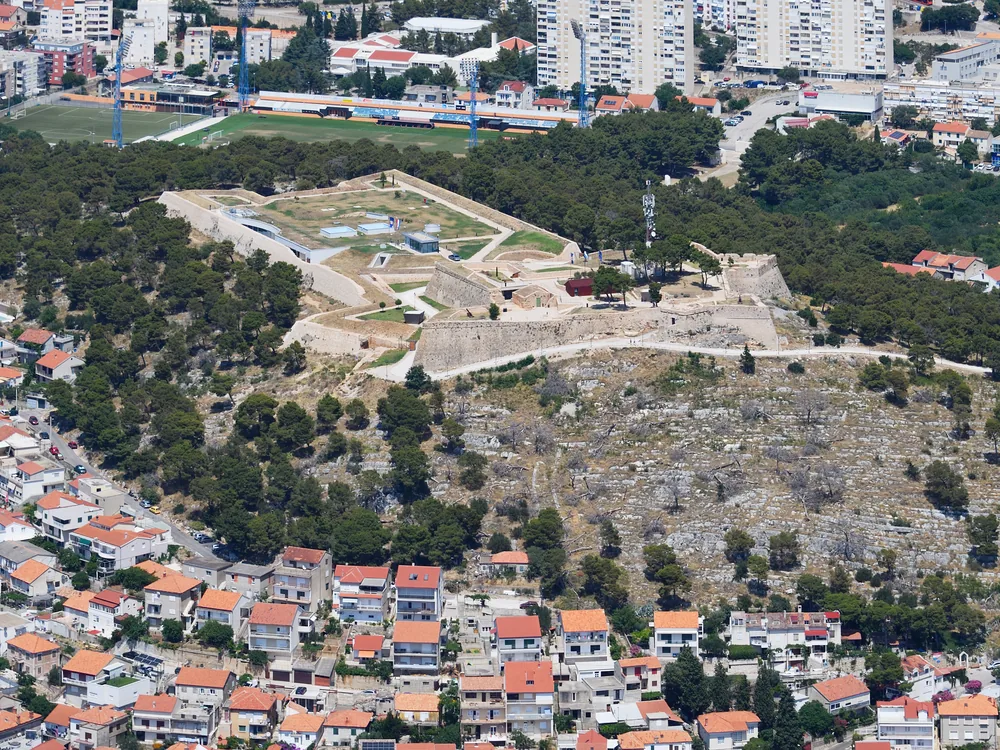
Built 1646 · 17th-century Venetian artillery-era fortress with irregular polygonal plan adapted to hilltop terrain — built simultaneously with Barone Fortress in 1646 as the second element of Šibenik's emergency outer defensive ring during the War of Candia; positioned on the highest natural hilltop of the city's defensive perimeter, the fortress plan is polygonal and asymmetric rather than the regular bastioned trace of Barone, because the hilltop's own shape dictated the layout more than pure military geometry; the walls follow the contours of the hill's rocky crown, producing a fortification that is visually striking and tactically effective without conforming to the textbook symmetry of Vauban-influenced design; unlike Barone, which received a comprehensive modern restoration and interpretive exhibit, St. John's remains in a semi-ruined state that preserves its atmospheric character as a hilltop ruin with panoramic views
This page is part of an independent travel guide and is not affiliated with, endorsed by, or operated by St. John's Fortress.
© Castles & Palaces
Quick Facts
- Hours
- Daily 08:00–20:00
- Guided tour from
- €57.6
- Duration
- 30–45 minutes (ramparts and panoramic views); 2 hours (electric tuk-tuk circuit of all three fortresses)
- Best time
- May to October for the panoramic views in good weather
- Nearest city
- Šibenik
Featured Tour
Šibenik: 3 Fortresses & Panorama Tour — All Fees Included
Cancellation available · Instant confirmation
Highlights
- ✦Best panoramic viewpoint in Šibenik — positioned on the highest hilltop in the city's defensive perimeter, the ramparts of St. John's Fortress offer the most complete view in Šibenik: the old town's terracotta rooftops, the Cathedral of St. James directly below, the Šibenik channel stretching south to the sea, the island of Prvić, and on clear days the wider Dalmatian island landscape extending north and south along the coast
- ✦Interlocking fields of fire with Barone Fortress — the tactical logic of the 1646 double-fortress construction was that neither Barone nor St. John's could be attacked without exposure to fire from the other; attackers approaching St. John's from any direction would be exposed to cannon from Barone's bastions; attackers approaching Barone would be exposed to fire from St. John's; the combination eliminated dead ground across the entire approach zone to the city's eastern hills
- ✦The 1647 Ottoman assault — in September 1647, Yusuf Pasha's Ottoman force attacked Šibenik; the interlocking defensive system of both fortresses held; the city remained Venetian while the broader War of Candia eventually cost Venice the island of Crete in 1669; Šibenik's successful defense in 1647 was one of the rare Venetian military successes in the conflict
- ✦Dual name: St. John and Šubićevac — the fortress is known both by its dedication to St. John (Sv. Ivan) and as Šubićevac, a name that references the medieval Croatian noble family the Šubić (later known as the Zrinski), who held Šibenik and its surrounding territory before Venice acquired the city in 1412; the Šubić name preserved in the fortress's vernacular designation carries the pre-Venetian medieval Croatian history of the site
- ✦Atmospheric semi-ruin — unlike Barone's modern AR exhibit and restored interior, St. John's remains in a more natural semi-ruined state, with overgrown stone walls, open ramparts, and the scale of the hilltop setting visible without interpretive mediation; visitors who walk to it independently rather than via the tuk-tuk get the full effort-and-reward of the steep approach
- ✦GetYourGuide electric tuk-tuk panorama tour — 2-hour circuit of all three Šibenik fortresses; 'All Fees Included' confirmed in product title and FAQ
Skip the queue with a guided tour
Skip-the-line tickets & expert guides
St. John's Fortress was built in the same summer of 1646 as Barone Fortress, by the same Venetian emergency engineering effort, for the same military purpose: to create an outer defensive ring for Šibenik strong enough to resist the Ottoman artillery that had been threatening the Dalmatian hinterland during the War of Candia. The two fortresses were designed together as a system — not as independent installations but as a combined defensive network in which each fortress covered the other's approaches and left attacking forces with no angle of advance that was not exposed to fire from multiple directions simultaneously.
Where Barone was built on the ridge southeast of the city with a compact bastioned trace, St. John's was positioned on the highest hilltop in Šibenik's entire defensive ring — a summit that gave it both the greatest altitude and, consequently, the longest sightlines and firing range in the system. The hill's irregular rocky crown dictated the fortress's plan: rather than the geometric regularity of the ideal bastioned trace, St. John's walls follow the natural contours of the hilltop in an asymmetric polygonal outline that trades textbook symmetry for tactical adaptation to the terrain. The result is a fortress whose plan looks irregular on a map but is highly effective in practice, exploiting every feature of the hilltop to create overlapping fields of fire.
The fortress carries two names that speak to different layers of Šibenik's history. The dedication to St. John (Sv. Ivan) reflects its Venetian construction and the Catholic devotional practice of naming military installations after patron saints. The alternative name Šubićevac references the medieval Croatian noble family the Šubić — one of the great houses of medieval Croatian nobility, who held Šibenik and controlled much of coastal Dalmatia before Venice acquired the city in 1412. The Šubić family was later absorbed into the Zrinski lineage through marriage, becoming the Zrinski who would play a central role in 17th-century Croatian political history, including the 1671 conspiracy that ended in the executions of Petar Zrinski and Fran Krsto Frankopan in Vienna. The Šubićevac name, preserved in local usage despite the Venetian official designation, maintains that pre-Venetian Croatian heritage in the city's landscape.
The test of the combined defensive system came in September 1647. Yusuf Pasha's Ottoman force attacked Šibenik expecting to find a city whose medieval walls could not withstand sustained bombardment. What the Ottoman commanders encountered was the newly-built outer ring — Barone on the southeastern ridge and St. John's on the highest hilltop — with their interlocking fields of fire covering every approach. The assault failed and the Ottomans withdrew. Šibenik remained Venetian for another century and a half, until Venice itself ceased to exist as an independent state in the 1797 Treaty of Campo Formio.
After the Austrian administration took over Dalmatia, the military rationale for maintaining the fortresses diminished. St. John's, like Barone, gradually deteriorated through the 19th and 20th centuries. Unlike Barone — which received a comprehensive modern restoration with an augmented-reality exhibit in 2016 — St. John's remains in a more natural semi-ruined state. The walls and ramparts are consolidated and safe to walk, but the interior has not been developed with interpretive content or visitor infrastructure beyond the views themselves. This contrast between the two 1646 fortresses creates a complementary visitor experience: Barone offers interpretation and context; St. John's offers atmosphere and panorama.
The panorama from St. John's ramparts is the best available from any publicly accessible point in Šibenik. Directly below: the old town's terracotta rooftops and, visible among them, the dome of the Cathedral of St. James — the UNESCO-listed cathedral built entirely from stone between 1431 and 1535, without timber or brick, the engineering achievement that defines Šibenik's architectural identity. From the hilltop, the Šibenik channel stretches south to the open sea, the island of Prvić is visible in the middle distance, and the wider Dalmatian island landscape extends along the coast in both directions.
The electric tuk-tuk tour covers all three Šibenik fortresses on a two-hour circuit with all entry fees included.
[Barone Fortress](/castles/croatia/barone-fortress), the companion fortress of the 1646 emergency construction, is the other half of the interlocking defensive system that stopped the 1647 Ottoman attack — its modern AR exhibit makes the tactical logic of the combined system visible. [St. Michael's Fortress](/castles/croatia/st-michaels-fortress-sibenik), the oldest of the three, predates the Venetian period and now serves as Šibenik's summer festival venue, directly above the harbor entrance. [Klis Fortress](/castles/croatia/klis-fortress), the medieval Croatian royal stronghold above Split, is the Dalmatian coast's inland fortress counterpart — a dramatically sited hilltop castle that was itself briefly a Venetian possession.
History
Venice acquired Šibenik from the Croatian-Hungarian crown in 1412, inheriting a city that came with a natural defensive asset — the rocky hilltop above the town that would eventually become St. John's Fortress. For more than two centuries the Venetians relied primarily on St. Michael's Fortress, the older harbour fortification below, as their principal defensive installation. The War of Candia changed the calculation.
When Ottoman forces began moving through the Dalmatian hinterland in 1646, threatening Venetian coastal cities with artillery the existing medieval walls were not designed to resist, Venice ordered an emergency outer defensive ring built around Šibenik. St. John's Fortress was constructed that same year on the highest hilltop of the city's defensive perimeter, simultaneously with Barone Fortress on the adjacent ridge. The two were designed from the outset as a combined interlocking system: fire from St. John's covered the approaches Barone could not, and vice versa, creating overlapping fields of fire across the hill terrain east of the city.
The combined system was tested in September 1647, when Yusuf Pasha's Ottoman forces assaulted Šibenik directly. The outer ring held. The city remained Venetian for another century and a half, until the Treaty of Campo Formio in 1797 transferred Dalmatia to Austria and the fortresses entered gradual decline. St. John's survived as an unmanaged ruin through the 19th and 20th centuries and is now accessible as a semi-ruined hilltop panoramic site, part of the three-fortress Šibenik circuit.
How to Visit
Getting there: Šibenik is on the Dalmatian coast between Split (80 km south) and Zadar (80 km north), accessible by car on the A1 motorway (exit Šibenik) or by regional bus. St. John's is the highest of the three Šibenik fortresses — the footpath from the Cathedral square takes approximately 15–20 minutes uphill.
Tickets: A small entry fee applies (confirm locally). The GetYourGuide electric tuk-tuk panorama tour covers all three Šibenik fortresses — Barone, St. John's, and St. Michael's — on a 2-hour circuit with all entry fees included; the tour title explicitly states "All Fees Included" and the FAQ confirms this.
Practical tips: The ramparts here give the best panoramic view of any publicly accessible point in Šibenik — the Cathedral of St. James is visible directly below, and the Šibenik channel and Dalmatian islands stretch to the horizon. Sunset visits from May to September are exceptional. The path is steep and the hilltop is exposed to wind; bring water and wear walking shoes.
Combine with: Barone Fortress, built simultaneously on the adjacent ridge in 1646, is the companion fortress whose interlocking fields of fire with St. John's stopped the 1647 Ottoman attack — its modern AR exhibit explains the combined system. St. Michael's Fortress, the oldest of the three, sits directly above the harbour and Cathedral square.
Frequently Asked Questions
The dual naming reflects two different historical layers of Šibenik's identity. The official Venetian dedication to St. John (Sv. Ivan) was assigned when the fortress was built in 1646, following Venetian military naming practice for Dalmatian fortifications. The alternative name Šubićevac references the Šubić family — a powerful medieval Croatian noble dynasty that held Šibenik and much of coastal Dalmatia before Venice acquired the city in 1412. The Šubić family later merged with the Zrinski through marriage, becoming the Zrinski-Frankopan line whose 1671 conspiracy against Habsburg rule ended in the executions of Petar Zrinski and Fran Krsto Frankopan in Vienna. The Šubićevac name, preserved in local vernacular despite the official Venetian designation, maintains the pre-Venetian Croatian history of the site in everyday usage.
Location
Tvrđava Sv. Ivana, Šibenik, 22000, Šibenik-Knin County, Croatia
Nearby Castles
Tours & Tickets
Powered by GetYourGuide
From
€57.6/ person