
St. Michael's Fortress
Tvrđava Sv. Mihovila
Croatia · Šibenik-Knin County, Šibenik · Near Šibenik
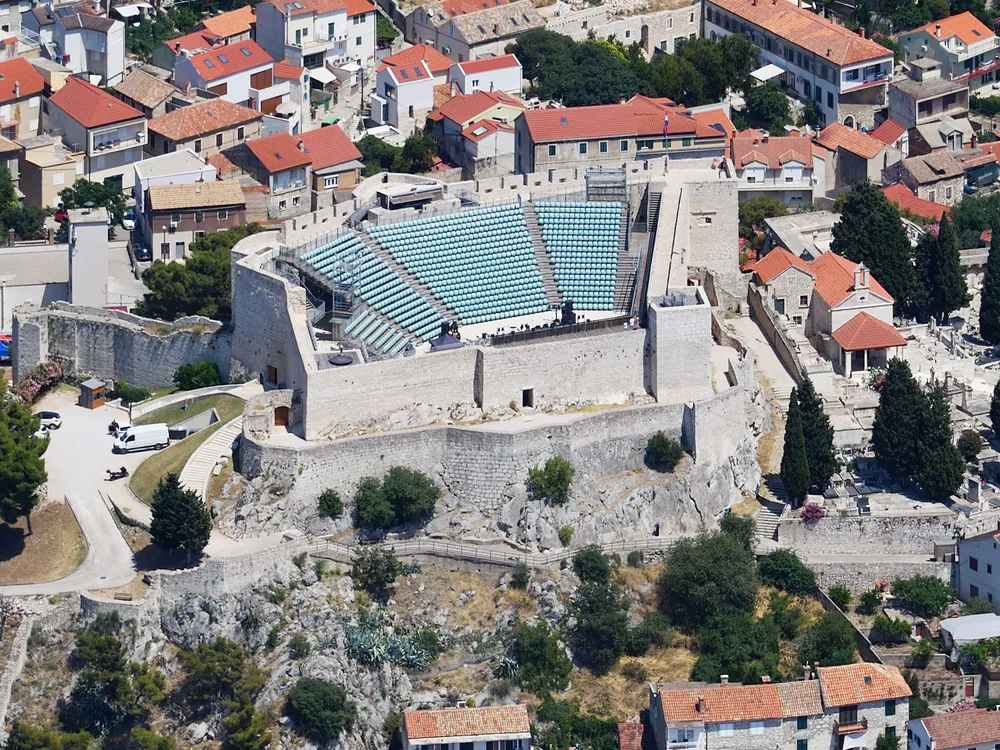
Built 1200 · Medieval Croatian fortress with Venetian artillery-era reinforcement — the oldest of the three Šibenik fortresses, with origins in the 12th–13th century under the Croatian-Hungarian crown; the core structure is a rocky-spur fortification perched directly above the entrance to Šibenik's harbor, exploiting the natural defensive advantage of the promontory to control access to the port below; the medieval fabric was reinforced and partially rebuilt by Venice after acquiring Šibenik in 1412, with additional work in the 15th and 16th centuries adapting the structure for artillery-era warfare; the fortress sits immediately above the Cathedral of St. James (UNESCO World Heritage Site, built 1431–1535), the defining monument of Šibenik's historic core, creating a visual pairing of the city's military and ecclesiastical architecture that is legible from the harbor and from the sea approach to the city; since 2014 the fortress has served as the primary outdoor stage for the Šibenik International Festival of Ancient Greek Drama and other summer festivals
This page is part of an independent travel guide and is not affiliated with, endorsed by, or operated by St. Michael's Fortress.
© Castles & Palaces
Quick Facts
- Hours
- Daily 09:00–23:00
- Guided tour from
- €57.6
- Duration
- 45 minutes–1 hour (fortress ramparts and harbor views); 2 hours (electric tuk-tuk circuit of all three fortresses)
- Best time
- Year-round
- Nearest city
- Šibenik
Featured Tour
Šibenik: 3 Fortresses & Panorama Tour — All Fees Included
Cancellation available · Instant confirmation
Highlights
- ✦The oldest fortress in Šibenik — while Barone and St. John's were emergency Venetian constructions of 1646, St. Michael's Fortress has origins in the 12th–13th century under the Croatian-Hungarian crown, predating Venetian rule by at least two centuries; it is the fortress that controlled Šibenik's harbor entrance through the medieval Croatian and Hungarian periods, before Venice acquired the city in 1412 and began a new phase of reinforcement
- ✦Positioned directly above the UNESCO Cathedral of St. James — the fortress perch above the harbor entrance places it immediately above the Cathedral of St. James, the defining monument of Šibenik — a stone barrel-vaulted cathedral built entirely from stone between 1431 and 1535 without timber or brick, designed by Juraj Dalmatinac and one of the outstanding examples of late-Gothic and early-Renaissance architecture in the Adriatic; the pairing of the military fortress above and the cathedral below is the essential visual dyad of Šibenik's historic core, legible from the harbor and from arriving boats
- ✦Šibenik International Festival of Ancient Greek Drama — since 2014 the fortress has served as the principal outdoor stage for this festival, which brings ancient Greek theatrical works to performance in a setting that is itself a product of a civilization's military ambition; the festival uses the fortress walls as a backdrop and the open-air configuration of the rocky spur as a natural amphitheatre; other summer concerts and cultural events also use the space during the June–September season
- ✦Views directly over the harbor entrance and the old town — from the ramparts the harbor channel, the sea approach to Šibenik, the Cathedral dome below, and the dense medieval street fabric of the old town are all visible in a compressed panorama that is more intimate than the wide coastal views from St. John's Fortress; this is the view from which Šibenik's historic core reads as an architectural whole
- ✦Venetian reinforcement after 1412 — when Venice acquired Šibenik, St. Michael's was the city's principal existing military fortification; the Venetians reinforced and adapted it for the artillery age over the 15th and 16th centuries, adding gun batteries and reinforcing the walls, before commissioning the 1646 outer ring (Barone and St. John's) as the Ottoman threat required a more comprehensive response
- ✦GetYourGuide electric tuk-tuk panorama tour — 2-hour circuit of all three Šibenik fortresses; 'All Fees Included' confirmed in product title and FAQ
Skip the queue with a guided tour
Skip-the-line tickets & expert guides
The oldest fortress in Šibenik stands on the most obvious defensive site the city offers: a rocky promontory directly above the entrance to the harbor, where the Šibenik channel narrows to its minimum width before opening into the bay. Whoever controlled this spur controlled the harbor. The fortress that the Croatian-Hungarian kings built here in the 12th or 13th century — the exact date of the earliest documented structure is uncertain, medieval construction on rocky promontories rarely being precisely datable — was a logical response to the strategic geography rather than a product of sophisticated military engineering. The site itself provides the defense; the walls and towers above it add to what the rock already offers.
Šibenik was a Croatian royal town before it was a Venetian one. The city's documented history begins in the 11th century, when it appears in medieval sources as a settlement of some significance on the Dalmatian coast; by the 12th century it had developed into a town with a bishop and a cathedral chapter, giving it both ecclesiastical standing and a degree of civic organization. The Croatian-Hungarian crown that held the coast during the medieval period used Šibenik and its fortress as one of the key points in the coastal defense network between Split and the northern Dalmatian islands. The town's acquisition by Venice in 1412 shifted that administrative context entirely without changing the strategic logic: the fortress above the harbor entrance remained the city's primary fortification through the change of sovereignty.
Venice reinforced what it inherited. Through the 15th and 16th centuries, as artillery warfare changed the requirements of fortification design, the Venetians added gun batteries, reinforced walls, and adapted the medieval structure's approaches for the realities of cannon. St. Michael's was never entirely rebuilt in the Vauban-influenced bastioned-trace style — that approach required flat ground and geometric regularity that the rocky spur could not offer — but it was made more effective as a harbor-covering artillery platform. It was also supplemented: by the late 16th century the city's growing population and territorial extent had expanded beyond what a single hilltop fortress could protect, and the Ottoman threat of the War of Candia made the need for a more comprehensive defensive ring urgent.
The answer in 1646 was Barone and St. John's — the two outer-ring fortresses built in emergency speed on the higher hills to the north and east. St. Michael's remained the inner harbor fortification, now part of a three-fortress defensive system rather than the sole fixed point of the city's military geography. The system's logic was tested in 1647 and held; Šibenik was not taken in the War of Candia.
Venice's eventual departure from Dalmatia in 1797 left St. Michael's in the same administrative limbo as its two companion fortresses — owned by a succession of authorities (Austrian, French briefly under Napoleon's Illyrian Provinces, Austrian again) who had no particular use for an 18th-century harbor fortification in an era of increasingly professional standing armies and changing strategic priorities. The fortress stood without active military use through the 19th and 20th centuries, available as a civic amenity but not systematically managed.
The festival transformation came in 2014. The Šibenik International Festival of Ancient Greek Drama chose St. Michael's as its primary performance venue, beginning a new functional identity for the fortress that has nothing to do with its original military purpose and everything to do with the atmospheric quality of a stone-walled hilltop open-air space above a historic harbor. The festival — which stages ancient Greek theatrical works including tragedy, comedy, and satyr play — found in St. Michael's a setting that provides a medieval-military backdrop for drama that predates the fortress by fifteen centuries. The combination has its own logic: ancient texts performed in a space that is itself old, the sea visible from the stage, the city below.
The position above the UNESCO Cathedral of St. James creates Šibenik's most distinctive architectural pairing. The Cathedral — built entirely from stone between 1431 and 1535, designed by Juraj Dalmatinac and completed by Nikola Firentinac, with barrel vaults and a dome constructed without timber or brick — is one of the finest monuments of late Gothic and early Renaissance architecture in the Adriatic. It sits directly below the fortress at the edge of the old town, and the relationship between the military installation above and the ecclesiastical monument below is visible from the harbor and from arriving boats as a compressed statement of the civic values the city expressed in its two most ambitious buildings.
[Barone Fortress](/castles/croatia/barone-fortress), built in 1646 with an AR exhibit reconstructing the Ottoman attack, and [St. John's Fortress](/castles/croatia/st-johns-fortress-sibenik), on the highest hilltop with the city's best panoramic views, complete the Šibenik fortress circuit — all three on the same GetYourGuide electric tuk-tuk tour. [Klis Fortress](/castles/croatia/klis-fortress), above Split, is the Dalmatian coast's inland counterpart.
History
The rocky promontory immediately above Šibenik's harbour entrance was the most obvious defensive site the city offered — the spur narrowed the channel and commanded the entire approach from the sea. The Croatian-Hungarian crown built the first fortress here in the 12th to 13th centuries, establishing St. Michael's as the city's primary military installation. Venice, which acquired Šibenik in 1412, inherited the fortress and spent the following century reinforcing and adapting it for artillery warfare, adding gun batteries and strengthened walls as the technology of siege warfare changed.
The construction of the Cathedral of St. James immediately below the fortress between 1431 and 1535 — the great commission that occupied Juraj Dalmatinac and Nikola Firentinac for decades — created Šibenik's defining civic pairing: Gothic-Renaissance cathedral and medieval fortress rising together from the same rocky slope above the harbour. The two buildings remain the city's most recognisable profile from the sea.
When the War of Candia brought Ottoman forces to the Dalmatian hinterland in 1646, Venice constructed Barone and St. John's Fortress on the outer hills as an emergency outer defensive ring, relegating St. Michael's to the role of inner harbour fortification. Austrian administration took over Dalmatia in 1797, and the fortress gradually left military use. Its most recent transformation has been cultural: since 2014, the Šibenik International Festival of Ancient Greek Drama has used the open fortress as its principal outdoor stage, giving the medieval walls a summer life they have not had in centuries.
How to Visit
Getting there: St. Michael's Fortress is the closest of the three Šibenik fortresses to the old town — 5 minutes on foot uphill from the Cathedral of St. James square, Šibenik's primary landmark. Šibenik is on the Dalmatian coast between Split (80 km) and Zadar (80 km), accessible by car via the A1 motorway or by regional bus.
Tickets: Entry fee applies (confirm at the fortress entrance or sibenik-tourism.hr). The GetYourGuide electric tuk-tuk panorama tour covers all three Šibenik fortresses — Barone, St. John's, and St. Michael's — on a 2-hour circuit with all entry fees included. During the summer festival season (June–September), the fortress also hosts the Šibenik International Festival of Ancient Greek Drama; festival tickets are sold separately via sibenik-kultura.hr.
Practical tips: The ramparts offer an intimate view directly over the harbour entrance and the dome of the UNESCO Cathedral of St. James below — this is Šibenik's essential visual pairing of fortress and cathedral, best photographed from the fortress in the morning light. The fortress is the starting point for the old town exploration; from here the Cathedral square, the medieval streets, and the harbor promenade are all within a short walk.
Combine with: Barone Fortress, built in 1646 with an AR exhibit reconstructing the Ottoman siege, and St. John's Fortress, on the highest hilltop with the widest panorama, complete the three-fortress Šibenik circuit — all on the same tuk-tuk tour.
Frequently Asked Questions
The Šibenik International Festival of Ancient Greek Drama has been held at St. Michael's Fortress since 2014, using the fortress walls and open-air hilltop setting as a stage and backdrop. The choice reflects the atmospheric value of the space rather than any historical connection between ancient Greek theatre and the fortress — ancient drama predates the fortress by at least fifteen centuries. The stone walls, the sea visible from the stage, and the hilltop position create a performance environment with natural acoustic properties and visual grandeur that indoor theatres cannot replicate. The festival stages tragedy, comedy, and satyr plays from the 5th-century BCE Athenian repertoire in a setting that resonates with the endurance of Mediterranean stone-building traditions across time. The same space hosts concerts and other cultural events through the June–September festival season.
Location
Tvrđava Sv. Mihovila, Šibenik, 22000, Šibenik-Knin County, Croatia
Nearby Castles
Tours & Tickets
Powered by GetYourGuide
From
€57.6/ person