
Clam-Gallas Palace
Palác Clam-Gallasů
Czech republic · Bohemia — Prague, Old Town (Staré Město), Husova Street · Near Prague
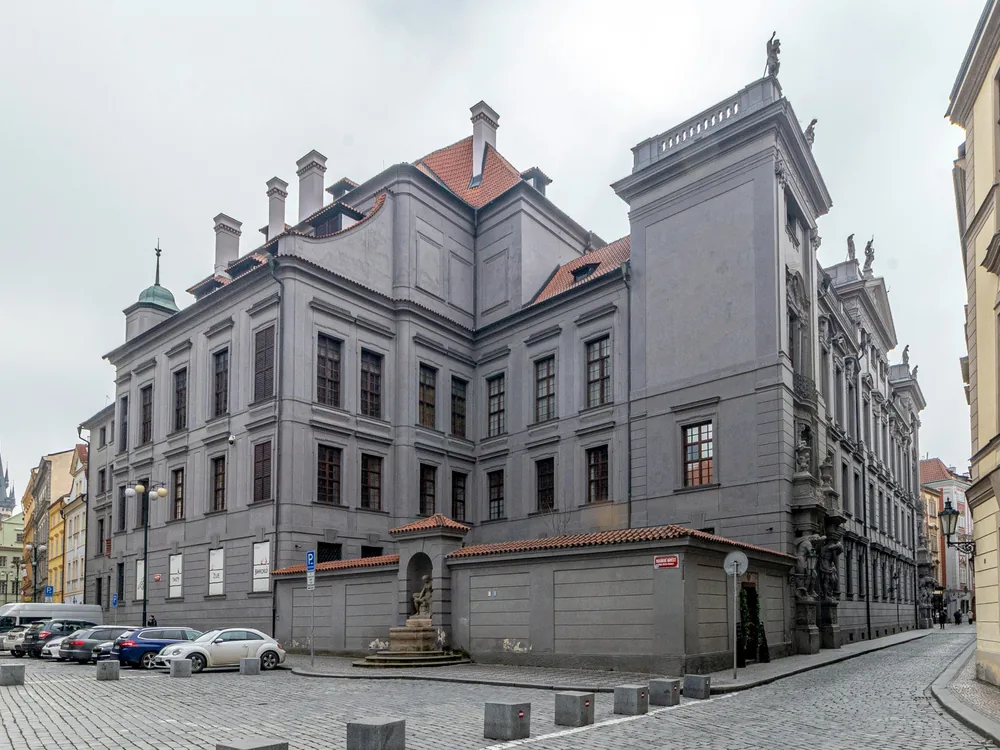
Built 1713 · Viennese High Baroque palace, 1713–1719, designed by Johann Bernhard Fischer von Erlach — the Clam-Gallas Palace is the only secular residential building designed by Fischer von Erlach (1656–1723) in Bohemia; Fischer was the pre-eminent Baroque architect of the Habsburg sphere, responsible for the Schönbrunn Palace project, the Vienna Hofburg additions, and the Karlskirche; at Clam-Gallas he produced a monumental urban palazzo whose primary architectural statement is the ceremonial entrance portal (two competing pairs of Hercules atlas figures by Matyáš Bernard Braun) and the grand ceremonial staircase rising from the arcaded courtyard; the palace's four wings enclose an internal courtyard with a restored well; the principal floor (piano nobile) is distributed across a sequence of state rooms whose ceiling frescoes were painted by Carlo Carlone between 1727 and 1730; the rooms include the Golden Hall (Zlatý sál), the Turquoise Hall (Tyrkysový sál), the Marble Hall (Mramorový sál), the Chinese Lounge (Čínský salónek), and the later winter-garden rooms added in the 19th century; the palace facade on Husova Street presents the characteristic Viennese High Baroque idiom: giant pilasters, rusticated base, and the portal sculptures that are the single most photographed element of the building
This page is part of an independent travel guide and is not affiliated with, endorsed by, or operated by Clam-Gallas Palace.
© Castles & Palaces
Quick Facts
- Hours
- Tue–Sun 09:00–18:00. Closed Mon
- Entry from
- €200
- Duration
- 1–2 hours (the ceremonial staircase, all principal state rooms of the piano nobile including the Golden Hall, Turquoise Hall, Marble Hall, and Chinese Lounge, plus the courtyard)
- Best time
- Year-round
- Nearest city
- Prague
Highlights
- ✦Fischer von Erlach's only Bohemian palace — the Viennese Baroque master in Prague — Johann Bernhard Fischer von Erlach (1656–1723) was the defining architect of the Habsburg Baroque: responsible for the original Schönbrunn Palace project, the Vienna Hofburg additions, the Karlskirche, and the national library; the Clam-Gallas Palace is the only urban residential building he designed outside Vienna and the Habsburg court's immediate sphere; the commission came from Jan Václav Gallas, Count of Campo and Imperial Field Marshal, who wanted a palace in Prague's Old Town commensurate with his status and with the grandeur of the Viennese court palaces he frequented; Fischer produced a building that introduced the Viennese High Baroque vocabulary — the giant pilasters, the dramatically sculpted portal, the ceremonial staircase — into a Bohemian urban context where nothing quite like it had previously existed
- ✦Braun's Hercules portal sculptures — the most theatrical doorway in Prague — the primary approach to the Clam-Gallas Palace from Husova Street passes between two pairs of Hercules atlas figures sculpted by Matyáš Bernard Braun (1684–1738), the pre-eminent Baroque sculptor in Bohemia; the four figures strain under the weight of the portal entablature in attitudes of concentrated muscular effort — a Baroque convention for portal sculpture that presents the act of entering a noble palace as supported by semi-divine physical power; Braun was simultaneously working on the sculptural programmes for the Charles Bridge and the Garden of Kuks Hospital during this period; the Clam-Gallas portal figures are his most concentrated statement in an urban architectural context, visible at close range from the pavement and at a scale that confronts rather than elevates the pedestrian
- ✦Carlone's ceiling frescoes and the sequence of state rooms — Baroque painted decoration in its completeness — the principal state rooms of the piano nobile preserve their original ceiling fresco cycle painted by Carlo Carlone between 1727 and 1730: allegorical compositions in the trompe-l'oeil tradition of Viennese Baroque fresco painting, depicting mythological and heraldic subjects appropriate to the Gallas family's imperial military status; the rooms — Golden Hall, Turquoise Hall, Marble Hall, Chinese Lounge — form a processional sequence from the ceremonial staircase landing through the apartment rooms, each with its fresco programme, its period stucco work, and its wall treatment; the Chinese Lounge reflects the period fashion for chinoiserie that simultaneously produced similar rooms in Schönbrunn and Charlottenburg; the sequence as a whole represents a remarkably intact survival of High Baroque residential decoration in a Bohemian urban palace
- ✦Prague City Archive and the palace's later history — from aristocratic residence to civic institution — the Clam-Gallas Palace passed through the Clam family (through the marriage of the last Gallas heiress to Christian Philipp von Clam) in the 18th century and remained in noble residential use into the 20th century; Czechoslovak President Edvard Beneš used the palace as a residence in the interwar period; after World War II, the palace was nationalised and eventually came under the management of the Prague City Archive (Archiv hlavního města Prahy), which occupies the building's working spaces while maintaining the piano nobile interiors as a museum open to visitors; the result is an active archive housed in a palace of world architectural significance — one of the stranger institutional situations in Central European heritage
Skip the queue with a guided tour
Skip-the-line tickets & expert guides
The portal on Husova Street in Prague's Old Town is guarded by four figures of Hercules. They are muscular, strained, and enormous — each figure carries part of the entablature of the doorway on his shoulders in the Baroque convention for atlas sculpture, their effort so theatrical and their scale so dominating that the pedestrian approaching from either direction on Husova encounters them as confrontation rather than ornament. They are the work of Matyáš Bernard Braun, the greatest Baroque sculptor in Bohemia, carved between 1713 and 1716 for a palace whose architectural ambition they perfectly announce.
The Clam-Gallas Palace was commissioned by Jan Václav Gallas, Count of Campo and Imperial Field Marshal — one of the most powerful military figures in the Habsburg Empire at the time — who wanted a residence in Prague's Old Town equal to the palatial architecture he knew from Vienna. To design it, he hired Johann Bernhard Fischer von Erlach, the pre-eminent Baroque architect of the Habsburg sphere. Fischer had designed the original Schönbrunn Palace project, the Karlskirche in Vienna, the Hofbibliothek, and the Vienna Hofburg's ceremonial additions. The Clam-Gallas Palace is the only secular residential building he designed in Bohemia — his single contribution to Prague's architectural history — and it introduced the Viennese High Baroque vocabulary into a city that had been working with its own distinct Bohemian Baroque tradition.
The building plan is organised around an arcaded courtyard, from which the grand ceremonial staircase rises to the piano nobile. The staircase is the architectural centrepiece of the interior: a single flight under a painted vault, wide enough to constitute a room in itself, designed to give the act of ascending to a noble's state apartments the processional character that Baroque court culture required. At the top of the staircase, a sequence of state rooms opens from the landing: the Golden Hall (Zlatý sál), the Turquoise Hall (Tyrkysový sál), the Marble Hall (Mramorový sál), and the Chinese Lounge (Čínský salónek), each with its ceiling fresco programme painted by Carlo Carlone between 1727 and 1730.
Carlone's frescoes are the interior equivalent of Braun's portal sculptures: allegorical compositions in the trompe-l'oeil tradition of Viennese Baroque ceiling painting, depicting mythological and heraldic subjects appropriate to the Gallas family's imperial military identity. The sequence of rooms moves from the formal grandeur of the Golden Hall through the more intimate painted decoration of the Turquoise Hall to the chinoiserie of the Chinese Lounge — a room that reflects the pan-European fashion for 'Chinese' ornament that simultaneously produced the Chinese rooms at Schönbrunn and Charlottenburg in the 1720s. The rooms as a whole represent one of the most intact surviving High Baroque residential interiors in Central Europe, undisturbed by the systematic 19th-century renovation that altered comparable palaces elsewhere.
The palace passed to the Clam family through the marriage of the last Gallas heiress and has been known as the Clam-Gallas Palace ever since. In the interwar period, Czechoslovak President Edvard Beneš used it as a residence. After World War II and nationalization, it came under the management of the Prague City Archive, which occupies the building's working spaces while maintaining the piano nobile as a museum open to visitors.
This institutional arrangement produces one of the stranger experiences in Central European cultural tourism: a palace of genuine world architectural significance — designed by the greatest Baroque architect of the Habsburg sphere, with portal sculptures by its greatest Baroque sculptor, and ceiling frescoes by a master of Baroque decorative painting — accessible for approximately the price of a cinema ticket. The GYG entry ticket (t526046, from €7.43) includes admission and audio guide, making this arguably the most underpriced major Baroque interior in Europe.
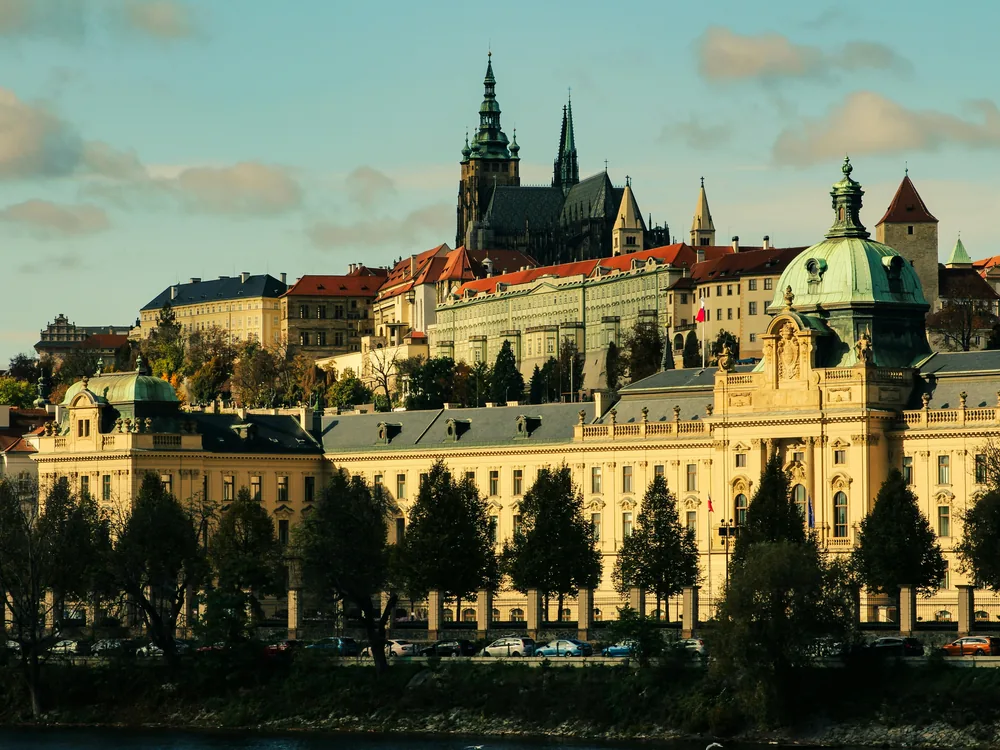
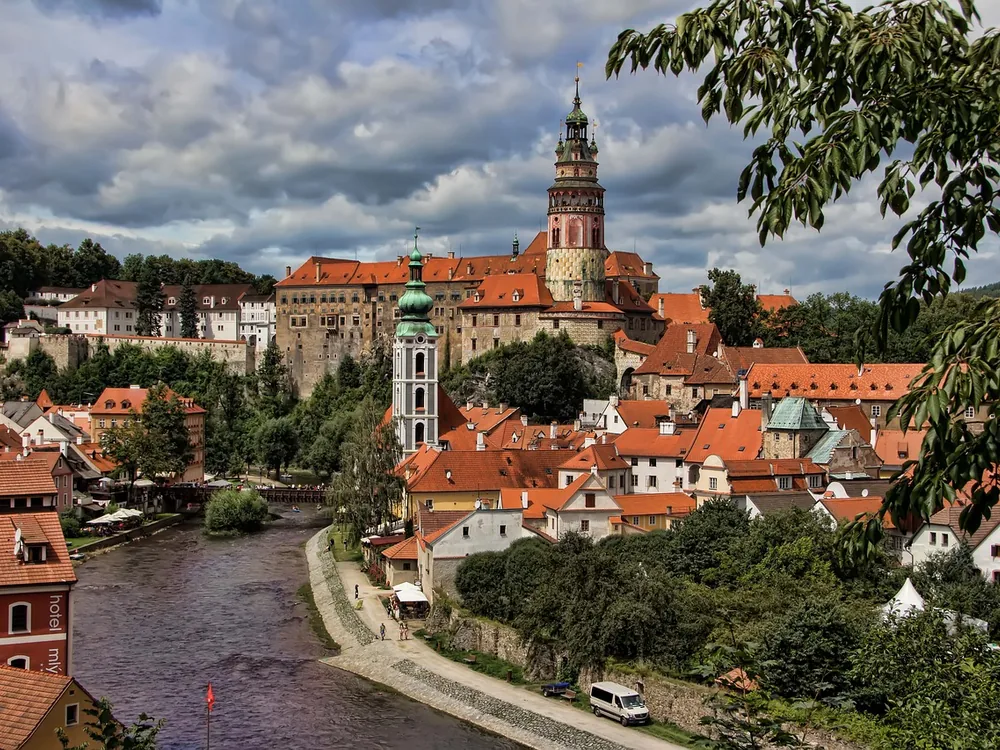
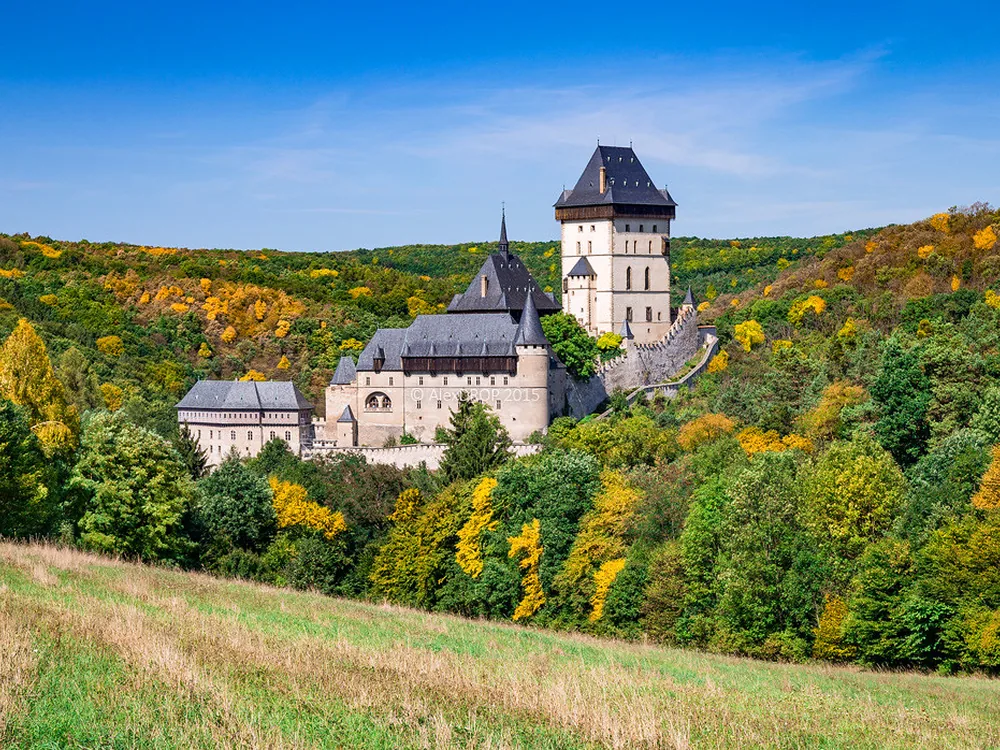
[Prague Castle](/castles/czech-republic/prague-castle) — the sprawling hilltop complex across the Vltava that defines Prague's skyline and contains the Cathedral of St Vitus — is the essential companion for understanding the scale of Prague's architectural heritage. [Karlštejn Castle](/castles/czech-republic/karlstejn-castle) — the iconic 14th-century Gothic fortress 30km southwest — and [Český Krumlov Castle](/castles/czech-republic/cesky-krumlov-castle) extend the Bohemian castle circuit beyond the capital.
History
Jan Václav Gallas, Count of Campo and Imperial Field Marshal, commissioned Johann Bernhard Fischer von Erlach to design his new Prague palace in 1713 — a choice that placed the most celebrated architect of the Habsburg Baroque at the centre of what became the finest private palace in the Old Town. The four Hercules atlas figures flanking the portal on Husova Street, carved by Matyáš Bernard Braun between 1713 and 1716, established the building's theatrical register from the street: enormous, muscular, and undeniably aristocratic. The main structure was complete by 1719, and Carlo Carlone's ceiling frescoes in the principal state rooms were finished by 1730.
The Gallas line eventually passed through the female line to the Clam family, who lent their name to the hyphenated palace title it carries today. Through the 19th century it continued as an aristocratic residence, with additional rooms — including a Chinese Lounge and a winter-garden space — added to the interior. During the interwar period, President Edvard Beneš used it as a Prague residence; it survived the German Occupation without major damage.
Nationalisation after 1945 brought the palace under state management, and it was eventually assigned to the Prague City Archive, which occupies its working spaces while the piano nobile — the ceremonial state rooms — has been opened to visitors with an entry ticket and audio guide. The combination of Fischer von Erlach's architecture, Braun's sculpture, and Carlone's frescoes makes this one of the most cohesive Baroque interiors in the Czech Republic, and one of the least visited given its location in central Prague.
How to Visit
Getting there: The palace is on Husova Street in Prague's Old Town, a 5-minute walk from Old Town Square. The nearest metro station is Staroměstská (line A). The surrounding area is a pedestrian zone with no dedicated parking.
Tickets: Walk-up entry is 200 CZK adult. The GYG entry ticket with audio guide (t526046, from €7.43, 4.5★/148 reviews) is the official Muzeum Prahy admission including audio guide kit rental for a self-guided visit of all accessible state rooms on the piano nobile.
Practical tips: Despite being steps from Old Town Square, the palace is far less crowded than the nearby major attractions — mid-morning on a weekday is typically quiet. The piano nobile is reached via approximately 30 steps up the ceremonial staircase; there is no lift access.
Combine with: [Prague Castle](/castles/czech-republic/prague-castle) — the hilltop complex 20 minutes by tram, with St Vitus Cathedral and the Royal Palace. [Karlštejn Castle](/castles/czech-republic/karlstejn-castle) — the 14th-century Gothic fortress 30 km southwest.
Frequently Asked Questions
The four Hercules atlas figures flanking the entrance portal of the Clam-Gallas Palace were sculpted by Matyáš Bernard Braun (1684–1738), the leading Baroque sculptor in Bohemia, between approximately 1713 and 1716. They represent the Baroque convention for portal sculpture in which semi-divine figures support the weight of the entablature — presenting the act of entering a noble palace as sustained by superhuman power. Braun was working simultaneously on the Charles Bridge statues and the sculptures for the Kuks Hospital garden during this period; the Clam-Gallas portal figures are his most intense work in an urban architectural context. They are among the most photographed elements of Prague's Baroque heritage.
Location
Palác Clam-Gallasů, Husova 20, 110 00 Praha 1, Czech Republic
Nearby Castles
Tours & Tickets
Powered by GetYourGuide
Entry from
€200/ adult