
Vyšehrad
Vyšehrad
Czech republic · Prague · Near Prague
Built 870 · Original Přemyslid fortress (10th century); rebuilt as Baroque military fortress 1654–1727 by the Habsburg Empire; Romanesque rotunda (11th century) and Gothic Basilica of St Peter and Paul remain as historic cores
This page is part of an independent travel guide and is not affiliated with, endorsed by, or operated by Vyšehrad.
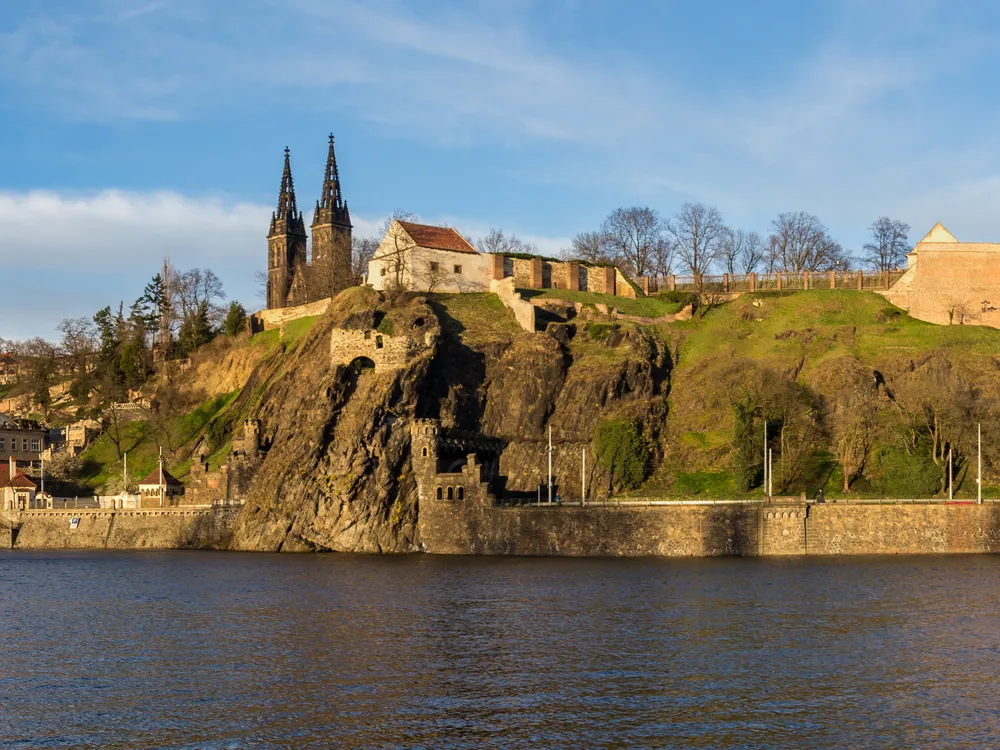
© Unsplash
Quick Facts
- Hours
- Daily Grounds open 24 hours; Casemates and Gorlice Gallery 09:30–18:00
- Guided tour from
- €38.25
- Duration
- 1.5–2 hours (grounds free; Casemates and Gorlice Gallery require separate ticket ~€4)
- Best time
- April to October
- Nearest city
- Prague
Featured Tour
Prague’s Best Hidden Gem: Vysehrad Castle & Historic Fort
Cancellation available · Instant confirmation
Highlights
- ✦Legendary seat of Princess Libuše, who founded Prague according to Czech myth — a story that predates the earliest documented fortress here, dated by historians to around 870 AD
- ✦The Romanesque Rotunda of St Martin, built around 1070 AD and still standing in the grounds, among the oldest intact buildings in the Czech Republic
- ✦Vyšehrad Cemetery and the Slavín monument — the collective tomb of 50 celebrated Czechs, with individual graves including Antonín Dvořák, Bedřich Smetana, Alphonse Mucha, Jan Neruda and Karel Čapek
- ✦A star-shaped Baroque military fortress built by the Habsburgs from 1654, its brick bastions and Casemates still defining the dramatic skyline visitors see today
- ✦The Devil's Column — three fragments of a Roman-era column lying in the grounds for reasons no historian has fully explained, attributed locally to a lost wager between a priest and the devil
Skip the queue with a guided tour
Skip-the-line tickets & expert guides
While Prague Castle draws the crowds on the river's left bank, the rocky promontory on the right bank — Vyšehrad — holds something rarer: a fortress where Czech myth and Czech history are impossible to separate, where legendary princes rub shoulders with buried composers, and where the views back across the Vltava to Prague's rooftops are arguably better than anything visible from the castle itself.
Czech legend holds that Vyšehrad was the seat of the first Přemyslid rulers, and that Libuše, the prophetic princess credited with founding Prague, stood on this very rock and looked north across the Vltava to foresee the city's future glory. Historians date the earliest fortress on the site to around 870 AD, a documented fact that sits alongside, rather than displacing, the legend — both converge on the same promontory, and Vyšehrad has never quite separated the two in the Czech imagination.
The site became the ceremonial seat of the Přemyslid dynasty in the 11th century under Vratislaus II, who for a period preferred it to Prague Castle across the river, briefly making Vyšehrad the more politically important of the two fortresses. The Romanesque Rotunda of St Martin, built around 1070, survives from this era as one of the oldest intact buildings in the Czech Republic, and the Basilica of St Peter and Paul was founded in the same period, though its current Gothic-revival towers date from a later rebuilding.
Most of what gives Vyšehrad its present silhouette, however, is far younger than its medieval core. In 1654 the Habsburgs rebuilt the entire site as a star-shaped Baroque military fortress, burying much of the medieval structure beneath new brick ramparts and bastions — a transformation completed by 1727. The Casemates carved into these ramparts once served as military storage and now house a small gallery, including four original sculpted figures removed from the Charles Bridge for preservation.
The most quietly moving part of any visit, though, is the Vyšehrad Cemetery, the National Cemetery opened in 1869 as the burial ground for the Czech nation's most celebrated cultural figures. Antonín Dvořák and Bedřich Smetana are buried here, as are Alphonse Mucha, Jan Neruda and Karel Čapek. The cemetery is not large — it is intensely concentrated, and the Slavín monument, the collective tomb of 50 celebrated Czechs, rewards focused attention rather than a passing glance. For anyone with an interest in Czech culture, this is among the most affecting sites in the country.
History
The earliest documented fortification at Vyšehrad dates to around 870 AD, on a rocky promontory above the Vltava that Czech legend independently identifies as the seat of the earliest Přemyslid rulers and the site from which Princess Libuše foresaw the founding of Prague. The fortress rose to genuine political importance in the 11th century under Vratislaus II, who made it his preferred seat over Prague Castle, building the Romanesque Rotunda of St Martin around 1070 and founding the Basilica of St Peter and Paul in the same period — both of which survive today, though much altered.
Vyšehrad's status as a royal seat declined in subsequent centuries as Prague Castle reasserted its primacy, and the medieval fortifications fell into disrepair through the Hussite wars and the Thirty Years' War. The site's character changed entirely in 1654, when the Habsburg Empire began rebuilding the entire promontory as a star-shaped Baroque military fortress, a project that continued until 1727 and buried much of the surviving medieval fabric beneath new brick ramparts, bastions and underground Casemates designed for artillery storage and defence.
The fortress's modern significance was sealed in 1869 with the opening of the Vyšehrad Cemetery as Prague's National Cemetery, intended as the resting place for the most distinguished figures of Czech cultural and intellectual life. Antonín Dvořák, Bedřich Smetana, Alphonse Mucha, Jan Neruda and Karel Čapek are among those buried there, alongside the Slavín monument, a collective tomb for 50 celebrated Czechs completed in 1893. Vyšehrad today functions as a public park and historic monument managed by the city of Prague, with its military Casemates and Gorlice Gallery open as a paid attraction within an otherwise free and unrestricted public space.
How to Visit
Getting there: Take Metro Line C to Vyšehrad station (two stops from Wenceslas Square), then walk 5 minutes to the Táborská Gate entrance. The fortress sits on the opposite Vltava bank from Prague Castle — a natural half-day addition without retracing steps through the city centre.
Tickets: Entry is free. The fortress grounds, ramparts, basilica exterior, Devil's Column, and National Cemetery are all freely accessible with no fixed closing time. The Casemates and Gorlice Gallery (housing four original Charles Bridge sculptures) require a separate ticket of ~€4. The GetYourGuide guided tour runs 2.5 hours and untangles the layered Přemyslid, Habsburg, and National Revival histories on the hill.
Practical tips: Vyšehrad is a genuine public park — locals walk dogs and eat lunch here daily. Allow 1.5–2 hours to cover the grounds properly; the Slavín monument and the graves of Dvořák and Smetana in the National Cemetery reward focused attention rather than a quick pass.
Combine with: Prague Castle — the Hradčany hilltop complex on the opposite Vltava bank, the essential pairing for Prague's two great elevated fortresses.
Frequently Asked Questions
Yes — the fortress grounds, ramparts, the exterior of the Basilica of St Peter and Paul, the Devil's Column, and the National Cemetery are all free to enter with no fixed opening hours. Only the Casemates and Gorlice Gallery, which house military storage spaces and original sculptures from the Charles Bridge, charge a small admission fee of around €4.
Location
Vyšehrad, V Pevnosti 159/5b, 128 00 Prague 2, Czech Republic
Nearby Castles
Tours & Tickets
Powered by GetYourGuide
From
€38.25/ person