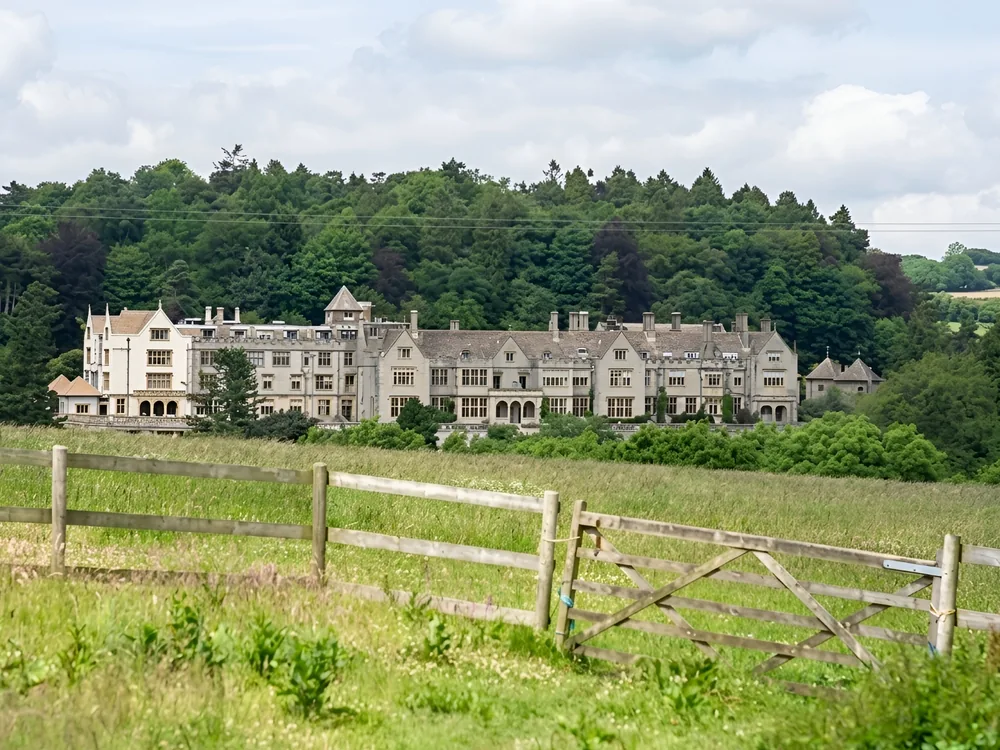
Bovey Castle
England · Devon — North Bovey, Dartmoor National Park · Near Exeter
Built 1906 · Edwardian neo-Elizabethan/Jacobean mansion, built 1906–1907 by architect Delmar Blow in granite from the estate itself with Darley Dale stone dressings — a genuine period country house with castellated features, Grade II* listed
This page is part of an independent travel guide and is not affiliated with, endorsed by, or operated by Bovey Castle.
© Castles & Palaces
Quick Facts
- Rooms from
- £239 / night
- Hotel rating
- ★★★★★ 5-Star Hotel
- Duration
- Restaurant dining: 1–2 hours; overnight stay separately bookable
- Best time
- Year-round
- Nearest city
- Exeter
Stay Here
Bovey Castle
★★★★★ 5-Star HotelRooms are split between the historic building and a newer wing
Booked via Booking.com · Cancellation terms vary by rate
General restaurant access open to non-residents; golf-clubhouse-specific dining reported as guests-only in some reviews — see Highlights above
Highlights
- ✦Built 1906–1907 for W.F.D. Smith, 2nd Viscount Hambleden, son of W.H. Smith, founder of the WHSmith bookshop chain
- ✦Designed by architect Delmar Blow in a neo-Elizabethan/Jacobean style, built from granite quarried on the estate itself with Darley Dale stone dressings from Derbyshire
- ✦Grade II* listed — a genuine Edwardian country house with castellated features, comparable in scale and period authenticity to Castle Drogo elsewhere in Devon
- ✦Used as a convalescent home for officers in the First World War and as a military hospital in the Second
- ✦Sold in 1930 to the Great Western Railway for just £15,000, following a £1 million death-duty bill after Lord Hambledon's death in 1928 — GWR opened it as a hotel and golf resort that same year
Stay overnight
Book a room via Booking.com
Bovey Castle occupies a substantial position within Dartmoor National Park near North Bovey in Devon, and despite its name, it is not a medieval fortification but a genuine Edwardian country house, built between 1906 and 1907 for W.F.D. Smith, 2nd Viscount Hambleden — son of W.H. Smith, the businessman who founded the WHSmith bookshop and newsagent chain that remains a familiar presence on British high streets to this day. The house was designed by the architect Delmar Blow in a confident neo-Elizabethan and Jacobean revival style, constructed from granite quarried directly on the estate and finished with dressings of Darley Dale stone brought from Derbyshire, giving the building a genuinely substantial and locally rooted material character.
Bovey Castle's castellated features and grand scale place it firmly within a distinctive category of genuinely historic English 'castle' properties that were never medieval fortresses to begin with — grand Edwardian and Victorian country houses built with castle-like styling as a deliberate architectural statement rather than a defensive necessity. Bovey holds Grade II* listed status, one tier below the highest level of English heritage protection, and is genuinely comparable in scale, period and ambition to Castle Drogo, another celebrated and widely recognised Edwardian 'castle' elsewhere in Devon — a useful point of reference for visitors more familiar with medieval castle architecture who might otherwise assume Bovey's name implies a much older building.
The house's early 20th-century history moved quickly from private grandeur into institutional service. During the First World War, Bovey served as a convalescent home for officers recovering from the conflict, and during the Second World War it operated as a military hospital — uses shared by numerous large English country houses whose scale and seclusion made them well suited to wartime medical and recuperative purposes. The Smith family's tenure at Bovey ended after Lord Hambledon's death in 1928, when the estate faced a punishing £1 million death-duty bill, a financial burden common to many British aristocratic families in the interwar period as inheritance taxation reshaped the economics of maintaining large country estates. The property was sold in 1930 to the Great Western Railway for just £15,000 — a striking gap between the estate's evident value and its actual sale price, reflecting how difficult these properties had become to maintain privately. GWR opened Bovey as a hotel and golf resort the same year, beginning its continuous life in hospitality that has now lasted nearly a century.
Today Bovey Castle operates as a 5-star resort — carrying the AA's 5 Red Star classification — set within 275 acres of Dartmoor parkland, with 59 bedrooms in the main house plus 22 additional self-catering lodges on the grounds, alongside a spa and a championship golf course that remains central to the resort's identity. Two restaurants welcome the public: Smith's Brasserie offers a more relaxed, informal dining experience, while the Great Western Restaurant provides a fuller fine-dining option, both open to non-residents with advance reservation. One practical nuance worth knowing: some non-resident golfers have noted that breakfast and coffee facilities specifically within the golf clubhouse are reserved for hotel guests, though this does not affect general access to the resort's two main restaurants, which remain open to the public in the ordinary way.
For visitors exploring Dartmoor National Park, Bovey Castle offers a genuinely substantial slice of Edwardian architectural ambition, a documented connection to one of Britain's most familiar retail names, and a public dining option within a resort built on land shaped by granite quarried from the very hills that surround it.
History
Bovey Castle was built between 1906 and 1907 for W.F.D. Smith, 2nd Viscount Hambleden, son of W.H. Smith, founder of the WHSmith retail chain, designed by architect Delmar Blow in a neo-Elizabethan and Jacobean style using granite quarried on the estate with Darley Dale stone dressings. It served as a convalescent home for officers in the First World War and a military hospital in the Second. Following Lord Hambledon's death in 1928 and a resulting £1 million death-duty bill, the estate was sold in 1930 to the Great Western Railway for £15,000, which opened it as a hotel and golf resort that year. Bovey Castle holds Grade II* listed status and today operates as a 5-star resort with 59 bedrooms and 22 self-catering lodges across 275 acres.
How to Stay
Getting there: North Bovey, Dartmoor National Park, Devon.
Rooms & rates: Castle, Valley and State Rooms are within the historic 1906-07 Edwardian manor house itself; Mews Rooms are in a separate courtyard mews building (second floor, stairs only); 22 further lodges (3 bedrooms each) are elsewhere in the grounds.
On-site: Restaurant, golf course, Dartmoor National Park grounds.
Good to know: Specify a Castle, Valley or State room if sleeping inside the original manor house is the priority — the Mews rooms and lodges, while comfortable, are separate structures.
Combine with: Castle Drogo, a comparable early-20th-century 'castle,' about 40 minutes away.
Frequently Asked Questions
No — Bovey Castle is a genuine Edwardian country house, built in 1906–1907 for W.F.D. Smith, 2nd Viscount Hambleden, in a neo-Elizabethan and Jacobean revival style with castellated features. It is Grade II* listed and comparable in period and scale to Castle Drogo, another well-known Edwardian 'castle' in Devon, rather than being a medieval fortification.
Location
North Bovey, Moretonhampstead, Devon TQ13 8RE, England
Nearby Castles
Rooms from
£239/ night