Corfe Castle
Corfe Castle
England · South West England — Dorset, Isle of Purbeck, Corfe Castle village · Near Bournemouth
Built 1086 · Medieval English castle, 11th–15th century, with Norman keep origins and later Plantagenet and medieval expansion; deliberately 'slighted' (partially demolished) by Parliamentary forces in 1646 — Corfe Castle occupies a natural gap in the Purbeck Hills, the only break in the chalk ridge that runs the length of the Isle of Purbeck; William the Conqueror built the first stone tower on this strategic hilltop in the late 11th century, exploiting the natural defensive mound at the point where the chalk ridge is breached; subsequent English monarchs expanded the castle throughout the medieval period, adding towers, walls, curtain elements, and residential structures that made Corfe one of the most important royal castles in England; King John in particular used the castle as a treasury and a place of imprisonment; the castle reached its greatest extent in the 14th–15th centuries; the Parliamentary slighting of 1646 was deliberate and systematic — Parliamentary forces undermined the towers and walls after capturing the castle, causing them to lean and collapse in the characteristic tumbling posture that the ruins retain today; the result of 17th-century military demolition is the visual drama that makes Corfe Castle England's most photographed ruin
This page is part of an independent travel guide and is not affiliated with, endorsed by, or operated by Corfe Castle.

© Castles & Palaces
Quick Facts
- Hours
- Daily 10:00–17:00
- Guided tour from
- €166.53
- Duration
- 2–3 hours (the castle ruins, the inner ward and outer gatehouse, village viewpoints, and the National Trust visitor centre at the base of the hill)
- Best time
- Year-round
- Nearest city
- Bournemouth
Featured Tour
Portland: Jurassic Coast Guided Mini Bus Excursions
Cancellation available · Instant confirmation
Highlights
- ✦The slighted ruins — what Parliamentary destruction actually means — the dramatic, visually striking quality of Corfe Castle's ruins is not the result of natural decay or centuries of abandonment; it is the result of deliberate, systematic demolition ordered by the Parliamentary government after the castle fell in 1646; Parliamentary 'slighting' involved miners undermining the foundations of towers and walls, causing them to lean and collapse while still partly standing — which is why Corfe Castle's towers tilt at impossible angles rather than simply crumbling; the chunks of masonry that tumbled down the steep sides of the hill during the slighting operation remain where they fell, giving the ruins the chaotic, violent visual character that distinguishes Corfe from conventionally ruined castles; the destruction was thorough enough to deny the castle any future military use, but not so complete that the ruins ceased to be one of the most arresting skylines in England
- ✦Lady Mary Bankes and the Civil War defense — the episode that made Corfe Castle famous — in the English Civil War, Corfe Castle was a Royalist stronghold; Sir John Bankes, the castle's owner and Attorney General to Charles I, died in 1644 while the castle was still in Royalist hands; his wife, Lady Mary Bankes, was left to defend the castle against two Parliamentary sieges — in 1643 and 1645–46 — with a garrison that at its smallest numbered only five men and her daughters; she held the castle for three years against vastly superior Parliamentary forces; the second siege ended in betrayal: a Royalist officer within the garrison opened the gates to the besiegers; Lady Bankes was allowed to leave with the castle's keys, which her descendants kept for generations; Parliament ordered the slighting immediately after; Lady Mary Bankes's defense became a celebrated example of Royalist courage and feminine resolution in 17th-century England
- ✦Norman origins and the Purbeck gap — the strategic geography that made the castle — the Purbeck Hills form a continuous chalk ridge across the Isle of Purbeck, broken at only one point: the gap at Corfe, where the village now sits and where the castle mound rises from the natural chalk eminence that commands the passage; whoever controlled this gap controlled all land access to the Isle of Purbeck — its stone quarries (Purbeck marble, used in medieval cathedrals across England), its coast, and the sea routes around the headland; William the Conqueror recognised this geography and placed his first stone tower here in the late 11th century; subsequent kings — including King John, who used Corfe as a treasury and a prison — expanded the castle into one of the most formidable fortifications in southern England; the strategic logic of the gap in the ridge remains readable today from the castle's summit
- ✦The steam railway, the village, and the Jurassic Coast context — Corfe Castle in its landscape — the village of Corfe Castle clusters around the base of the castle hill, its stone buildings and narrow streets giving a medieval atmosphere that the castle ruins overhead intensify; the Swanage Railway, a preserved steam line, stops at Corfe Castle village and connects it with Swanage to the south and Wareham (for mainline services) to the north; the Jurassic Coast — England's only natural UNESCO World Heritage Site — runs along the Dorset and East Devon coastline, with Corfe Castle positioned inland from some of its most spectacular sections, including Lulworth Cove, Durdle Door, and the Isle of Portland; the GYG Jurassic Coast minibus tour (t1304777) includes Corfe Castle as one of several stops alongside these coastal highlights, making it possible to experience both the inland castle and the coastal scenery in a single day from Portland
Skip the queue with a guided tour
Skip-the-line tickets & expert guides
The first view of Corfe Castle from the road across the Purbeck heath gives an immediate impression of something gone wrong. The towers lean at angles that stone towers should not lean. The walls are broken in ways that do not suggest gradual decay but sudden violence. The silhouette on the chalk hilltop — one of the most reproduced images in English heritage photography — is the result not of centuries of weathering but of two days of deliberate destruction carried out by Parliamentary sappers in 1646.
The gap in the Purbeck Hills at Corfe is the only natural break in the chalk ridge that runs the length of the Isle of Purbeck. Whoever controlled this gap controlled all land access to the peninsula — its quarries of Purbeck marble (used in English medieval cathedrals from Salisbury to Canterbury), its coastline, and the sea routes around the headland. William the Conqueror recognised this geography and placed his first stone tower on the natural chalk mound at the gap in the late 11th century. The castle that grew around it over the following five centuries became one of the most strategically significant royal fortresses in southern England.
King John, who had a particular attachment to Corfe, used it as a treasury, a repository for crown regalia, and a prison. His reign saw significant expansion of the castle's walls and towers. Subsequent Plantagenet and later medieval monarchs continued to develop the site, adding the outer gatehouse, the outer ward, and the residential buildings in the inner bailey that made the castle a working royal residence as well as a military fortification. By the time of the Civil War, Corfe Castle had been in continuous occupation and development for six centuries.
The Civil War episode is the one that made Corfe Castle famous. When Sir John Bankes, the castle's owner and Charles I's Attorney General, died in 1644 while away on the king's business, his wife Lady Mary Bankes was left holding the castle against a Parliamentary force that wanted it. She held it twice — in 1643 (when a Royalist relief force helped lift the first siege) and again in 1645–46 — with a skeleton garrison that at its smallest consisted of five men, her daughters, and herself. The second siege ended in treachery: a Royalist officer within the garrison admitted the besiegers through a side gate. Parliamentary forces entered Corfe Castle without the assault that would have been needed to take it by force. Lady Bankes was permitted to leave with the castle's keys; her descendants kept them as a family heirloom.
Parliament's response was the slighting — the systematic partial demolition of castle fortifications to prevent any future military use. Parliamentary miners undermined the foundations of towers and walls, causing them to collapse while still partly standing, their faces still vertical as their bases gave way. The result is the characteristic posture of Corfe's ruins: towers leaning, walls broken in mid-course, great chunks of medieval masonry tumbled down the steep hill sides and lying where they fell. The destruction was carried out in 1646 and has not been significantly altered since.
The National Trust, which has owned the castle since 1982, manages the site with an approach that preserves the ruins in their post-slighting state rather than attempting reconstruction. The visitor experience involves ascending the hill through the outer gatehouse, crossing the outer ward, and climbing to the inner ward and the shattered keep — at each level, the views across the Purbeck heath and toward the coast expand, and the structural drama of the leaning towers becomes more apparent at close quarters.
The featured GYG tour (t1304777) is a six-hour Jurassic Coast minibus excursion from Portland covering multiple coastal stops including Corfe Castle, Lulworth Cove, Durdle Door, and Weymouth, in a small group (max 10). **The tour price does not include castle admission:** the Corfe Castle stop involves a guided narrated visit and photography opportunity, with National Trust entry (approximately £15.50 per adult) payable separately on-site. This is a stop on a broader coastal excursion, not a dedicated castle tour.
For visitors arriving independently, the castle is accessible year-round. The Swanage Steam Railway stops at Corfe Castle village and connects the site with Swanage and Wareham on its scenic route through the Purbeck Hills — one of the most pleasant ways to approach the castle.
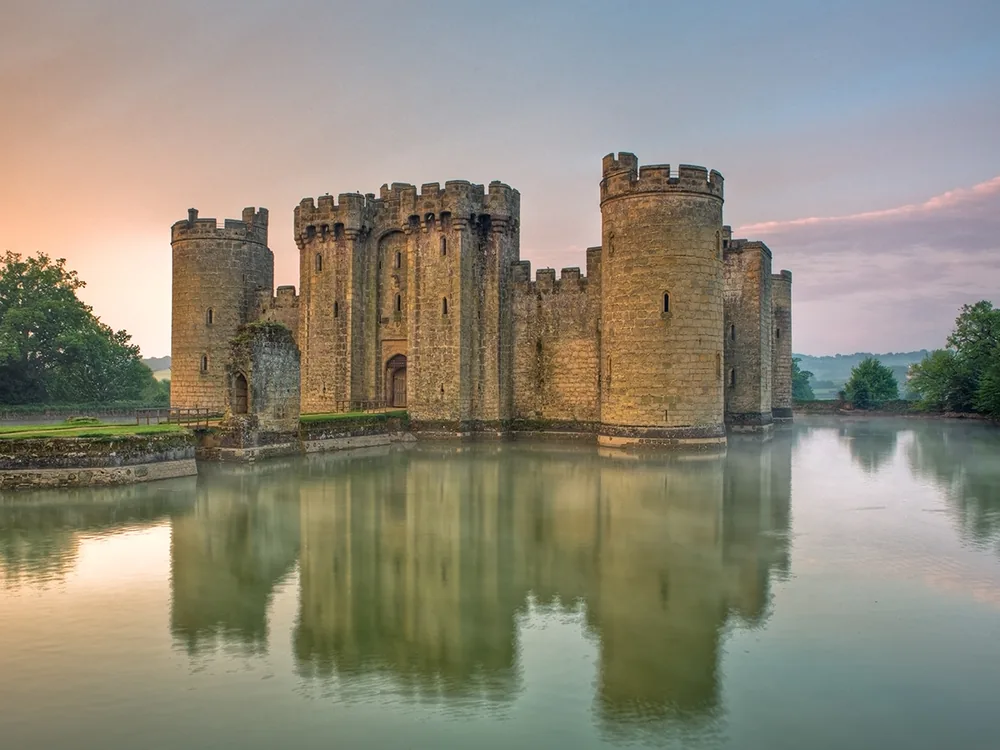
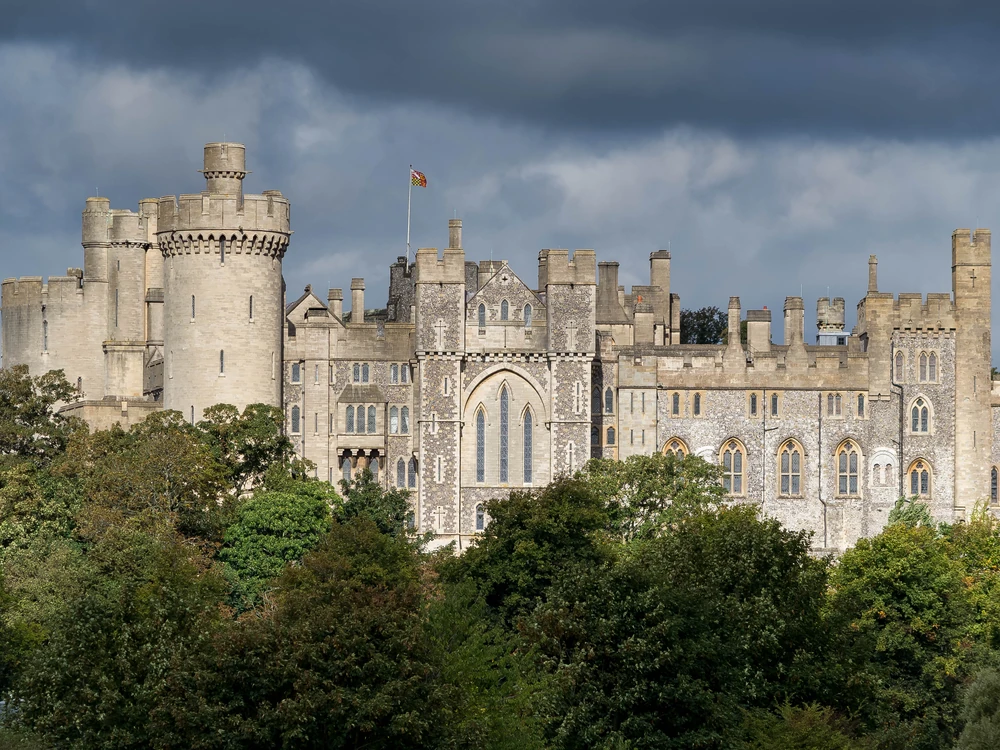
[Pendennis Castle](/castles/england/pendennis-castle) — Henry VIII's Tudor artillery fort in Cornwall — was, coincidentally, another castle that held out for the King during the Civil War, finally surrendering in 1646 as Corfe did. [Bodiam Castle](/castles/england/bodiam-castle) and [Arundel Castle](/castles/england/arundel-castle) extend the South England castle circuit for visitors with more time.
History
Corfe occupies the only natural gap in the Purbeck Hills, a strategic break in the chalk ridge that made the site a military priority for whoever controlled southern England. The castle's documented history begins with William the Conqueror, who built the first stone tower on the chalk mound in 1086. Henry I and Henry II developed it as a royal residence and treasury, and King John made the most significant medieval additions — expanding the walls and towers and using the castle as a secure prison, including the imprisonment of Arthur of Brittany. Development continued through the 13th to 15th centuries, with the outer gatehouse, outer ward, and inner residential buildings progressively expanded.
The royalist chapter began in 1635, when Sir John Bankes, Attorney General to Charles I, acquired the estate. After Sir John died in 1644, his wife Lady Mary Bankes held the castle through two Parliamentary sieges — repelling the first in 1643 with a Royalist relief force, and resisting the second until 1645–46, when an officer inside the garrison opened the gates to the besiegers. Parliament ordered the slighting in 1646: towers were undermined, walls breached, and the castle rendered permanently unusable for military purposes. Lady Bankes left with the castle keys, which her descendants kept as a family heirloom.
The ruins remained in the Bankes family for over three centuries, increasingly visited as a romantic landscape feature, before the National Trust acquired them in 1982.
How to Visit
Getting there: Corfe Castle village is on the A351 between Wareham and Swanage, about 10 km from Wareham. By rail, take a mainline train to Wareham (London Waterloo, around 2h30) then join the Swanage Steam Railway, which stops at Corfe Castle station — one of the most atmospheric arrivals at any English castle. The castle is a 5-minute uphill walk from the village.
Tickets: National Trust members enter free. Walk-up admission is £15 for adults and £8 for children; advance booking is available at nationaltrust.org.uk. The GYG Jurassic Coast minibus excursion from Portland (t1304777, from £136) covers Corfe Castle, Lulworth Cove, and Durdle Door in a small group (max 10) — note that Corfe Castle admission is NOT included in the tour price and must be purchased separately on-site at approximately £15.50 per adult.
Practical tips: The best photographs of the ruins are from the village street looking uphill — arrive before the castle opens at 10:00 for empty foregrounds and the clearest light. The ascent through the outer gatehouse to the inner ward involves steep, uneven ground. Mist over the Purbeck valley in autumn and winter gives the shattered towers a particularly dramatic quality.
Combine with: [Bodiam Castle](/castles/england/bodiam-castle), the perfect moated ruin in East Sussex, for a contrast in ruined castle types, and [Arundel Castle](/castles/england/arundel-castle) in West Sussex for a well-preserved counterpart on the same southern England circuit.
Frequently Asked Questions
The dramatic tilting, leaning, and fragmented state of Corfe Castle's ruins is not the result of natural decay. It was produced by deliberate Parliamentary slighting in 1646, immediately after Parliamentary forces captured the castle at the end of the English Civil War. Slighting involved miners undermining the foundations of towers and walls, causing them to collapse while still partly standing — which is why the towers lean at impossible angles rather than simply crumbling. The demolition was thorough enough to deny the castle any future military use, but left the ruins in the visually dramatic state that has made Corfe Castle one of England's most photographed historic sites.
Location
Corfe Castle, Wareham BH20 5EZ, England
Nearby Castles

Tours & Tickets
Powered by GetYourGuide
From
€166.53/ person