Mont Orgueil Castle
Château Mont-Orgueil
Jersey · Jersey — east coast, Gorey Harbour, Parish of Grouville · Near Saint Helier
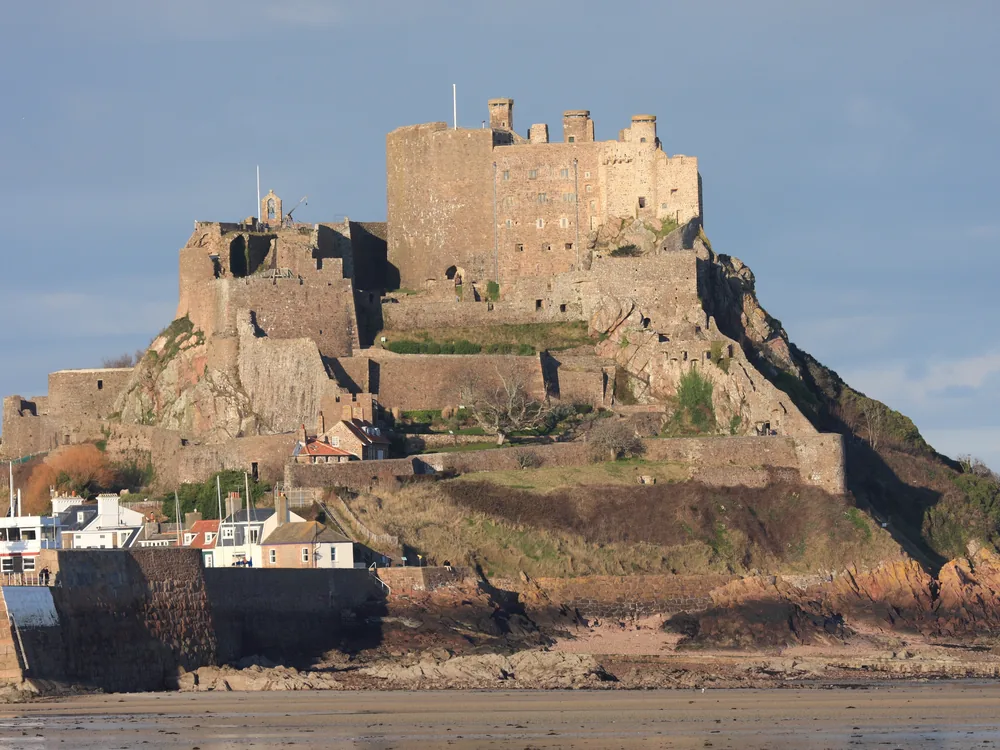
Built 1204 · Concentric medieval fortification, 13th–16th century, with extensive later modifications — Mont Orgueil is a concentric medieval castle occupying the summit of a granite headland above Gorey Harbour on Jersey's east coast; construction began following the separation of Normandy from the English crown in 1204, when Jersey — as a possession of the English crown — required coastal fortification against French attack; the castle's plan is determined entirely by the shape of the granite headland on which it sits: there is no geometric regularity in the defensive walls, which follow the natural contours of the rock in a series of ascending wards separated by defensive walls and towers; the lowest ward (at harbour level) gives onto the upper wards through a sequence of gateways, each of which constitutes a separate defensive obstacle; the highest point of the castle — the Great Tower — commands views across the bay to the coast of Normandy 40km east; the castle was extensively modified in the 15th and 16th centuries as gunpowder warfare made vertical fortifications less effective, with artillery platforms and lower defensive emplacements added to the medieval circuit; its military function was eventually superseded by Elizabeth Castle (built from 1550 onward) in the bay to the west, which could better accommodate artillery; Mont Orgueil was then used as a state prison and residence before its conservation as a heritage site; the WWII German Occupation of Jersey (1940–1945) left fortification remnants on the headland integrated into the castle's historic layers
This page is part of an independent travel guide and is not affiliated with, endorsed by, or operated by Mont Orgueil Castle.
© Castles & Palaces
Quick Facts
- Hours
- Daily 10:00–17:00
- Guided tour from
- €61
- Duration
- 2–3 hours (the full climb through the ascending ward sequence to the Great Tower summit, the WWII German Occupation displays, the harbour-level exhibits, and the views across Gorey Harbour and toward Normandy; the castle rewards a slow visit up to the summit)
- Best time
- May
- Nearest city
- Saint Helier
Featured Tour
Jersey: Heritage Pass — Mont Orgueil & Elizabeth Castle (7-Day Access)
Cancellation available · Instant confirmation
Highlights
- ✦The headland ascent and the concentric ward sequence — medieval castle-climbing at its most theatrical — Mont Orgueil Castle is not a flat-plan fortress: it is a castle that climbs a granite headland from the harbour level to the Great Tower summit in a sequence of ascending wards, each separated by gates and defensive walls that made any assault require capturing multiple obstacles one by one; the experience of visiting follows the line of a medieval attack — entering at the lowest ward above the harbour, climbing through successive gateways, each one higher than the last, until reaching the Great Tower at the summit with its 360-degree views over Gorey Harbour, Saint Helier Bay, the coast of Normandy to the east, and the interior of Jersey to the west; the castle's shape is entirely determined by the natural form of the granite headland — no geometric regularity, no idealized plan, just defensive necessity worked out in stone against the contour lines of the rock below
- ✦The view to Normandy — looking across the Channel from the headland where the English-French maritime boundary was established — from the Great Tower summit of Mont Orgueil, the Cotentin Peninsula of Normandy is visible on clear days, approximately 40km to the east across the Channel; this is the view that explains the castle: Jersey was a possession of the English crown whose proximity to the French coast made it perpetually exposed to French attack; Mont Orgueil was built in 1204 when Normandy was lost to the French and Jersey remained English, specifically to fortify the island against the threat from the coast that is visible from the summit; the castle was the military anchor of Jersey's English identity for 350 years; standing at the summit and looking toward Normandy is a precise geographical encounter with the reason the castle exists
- ✦The WWII German Occupation fortifications — the most recent layer in 800 years of defence — Jersey was the only part of the British Isles occupied by German forces during World War II, from 1940 to 1945; the German military incorporated Mont Orgueil headland into their Atlantic Wall coastal defence system, adding observation posts, gun emplacements, and fortifications to the medieval and early modern castle fabric; these WWII elements are still visible on the headland and are interpreted as part of the castle's historical layers rather than isolated from the medieval structure; the German Occupation of Jersey is among the least-known episodes of British Second World War history outside the island itself — the castle's WWII displays are among the most accessible introductions to this history available to visitors to Jersey
- ✦The Heritage Pass pairing with Elizabeth Castle — two castles that define Jersey's defensive history across 800 years — the GYG Heritage Pass (t1308839) covers both Mont Orgueil Castle (13th century, east coast, medieval concentric) and Elizabeth Castle (begun 1550, Saint Helier Bay, early modern artillery fort) with a single 7-day ticket; the two castles are the complementary halves of Jersey's defensive history: Mont Orgueil represents the medieval English claim to the island (built to defend against Normandy in 1204) while Elizabeth Castle represents the early modern response to artillery warfare (built when Mont Orgueil's vertical fortifications could no longer stop cannon fire); visiting both gives a complete picture of how island defence evolved over four centuries; Elizabeth Castle's tidal-island access by causeway and amphibious ferry adds a logistical element that makes the pairing an experience rather than two separate heritage visits
Skip the queue with a guided tour
Skip-the-line tickets & expert guides
From Gorey Harbour, the granite headland rises almost vertically from the water, and the castle rises from the headland. Mont Orgueil — 'Mount Pride' in Norman French — is named for the quality it projects from the water: the visual assertion of a fortification so placed that the sea approach to Jersey's east coast passes beneath its walls. The castle was built for exactly this projection. When Normandy fell to the French in 1204 and Jersey remained under English control, the east coast of the island — facing the Cotentin Peninsula 40km across the Channel — required fortification against attack from the territory that was now hostile.
The castle that was built from 1204 onward is not a flat-plan fortress with a geometric wall circuit. It is a series of ascending wards — lower, middle, upper — each separated from the next by walls and gateways, each tier requiring its own conquest in any assault, all of them determined by the irregular shape of the granite headland underneath. The lowest ward gives onto the harbour; the highest point, the Great Tower, stands at the summit with views in every direction: Gorey Harbour below, the interior of Jersey to the west, and the Normandy coast to the east. On a clear day, the Cotentin Peninsula is visible from the summit — the coast from which, for most of the castle's history, the threat came.
Mont Orgueil functioned as Jersey's primary military fortification for over 350 years. It was the castle that defended the English crown's claim to the island through repeated French attacks, sieges, and occupations. By the mid-16th century, the development of gunpowder artillery had made the castle's vertical fortifications increasingly vulnerable — cannon fire could be lobbed over the high walls that had been adequate against arrows and catapults. Elizabeth Castle, begun in 1550 in the bay to the west of Saint Helier, was built partly as a response to this obsolescence. Mont Orgueil transitioned to use as a state prison and residence after its military supersession.
The castle's most recent military layer is its least expected. In 1940, German forces occupied Jersey — the only part of the British Isles to fall under German occupation during World War II. The German military incorporated the Mont Orgueil headland into their Atlantic Wall coastal defence system, adding observation posts, gun emplacements, and concrete fortifications to the castle's medieval fabric. These WWII elements are still visible and are interpreted alongside the medieval structure as part of the castle's 820-year sequence of military use.
The GYG Heritage Pass (t1308839, from €61, valid 7 days) covers both Mont Orgueil and Elizabeth Castle — the two castles that together define Jersey's defensive history across four centuries. The pass is the standard access product for visiting Jersey's major heritage sites; both castles are managed by Jersey Heritage. 1 review as of writing → rating: null, reviews: 0, is_top_pick: false per REGLA #3.
Mount Orgueil's Gorey Harbour setting gives it additional appeal beyond its history: the harbour at the base of the headland is a working fishing port with restaurants and a beach, making the castle a natural centrepiece of an east coast day. The bus from Saint Helier (Route 1/1A/3) takes approximately 25–30 minutes.
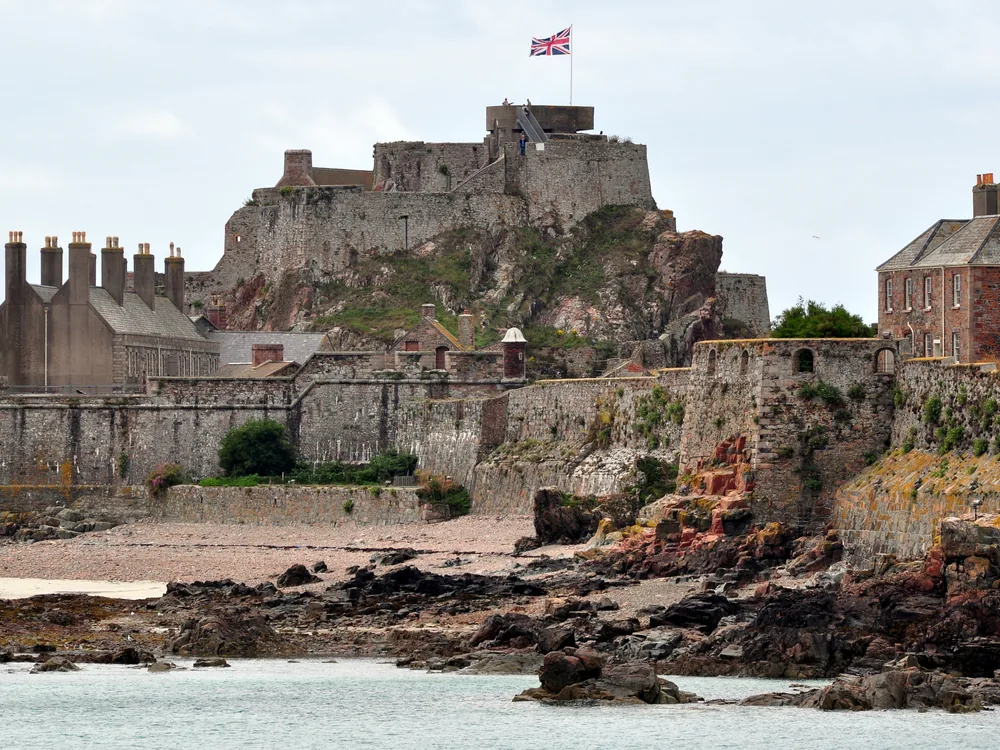
[Elizabeth Castle](/castles/jersey/elizabeth-castle) — in Saint Helier Bay, accessible by causeway at low tide or by amphibious ferry at high tide — is the Heritage Pass companion. [Corfe Castle](/castles/england/corfe-castle) and [Pendennis Castle](/castles/england/pendennis-castle) extend the broader English Channel military heritage circuit.
History
Mont Orgueil's construction began in 1204, the year the separation of Normandy from the English crown made the eastern coast of Jersey a front line facing France. The castle's placement on the granite headland above Gorey — where the sea approach to the east coast passes directly beneath the walls — was the defensive logic made architectural: no ship could approach without being visible and vulnerable from above. The main ward sequence and tower structure were established through the 13th and 14th centuries, making Mont Orgueil Jersey's primary fortification. French forces besieged and held the castle briefly during a French occupation of Jersey from 1461 to 1468 before English authority was restored.
The development of gunpowder artillery in the 15th and 16th centuries posed a challenge that Mont Orgueil's high medieval profile was poorly equipped to meet: high walls were vulnerable to cannon fire in ways they had not been to earlier siege weapons. Lower artillery platforms were added to the medieval ward walls, but the castle's fundamental geometry made it increasingly unsuitable as primary military defence. When Elizabeth Castle was begun in Saint Helier Bay around 1550, Mont Orgueil began its transition from military stronghold to state prison — a role it filled through the 17th and 18th centuries. Walter Raleigh served as governor of Jersey from 1600 to 1603 and used the castle as a residence.
The German Occupation from 1940 to 1945 added gun emplacements and observation posts as part of the Atlantic Wall; these fortifications remain in place alongside the medieval and early modern fabric. Jersey Heritage manages the castle and the Heritage Pass is valid for both Mont Orgueil and Elizabeth Castle.
How to Visit
Getting there: From Saint Helier, bus Routes 1, 1A, or 3 run to Gorey (approximately 25–30 minutes; check mct.je for schedules). By car, take the A3 east from Saint Helier — paid parking at Gorey Harbour. Taxis from Saint Helier take approximately 15–20 minutes.
Tickets: £14 adult / £8 child at the gate or jerseyheritage.org. The GYG Jersey Heritage Pass (t1308839, from €61) is a 7-day pass covering both Mont Orgueil and Elizabeth Castle — the standard product for visiting both Jersey Heritage castles; individual tickets for one castle only are also available at the gate.
Practical tips: Budget 2–3 hours minimum for the full ascent to the Great Tower summit and back — the views improve at every successive ward, culminating in the 360-degree view from the summit including the Normandy coast on clear days. The climb is steep throughout and is not accessible above the lowest ward for visitors with limited mobility. The harbour restaurants below make a natural lunch or dinner stop alongside the castle visit.
Combine with: [Elizabeth Castle](/castles/jersey/elizabeth-castle) in Saint Helier Bay — the 16th-century artillery fort that superseded Mont Orgueil — is the Heritage Pass companion visit. Return from Gorey to Saint Helier by bus (30 minutes), then access Elizabeth Castle by stone causeway at low tide or DUKW amphibious ferry at high tide.
Frequently Asked Questions
The GYG Heritage Pass (t1308839) is a 7-day access pass that covers both Mont Orgueil Castle in Gorey and Elizabeth Castle in Saint Helier Bay. It is a single ticket valid for entry to both sites over 7 consecutive days — not a ticket for one castle only. The pass is the standard product for visiting Jersey's two major heritage fortifications; purchasing the Heritage Pass through GYG or directly through Jersey Heritage is the most efficient approach for visitors who plan to visit both, which together give the most complete picture of how Jersey's defences evolved from the medieval period through the early modern era.
Location
Mont Orgueil Castle, Gorey, JE3 9FQ, Jersey
Nearby Castles


Tours & Tickets
Powered by GetYourGuide
From
€61/ person