
Framlingham Castle
Framlingham Castle
England · Suffolk, East Anglia · Near Ipswich
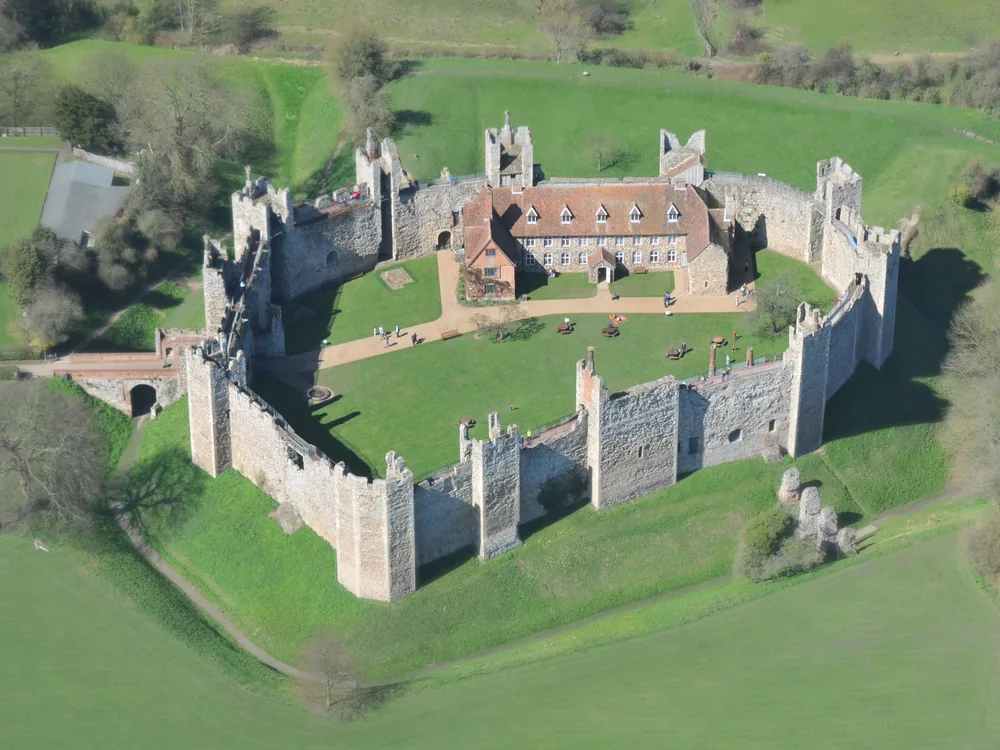
Built 1190 · Late 12th-century curtain-wall castle without a central keep — an architecturally distinctive design for its period, built c.1190 by Roger Bigod, 2nd Earl of Norfolk, on the site of an earlier castle destroyed by Henry II in 1173; the castle consists of 13 mural towers connected by a continuous curtain wall enclosing a large inner ward, without the central donjon tower that dominated Norman and early Angevin castle design in England; the keep-less curtain-wall design, sometimes described as a response to Byzantine or Middle Eastern fortification models that Bigod may have encountered on crusade, produces a castle that looks inward to a large enclosed courtyard rather than upward to a dominant tower; the towers house the principal accommodation and command positions; the outer ward, originally defended, is now largely earthwork; later additions include Tudor-period decorative chimneys atop the towers — installed without functioning fireplaces, purely for visual effect, when the castle was held by the Howard (Dukes of Norfolk) family in the early 16th century; from the 17th century the inner ward was used as a poorhouse and later as a workhouse for the Framlingham parish poor — a distinctive post-military use preserved in local records
This page is part of an independent travel guide and is not affiliated with, endorsed by, or operated by Framlingham Castle.
© Castles & Palaces
Quick Facts
- Hours
- Daily 10:00–17:00
- Entry via GetYourGuide
- €15.83
- Duration
- 1.5–2 hours
- Best time
- Year-round
- Nearest city
- Ipswich
Featured Tour
Framlingham Castle Entry Ticket
Cancellation available · Instant confirmation
Highlights
- ✦Framlingham's defining historical moment is the summer of 1553, when Mary Tudor arrived at the castle as the disputed heir to the English throne. Edward VI had died and the Lady Jane Grey had been proclaimed queen by the Protestant faction around John Dudley, Duke of Northumberland — but Mary, daughter of Henry VIII and Catherine of Aragon, was the legitimate heir by Henry's Act of Succession, and the majority of the country recognised her as such. Mary assembled troops, rallied supporters, and coordinated her claim to the throne from Framlingham; within days, Jane Grey's council collapsed, Northumberland submitted, and Mary rode in triumph to London. She was the first woman to successfully claim and hold the English throne, and Framlingham was the base from which she launched that claim
- ✦The design of the castle is architecturally anomalous for its time: Roger Bigod built 13 mural towers on a continuous curtain wall enclosing a large inner courtyard, without the central donjon (keep) tower that dominated every other major castle built in England from the Norman Conquest to the end of the 12th century; the keep-less curtain-wall design was common in Byzantine and Middle Eastern fortification as Crusader architects encountered it, and Bigod's access to that design tradition (directly via crusade, or indirectly via the cross-cultural exchange of the 12th-century Crusader states) is the most persuasive explanation for a castle that looks structurally nothing like its English contemporaries; the result is a castle that feels architecturally modern for 1190 — the curtain-wall enclosure that would become the standard English castle form in the 13th century appears fully realised here before the generation of builders usually credited with its development
- ✦The Tudor decorative chimneys on the tower tops are among the strangest features of any English castle: added by the Howard family (Dukes of Norfolk) in the early 16th century, they were built without functioning fireboxes or flues — they are purely decorative, a display of architectural sophistication and wealth without any practical function whatsoever; they are tall, ornate, and technically hollow; from the wall walk, the row of chimneys against the Suffolk sky is one of the most distinctive silhouettes in English castle heritage, and their non-functionality is a historically perfect encapsulation of Tudor conspicuous display
- ✦The castle's post-medieval career as a poorhouse — the inner ward converted to house the poor of the Framlingham parish from the 17th into the 19th century — is one of the more unusual afterlives of any English castle and worth noting precisely because it is not usually what gets foregrounded in castle marketing; the transition from military to charitable use was not uncommon in English post-medieval history (similar repurposings happened at other former royal and noble castles across the country), but Framlingham's documented record as a working workhouse gives the courtyard an additional layer of social history that runs alongside the Tudor drama of 1553
- ✦The wall walk around the curtain wall is one of the most complete such circuits in England — visitors can walk the full perimeter of the 13-tower enclosure at height, with views over the Suffolk countryside in one direction and into the inner courtyard in the other; the walk is narrow in places and involves the original medieval stair widths, but where accessible it provides the spatial understanding of the castle's design that the courtyard level cannot convey
Tickets & tours
Book through GetYourGuide
Framlingham Castle stands in the market town of Framlingham in Suffolk, approximately 25 kilometres north of Ipswich, in the agricultural countryside of East Anglia. It is managed by English Heritage and is one of the most architecturally distinctive medieval castles in England — built in the 1190s by Roger Bigod, 2nd Earl of Norfolk, on the site of an earlier castle that Henry II had demolished in 1173 as punishment for the first castle's role in a rebellion.
The architectural anomaly is worth addressing directly. Norman castle design in England was organised around a central donjon — a great tower, keep, or motte-top structure that dominated the site and concentrated the principal defensive and residential functions in a single vertical mass. From the White Tower of the Tower of London to Colchester, Rochester, and the castles built across the post-Conquest landscape, the keep was the definitional feature of the Norman military building tradition. Framlingham has no keep. Roger Bigod built instead 13 towers on a continuous curtain wall enclosing a large inner courtyard, placing accommodation and defensive functions distributed around the perimeter rather than concentrated in a central mass. This curtain-wall enclosure design would become the standard pattern for English castle building in the 13th century — at Dover, at Caerphilly, at Beaumaris — but in 1190 it appears at Framlingham fully realised before the generation of builders usually credited with developing it. The most persuasive explanation involves Roger Bigod's access, direct or indirect, to the Byzantine and Middle Eastern fortification traditions that English and French crusaders encountered in the 12th-century Holy Land.
The castle's most consequential historical moment came in July 1553. King Edward VI died on 6 July without a legitimate Protestant heir; the Protestant faction around John Dudley, Duke of Northumberland, had persuaded Edward to alter the succession in favour of Lady Jane Grey (Dudley's daughter-in-law), bypassing the Catholic Mary Tudor despite Henry VIII's Act of Succession. Mary had been warned of this plan and moved quickly to Framlingham, where the Howard family (Dukes of Norfolk) held the castle and where she had allies among the East Anglian gentry. Over the following days she assembled troops, issued proclamations asserting her legitimacy, and organised the political case for her succession with unusual efficiency. The country responded in her favour at a speed that surprised even her own advisors: Dudley's council collapsed within days, Jane Grey's brief nine-day reign ended, and Mary rode to London as Queen of England. Framlingham was the base from which the first woman to successfully claim and hold the English throne launched her claim.
Subsequent decades added the Tudor decorative chimneys still visible on the tower tops — installed by the Howard family without functioning flues or fireboxes, purely as a display of sophistication and wealth. Their non-functionality is technically visible to modern observers and historically perfect: conspicuous architectural display without practical purpose is the precise definition of Tudor great house ornamentation, and the Framlingham chimneys are its most extreme expression.
The castle's post-military history is less commonly discussed but historically significant. From the 17th century the inner courtyard was used to house the poor of the Framlingham parish — the castle repurposed as a poorhouse, and later a workhouse, in the social welfare systems of early modern and Georgian England. The transition from military stronghold to poor relief institution was not unique to Framlingham but is particularly well-documented here, adding a layer of social history to the courtyard's surface that the 1553 narrative tends to overshadow.
English Heritage manages the castle today. The self-guided visit includes the wall walk around the curtain wall — one of the most complete such circuits in England — and interpretation covering the Bigod construction, the 1553 Mary Tudor episode, the Howard family, and the poorhouse period. The pre-booked GetYourGuide entry ticket is valid on the selected date; English Heritage members visit free.
History
An earlier castle at Framlingham held by the Bigod Earls of Norfolk was demolished in 1173 when Roger Bigod I backed the rebellion of Henry the Young King against his father Henry II — a standard royal punishment for aristocratic disloyalty. Roger Bigod II, 2nd Earl of Norfolk, rebuilt the castle in the 1190s in a form that was architecturally unusual for its time: thirteen mural towers and a curtain wall with no keep, creating a circuit of defence without the central donjon that most contemporary castle-builders placed at the heart of their works. The result is one of the most legible medieval curtain-wall plans in England.
The Howard family, Dukes of Norfolk, held Framlingham through the 15th and 16th centuries, adding the decorative chimneys to the tower tops that remain the castle's most distinctive visual detail — an aristocratic gesture that turned military profile into architectural ornament. The castle's most consequential political moment came in July 1553, when Mary Tudor assembled her troops at Framlingham and launched the campaign that successfully claimed the English throne from the Protestant Lady Jane Grey. The Catholic Mary arrived at Framlingham with no guaranteed support and left with a kingdom.
The castle's later history was markedly less dramatic. From the 17th century it was repurposed as a poorhouse for the Framlingham parish, a function that persisted into the 19th century before the workhouse use ended and the castle settled into its current life as a heritage ruin. English Heritage has managed it since 1913.
How to Visit
Getting there: Framlingham is 25 km north of Ipswich in Suffolk. By car from Ipswich: approximately 35 minutes via the A12 and B1116. There is no direct rail service; the nearest station is Wickham Market (12 km away), served by taxi or infrequent bus. Limited bus services run from Ipswich on routes B65/B66.
Tickets: Walk-up admission is £14 for adults and £8 for children; English Heritage members enter free. The GetYourGuide pre-booked entry ticket is valid on the selected date and covers self-guided access to the full castle including the wall walk.
Practical tips: Walk the complete circuit of the curtain wall — one of the most uninterrupted medieval wall walks in England — to appreciate the keep-less design from above. The decorative Tudor chimneys on the tower tops are best seen close-up from the wall walk itself; the absence of functional fireboxes is immediately visible and worth noting.
Combine with: Framlingham's medieval market town and the Church of St Michael — which holds the Howard family tombs, including Thomas Howard, 3rd Duke of Norfolk — deserve at least 30 minutes immediately after the castle. Orford Castle (25 km southeast, English Heritage, unusual polygonal keep) is the natural half-day extension for a full East Suffolk day.
Frequently Asked Questions
Framlingham was built in the 1190s by Roger Bigod, 2nd Earl of Norfolk, with 13 towers on a curtain wall and no central donjon — an unusual design for English castle building of the period. The most persuasive explanation is that Bigod or his architects were influenced by Byzantine and Middle Eastern fortification designs encountered during the Crusades, where curtain-wall enclosures without central keeps were more common. This design would become the standard English castle pattern in the 13th century, making Framlingham's 1190 construction notably ahead of contemporary English practice.
Location
Church Street, Framlingham, Suffolk IP13 9BP, England
Nearby Castles
Tours & Tickets
Powered by GetYourGuide
From
€15.83/ person