
Château de Guise
Château Fort de Guise
France · Hauts-de-France · Near Saint-Quentin
Built 940 · Medieval castle successively fortified and transformed into a Renaissance bastioned fortress; the 16th-century work by the Dukes of Guise represents one of the most sophisticated bastioned systems in northern France before Vauban; extensive underground casemates and passages
This page is part of an independent travel guide and is not affiliated with, endorsed by, or operated by Château de Guise.
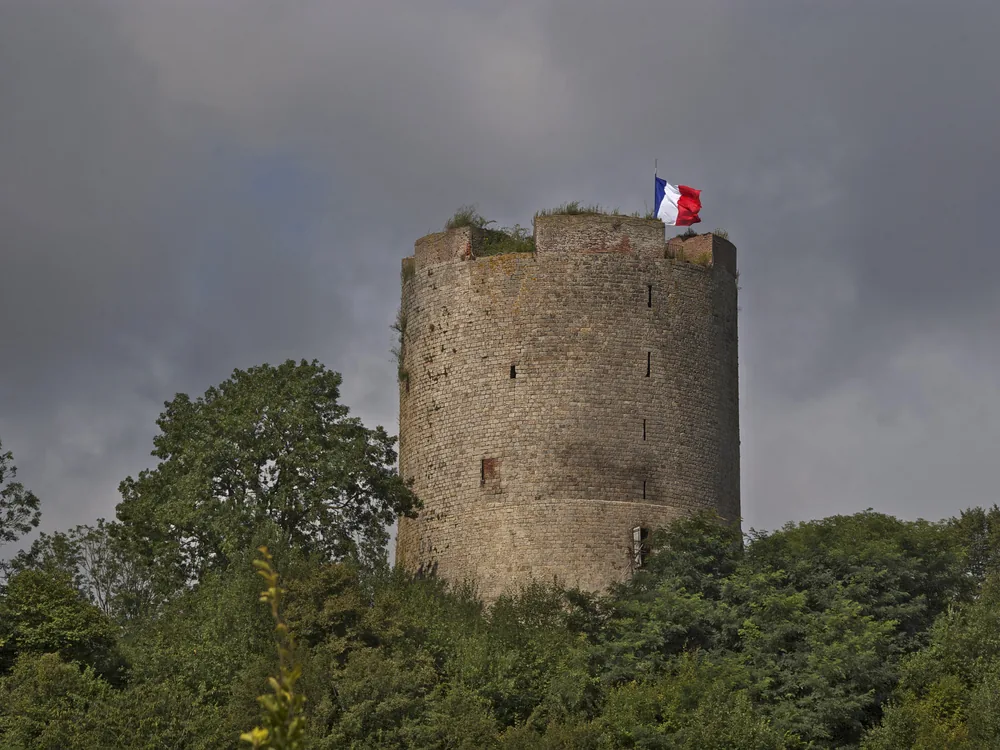
© Castles & Palaces
Quick Facts
- Hours
- Tue–Sun 10:00–18:00. Closed Mon
- Entry via GetYourGuide
- €8
- Duration
- 1.5–2.5 hours (self-guided numbered route)
- Best time
- May to September
- Nearest city
- Saint-Quentin
Featured Tour
Guise Castle: 1000 Years of History and Architecture Self-Guided Tour
Cancellation available · Instant confirmation
Highlights
- ✦The bastioned defensive system — the 16th-century earthwork bastions added by the Dukes of Guise create one of the most sophisticated Renaissance military systems in northern France; the military engineer Vauban noted them a century later in his survey of French fortifications
- ✦Underground casemates and passages — a network of underground galleries beneath the bastions, designed for protected movement of troops and for cannon emplacement; among the most extensive surviving casemate systems in northern France
- ✦The keep (donjon) — the medieval tower at the heart of the castle, with walls up to 5 metres thick at the base, surviving from the original 10th-century fortification
- ✦The Archaeological Museum and Arsenal cellar — exhibits from the castle excavations and from the Dukes of Guise period, housed in the vaulted underground chambers
- ✦Club du Vieux Manoir restoration — since 1952, a volunteer organisation has carried out all restoration work at the castle; this non-commercial approach has preserved the fabric authentically and the volunteer model is itself of interest
- ✦Self-guided numbered route — an independently-paced tour following numbered information points across all major elements of the castle: keep, bastions, casemates, museum, and courtyard
Skip the queue with a guided tour
Skip-the-line tickets & expert guides
The Château de Guise stands above the town of Guise in the Aisne department of Picardy, in the rolling agricultural country of the Thiérache region roughly 50 kilometres north of Laon and 40 kilometres south of Cambrai. It is one of the oldest continuously fortified sites in northern France — a position that has been defended, adapted, and expanded across nearly a thousand years — and one of the most significant examples of pre-Vauban bastioned military architecture in the country.
The first documented fortification at Guise dates from around 940, when the site on its spur above the Oise river was first used as a defensive position. The medieval castle that grew from this foundation became one of the principal fortresses of the region, controlling the Oise valley and the routes between the Champagne region and Flanders. The name Guise — and the title of the Dukes of Guise — became one of the most politically charged in French history during the 16th century: the Guise family, staunchly Catholic partisans during the Wars of Religion, were the primary rivals of the Bourbon kings and the organisers of the Catholic League that plunged France into decades of civil conflict.
It was under the Dukes of Guise in the 16th century that the castle underwent its most transformative phase. The Renaissance revolution in military engineering — driven by the realisation that medieval towers and curtain walls were no defence against the new bronze artillery — required a completely different approach to fortification: lower, thicker earthwork bastions, angled to deflect cannonballs, with casemates beneath for sheltered artillery positions. The Guise family commissioned exactly this kind of modernisation, and the result was one of the most elaborate bastioned systems in northern France before the military engineer Sébastien Le Prestre de Vauban standardised French fortification design in the late 17th century. Vauban himself noted the Guise fortifications in his comprehensive survey of French defensive positions — a significant recognition from the man who redesigned French military architecture across an entire generation.
The castle's 16th-century bastioned system is the primary architectural achievement visible today. The earthwork bastions — triangular projecting platforms that allowed defenders to fire along the face of adjacent walls, eliminating the dead ground that medieval round towers left undefended — are well-preserved and walkable; the numbered self-guided route covers all five bastions on the perimeter. Below the bastions, the casemate system — vaulted underground galleries running through the earthwork — is the most atmospherically distinctive element: the sound deadening, the heavy vault construction, and the loop-hole openings designed for cannon give the passages a weight quite different from the more common medieval dungeon experience.
The castle's 20th-century history is a story of destruction and volunteer recovery. The First World War devastated Guise: the town was occupied by German forces from 1914 to 1918, and the castle, used as a headquarters and observation point, suffered significant structural damage. Restoration began after the war but resources were limited. In 1952, the Club du Vieux Manoir — a French volunteer organisation dedicated to heritage restoration — took on the castle and has carried out all restoration work since, using entirely volunteer labour and the entry receipts from visitors. This non-commercial model has preserved the fabric authentically and more slowly than a commercial restoration would have, which has advantages: the work is conservative rather than reconstructive, and the volunteer character of the operation is itself transparent in the way the castle is presented to visitors.
The self-guided tour follows a numbered route through all the major elements: the medieval keep (donjon) with its walls up to 5 metres thick at the base, surviving from the early fortification phases; the 16th-century bastions and their connecting wall walks; the underground casemates and passages; the courtyard with the main palace range (largely ruined); the Archaeological Museum in the former arsenal cellar, with finds from the castle excavations and period artefacts from the Guise family era; and the panoramic terrace overlooking the Oise valley and the Thiérache agricultural landscape.
The Dukes of Guise connection gives the castle its political depth beyond the military architecture. Francis, Duke of Guise, who was assassinated in 1563 during the Wars of Religion, and his son Henry, Duke of Guise — assassinated on the order of Henry III in 1588, an event that precipitated the final crisis of the Valois dynasty — were among the most powerful and controversial figures of 16th-century France. The castle at Guise was their principal northern stronghold, and the family history it embeds is one of the most dramatic in the French Wars of Religion.
For visitors in northern France, the Château de Guise fills a gap that many tourist circuits miss: the great bastioned fortress tradition of the 16th–17th centuries, which Vauban would refine into his systematic network, is better represented here than at many more famous sites where later restoration has covered or replaced the earlier work.
History
First documented fortification at the Guise spur around 940. Medieval castle built up through the 11th–15th centuries. Major transformation into a bastioned Renaissance fortress by the Dukes of Guise in the 16th century — one of the largest bastioned systems in northern France, noted by Vauban. Damaged in the First World War during German occupation of the town. Restoration taken on by the Club du Vieux Manoir volunteer organisation since 1952.
How to Visit
Getting there: Guise is ~50 km north of Laon and ~2 hours from Paris by car via N2/A26 (exit toward Saint-Quentin, then D946). The nearest train station is Guise on the Saint-Quentin–Hirson line with infrequent services — a car is more practical for most visitors.
Tickets: Adults €8, children €5. The GetYourGuide self-guided entry ticket covers the full numbered-route tour — keep, bastions, casemates, museum, and courtyard. You can start at any point and set your own pace.
Practical tips: The castle is open Easter to early November and closed in winter — plan accordingly. Allow 1.5–2.5 hours for the full circuit including the underground casemates (the most atmospherically distinctive section). The volunteer-restoration context — Club du Vieux Manoir has done all work since 1952 — is worth asking staff about; the process is as interesting as the fabric.
Combine with: The Thiérache region's distinctive fortified red-brick churches (a unique feature of this corner of France) make a natural half-day addition, and Laon (50 km south) has one of France's finest Gothic cathedrals for a full northern France day.
Frequently Asked Questions
The Guise family were one of France's most powerful aristocratic dynasties in the 16th century — the leaders of the Catholic League during the Wars of Religion (1562–1598) and the principal political rivals of the Valois and Bourbon kings. Francis, 2nd Duke of Guise (assassinated 1563), was the most celebrated French military commander of his generation. His son Henry, 3rd Duke of Guise (assassinated 1588 on Henry III's orders) was the central figure of the Catholic League, whose power made him briefly more influential than the king. The assassination of Henry of Guise at the Château de Blois precipitated the collapse of the Valois dynasty and the accession of Henry IV.
Location
Place du Château, 02120 Guise, France
Nearby Castles
Tours & Tickets
Powered by GetYourGuide
From
€8/ person