
Château de Villandry
Château de Villandry
France · Loire Valley · Near Tours
Built 1532 · Renaissance
This page is part of an independent travel guide and is not affiliated with, endorsed by, or operated by Château de Villandry.
© Unsplash
Quick Facts
- Hours
- Daily 09:00–18:00
- Guided tour from
- €115
- Duration
- 1.5–2.5 hours
- Best time
- May to October
- Nearest city
- Tours
Featured Tour
Tours: Chateaux Azay-le-Rideau and Villandry Morning Tour
Cancellation available · Instant confirmation
Highlights
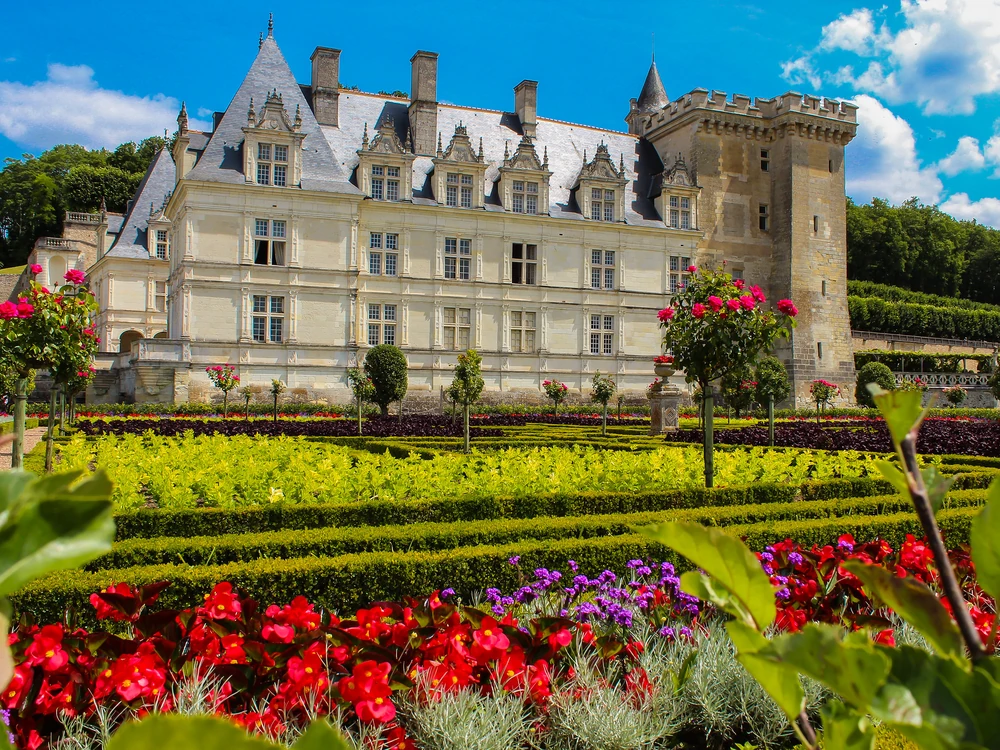
- ✦The Ornamental Kitchen Garden (Potager) — nine large squares of geometric vegetable patterns in cabbages, leeks, chard and lettuces, redesigned each year and as formally precise from the terrace above as any palace parterre in France
- ✦The Garden of Love — four box-hedge parterres spelling out the emblems of tender, passionate, fickle and tragic love, best seen from the château's upper windows looking down at the labyrinthine patterns
- ✦The Water Garden — the highest of the three terraces, a large reflecting pool and formal water features that feed the two lower gardens by gravity, and the quietest part of the grounds
- ✦The château interior's 16th-century Moorish coffered ceiling, transported from Toledo and installed by Joachim Carvallo after his 1906 purchase of the château — one of the finest examples of Islamic decorative art in France
- ✦More than 50 kilometres of box hedging clipped by hand three times a year and 120,000 vegetables planted each spring in the kitchen garden alone, still maintained by the Carvallo family who restored it — a living project, not a state museum
Skip the queue with a guided tour
Skip-the-line tickets & expert guides
Villandry makes a simple but complete argument: that garden design is a spatial art equal to stone and marble, and that a château can be a backdrop rather than the spectacle itself. At Chambord, Chenonceau or Blois, the building is what visitors come to see. At Villandry, the three terraces of Renaissance gardens are the architecture, and the modest 16th-century château at their edge exists mainly to give them a vantage point.
The gardens visitors see today did not survive from the Renaissance — they were recreated. Joachim Carvallo, a Spanish-born cardiologist, and his American heiress wife Ann Coleman bought the decrepit château in 1906 and spent the rest of their lives and fortune reconstructing its Renaissance gardens from 16th-century engravings by the French draughtsman Jacques Androuet du Cerceau. No such garden existed anywhere in France at the time; the project was an act of historical imagination as much as horticulture. Four generations later, the Carvallo family still owns and runs Villandry, one of the few great Loire châteaux that has never passed into state hands.
The Potager — the ornamental kitchen garden — restores an idea that medieval and Renaissance France took seriously: that the orderly cultivation of the earth was itself an image of the orderly cosmos. Villandry's nine geometric squares are planted with ornamental vegetable varieties chosen for colour and form as much as for eating, and the effect, seen from the terrace above, is one of the genuinely surprising aesthetic experiences in the Loire Valley — vegetables arranged with the same formal precision as a palace flowerbed.
Villandry's site carried weight long before Carvallo's restoration. In 1189, a peace conference at the medieval manor here brought together Henry II of England and Philip II of France, with Henry dying shortly after the treaty was signed. The present château was built from 1532 by Jean Le Breton, François I's finance minister and secretary of state, who had personally overseen construction at Chambord and clearly understood exactly what a Loire château of ambition should look like.
History
A medieval manor stood on this site as early as the 12th century, and it was here in 1189 that Henry II of England met Philip II of France for a peace conference — a treaty Henry signed shortly before his death. Jean Le Breton, finance minister and secretary of state under François I, demolished the medieval keep in 1532 and built the present château in the early French Renaissance style he had overseen at Chambord, leaving only the original keep standing as a memory of the site's older history.
The Renaissance gardens did not survive the following centuries intact. In the 18th century, as English-style landscape parks swept across France, Villandry's formal terraces were torn out and replaced with picturesque parkland, and by the 19th century the château itself had fallen into disrepair. The turning point came in 1906, when Joachim Carvallo purchased the estate and began a restoration grounded in historical research rather than guesswork, using 16th-century garden engravings to recreate terraces that had not existed on the site for well over a hundred years. The Toledo ceiling, brought from Spain and installed in the château's interior, dates from this same restoration period.
Four generations of the Carvallo family have maintained Villandry since 1906, sustaining the annual cycle of planting, clipping and replanting that keeps the gardens in their current form. The Loire Valley, including Villandry, was inscribed as a UNESCO World Heritage Site in 2000, recognising the valley's château and garden landscape as a unified cultural achievement.
How to Visit
Getting there: Villandry is 18 km west of Tours on the D7, about 25 minutes by car. By bicycle, the flat Loire à Vélo cycle route covers the same distance in around 1.5 hours. There is no direct train; the nearest station is Savonnières (3 km), reachable onward by taxi or bicycle.
Tickets: Walk-up admission is €13 for adults, €6 for children, covering both the gardens and the château interior. The GetYourGuide guided morning tour combines Azay-le-Rideau and Villandry in a 4-hour tour from Tours and is the top-rated guided option for the two châteaux together.
Practical tips: Arrive by 10:00 to see the gardens before tour groups build up. Start on the top terrace (the Water Garden) for the full layout overview, then work down to the Garden of Love for photographs. Allow 45 minutes in the Ornamental Kitchen Garden — its geometric planting rewards slow walking. The Toledo ceiling in the château interior takes 30–40 minutes and is worth including.
Combine with: Château de Azay-le-Rideau is 15 km south and the classic pairing — most Loire day-trip operators combine the two. Château de Chenonceau is further east but completes the essential Loire triangle of Renaissance garden, château-on-water, and monumental staircase.
Frequently Asked Questions
Yes. The Ornamental Kitchen Garden's planting pattern is redesigned each year, so the colours and arrangement of vegetables in the nine geometric squares differ from one season to the next, even though the underlying layout stays consistent. The box hedges are clipped by hand three times a year, including in June and October, and look sharpest immediately after each clipping.
Location
3 Rue Principale, 37510 Villandry, France
Nearby Castles
Tours & Tickets
Powered by GetYourGuide
From
€115/ person