
Burghausen Castle
Burg Burghausen
Germany · Bavaria · Near Burghausen
Built 1255 · Gothic
This page is part of an independent travel guide and is not affiliated with, endorsed by, or operated by Burghausen Castle.
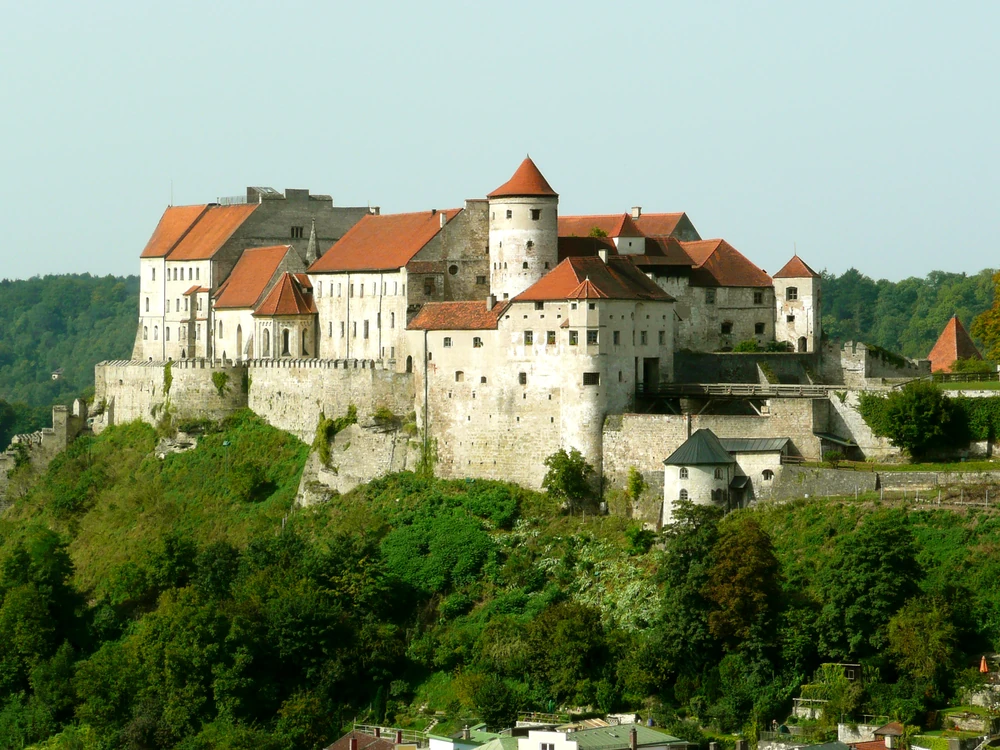
© Unsplash
Quick Facts
- Hours
- Daily 09:00–18:00
- Guided tour from
- €222
- Duration
- 2–3 hours
- Best time
- May to September
- Nearest city
- Burghausen
Featured Tour
Burghausen: Burghausen Castle Private Tour
Cancellation available · Instant confirmation
Highlights
- ✦A ridge-top complex stretching 1,051 metres — officially the world's longest castle and a record that has stood for decades
- ✦Six successive courtyards, each built for a different purpose, creating a journey through medieval military and domestic architecture
- ✦Views from the ramparts into Austria, over the turquoise Salzach River and the Wöhrsee lake far below
- ✦The annual Burghausen Jazz Festival, held in the inner courtyard each June — one of the most atmospheric open-air music venues in Germany
- ✦The State Gallery in the main keep, with late Gothic paintings, medieval altarpieces, and the history of the Duchy of Bavaria-Landshut
Skip the queue with a guided tour
Skip-the-line tickets & expert guides
Burghausen Castle holds a record that no other fortress in the world has come close to matching: at 1,051 metres, it is the longest castle complex ever built. Stretched along a narrow limestone ridge above the confluence of the Salzach River and the Wöhrsee, it was not designed as a single building but as a chain of six successive courtyards, each separately fortified, creating a defensive sequence that an attacker would need to breach multiple times to reach the main keep at the southern end. Walk its full length and the town of Burghausen gradually recedes below you, the Austrian Alps appear on the horizon, and the experience shifts from sightseeing to something closer to a walk through medieval strategic logic.
The castle was the secondary residence and treasury of the Wittelsbach Dukes of Bavaria — the dynasty that also built Neuschwanstein, Nymphenburg, and the Residenz in Munich. Here, though, the aesthetic is entirely Gothic rather than Baroque fantasy: the towers are heavy, the walls are thick, and the views are earned by climbing. The main keep at the southern tip houses a State Gallery with late Gothic altarpieces and panel paintings that feel exactly right in rooms of this age and weight.
Each June, Burghausen Castle becomes one of the most unusual concert venues in Europe. The inner courtyard fills with an audience of several thousand for the Burghausen Jazz Festival, with the castle walls providing extraordinary acoustic reflection. The contrast — medieval stone, modern jazz, summer darkness, and torchlight — is one of those experiences particular to old European places that use their history imaginatively rather than simply displaying it.
History
The hill above Burghausen was fortified at least as early as the 10th century, when the site is first mentioned in documents (1025 AD). The Wittelsbach dynasty, who would go on to rule Bavaria for seven centuries, made Burghausen their ducal treasury and secondary residence in 1255 — the year that marks the beginning of the castle's transformation from a simple hilltop fort into a complex of successive courtyards and towers.
The most significant period of construction came under Duke George the Rich (Georg der Reiche) of Bavaria-Landshut, who ruled from 1479 to 1503. The 'Reiche' in his name referred to his legendary wealth, and he spent it on Burghausen — extending the castle to its present extraordinary length, adding towers, rebuilding the main keep, and creating the sequence of six courtyards that makes the complex unique. The castle served its purpose as a treasury for the valuables of the Duchy, including the famous Landshut ducal treasure, kept here safe from attack.
Following the Landshut War of Succession (1503–1505), Burghausen passed under unified Bavarian rule and gradually lost its strategic importance. By the 19th century, when Romantic-era travellers and artists began to rediscover Germany's medieval heritage, Burghausen attracted painters and writers for the same reason it attracts photographers today: the castle reflected in the Wöhrsee below, the ridge stretched against the horizon, and the Austrian Alps in the distance compose a view that has changed almost nothing in five hundred years.
How to Visit
Getting there: Burghausen is 90 km east of Munich on the Bavarian-Austrian border. By car from Munich, take the A94 east then the B20 south — about 1.5 hours. By public transport, take the regional train from Munich Hauptbahnhof via Mühldorf (1.5–2 hours); the castle is a 30-minute walk uphill from the station or a short taxi ride. The closest larger city is Salzburg, 60 km south in Austria.
Tickets: Entry to the main keep and State Gallery costs €5 for adults; children are admitted free. The outer courtyards are free to enter at all times. The GetYourGuide private tour covers 1.5 hours with an expert local guide and includes the entry ticket — ideal for groups wanting a tailored castle experience.
Practical tips: Enter at the southern end and walk northward through all six courtyards — the views improve steadily as you climb. Allow 90 minutes for the full 1,051-metre length at a relaxed pace, plus 30–45 minutes for the State Gallery. Winter hours are shorter (October–March: 10:00–16:00). If visiting in June, check the Jazz Festival schedule early — headline concerts sell out months in advance.
Combine with: Neuschwanstein Castle is the other landmark Bavarian castle, about 2 hours west — pair on a Bavaria loop.
Frequently Asked Questions
Burghausen Castle stretches 1,051 metres along a narrow limestone ridge — a record confirmed by the Guinness Book of Records. Its length is not a design flourish but a military and practical response to the ridge's topography: rather than building a single large fortification, the Wittelsbach dukes built a chain of six successive courtyards, each separately fortified, so that an attacker breaching one defensive line would face another. The result is the longest continuous castle complex ever constructed.
Location
Burg 48, 84489 Burghausen, Germany
Nearby Castles
Tours & Tickets
Powered by GetYourGuide
From
€222/ group