
Mirabell Palace
Schloss Mirabell
Austria · Salzburg — Neustadt, north bank of the Salzach · Near Salzburg
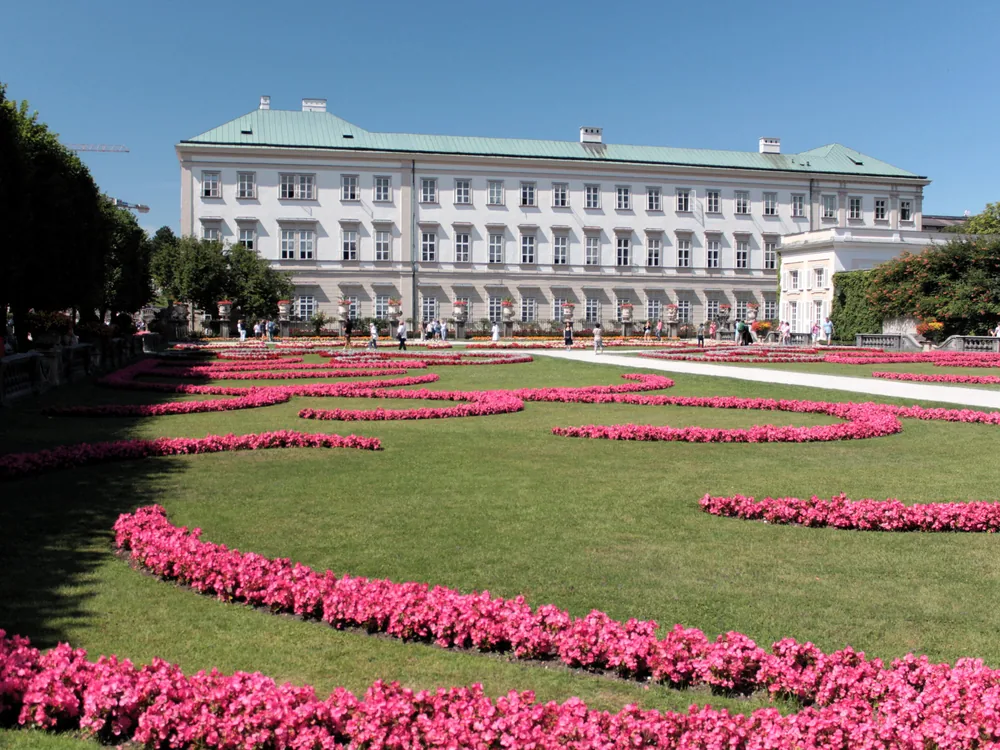
Built 1606 · Baroque palace and formal garden — the current building was designed by Johann Lukas von Hildebrandt (architect of the Belvedere in Vienna) and completed between 1721 and 1727 for Archbishop Franz Anton von Harrach, replacing the earlier 1606 structure commissioned by Archbishop Wolf Dietrich von Raitenau; the Marble Hall (Marmorsaal) on the piano nobile is the centrepiece — white marble walls, gilded stucco reliefs, and ceiling frescoes by Martino Altomonte depicting the four elements; the Mirabellgarten was redesigned in Baroque style at the same period, with a formal parterre, geometric hedge gardens, and the Dwarf Garden (Zwerglgarten)
This page is part of an independent travel guide and is not affiliated with, endorsed by, or operated by Mirabell Palace.
© Castles & Palaces
Quick Facts
- Hours
- Mon 08:00–18:00. Tue 13:00–16:00. Wed & Thu 08:00–16:00. Fri 13:00–16:00. Sat & Sun Closed (exterior/gardens open)
- Guided tour from
- €39
- Duration
- 30–60 minutes (gardens); add 20 minutes if the Marble Hall is open during your visit
- Best time
- May to September
- Nearest city
- Salzburg
Featured Tour
Salzburg: Mozart Concert at Mirabell Palace (optional evening experience)
Cancellation available · Instant confirmation
Highlights
- ✦Free entry — the Mirabellgarten and the palace exterior are free and open every day; the Marble Hall interior is free during limited weekday public hours; neither the gardens nor the main hall require a ticket or advance booking
- ✦The Marble Hall (Marmorsaal) — Johann Lukas von Hildebrandt's Baroque masterpiece: white marble walls, gilded stucco reliefs, and ceiling frescoes by Martino Altomonte depicting the four elements; Mozart performed here as a child of 6 in 1762 and many times during his Salzburg years
- ✦The Sound of Music steps — the wide stone staircase at the western end of the Mirabellgarten, where Julie Andrews and the von Trapp children performed 'Do-Re-Mi' in the 1965 film; the Pegasus fountain and the steps remain immediately recognizable to most international visitors
- ✦The Dwarf Garden (Zwerglgarten) — a peculiar Baroque garden feature: 28 marble statues of court jesters, dwarves, and fantastical figures in a hedged enclosure; an unusual survival of aristocratic Baroque garden wit, largely overlooked by visitors focused on the main parterre
- ✦Mozart Concert in the Marble Hall (optional, from €39) — a separately ticketed 1.5-hour evening concert of Mozart chamber music performed by professional musicians in the Marble Hall; the GetYourGuide product is a genuine evening concert experience, not related to the free daytime palace visit
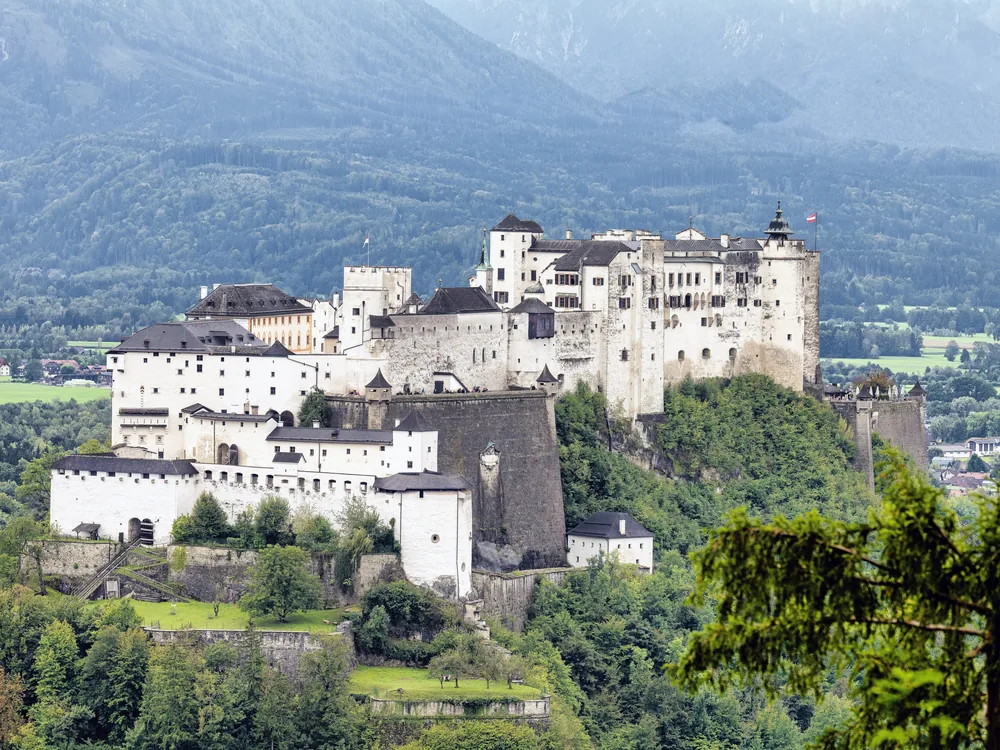
- ✦[Hohensalzburg Fortress](/castles/austria/hohensalzburg-fortress) — the medieval fortress on the Festungsberg hill, visible across the Salzach from the Mirabellgarten and a 15-minute walk via the Old Bridge; the two form the city's canonical visual pairing across the river
Skip the queue with a guided tour
Skip-the-line tickets & expert guides
Mirabell Palace stands on the north bank of the Salzach in Salzburg's Neustadt quarter, facing the Festungsberg and the silhouette of Hohensalzburg Fortress across the river. The palace is, by European standards, relatively modest in scale — it is not a Versailles or a Schönbrunn. What distinguishes it is the precision of its Baroque design, the quality of its garden, and an unusual combination of accessibility and celebrity: the Mirabellgarten is free to enter, beautifully maintained, and one of the most photographed sites in central Salzburg — partly for its own formal beauty and partly for its role in the 1965 film The Sound of Music.
The first building on this site was commissioned in 1606 by Wolf Dietrich von Raitenau, Archbishop of Salzburg, for his mistress Salome Alt, with whom he had twelve or more children — an arrangement that was scandalous by the standards of Counter-Reformation Catholic episcopacy, though Wolf Dietrich maintained it openly. He named the palace Altenau after her. His successor stripped him of his archbishopric and imprisoned him in Hohensalzburg, where he died in 1617. The palace was renamed Mirabell ('beautiful view') and passed through several subsequent archbishops.
Fire destroyed the original building in 1818. The current structure was designed by Johann Lukas von Hildebrandt — the Viennese architect who designed the Upper Belvedere and was one of the dominant figures of Austrian Baroque architecture — for Archbishop Franz Anton von Harrach. Construction ran from approximately 1721 to 1727. Hildebrandt's design is most fully expressed in the Marble Hall (Marmorsaal): a first-floor ceremonial room with white Salzburg marble walls, gilded stucco relief decoration, and ceiling frescoes by Martino Altomonte depicting the four classical elements in allegorical scenes. The Hall's proportions, its light (south-facing windows opening to the garden), and its acoustic qualities make it one of the finest Baroque interiors in Austria.
Wolfgang Amadeus Mozart performed in the Marble Hall in 1762, at age six, during one of his father Leopold's first efforts to exhibit the child prodigy to Salzburg's ruling class. Mozart continued to perform here and in other Salzburg venues through his residence in the city until 1781, when he permanently relocated to Vienna. The connection to Mozart is genuine and significant — the Marble Hall was part of the aristocratic concert circuit in which Mozart operated as a performer and composer throughout his Salzburg years.
The Mirabellgarten is the primary reason most visitors come. Redesigned in the early 18th century to complement Hildebrandt's palace, the garden is a formal Baroque parterre: geometric flower beds arranged in four sections around the central Pegasus fountain, with clipped hedges forming the outer boundaries, a rose garden to the east, and the Dwarf Garden (Zwerglgarten) in the northwest corner — a peculiar Baroque garden feature housing 28 marble statues of court jesters, dwarves, and fantastical figures, a survival of the aristocratic tradition of collecting human rarities that the Baroque courts considered entertainment. The statues are unsigned and undated but consistent in style with early 18th-century Salzburg sculpture.
The Sound of Music connection dominates contemporary visitor expectations. The 1965 Robert Wise film used the Mirabellgarten — specifically the wide stone staircase at the western garden wall, the Pegasus fountain, and the hedge garden — as the primary location for the 'Do-Re-Mi' sequence with Julie Andrews and the children. The steps, the fountain, and the archway framing have been reproduced in millions of photographs and social media posts since the film's release. Guided Sound of Music tours of Salzburg typically stop here as one of their first points. The film's reality and the palace's own history are completely unrelated — the actual von Trapp family had no connection to Mirabell — but the cinematic association has made the garden's staircase one of the most recognised images in Austrian tourism.
The Mozart Concert in the Marble Hall is a separate evening event: a 1.5-hour chamber concert of Mozart's music performed by professional musicians in the Marble Hall, typically running three or four evenings per week. This is a genuine concert experience — not a theatrical performance or a touristic approximation — and is consistently well-reviewed. It is entirely distinct from the free daytime garden and palace visit. [Hohensalzburg Fortress](/castles/austria/hohensalzburg-fortress), on the Festungsberg directly across the Salzach, is the historical and architectural complement: a medieval hilltop castle that dominates the city from the south while Mirabell anchors the northern bank.
History
Archbishop Wolf Dietrich von Raitenau, the most ambitious of Salzburg's prince-bishops, built the original palace in 1606 as a private residence for his mistress Salome Alt and the fifteen children she bore him — naming it Altenau, after her. It was a gesture that scandalised both the Church hierarchy and the Salzburg aristocracy. Wolf Dietrich's enemies eventually had their revenge: in 1617, he was imprisoned by the Bavarian duke at the instigation of his Salzburg rivals, and the palace was renamed Mirabell by his successors — Salome Alt's name erased from the building in which she had lived.
The palace Wolf Dietrich built was lost to fire in 1818. The Baroque building standing today was constructed between 1721 and 1727 to designs by Johann Lukas von Hildebrandt for Archbishop Franz Anton von Harrach, with the Mirabellgarten redesigned in its current formal layout at the same time. It was in this building that the six-year-old Wolfgang Amadeus Mozart performed in the Marble Hall in 1762 — an early demonstration for the Salzburg court that has been commemorated by the city ever since.
Salzburg was incorporated into the Austrian Empire in 1816, and the palace gradually assumed civic functions that it retains today: the Marble Hall is used for concerts and civil weddings, and the city administration occupies working spaces in the complex. The Sound of Music was filmed in the Mirabellgarten in 1965, giving the gardens a global recognition that has sustained ever since. The Historic Centre of Salzburg, including the palace and gardens, received UNESCO World Heritage inscription in 1996.
How to Visit
Getting there: Mirabellplatz is a 10-minute walk from Salzburg Hauptbahnhof or 5 minutes from the Old Town via the Salzach bridges. Tram and bus services connect to Mirabellplatz from central Salzburg.
Tickets: Entry to the Mirabellgarten is always free, open daily from dawn to dusk. The Marble Hall interior is also free during limited weekday public hours (Mon/Wed/Thu 08:00–16:00, Tue/Fri 13:00–16:00) but is frequently closed for official functions and civil weddings — verify at salzburg.info before making the interior a priority. The GetYourGuide Mozart Concert is a separately ticketed 1.5-hour evening chamber concert in the Marble Hall; book in advance as popular evenings sell out.
Practical tips: The Sound of Music steps at the western garden wall and the Pegasus fountain are the most photographed spots; arrive early morning for photos without crowds. The Dwarf Garden (Zwerglgarten) in the northwest corner of the garden is largely overlooked: the 28 marble statues of jesters, dwarves, and fantastical figures are an unusual Baroque survival worth finding before you leave.
Combine with: Hohensalzburg Fortress — the medieval fortress visible from the garden across the Salzach, approximately 15 minutes on foot via the Staatsbrücke bridge through the Old Town.
Frequently Asked Questions
No — the Marble Hall is open to free public visitors on weekdays during limited hours (Mon/Wed/Thu 8:00–16:00, Tue/Fri 13:00–16:00). These hours are subject to closure for official events and civil wedding ceremonies. The Mozart Concert is a separate ticketed evening event — a genuine chamber music concert, not a guided tour. Both options give access to the same room; the concert gives it in a musical context.
Location
Mirabellplatz 4, 5020 Salzburg, Austria
Nearby Castles
Tours & Tickets
Powered by GetYourGuide
From
€39/ person