
Cecilienhof Palace
Schloss Cecilienhof
Germany · Brandenburg, Potsdam · Near Potsdam
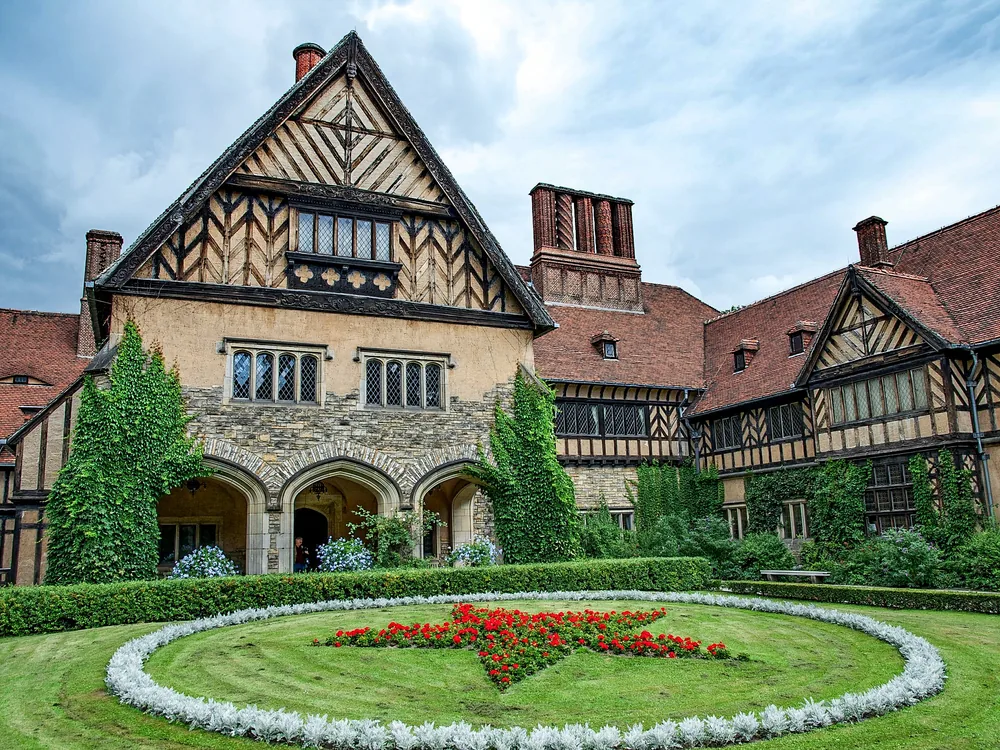
Built 1914 · English Tudor Revival country house designed by Paul Schultze-Naumburg, 1914–1917; the last palace built by the Hohenzollern dynasty before the abdication of Kaiser Wilhelm II in 1918; Schultze-Naumburg modelled the building on an English country house of the early 17th century — irregular plan, half-timbered gables, brick chimneys, leaded windows — at the specific request of Crown Princess Cecilie, who preferred an English residential style to Prussian palace formality; the building incorporates 176 rooms, courtyards, and a garden extending to the shore of the Jungfernsee lake within the Neuer Garten; part of the UNESCO 'Palaces and Parks of Potsdam and Berlin' World Heritage Site (inscribed 1990); closed to the public since 1 November 2024 for a multi-year renovation — visit planning must account for this closure
This page is part of an independent travel guide and is not affiliated with, endorsed by, or operated by Cecilienhof Palace.
© Castles & Palaces
Quick Facts
- Hours
- Closed Mon–Sun
- Day trip from
- €25
- Duration
- 1.5–2 hours (when open)
- Best time
- Spring to Autumn
- Nearest city
- Potsdam
Featured Tour
Potsdam: Sanssouci, Cecilienhof & New Palace Castles Tour
Cancellation available · Instant confirmation
Highlights
- ✦Cecilienhof is where the postwar European order was negotiated: between 17 July and 2 August 1945, Winston Churchill (succeeded mid-conference by Clement Attlee), Harry Truman, and Joseph Stalin met in the palace's main study and the conference hall to agree the Oder-Neisse line as Germany's eastern border, the division of Germany into occupation zones, and the conditions for Japan's surrender — three weeks before Hiroshima; the palace has been preserved largely as it was left after the conference, with Soviet, British, and American delegation rooms intact
- ✦The building itself is the last palace ever constructed by the Hohenzollern dynasty — begun in 1914 for Crown Prince Wilhelm and Crown Princess Cecilie von Mecklenburg, completed in 1917 in the middle of the First World War that would destroy the empire it was built to represent; within one year of completion, Wilhelm II abdicated and the family never returned as rulers
- ✦Crown Princess Cecilie's choice of English Tudor Revival for the palace's architectural style — half-timbered gables, irregular roofline, brick chimneys, leaded casements — was deliberate: she had visited English country houses and preferred their residential informality to the formal Baroque or Neoclassical vocabulary of official Prussian palace architecture; the result sits in the Neuer Garten landscape like an English manor transported to the Brandenburg lakeshore
- ✦The Neuer Garten, in which Cecilienhof sits, was designed by Peter Joseph Lenné as a Romantic English landscape garden and runs along the eastern shore of the Heiliger See and Jungfernsee; the garden contains a marble palace (the Marmorpalais), several garden pavilions, and a view from the lakeshore that looks across the water toward the Heilandskirche at Sacrow — a landscape composition of unusual quality even by Potsdam's standards
- ✦Cecilienhof is part of the UNESCO 'Palaces and Parks of Potsdam and Berlin' World Heritage Site (1990), the same inscription that covers [Sanssouci Palace](/castles/germany/sanssouci-palace) and the [New Palace (Neues Palais)](/castles/germany/neues-palais) — a designation that reflects Potsdam's position as one of the most concentrated royal-garden landscapes in Europe
Tickets & tours
Book through GetYourGuide
Cecilienhof Palace stands in the Neuer Garten in Potsdam, on the shore of the Jungfernsee lake, at a point in the Brandenburg landscape where the garden, the lake, and the distant spires of the Potsdam skyline combine into one of the most evocative Royal Park views in Germany. The palace was built for Crown Prince Wilhelm and Crown Princess Cecilie von Mecklenburg between 1914 and 1917 — begun in the year the First World War started, completed while it continued, and never used as a royal residence in any normal sense because the empire it was built for ended in November 1918.
The architectural decision that defines Cecilienhof is the choice of English Tudor Revival as its style. Crown Princess Cecilie had visited English country houses and found their residential character — irregular plans, half-timbered gables, tall chimneys, leaded casement windows, courtyard gardens — more appropriate for a private princely home than the formal symmetry of Prussian palace architecture. Her architect, Paul Schultze-Naumburg, obliged: the result is a 176-room building that reads from the garden as an Elizabethan manor house rather than a German royal palace, with oak-beamed interiors, inglenook fireplaces, and the general atmosphere of aristocratic English domesticity that Cecilie had admired in her travels.
The building is the last palace ever constructed by the Hohenzollern dynasty. From the perspective of 1914, when the commission was placed, this fact could not have been foreseen: the Hohenzollerns had ruled Prussia and the German Empire for two centuries, and Wilhelm II showed no sign of abdication. By 1917, the year of Cecilienhof's completion, the war had been going on for three years and the imperial position was weakening but not yet broken. In 1918, Wilhelm II abdicated and the family went into exile in the Netherlands, never returning to this palace or any other as rulers.
The palace's second life, and the one that ensures its permanent historical significance, began on 17 July 1945. Cecilienhof was chosen as the site of the Potsdam Conference — the meeting of Churchill, Truman, and Stalin (Churchill replaced mid-conference by Clement Attlee after the British general election) that would settle the postwar European order. The conference ran until 2 August 1945. Its decisions — the Oder-Neisse line as Germany's eastern border, the division of Germany into four occupation zones, the expulsion of Germans from Poland and Czechoslovakia, the framework for Japan's surrender — were among the most consequential of the twentieth century, determining the shape of European borders and the conditions of Cold War geopolitics for four decades.
The palace has been preserved with the conference rooms substantially intact, which makes it a rare kind of historical site: not primarily a monument to royal architecture but a physical record of the moment when the modern political map of Europe was drawn. The circular table in the main conference room, the delegation suites used by the Soviet, British, and American teams, the study where bilateral meetings took place — these are among the most historically loaded domestic spaces in Germany, and the contrast between their relative modesty (an English Tudor country house rather than a Versailles-scale palace) and the magnitude of the decisions made in them is part of what makes Cecilienhof so affecting as a place.
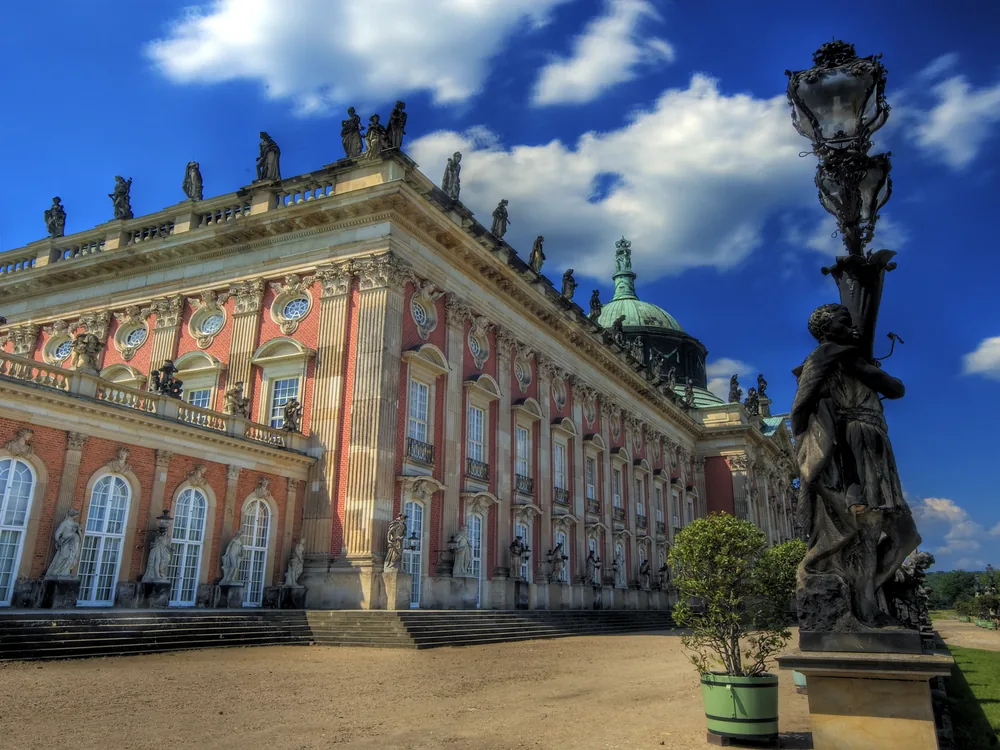
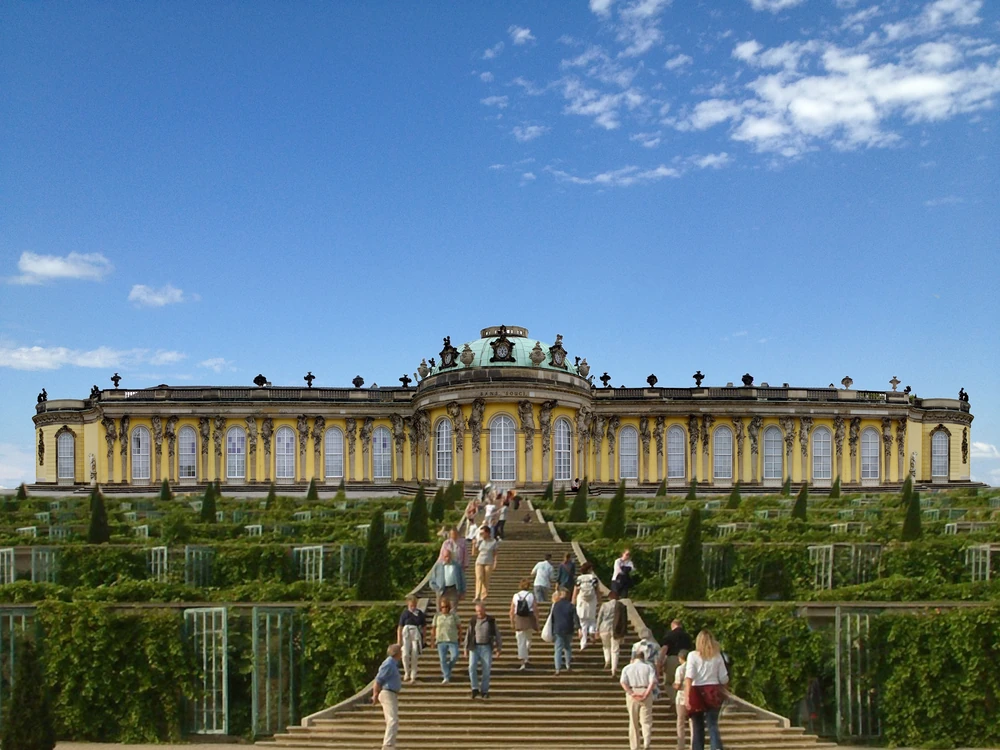
The palace is part of the UNESCO 'Palaces and Parks of Potsdam and Berlin' World Heritage Site (inscribed 1990), the same designation that covers [Sanssouci Palace](/castles/germany/sanssouci-palace) — the 18th-century summer palace of Frederick the Great — and the [Neues Palais](/castles/germany/neues-palais), Frederick's triumphal statement palace built after the Seven Years' War. The three Potsdam palaces together represent three centuries of Hohenzollern royal architecture: Baroque Rococo (Sanssouci), High Baroque state ceremony (Neues Palais), and Edwardian English country house (Cecilienhof) — a compressed history of royal architectural taste from 1745 to 1917.
CECILIENHOF IS CURRENTLY CLOSED for a multi-year renovation that began 1 November 2024. No reopening date has been announced. Visitors planning a Potsdam trip should verify current status at spsg.de before scheduling the palace as a destination. Sanssouci Palace and the Neues Palais remain open, and the Neuer Garten grounds around Cecilienhof may be accessible during the renovation period. The GetYourGuide Potsdam Castles Tour combines all three palaces in a half-day circuit from Berlin and includes current guidance on interior access based on the renovation status.
For visitors coming specifically for the Potsdam Conference history rather than the architecture, the exterior of the palace and the surrounding garden remain significant even when the interior is closed: the building's scale, the lakeside position, and the Neuer Garten landscape are all accessible, and the historical significance of the site is legible from outside.
History
Cecilienhof was the last palace the Hohenzollern dynasty would ever build. Construction began in 1914 for Crown Prince Wilhelm and Crown Princess Cecilie von Mecklenburg, designed by Paul Schultze-Naumburg in the English Tudor Revival style that was fashionable among European royal houses at the time. The palace was completed in 1917. A year later, in November 1918, Wilhelm II abdicated and the dynasty went into exile — the building they had just finished was the last expression of an imperial pretension that had just collapsed.
The palace acquired its place in world history in the summer of 1945, when it was chosen as the venue for the Potsdam Conference. From 17 July to 2 August, Churchill (replaced mid-conference by Attlee following the British election), Truman, and Stalin met in the palace's conference rooms to negotiate the postwar European settlement: the Oder-Neisse line as the German eastern border, the division of Germany into occupation zones, reparations, and the conditions for Japan's surrender. The geopolitical framework of the Cold War was substantially established in these rooms.
The palace has been preserved partly as it was left after the conference, functioning as a museum to the 1945 meeting. It received UNESCO World Heritage inscription in 1990 as part of the Palaces and Parks of Potsdam and Berlin designation. The palace closed for a multi-year renovation on 1 November 2024; a reopening date has not yet been announced.
How to Visit
Getting there: Potsdam is 30 minutes from Berlin by S-Bahn (S7) or regional train. Cecilienhof is in the Neuer Garten, about 3 km from Potsdam Hauptbahnhof — take tram line 92 or 96 to Alleestraße, or a short taxi.
Tickets: Entry when open costs €10 for adults and €5 for children; book online at spsg.de. Note that Cecilienhof has been closed since 1 November 2024 for a multi-year renovation with no announced reopening date — verify current status at spsg.de before visiting. The GetYourGuide Potsdam Castles Tour covers Sanssouci, Cecilienhof, and the Neues Palais in a 3-hour guided circuit from Berlin.
Practical tips: The Neuer Garten grounds may remain accessible during the renovation; the exterior and lakeside position are worth seeing even if the interior is closed. Sanssouci and Neues Palais both remain open and can fill a full Potsdam day.
Combine with: Neues Palais and Sanssouci Palace are both within the Potsdam park landscape — a full day covers all three.
Frequently Asked Questions
The Potsdam Conference (17 July–2 August 1945) agreed: the Oder-Neisse line as Germany's eastern border (ceding Silesia, Pomerania, and southern East Prussia to Poland); the division of Germany into four occupation zones (American, British, French, Soviet); the formal expulsion of Germans from Poland, Czechoslovakia, and Hungary; reparations from Germany; and the conditions of Japan's surrender (the Potsdam Declaration). These decisions shaped European borders and Cold War geopolitics for the following four decades.
Location
Im Neuen Garten, 14469 Potsdam, Germany
Nearby Castles
Tours & Tickets
Powered by GetYourGuide
From
€25/ person