
New Palace (Neues Palais)
Neues Palais
Germany · Brandenburg, Potsdam · Near Potsdam
Built 1763 · High Baroque palace at the western end of Sanssouci Park, Potsdam; built 1763–1769 by Frederick the Great immediately after the Seven Years' War to demonstrate Prussian power and resilience despite the war's near-bankrupting strain; designed by four architects — Johann Gottfried Büring, Heinrich Ludwig Manger, Carl von Gontard, and Jean Laurent Legeay — working under Frederick's precise programmatic direction; the main facade stretches 213 metres, with a central dome and sandstone sculpture programme of approximately 400 figures; over 200 rooms include the Grotto Hall (walls encrusted with shells, minerals, and semi-precious stones), the Marble Hall (70 metres long, 12 metres high), the Upper Gallery with Flemish and Dutch master paintings, and the Court Theatre; Frederick himself never used it as a residence but stayed at Sanssouci, 1.5 km east; Kaiser Wilhelm II preferred the New Palace and used it as his primary Potsdam residence until his abdication in 1918; part of the UNESCO 'Palaces and Parks of Potsdam and Berlin' World Heritage Site (1990)
This page is part of an independent travel guide and is not affiliated with, endorsed by, or operated by New Palace (Neues Palais).
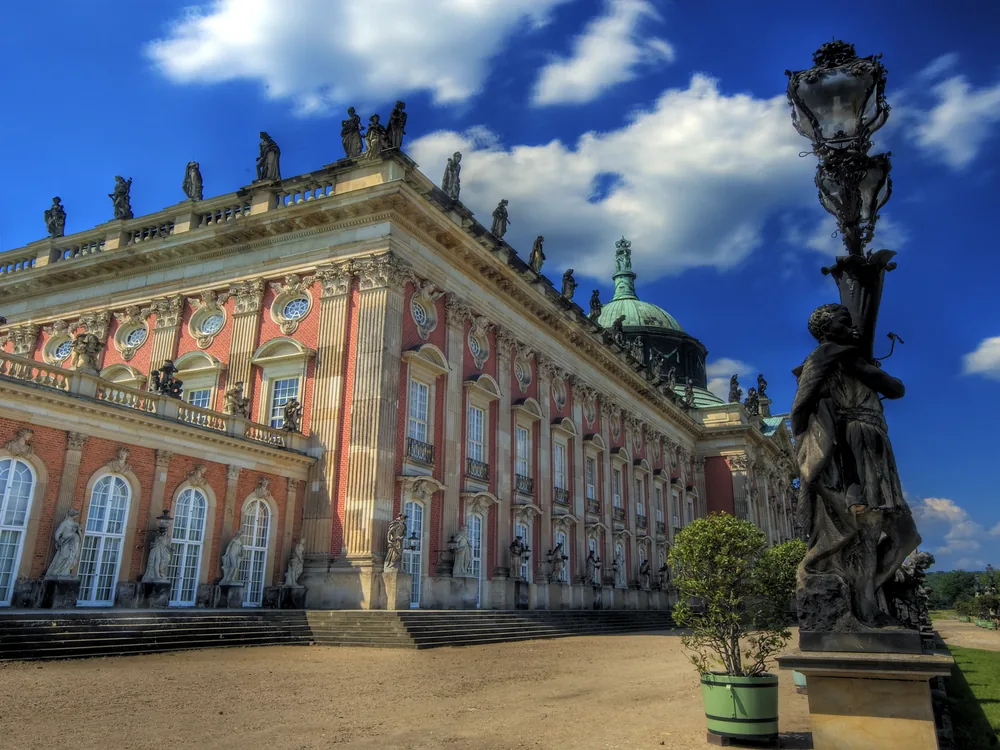
© Castles & Palaces
Quick Facts
- Hours
- Tue–Sun 10:00–17:30. Closed Mon
- Day trip from
- €25
- Duration
- 2–2.5 hours
- Best time
- April to October
- Booking
- Required — book 3+ days ahead
- Nearest city
- Potsdam
Featured Tour
Potsdam: Sanssouci, Cecilienhof & New Palace Castles Tour
Cancellation available · Instant confirmation
Highlights
- ✦The New Palace was built specifically as a demonstration of Prussian power and financial resilience after the Seven Years' War (1756–1763) — a conflict so devastating that Frederick the Great was reduced at one point to using debased coinage and had to accept Russian, Austrian, and French troops simultaneously on Prussian territory; the palace, begun the year peace was signed, was Frederick's public statement that Prussia was unbroken, which explains its deliberately excessive scale: 213 metres of facade, 400 sandstone sculptures, over 200 rooms
- ✦Frederick never slept here: he built the New Palace as a reception venue for state occasions, foreign dignitaries, and events requiring an appropriately intimidating setting, while continuing to live at his intimate Rococo retreat at Sanssouci 1.5 kilometres east; the disconnect between the building's grandiose programme and its owner's domestic preferences is part of what makes the New Palace a specifically political rather than personal building
- ✦The Grotto Hall, deep in the palace's lower level, is one of the most bizarre rooms in any royal palace in Europe: its walls, vaulting, and floor are encrusted with shells, minerals, fossils, semi-precious stones, coral, and glass — a Baroque fantasy of the natural world on a room-sized scale; Frederick reportedly enjoyed watching guests' discomfort in the space, which is disorienting even by the standards of elaborate palace decoration
- ✦Kaiser Wilhelm II chose the New Palace over all of Potsdam's other royal buildings as his primary residence, living here regularly from his accession in 1888 until his abdication in November 1918 — thirty years during which the building functioned as the working centre of the German imperial government rather than a ceremonial showpiece; he left from here for the Netherlands and never returned; the rooms retain the atmosphere of a palace that was recently and seriously occupied
- ✦The palace stands at the western terminus of Sanssouci Park's main axis, visible from [Sanssouci Palace](/castles/germany/sanssouci-palace) 1.5 km to the east, with the Chinese House, the Belvedere on the Klausberg, and Charlottenhof Palace arranged along the connecting parkland — making the walk between Sanssouci and the New Palace one of the most architecturally dense garden promenades in Germany
Tickets & tours
Book through GetYourGuide
The New Palace (Neues Palais) stands at the western end of Sanssouci Park in Potsdam, Brandenburg, at the opposite end of the main garden axis from Sanssouci Palace. The distance between the two buildings is about 1.5 kilometres — a promenade through Sanssouci Park's formal allées and garden rooms that connects two radically different expressions of the same royal personality: Sanssouci (begun 1745) as Frederick the Great's intimate personal retreat; the New Palace (begun 1763) as his public demonstration of Prussian power.
The New Palace was built between 1763 and 1769, starting the year that the Seven Years' War ended with the Treaty of Hubertusburg. The Seven Years' War had been the defining crisis of Frederick's reign: a conflict in which Prussia faced simultaneous military pressure from Russia, Austria, France, Sweden, and Saxony, nearly lost, and survived primarily because of Frederick's personal tactical competence and a change of Russian regime (the death of Empress Elizabeth and the accession of Peter III, who was an admirer of Frederick and withdrew Russian forces in 1762). The war left Prussia financially strained and physically damaged — territory occupied, cities damaged, the treasury nearly empty.
Frederick's decision to begin a 213-metre Baroque palace the year peace was signed was therefore a deliberate political signal: Prussia had not been broken by the war, the Hohenzollern state retained the resources to build on an imperial scale, and any rival who had anticipated Prussian weakness would find his assumption incorrect. The New Palace is a piece of foreign-policy architecture as much as a domestic building.
Four architects worked on the design under Frederick's direction — Johann Gottfried Büring, Heinrich Ludwig Manger, Carl von Gontard, and the French architect Jean Laurent Legeay — producing a High Baroque ensemble with a 213-metre central block, flanking structures, a dome, and a sandstone sculpture programme of approximately 400 figures. The scale is deliberately intimidating; the building was planned as a reception venue for state visits and formal occasions requiring an appropriately overwhelming setting. Frederick himself preferred to stay at Sanssouci, the much smaller Rococo palace at the other end of the park, when he was in Potsdam for personal rather than state purposes.
The interior programme reflects this dual function. The state rooms — the Marble Hall (70 metres long, 12 metres high, white Carrara marble and gilt), the Upper Gallery with Flemish and Dutch master paintings, the Jasper Gallery, the Lower Gallery — are scaled for ceremonial reception: proportioned to make visitors feel small, decorated to project wealth and cultural sophistication in immediate visual terms. The Court Theatre, by contrast, is an intimate Baroque opera house fitted with original machinery for scene changes, used for performances during Frederick's time and still used for chamber concerts and opera today.
The Grotto Hall, in the lower level, is the palace's most singular room: a vaulted chamber whose walls, floor, and ceiling are entirely encrusted with shells, minerals, fossils, semi-precious stones, coral, and coloured glass. The room has no architectural precedent in Prussian architecture; it is a Baroque fantasy of the natural world executed at room scale, disorienting and slightly oppressive in its density of surface decoration. Frederick reportedly brought guests here specifically to observe their reactions.
The palace's second significant period of continuous use came under Kaiser Wilhelm II, who preferred it to all other Hohenzollern residences and used it as his primary Potsdam base from 1888 until his abdication in November 1918. During his thirty-year residency, the New Palace was a functioning centre of imperial government rather than a museum piece — ministers received, diplomatic correspondence conducted, imperial decisions made in rooms that Frederick had built for their ceremonial impressiveness rather than their domestic comfort. Wilhelm left for the Netherlands in 1918 and never returned; the rooms were subsequently preserved as he had used them, which gives certain areas of the palace a quality of recent habitation unlike the more museum-like atmosphere of Sanssouci.
The New Palace is part of the UNESCO 'Palaces and Parks of Potsdam and Berlin' World Heritage Site (1990), the same inscription that covers [Sanssouci Palace](/castles/germany/sanssouci-palace) and [Cecilienhof Palace](/castles/germany/cecilienhof-palace) — the three principal Hohenzollern buildings in Potsdam representing three centuries of the dynasty's architectural ambition. Of the three, the New Palace requires the most time: the state rooms are extensive, the park walk from Sanssouci or from the Potsdam Hauptbahnhof adds to the visit, and the Court Theatre programme adds the option of an evening concert after the day's sightseeing.
The GetYourGuide Potsdam Castles Tour combines Sanssouci, the New Palace, and Cecilienhof in a guided half-day circuit from Berlin — the most practical way to navigate all three sites without a car, since Sanssouci Park is not easily covered by public transport alone.
History
Frederick the Great began construction of the New Palace in 1763, immediately after the Seven Years' War — a deliberate architectural statement that Prussia, despite the exhausting conflict it had just survived, remained a great power capable of building on a royal scale. The 200-room palace was completed in 1769 and placed at the western end of the Sanssouci Park axis, at the opposite end from Frederick's intimate vineyard palace where he actually lived. The New Palace was conceived for reception rather than residence: Frederick used it to impress foreign visitors while continuing to occupy the much smaller Sanssouci as his personal retreat.
After Frederick's death in 1786, the palace passed through successive Hohenzollern monarchs until Kaiser Wilhelm II, who acceded in 1888, adopted it as his primary Potsdam residence — giving the building a domestic warmth its original patron had never intended. Wilhelm added an elevator, updated the heating, and used the palace as a working royal home. When he abdicated in November 1918 and left for Dutch exile, the palace passed to the Prussian state and was opened to the public the following year.
UNESCO inscription as part of the Palaces and Parks of Potsdam and Berlin followed in 1990. The palace is open from April to October, and the Court Theatre within the complex hosts chamber concerts and opera during the season.
How to Visit
Getting there: Potsdam Hauptbahnhof is 30 minutes from Berlin by S-Bahn (S7) or regional train. From the station, take bus 606 or 695 to the Neues Palais stop; alternatively, the park walk from Potsdam Sanssouci station takes about 40 minutes through the formal gardens. By car: parking is available at the Neues Palais car park on Am Neuen Palais.
Tickets: Entry costs €12 for adults, €6 for children; book online at spsg.de to guarantee entry, especially on summer weekends. Combined tickets with Sanssouci and Charlottenhof are also available. The GetYourGuide Potsdam Castles Tour is a 3-hour guided circuit from Berlin covering Sanssouci, the New Palace, and Cecilienhof — the most efficient way to visit all three without a car.
Practical tips: The Grotto Hall (lower level, walls and vaulting encrusted with shells, minerals, and semi-precious stones) is the single most unusual room in the palace — don't skip it on a short visit. The Court Theatre inside the palace hosts chamber concerts and opera during the season; check spsg.de/events for the current programme before your trip. In winter (November–March) only specific pre-booked tours operate — confirm availability before travelling.
Combine with: Sanssouci Palace is 1.5 km east along the main garden axis — the 40-minute park walk between the two buildings passes the Chinese House, the Belvedere, and Charlottenhof, making the route itself part of the visit. Cecilienhof Palace, where the 1945 Potsdam Conference was held, is in the Neuer Garten to the northeast; confirm current renovation status at spsg.de before visiting.
Frequently Asked Questions
The New Palace was deliberately built as a political statement — Frederick wanted to demonstrate to Prussia's European rivals that the country had not been weakened by the Seven Years' War (1756–1763), during which Prussia faced simultaneous pressure from Russia, Austria, France, and others. Building one of the largest Baroque palaces in northern Europe the year peace was signed was Frederick's public signal that Prussia retained the resources and the will to project power. He himself rarely stayed there; Sanssouci was his personal retreat. The New Palace was always primarily political architecture.
Location
Am Neuen Palais, 14469 Potsdam, Germany
Nearby Castles
Tours & Tickets
Powered by GetYourGuide
From
€25/ person