
Ehrenbreitstein Fortress
Festung Ehrenbreitstein
Germany · Rhineland-Palatinate, Koblenz, Upper Middle Rhine Valley — UNESCO World Heritage Area · Near Koblenz
Built 1817 · 19th-century Prussian military fortress on a Roman and medieval defensive plateau — the plateau above Koblenz on the right bank of the Rhine has been fortified continuously since Roman times, with a documented medieval fortress from at least the 11th century; the present structure is almost entirely Prussian: built between 1817 and 1828 after Napoleon's forces destroyed the earlier fortress in 1801 by tunnelling and detonating its powder magazines; the Prussian construction is one of the largest peacetime fortress-building projects in 19th-century German history, a sprawling complex of bastions, casemates, magazines, barracks, and connecting passages on a plateau 118 metres above the Rhine; the Landesmuseum Koblenz occupies the interior with exhibitions on regional history, photography, and archaeology; the cable car to the fortress (Seilbahn Koblenz, first installed 1925, rebuilt for the 2011 Bundesgartenschau) is the primary scenic access from the city below
This page is part of an independent travel guide and is not affiliated with, endorsed by, or operated by Ehrenbreitstein Fortress.
© Castles & Palaces
Quick Facts
- Hours
- Daily 10:00–18:00
- Guided tour from
- €16
- Duration
- 1.5–2 hours (fortress plateau and Landesmuseum); additional time for the cable car and Koblenz city combination
- Best time
- April to October
- Nearest city
- Koblenz
Featured Tour
Koblenz: Cable Car Tickets with Optional Entrance to Ehrenbreitstein Castle
Cancellation available · Instant confirmation
Highlights
- ✦The view over the Deutsches Eck — the fortress's plateau 118 metres above the Rhine gives an unobstructed panorama over the Deutsches Eck, the symbolic 'German Corner' where the Rhine and Moselle rivers converge at Koblenz; the view encompasses the confluence, the equestrian monument of Kaiser Wilhelm I at the tip of the headland, the rooftops of the old city below, and the wider Rhine valley stretching north and south toward the UNESCO Middle Rhine Gorge
- ✦One of the largest standing fortresses in Europe — the Prussian construction of 1817–1828 covers the full plateau with an interconnected complex of bastions, magazines, casemates, barracks, and connecting passages; the scale is a product of post-Napoleonic Prussian military ambition — the Rhine was to be defended against future French incursion by a ring of fortresses so large and so reinforced that no single assault could reduce them; Ehrenbreitstein was the centrepiece of this Rhine defence program
- ✦Napoleon's destruction and Prussia's reconstruction — in January 1801, French forces evacuating the fortress under the terms of the Treaty of Lunéville destroyed the earlier Koblenz electoral fortress by tunnelling beneath the powder magazines and detonating them; the explosion destroyed what had been one of the principal fortifications in the western Holy Roman Empire; the Prussian architects who rebuilt it between 1817 and 1828 deliberately built larger, higher, and with greater structural redundancy than the original
- ✦A fortress plateau since Roman times — Roman troops stationed at the confluence of the Rhine and Moselle used the Ehrenbreitstein plateau as a fortified position; the medieval fortress that preceded the Prussian construction was documented from the 11th century and served successive Archbishops of Trier as one of their principal residences; the Prussian fortress sits on 2,000 years of continuous military occupation of the same site
- ✦The cable car connection: the Seilbahn Koblenz — the gondola cable car connecting the city below to the fortress plateau was first installed in 1925; the current system was rebuilt for the 2011 Bundesgartenschau (Federal Garden Show), which used the fortress grounds as part of the exhibition site; the cable car ride is the most scenic approach and provides panoramic views over the Rhine and the city on the ascent
- ✦GetYourGuide cable car + fortress entry combination ticket — select the combination variant for both cable car round trip and fortress entry
Skip the queue with a guided tour
Skip-the-line tickets & expert guides
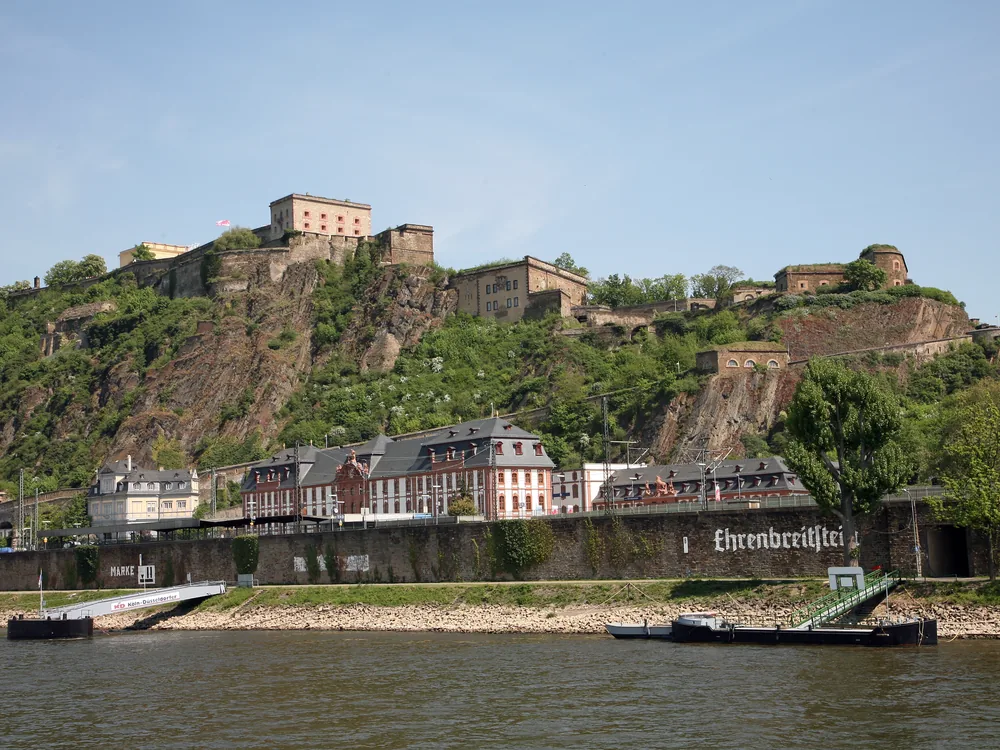
The Rhine and Moselle meet at Koblenz — two major rivers joining at a headland called the Deutsches Eck, where a massive equestrian statue of Kaiser Wilhelm I has stood since 1897. From this confluence, looking across the Rhine to the right bank, the Ehrenbreitstein plateau rises 118 metres above the river, and the fortress that covers it is visible from every point in the lower city: a sprawling mass of stone bastions and casemates, extended across the full width of the plateau, built at a scale that announces itself as something intentionally overwhelming.
The plateau has been fortified for two thousand years. Roman troops garrisoned here to control the Rhine-Moselle confluence; the medieval fortress documented from at least the 11th century served the Archbishop-Electors of Trier as one of their primary Rhine residences, and the strategic position at the junction of two major river arteries made Ehrenbreitstein one of the most important defensive positions in the western Holy Roman Empire. By the late 17th century, under the Elector Johann Hugo von Orsbeck, the fortress had been expanded into a sophisticated Baroque military complex, considered one of the strongest on the Rhine.
Napoleon ended it. In January 1801, as French forces evacuated the fortress under the terms of the Treaty of Lunéville that transferred the left bank of the Rhine to France, French engineers tunnelled beneath the powder magazines of the Koblenz fortress and detonated them. The explosion destroyed the main structure, leaving a ruin on the plateau and removing the principal fortification of the middle Rhine from the military map of Central Europe. It was one of the more comprehensive acts of deliberate military demolition in the Napoleonic wars.
The Prussian answer was to build it bigger. After the Congress of Vienna in 1815 assigned Koblenz and the middle Rhine to Prussia, the Prussian military authorities began planning the reconstruction of Ehrenbreitstein not as a restoration of the destroyed fortress but as a new, larger, and more modern military complex. Construction ran from 1817 to 1828 — eleven years of sustained investment in one of the largest peacetime fortress-building projects in 19th-century German history. The resulting complex covers the entire plateau with an interconnected system of bastions, casemates, magazines, barracks, and connecting passages designed to be impregnable to the contemporary siege artillery that had reduced earlier fortifications across Europe. The scale is the post-Napoleonic German response to the fact that the French had destroyed the previous fortress: the new one would be built at a scale that made such an act of destruction practically impossible.
The fortress was never seriously tested militarily. As Prussian and subsequently German power consolidated across the 19th century, the Rhine frontier became progressively less contested, and Ehrenbreitstein transitioned from an active military installation to an administrative and eventually a cultural site. The Landesmuseum Koblenz, which now occupies the interior, presents exhibitions on the regional history of Rhineland-Palatinate, photography, and Rhenish archaeology — a museum institution within an 11-year construction project that was conceived as a military fortress.
The cable car connecting the city to the plateau — the Seilbahn Koblenz — was first installed in 1925 for an exhibition and has been the primary scenic access ever since. The current gondola system was rebuilt for the 2011 Bundesgartenschau (Federal Garden Show), which used the fortress grounds as part of its exhibition landscape. The cable car ascent provides an eight-minute crossing of the Rhine from the Koblenz waterfront to the plateau, with the Deutsches Eck visible directly below during the final approach. The alternative is a free-of-charge foot path up the hillside, approximately 40 minutes each way.
The fortress sits within the Upper Middle Rhine Valley UNESCO World Heritage Site, inscribed in 2002 for the stretch of the Rhine from Koblenz to Bingen — one of the most densely fortified and historically significant river landscapes in Europe, lined with the tower-castles and steep vineyards of the Rhine Gorge that defined the river's romantic identity from the 18th century onward.
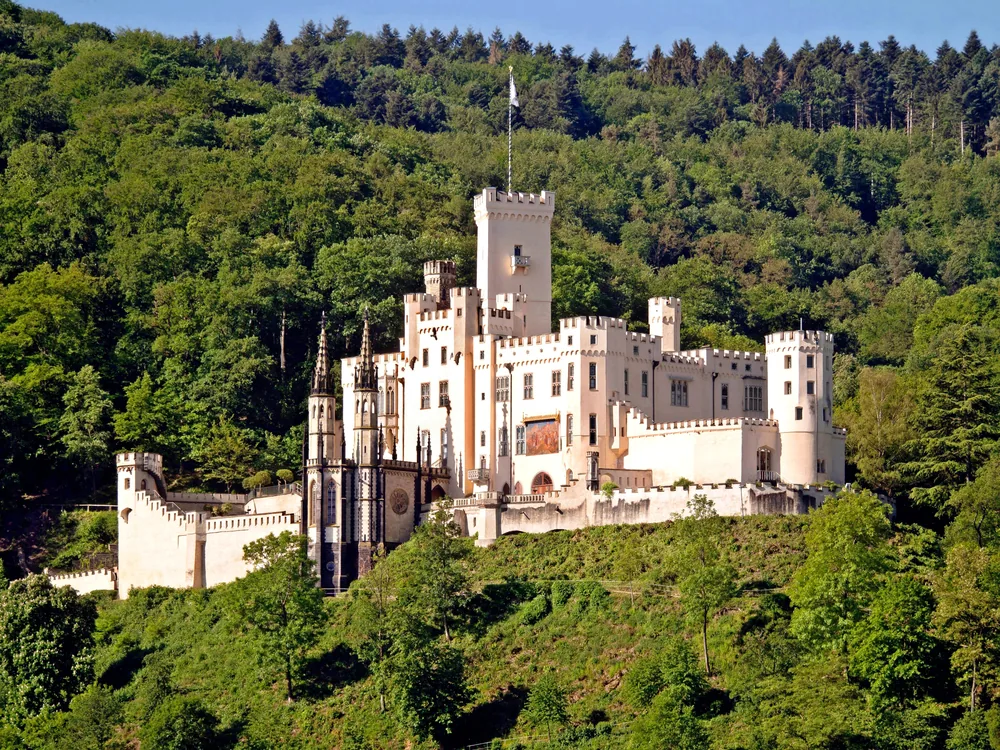
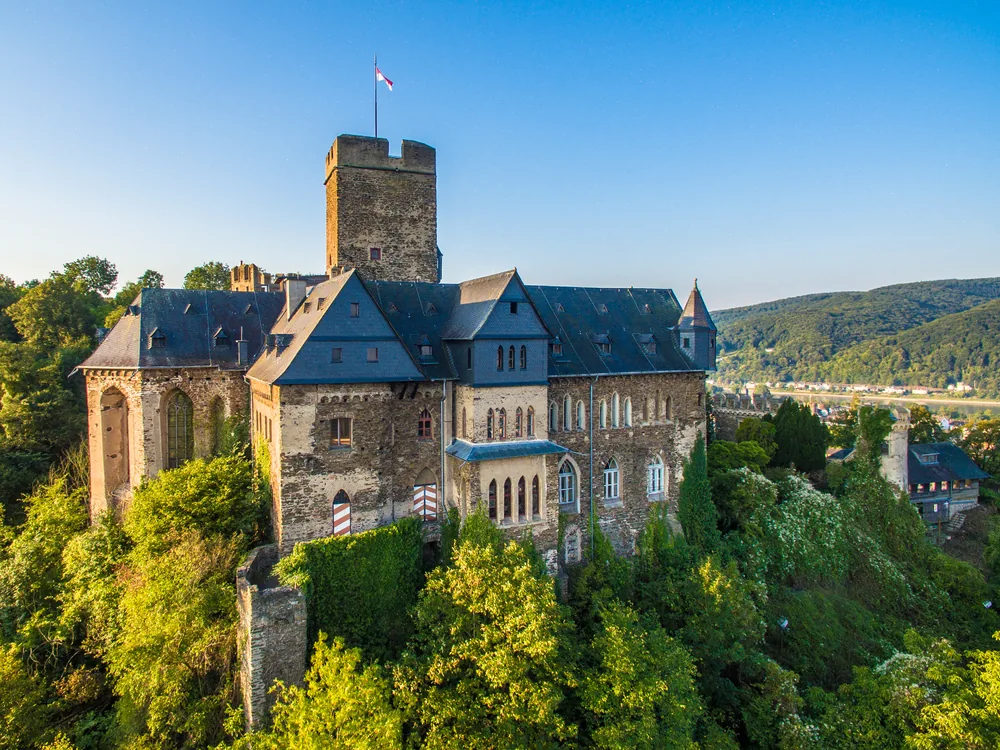
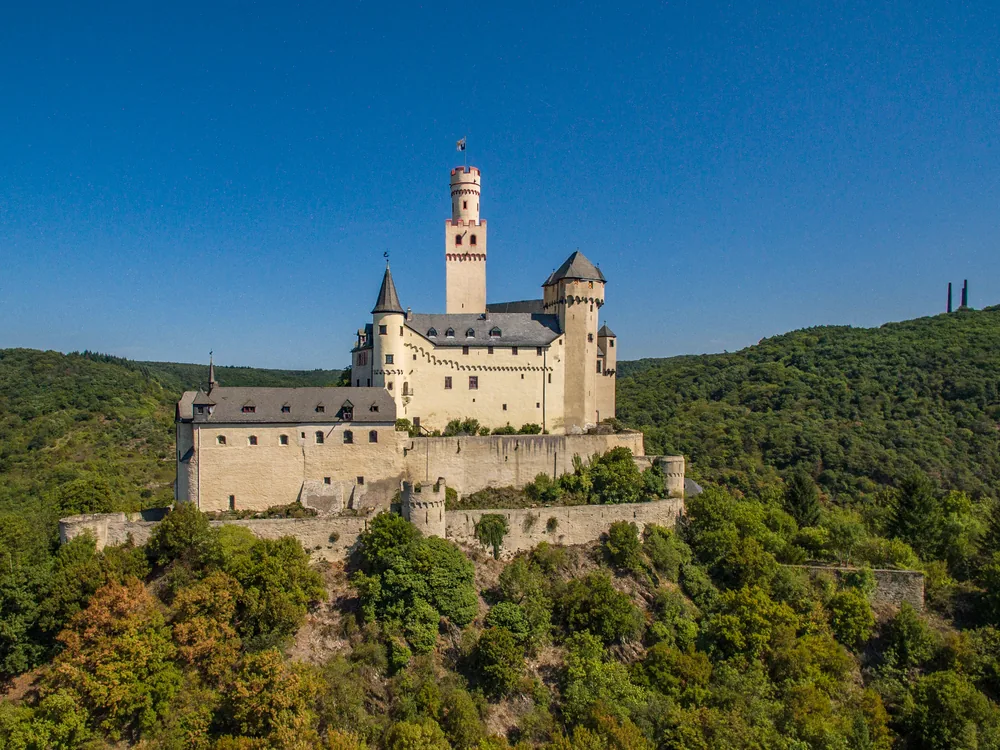
[Stolzenfels Castle](/castles/germany/stolzenfels-castle), 5 kilometres south of Koblenz on the Rhine bank, is the nearest comparable site — a Gothic Revival castle rebuilt by Crown Prince Friedrich Wilhelm of Prussia in the 1830s as a summer residence, visible from the southern end of the Ehrenbreitstein plateau. [Lahneck Castle](/castles/germany/lahneck-castle) stands at the confluence of the Rhine and Lahn rivers just south of Koblenz. [Marksburg Castle](/castles/germany/marksburg-castle) at Braubach, 15 kilometres south, is the only Rhine Gorge castle never destroyed — the one castle in the UNESCO site whose medieval fabric is entirely original.
History
The plateau above the Rhine-Moselle confluence at Koblenz has been fortified since Roman times — the commanding position over the river junction made it an obvious choice for successive military planners. Medieval fortification is first documented in 11th-century sources, and the site served successive Archbishops of Trier as a Rhine residence and administrative centre for centuries. Baroque expansion under Archbishop-Elector Johann Hugo von Orsbeck in the 17th century made Ehrenbreitstein one of the strongest fortresses on the Rhine.
That strength proved insufficient against French Revolutionary engineering. In January 1801, French forces evacuating under the Treaty of Lunéville tunnelled beneath the powder magazines and destroyed the fortress in a controlled detonation — one of the most systematically executed demolitions of a major Rhine fortification. The ruins remained on the plateau until the Congress of Vienna assigned the middle Rhine to Prussia in 1815, setting in motion the largest post-Napoleonic fortification project on the German Rhine: a new fortress built between 1817 and 1828 at even greater scale and structural strength than its predecessor, officially completed in 1842.
Progressive demilitarisation in the late 19th and 20th centuries converted the fortress to administrative and cultural purposes. A cable car connecting the city to the plateau was first installed in 1925 and rebuilt in 2011 for the Bundesgartenschau (Federal Garden Show) held partly on the fortress grounds. The Upper Middle Rhine Valley, including Ehrenbreitstein's plateau, received UNESCO World Heritage inscription in 2002. The Landesmuseum Koblenz now operates within the fortress, open daily.
How to Visit
Getting there: Koblenz is well-connected by rail — ICE and IC trains arrive from Cologne (about 1 hour), Frankfurt (about 2 hours), and Mainz (about 1 hour). The cable car (Seilbahn Koblenz) departs from the Koblenz waterfront near the Deutsches Eck and reaches the fortress plateau in 8 minutes. Alternatively, a free foot path from the Rhine bank takes about 40 minutes uphill.
Tickets: The fortress plateau and exterior fortifications are free. The Landesmuseum Koblenz inside charges a separate admission. The GetYourGuide cable car + fortress combination ticket covers both the cable car round trip and fortress entry — when booking, select the combination variant rather than the cable-car-only option. The cable car does not operate in high winds.
Practical tips: The cable car crossing of the Rhine takes 8 minutes and provides a panoramic view over the Deutsches Eck on the approach — worth the modest extra cost over the free foot path. Arrive before 10:30 in summer; queues at the cable car base build quickly through the morning.
Combine with: Stolzenfels Castle is 5 km south for a same-day Rhine castle pairing. Lahneck Castle guards the Rhine–Lahn confluence just south, and Marksburg Castle at Braubach is 15 km downriver — the only Rhine Gorge castle never destroyed.
Frequently Asked Questions
The Deutsches Eck (German Corner) is the name for the headland at Koblenz where the Moselle River flows into the Rhine — the most clearly defined river confluence in the German Rhineland. The headland carries an equestrian statue of Kaiser Wilhelm I on a tall base, installed in 1897 as a monument to German unification; the statue was destroyed in 1945 and the base used as a memorial before a replica of the statue was reinstalled in 1993. From the Ehrenbreitstein plateau 118 metres above the confluence, the Deutsches Eck is visible directly below and across the Rhine — the castle's position provides the most complete overhead view of the confluence available from any accessible point in the region.
Location
Festung Ehrenbreitstein, 56077 Koblenz, Germany
Nearby Castles
Tours & Tickets
Powered by GetYourGuide
From
€16/ person