
Stolzenfels Castle
Schloss Stolzenfels
Germany · Rhineland-Palatinate, Rhine Gorge · Near Koblenz
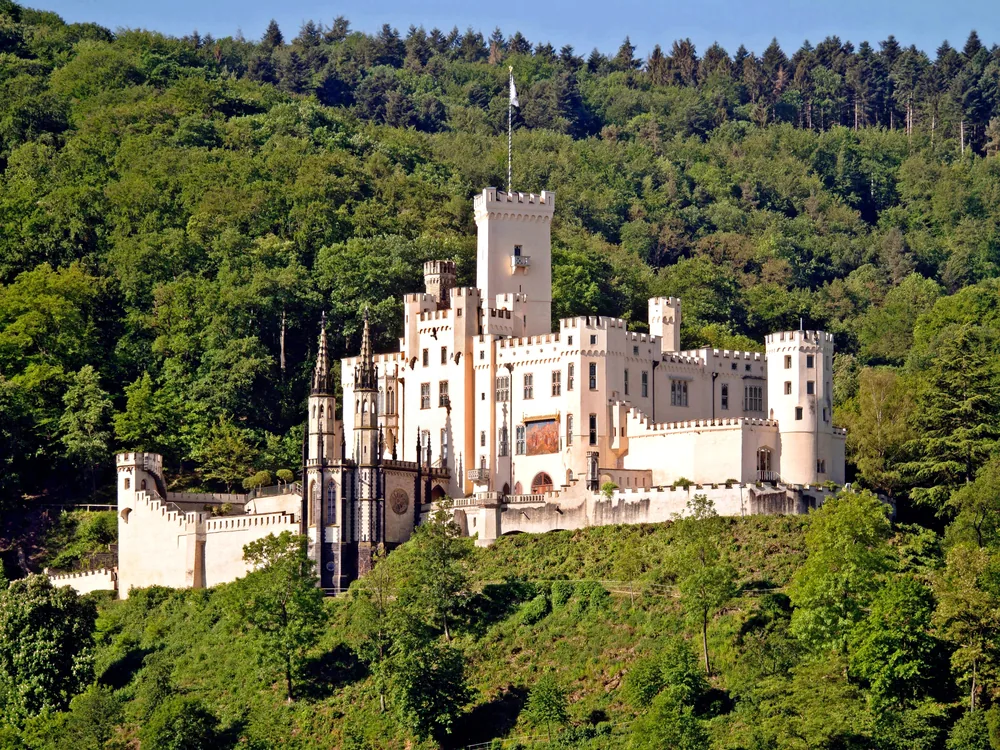
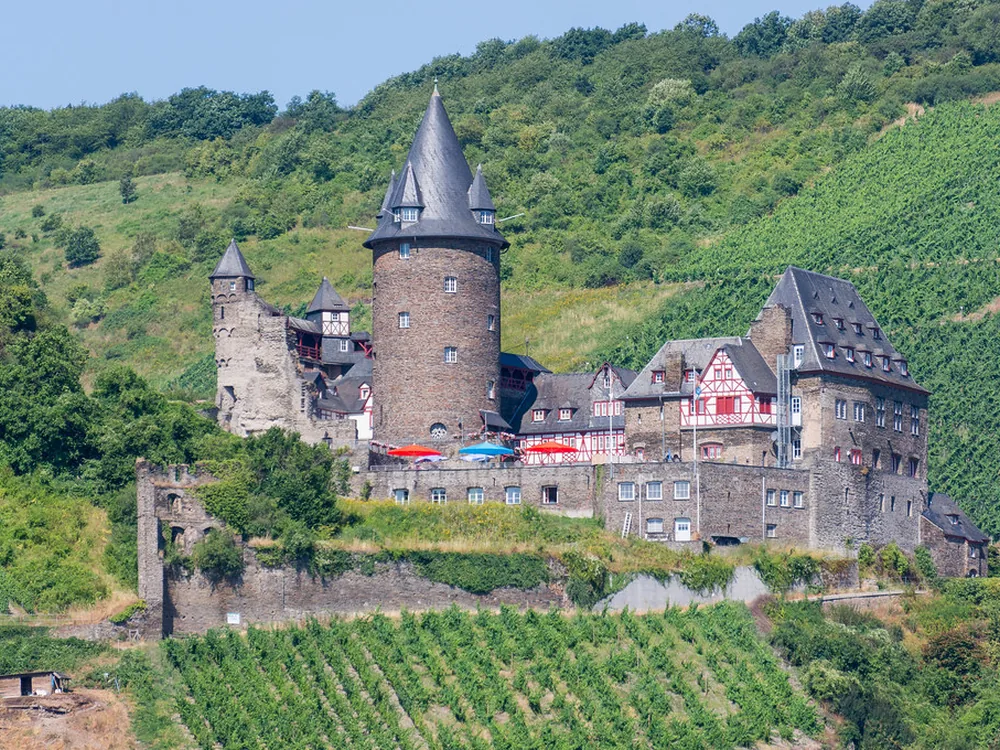
Built 1259 · Gothic Revival summer palace on a high Rhine bluff south of Koblenz; the original castle was built in 1259 by Archbishop Arnold II von Isenburg of Trier as a toll station and river-control fortress — one of the series of Rhine toll castles that made the river profitable and politically contested through the medieval period; destroyed by French forces in 1689 during the Nine Years' War; the ruined site was gifted to Prussian Crown Prince Frederick William by the City of Koblenz in 1823; Frederick William commissioned Karl Friedrich Schinkel to design a Gothic Revival rebuilding and summer residence, completed 1842; Schinkel's approach was consciously Romantic — integrating the surviving medieval masonry with new construction, adding a garden designed by Peter Joseph Lenné, and creating interiors that quoted medieval motifs through the filter of 19th-century historicist taste; Frederick William used it as his Rhine summer residence until 1857; one of the defining monuments of 19th-century Prussian Rhine Romanticism; access via boat from Koblenz or uphill path from the village; on the GetYourGuide Rhine boat tour, viewed from the river rather than interior access
This page is part of an independent travel guide and is not affiliated with, endorsed by, or operated by Stolzenfels Castle.
© Castles & Palaces
Quick Facts
- Hours
- Wed–Fri 10:00–17:00. Sat & Sun 10:00–18:00. Closed Mon & Tue
- Day trip from
- €19
- Duration
- 1.5 hours
- Best time
- April to October
- Nearest city
- Koblenz
Featured Tour
From Koblenz: Stolzenfels, Marksburg & Lahneck Rhine Valley Boat Tour
Cancellation available · Instant confirmation
Highlights
- ✦Stolzenfels began as an Archbishop of Trier's toll station in 1259 — one of dozens of Rhine toll castles whose existence made the river one of medieval Europe's most commercially significant and politically contested waterways; after the French destroyed it in 1689, it sat as a picturesque ruin for 134 years until Crown Prince Frederick William visited, fell in love with the Rhine landscape, and received the ruin as a gift from the City of Koblenz in 1823
- ✦The architect Frederick William chose for the rebuilding was Karl Friedrich Schinkel — the most important German architect of the 19th century, whose work in Berlin (the Altes Museum, the Neue Wache, the Schauspielhaus) had established the dominant vocabulary of Prussian Neoclassicism; at Stolzenfels, Schinkel pivoted to Gothic Revival, integrating surviving medieval masonry with new construction in a historically informed but architecturally ambitious Romantic package
- ✦Peter Joseph Lenné — the landscape architect responsible for Sanssouci Park in Potsdam and much of Berlin's Tiergarten — designed the terraced gardens between the castle and the Rhine cliff, which descend through vine-terraced slopes to the river in a composition of deliberate scenic drama; the view from the castle garden back toward the Rhine, with the Lahneck Castle visible across the Lahn mouth, is the defining image of the Romantic Rhine landscape
- ✦The GetYourGuide Rhine boat tour passes Stolzenfels from the water — the most evocative approach, since the castle was designed to be seen from the Rhine; the silhouette from the river, with the Gothic towers rising above the vine-covered cliff, is precisely the image that made the Middle Rhine the defining landscape of 19th-century German Romanticism for Turner, Victor Hugo, and Byron
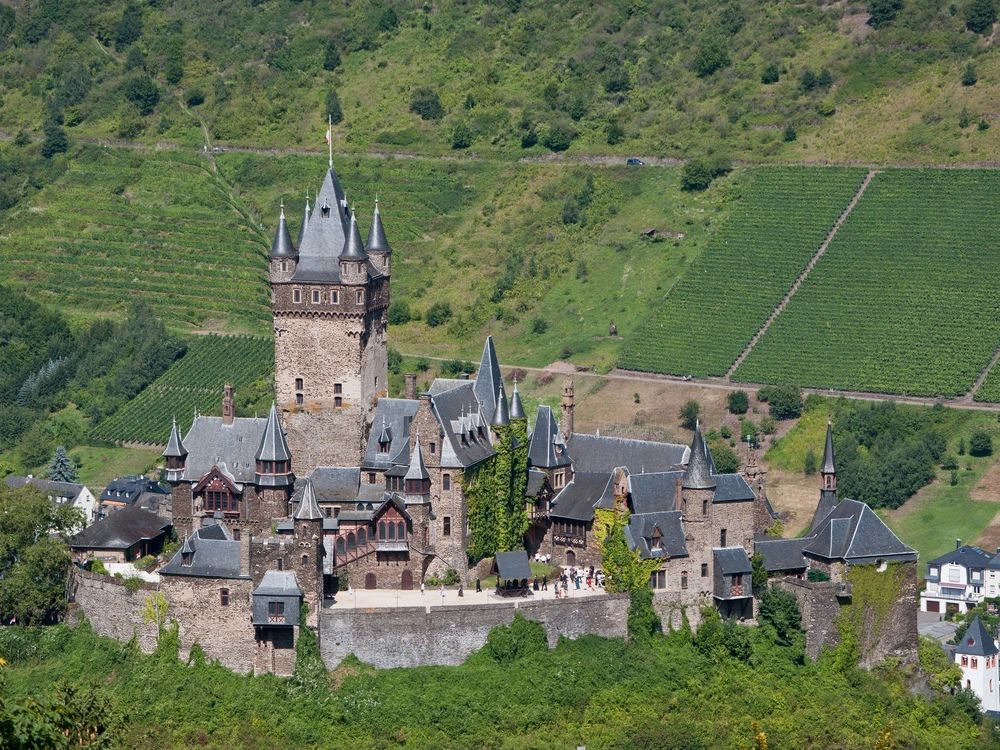
- ✦The castle's location at the southern edge of Koblenz, immediately upstream from where the Lahn meets the Rhine, makes it the southernmost point of the cluster of Rhine Gorge fortifications that continues through [Lahneck Castle](/castles/germany/lahneck-castle) at the Lahn mouth, [Marksburg Castle](/castles/germany/marksburg-castle) at Braubach, and [Reichsburg Cochem](/castles/germany/reichsburg-cochem) further south — each one occupying the kind of dramatic bluff-top position that made the Rhine Gorge one of the first stretches of European landscape to be systematically described as 'sublime'
Tickets & tours
Book through GetYourGuide
Stolzenfels Castle stands on a high bluff above the Rhine south of Koblenz, at the southern edge of the city and just upstream from where the Lahn river joins the Rhine. The site commands one of the Rhine's most visually dramatic approach angles: arriving by boat from Koblenz, the Gothic Revival towers appear above the vine-covered cliff with the kind of composed picturesqueness that would have been immediately recognised by any 19th-century traveller who had read Byron, looked at Turner's Rhine paintings, or read Victor Hugo's account of his Rhine journey.
The original castle was built in 1259 by Archbishop Arnold II von Isenburg of Trier as a customs and toll station on the Rhine. Medieval Rhine tolls were a significant source of income for the ecclesiastical and secular lords who controlled the riverbanks: every boat passing upriver or downriver was liable to stop at each toll station and pay. The Archbishop of Trier's toll point at Stolzenfels competed with other Rhine lords' toll stations for shares of the river's commercial traffic, and the castle served simultaneously as a tax-collection point, a garrison to enforce payment, and a symbol of the Archbishop's territorial claims over this stretch of river.
French forces destroyed the castle in 1689 during the Nine Years' War — part of the systematic destruction of Rhine fortifications that Louis XIV's generals carried out as a strategic measure to prevent the river from being used as a defensive line against France. The ruin stood for 134 years: picturesque by Romantic standards, visited by travellers on Rhine journeys, drawn and painted, but without any active stewardship.
In 1823, Crown Prince Frederick William of Prussia visited Koblenz and found the Rhine landscape captivating. The City of Koblenz, keen to cultivate a relationship with Prussian royalty, gifted him the Stolzenfels ruins. Frederick William accepted and immediately commissioned Karl Friedrich Schinkel — at the peak of his influence as Germany's most important architect — to prepare designs for a Gothic Revival rebuilding. Schinkel's approach was Romantically informed rather than archaeologically precise: he incorporated the surviving medieval masonry where possible, designed new towers and halls in a Gothic vocabulary drawn from his knowledge of English and French medieval architecture, and treated the resulting building as a Romantic idealization of what a medieval Rhineland castle might have looked like in its prime rather than a faithful reconstruction of the original Trier fortress.
The rebuilding was completed in 1842 and Frederick William (by then King Frederick William IV) used it as his Rhine summer residence, hosting visitors who came to see the romanticized Rhine and were received in rooms that quoted the Middle Ages through the filter of mid-19th-century historicist taste. Peter Joseph Lenné's terraced gardens between the castle walls and the Rhine cliff edge completed the composition: vine terraces, formal plantings, and a view down to the river that was itself a designed landscape element.
The castle passed to the Prussian state after the abdication of Wilhelm II in 1918, and is now managed by the Generaldirektion Kulturelles Erbe Rheinland-Pfalz as a museum open April to October. The interior rooms display period furniture, paintings, and decorative art from the Schinkel rebuilding period, creating a portrait of 1840s princely taste in a Gothic Revival frame.
The most atmospheric way to encounter Stolzenfels remains the same as in the 19th century: from the Rhine, by boat. The GetYourGuide Rhine boat tour from Koblenz cruises past Stolzenfels, Lahneck Castle at the Lahn mouth, and Marksburg Castle at Braubach — two hours of river-cruise with castle silhouettes appearing around each bend, which is how the Rhine Gorge was first experienced by the wave of Romantic-era travellers who made the Middle Rhine journey a cultural pilgrimage. The boat tour does not include interior access; for that, a separate independent visit during the April–October season is required.
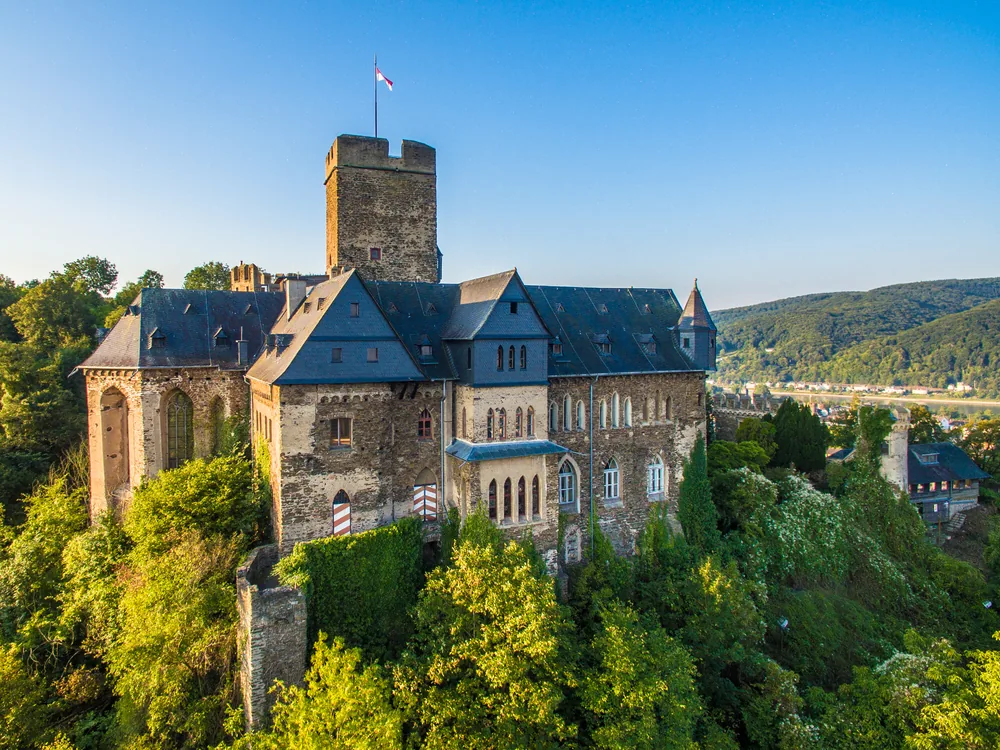
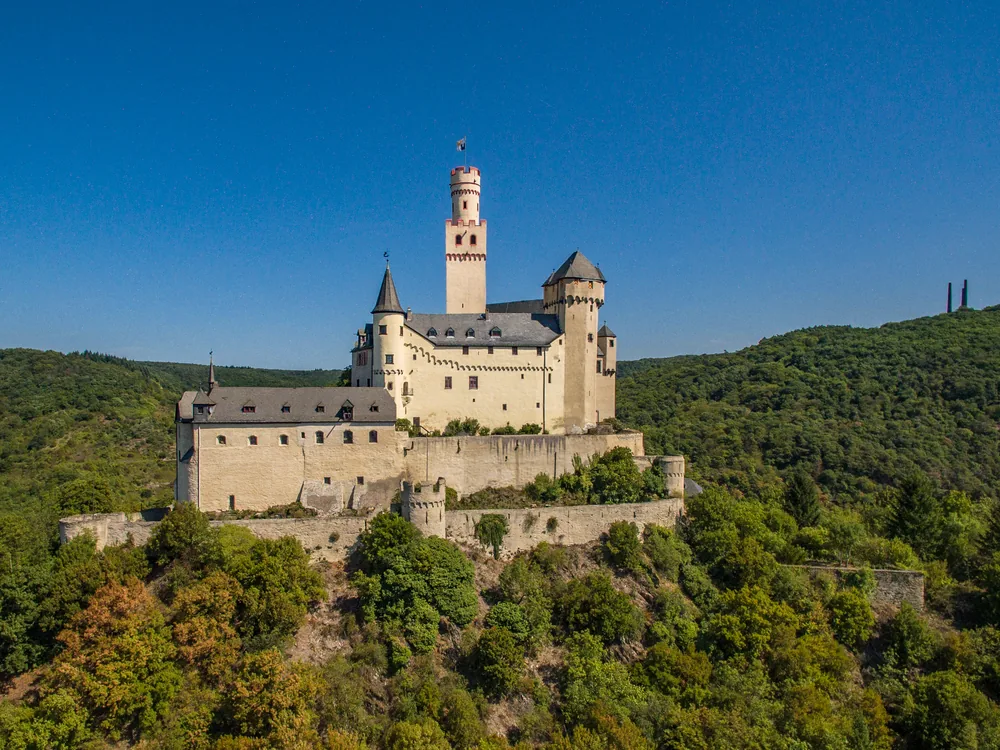
[Lahneck Castle](/castles/germany/lahneck-castle) is the closest companion: built in 1226, also by an Archbishop (of Mainz rather than Trier), at the mouth of the Lahn one kilometre northeast of Stolzenfels — the two castles face each other across the Rhine-Lahn confluence and were built by rival archbishops to control the same stretch of river. [Marksburg Castle](/castles/germany/marksburg-castle) upstream at Braubach is the Rhine Gorge's best-preserved medieval fortress, the only one never destroyed — its silhouette visible from the Stolzenfels garden terrace on clear days.
History
Archbishop Arnold II von Isenburg of Trier built the original castle at Stolzenfels in 1259 as a Rhine toll station — one of dozens of fortified collection points that lined the gorge in the medieval period, each representing an episcopal or noble claim on the commerce moving through the river. It served as an administrative seat and toll point through the 13th to 17th centuries, passing through several owners, before French forces demolished it in 1689 during the systematic destruction of Rhine fortifications in the Nine Years' War.
The ruins stood for a century and a half as a picturesque landscape feature — visited, painted, and written about by the Romantic travellers who made the Rhine Gorge one of the defining journeys of early 19th-century Europe. In 1823, the City of Koblenz gifted the ruins to Crown Prince Frederick William of Prussia, who was already engaged in the architectural expression of Romantic medievalism on the Rhine. The rebuilding, designed by Karl Friedrich Schinkel with gardens by Peter Joseph Lenné, proceeded between 1836 and 1842 in a restrained Gothic Revival style. Frederick William — crowned King Frederick William IV in 1840, the year the rebuilding was in progress — used the completed castle as his Rhine summer residence, visiting regularly until his last stay in 1857.
The Prussian royal abdication in 1918 transferred the castle to state ownership. It is now a museum open from April to October, within the Upper Middle Rhine Valley UNESCO World Heritage Site.
How to Visit
Getting there: From Koblenz: by Rhine steamer from the Deutsches Eck landing stage (recommended); or by car to Kapellen-Stolzenfels village and then a 15-minute walk uphill. By train, Koblenz Hauptbahnhof is 5 minutes from Frankfurt or Cologne by InterCity.
Tickets: Walk-up admission is €5 for adults, €3 for children; open April–October, Wednesday–Sunday. The GetYourGuide Rhine boat tour cruises past Stolzenfels, Lahneck, and Marksburg Castle from the water but does not stop for interior access — book it to see all three castle silhouettes from the river in a single 2-hour cruise.
Practical tips: The most atmospheric approach is by boat from Koblenz — the Gothic towers above the vine-covered cliff were designed to be seen from the river, exactly as Schinkel intended. On foot, the uphill path from Kapellen-Stolzenfels village rewards the effort with views back down the Rhine gorge.
Combine with: Lahneck Castle, 1 km north at the Lahn–Rhine confluence, was built by a rival archbishop and faces Stolzenfels across the water — the two castles together tell the story of medieval Rhine toll politics. Marksburg Castle upstream at Braubach is the only Rhine gorge castle never destroyed and makes a natural half-day extension.
Frequently Asked Questions
No. The GetYourGuide Rhine boat tour is a river cruise that passes Stolzenfels Castle from the water — you see the castle from the boat but do not disembark for an interior visit. For interior access, visit independently April–October (Wednesday–Sunday) by taking the Rhine steamer from Koblenz or driving to Kapellen-Stolzenfels and walking the uphill path to the castle.
Location
Schloss Stolzenfels, 56075 Koblenz, Germany
Nearby Castles
Tours & Tickets
Powered by GetYourGuide
From
€19/ person