
Nuremberg Castle
Kaiserburg Nürnberg
Germany · Bavaria, Franconia, Nuremberg · Near Nuremberg
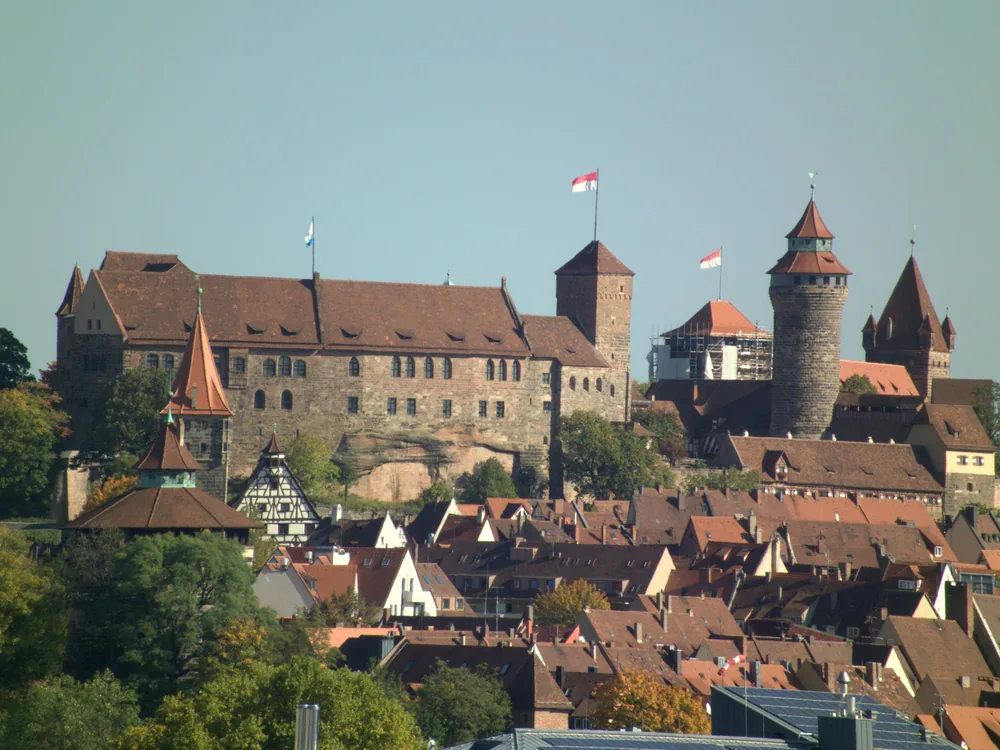
Built 1000 · Romanesque and medieval imperial castle, substantially reconstructed after 1945 WWII bombing — the castle occupies a sandstone ridge above Nuremberg's old town and comprises three main elements: the Imperial Castle (Kaiserburg, the Holy Roman Emperor's residence), the Burgraves' Castle (Burggrafenburg, an earlier fortification to the east belonging to the Hohenzollern burgrave family), and the Imperial Stables (Kaiserstallung, a 15th-century granary converted to stables, now a youth hostel); the most significant surviving medieval fabric is the Palas (imperial residence), the double chapel (Doppelkapelle, 11th–12th century, where the upper level was reserved for the emperor and the lower for lesser courtiers), and the Sinwell Tower (round keep, 13th century); these elements survived the 1944–45 Allied bombing raids that destroyed much of the Kaiserburg; postwar reconstruction restored the castle to its pre-bombing medieval appearance
This page is part of an independent travel guide and is not affiliated with, endorsed by, or operated by Nuremberg Castle.
© Castles & Palaces
Quick Facts
- Hours
- Daily 09:00–18:00
- Guided tour from
- €69
- Duration
- 1.5–2 hours (castle independently); 3.5 hours (GetYourGuide tour including old town)
- Best time
- April to October
- Nearest city
- Nuremberg
Featured Tour
Nuremberg: Castle and Old Town Tour — Entrance Tickets & Rotbier Tasting
Cancellation available · Instant confirmation
Highlights
- ✦The 1356 Golden Bull mandate — Emperor Charles IV's constitutional document governing Holy Roman imperial elections explicitly named Nuremberg as the city where every newly elected king had to hold his first Imperial Diet; this legal requirement made the castle the ceremonial heart of a political system that governed Central Europe for over four centuries
- ✦Keeper of the imperial regalia — from 1424 until the Napoleonic Wars, the Holy Roman Empire's imperial regalia (the crown, orb, sceptre, imperial cross, Holy Lance, and other coronation items) were kept in Nuremberg under the city's trusted protection; this concentration of symbolic imperial authority in one city was without parallel in the Empire
- ✦The double chapel (Doppelkapelle) — a surviving Romanesque double-level chapel from the 11th–12th century, one of the oldest elements of the castle complex; the upper level was reserved for the emperor, the lower for lesser courtiers; the vertical social separation physically encoded the imperial hierarchy in the architecture
- ✦Hohenstaufen imperial court — Frederick I Barbarossa, Henry VI, and Frederick II all held court and imperial diets at Nuremberg Castle; the city's position at the geographic centre of the Holy Roman Empire and on the main north-south trade route made it the natural meeting point for the empire's princes and the emperor
- ✦WWII damage and reconstruction — the 1944–45 Allied bombing raids that destroyed most of Nuremberg's old town also heavily damaged the castle; only the double chapel and the Sinwell Tower survived intact; postwar reconstruction restored the castle to its medieval appearance without reinstating later 19th-century additions, making the current building a mid-20th-century reconstruction of a medieval form
- ✦GetYourGuide Castle and Old Town tour — a 3.5-hour guided tour including castle entrance tickets and a Rotbier (Nuremberg red beer) tasting; the highest GetYourGuide rating in the site's Franconian castle cluster
Skip the queue with a guided tour
Skip-the-line tickets & expert guides
Nuremberg Castle — the Kaiserburg — occupies a sandstone ridge above the old town of Nuremberg, the walls of the castle blending into the city walls below them as if the two were a single fortification. From the courtyard or the Sinwell Tower, the red-roofed medieval cityscape extends in every direction, and the relationship between the castle and the city it governed is immediately apparent: this is not a castle set apart from its territory but one embedded in it, the residence of the most powerful court in medieval Germany, built on and with the same sandstone that forms the cliff below.
The castle's origins go back to approximately 1000 AD, when the Salian dynasty maintained a royal castle on the Nuremberg ridge as a residence during their journeys through Franconia. The Hohenstaufen emperors who followed the Salians in the 12th and 13th centuries developed the site more systematically, constructing the Palas (the imperial residential hall) and the double chapel that are the oldest surviving fabric of the castle complex. The Doppelkapelle — the double-level Romanesque chapel dating from the 11th and 12th centuries — is the most eloquent surviving element from this period: a chapel architecturally encoded with the social hierarchy of the imperial court, where the upper level, with its painted ceiling and direct access from the imperial apartments, was reserved for the emperor alone, and the lower level served the remainder of the court. The two levels share the same sacred space but not the same access — a physical expression of the social architecture of feudal imperial power.
Frederick I Barbarossa was the Hohenstaufen emperor most closely associated with the Nuremberg court; he issued numerous imperial charters from Nuremberg and used the castle as a base for his administration of the empire's German territories. His son Henry VI and grandson Frederick II continued the pattern. The castle's centrality in Hohenstaufen rule reflected Nuremberg's geographic position: at the junction of the main north-south and east-west trade and travel routes through the Holy Roman Empire, the city was the natural meeting point for the empire's territorial princes and the emperor, and the castle was the emperor's residence when in the city.
The formal constitutional significance of the site was established in 1356, when Emperor Charles IV issued the Golden Bull — the document that governed Holy Roman imperial elections for the next four and a half centuries. Among its provisions, the Golden Bull specified that every newly elected king had to hold his first Imperial Diet in Nuremberg. This requirement made the Kaiserburg not merely an occasional residence but the mandatory ceremonial starting point of every new reign — a constitutional role with no equivalent in any other European political system. Charles's rationale was partly pragmatic (Nuremberg was accessible from all parts of the Empire) and partly political (the powerful imperial city was a reliable supporter of the emperor against the more troublesome territorial princes).
In 1424, the decision was made to store the Holy Roman Empire's imperial regalia in Nuremberg — the crown, the orb, the sceptre, the imperial cross, the Holy Lance, and other coronation items that were the physical symbols of imperial authority. The city held the regalia until 1796, when the approach of French Revolutionary armies under Napoleon forced their emergency evacuation to Regensburg and eventually Vienna. The regalia are now held in Vienna's Schatzkammer (Imperial Treasury), but Nuremberg holds replicas in the Germanic National Museum.
The Habsburg emperors Frederick III and Maximilian I were the last to reside at the Kaiserburg for extended periods. After the Imperial Diet permanently relocated to Regensburg in 1663, the castle's political function faded; it became a civic monument, a military installation, and eventually a partially managed historic site. The Allied bombing raids of January 1945 — targeting Nuremberg partly because of its association with Nazi Party rallies held in the city from 1933 — destroyed most of the castle's residential buildings; only the double chapel and the Sinwell Tower came through the raids intact. The postwar reconstruction, completed through the 1950s and 1960s, restored the castle to its medieval appearance based on historical documentation, deliberately omitting the 19th-century additions that had accumulated before the bombing.
Today the castle is managed by the Bavarian Palace Administration (Bayerische Schlösserverwaltung). The principal visitor circuit covers the Palas (imperial hall, with armour and replica regalia), the double chapel, the Sinwell Tower (panorama over the old town), and the deep well (52 metres, drilled through the sandstone in the 15th century). The GetYourGuide Castle and Old Town tour is the highest-reviewed GetYourGuide experience in the site's Franconian coverage; the 3.5-hour format includes castle entry, a guided walk through the old town, and a Rotbier (Nuremberg red beer, a local beer style distinct from Bavarian lager) tasting.
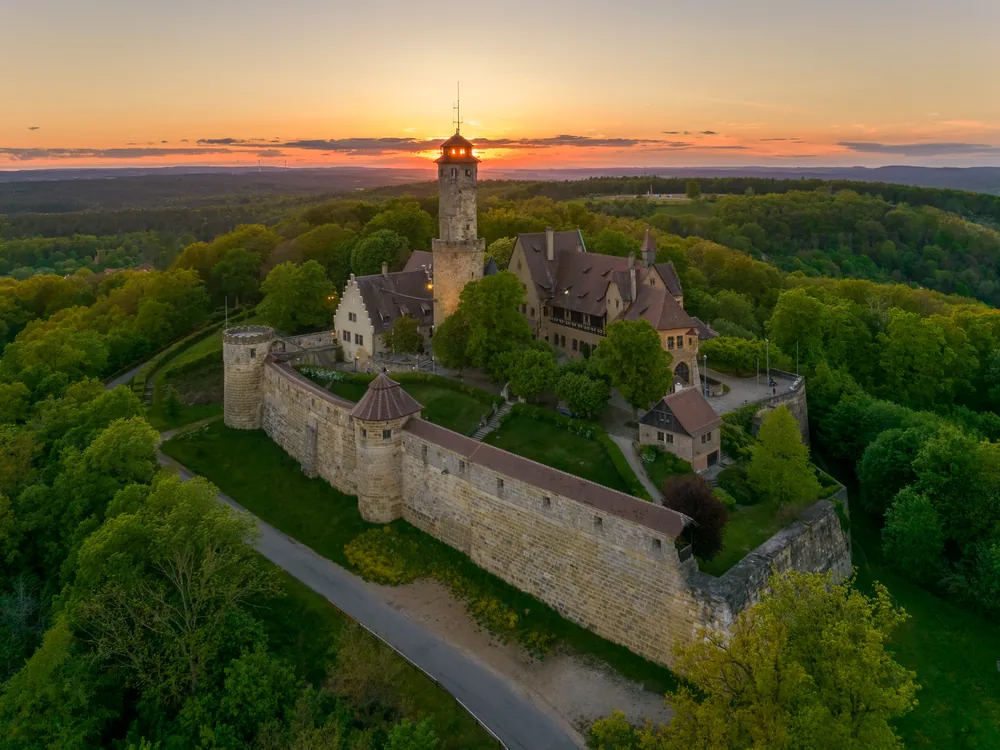
For Franconian context: [Altenburg Castle](/castles/germany/altenburg-castle-bamberg) in Bamberg, approximately 60 kilometres north of Nuremberg, is the other major Franconian castle on this site — a hilltop fortress above the UNESCO-inscribed city of Bamberg, with the specific atmosphere of a well-preserved medieval keep in a region where the Romanesque tradition lasted longer than elsewhere in Germany.
History
The Salian dynasty maintained a royal castle on Nuremberg's sandstone ridge around 1000 AD, establishing the site that the Hohenstaufen emperors would develop into the most politically significant castle in medieval Germany. The Doppelkapelle (double chapel) dates from the Hohenstaufen period; Frederick I Barbarossa, Henry VI, and Frederick II all held court at Nuremberg, and the city became the de facto primary imperial residence in Germany — not through constitutional declaration but through the sheer frequency of royal presence.
Constitutional status came with Emperor Charles IV's Golden Bull of 1356, which required every newly elected German king to hold his first Imperial Diet at Nuremberg, formalising what practice had already established. Imperial regalia were transferred to Nuremberg for safekeeping in 1424, adding a symbolic importance to the castle's political centrality that persisted even as Habsburg emperors Frederick III and Maximilian I gradually shifted the imperial centre of gravity toward Vienna. The permanent relocation of the Imperial Diet to Regensburg in 1663 marked the effective end of Nuremberg's constitutional role, and the evacuation of the Imperial regalia in 1796 — first to Regensburg, then to Vienna, as Napoleon's forces advanced — removed the last symbolic claim to primacy.
Allied bombing raids in January 1945 destroyed most of the castle's buildings, but the Doppelkapelle and the Sinwell Tower survived intact. Postwar reconstruction in the 1950s and 1960s restored the medieval appearance — excluding 19th-century additions — and the castle is now managed by the Bayerische Schlösserverwaltung as a state museum.
How to Visit
Getting there: Nuremberg Hauptbahnhof is in the city centre, a 15-minute walk from the castle through the old town. U-Bahn lines U1/U11 (stops Lorenzkirche or Hauptmarkt) are useful from the station. Nuremberg is well connected by ICE train: Munich 1 hour, Frankfurt 2 hours, Berlin 3.5 hours.
Tickets: Walk-up entry costs €7 for adults; children under 18 enter free. Buy at the ticket office on site or online at kaiserburg-nuernberg.de. Open daily (April–September 09:00–18:00; October–March 10:00–16:00). The GetYourGuide guided tour is a 3.5-hour circuit covering the castle (entry included), the old town, and a Nuremberg Rotbier tasting at a local brewery.
Practical tips: The double chapel (Doppelkapelle, 11th–12th century) is the oldest surviving fabric — the two-level design with the emperor's private upper chapel directly above the courtiers' lower chapel makes the medieval hierarchy immediately legible in stone. The Sinwell Tower gives the best panorama over the red-roofed old town. Allow 1.5–2 hours for an independent visit covering the Palas, the chapel, the tower, and the 52-metre deep well.
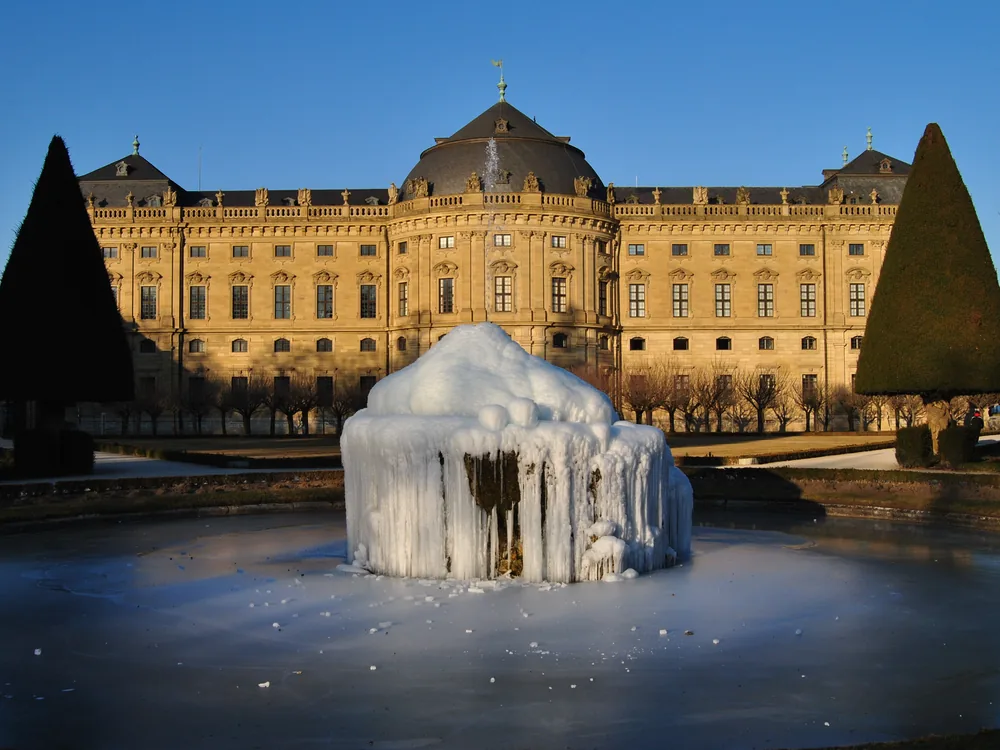
Combine with: Altenburg Castle Bamberg in Bamberg is 60 km north by ICE (30 minutes) — Bamberg is UNESCO-inscribed and the two sites form a natural full-day Franconian imperial circuit. Würzburg Residence is 1 hour west by train, the most celebrated Baroque palace in Germany and a strong counterpoint to the Kaiserburg's medieval severity.
Frequently Asked Questions
The Golden Bull was a constitutional document issued by Emperor Charles IV in 1356 that governed Holy Roman imperial elections for nearly five centuries. Among its provisions, it specified that every newly elected king had to hold his first Imperial Diet — the formal assembly of the empire's princes — at Nuremberg. This requirement gave the Kaiserburg a constitutionally mandated ceremonial role at the start of every new reign, making it the mandatory first stop on every emperor's political journey. No other castle or city in the Holy Roman Empire had this specific constitutional status.
Location
Auf der Burg 13, 90403 Nürnberg, Germany
Nearby Castles
Tours & Tickets
Powered by GetYourGuide
From
€69/ person