
Pillnitz Palace
Schloss Pillnitz
Germany · Saxon Switzerland-Eastern Ore Mountains, Saxony · Near Dresden
Built 1720 · Baroque chinoiserie river palace in the Elbe valley east of Dresden — built by Augustus the Strong, Elector of Saxony and King of Poland, between 1720 and 1724; designed by Matthäus Daniel Pöppelmann, the same architect who designed the Zwinger in Dresden; the ensemble comprises three main buildings in a distinctive chinoiserie Baroque style — the Wasserpalais (Water Palace) facing the Elbe, the Bergpalais (Hill Palace) on the opposite side of the formal garden, and the Neues Palais (New Palace) connecting them; the chinoiserie detailing reflects the European fascination with East Asian design motifs in the early 18th century, when trade with China and Japan was beginning to make Asian decorative objects available to European courts, and Augustus the Strong's collection of East Asian porcelain was one of the largest in Europe; the formal garden between the two river and hill palaces contains the most famous single feature of the Pillnitz estate: a camellia tree (Camellia japonica) planted in 1801, now approximately 230 years old, which is housed in a purpose-built mobile greenhouse that slides back to expose the tree during its bloom period (February–April); the camellia is believed to be the oldest camellia in continuous cultivation in Europe; the palace is managed by the Staatliche Schlösser, Burgen und Gärten Sachsen (State Palaces, Castles and Gardens of Saxony)
This page is part of an independent travel guide and is not affiliated with, endorsed by, or operated by Pillnitz Palace.
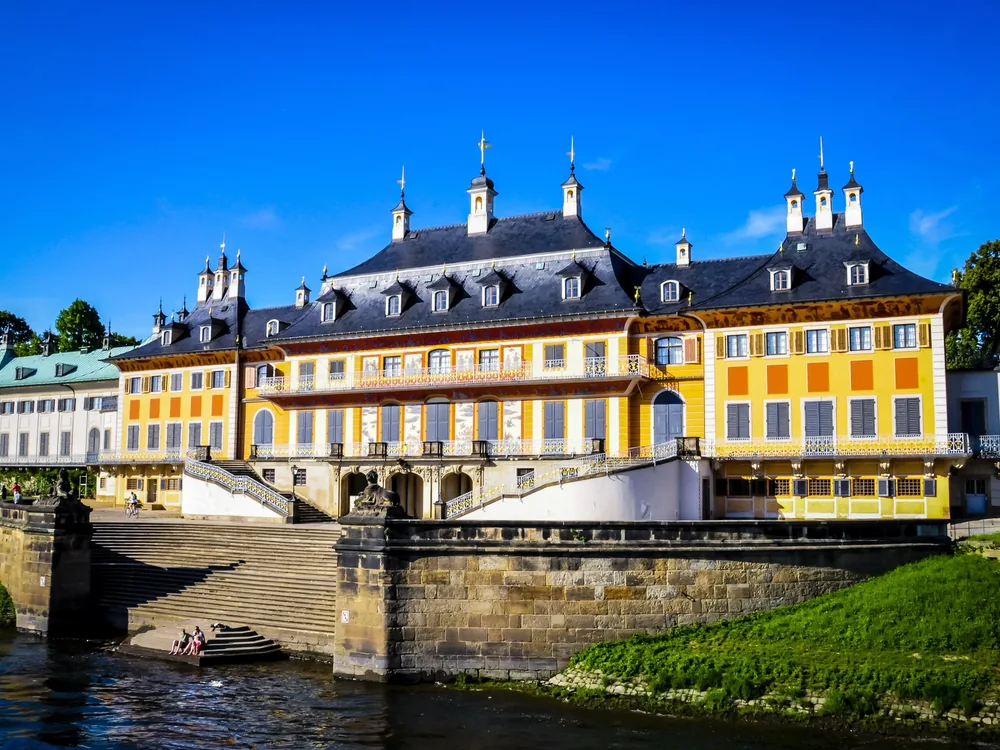
© Castles & Palaces
Quick Facts
- Hours
- Tue–Sun 10:00–18:00. Closed Mon
- Guided tour from
- €32
- Hotel rating
- ★★★★ 4-Star Hotel
- Duration
- 2–3 hours (palace museums + garden + camellia)
- Best time
- May to October
- Nearest city
- Dresden
Featured Tour
Dresden: 2-Hour Elbe River Cruise Passing Pillnitz
Cancellation available · Instant confirmation
Stay Here
Schloss Hotel Dresden-Pillnitz
★★★★ 4-Star HotelRooms are within the historic castle building itself
Booked via Booking.com · Free cancellation on most rates
The palace museums (Wasserpalais/Bergpalais, camellia garden) are covered above in How to Visit, with their own GetYourGuide listing — not duplicated here.
Highlights
- ✦Augustus the Strong (Friedrich August I, Elector of Saxony and King of Poland) commissioned Pillnitz as a pleasure palace on the Elbe in 1720, assigning the design to Matthäus Daniel Pöppelmann — the same architect who was simultaneously designing the Zwinger in Dresden city centre; Pillnitz and the Zwinger are therefore companion works by the same architect for the same patron in the same decade, designed in complementary but stylistically distinct registers; the Zwinger is extravagant Baroque in stone and gilt; Pillnitz is chinoiserie fantasy in plaster and paint, expressing Augustus's fascination with East Asian art and his ambition to assemble one of Europe's largest porcelain collections; together they define the visual ambition of Dresden under Augustus, one of the most culturally productive reigns in German Baroque history
- ✦The 230-year-old camellia (Camellia japonica) in the Pillnitz garden is believed to be the oldest camellia in continuous cultivation in Europe. Planted in 1801 from stock brought to Saxony from Japan, it is now approximately 9 metres tall and blooms annually in late winter (typically February to April). The palace built a custom purpose-built greenhouse specifically for this tree: a large wooden-and-glass mobile structure that slides on rails to cover the camellia during the cold months and retract in spring to expose it; the fact that the architectural response to a single tree is a mobile building that moves on tracks is one of the most committed acts of horticultural devotion in European palace history; visitors during the February–April bloom period see the camellia in flower before the palace museums have reopened for the season
- ✦The chinoiserie style of Pillnitz — Baroque palace architecture decorated with motifs derived from East Asian design, including pagoda-like rooflines, painted Chinese figures, and lacquer-style surface treatments — reflects the European cultural moment of the early 18th century when Chinese and Japanese export goods were arriving in European markets in quantity for the first time and East Asian design was the fashionable shorthand for luxury, refinement, and novelty; Augustus the Strong's collection of East Asian porcelain was among the largest in Europe (he famously traded a regiment of cavalry to the Prussian king Friedrich Wilhelm I for 151 Chinese vases); Pillnitz palace is the architectural expression of this collecting impulse extended from the cabinet to the building itself
- ✦The Elbe valley landscape east of Dresden — the Elbe Sandstone Mountains (Elbsandsteingebirge) beginning just southeast of Pillnitz and extending into the Saxon Switzerland National Park — is part of what makes Pillnitz's setting distinctive: the palace sits at the point where the suburban Elbe riverscape east of Dresden begins to give way to the sandstone cliff landscape that characterises the upper Elbe; viewing Pillnitz from the river (from the cruise or from the opposite bank) gives the most complete picture of how the palace relates to its landscape, with the Wasserpalais facing the water and the sandstone hills rising behind
- ✦CRITICAL NOTE FOR VISITORS: The GetYourGuide product on this page is a 2-hour Elbe river cruise that passes Pillnitz from the water — GetYourGuide's own listing states explicitly that there is no time to visit Pillnitz Castle during the cruise. The boat passes the Wasserpalais facade; the cruise does not stop and does not include palace entry or garden access. This is disclosed prominently because the cruise appears in searches for Pillnitz and could be booked by visitors expecting castle access. To visit the palace, take bus 63 from Dresden city centre (approximately 40 minutes) to the palace entrance independently of the cruise.
Skip the queue with a guided tour
Skip-the-line tickets & expert guides
Pillnitz Palace stands on the south bank of the Elbe river in the village of Pillnitz, approximately 10 kilometres upstream (east) of Dresden city centre. It is a Baroque pleasure palace in the chinoiserie style — decorated with East Asian-derived motifs, pagoda rooflines, and lacquer-style painted surfaces — built by Augustus the Strong, Elector of Saxony and King of Poland, between 1720 and 1724. The architect was Matthäus Daniel Pöppelmann, who was simultaneously designing the Zwinger in central Dresden: Pillnitz and the Zwinger are companion works by the same architect for the same patron in the same decade.
The palace ensemble comprises three main structures: the Wasserpalais (Water Palace), whose formal entrance faces the Elbe, the Bergpalais (Hill Palace) on the opposite side of the formal garden, and the Neues Palais (New Palace, completed later) connecting them. The chinoiserie style expressed Augustus's fascination with East Asian art and his pursuit of one of Europe's largest porcelain collections — he famously traded a regiment of 600 cavalry soldiers to the Prussian king Friedrich Wilhelm I in exchange for 151 Chinese vases. Pillnitz palace is the architectural manifestation of this collecting impulse scaled from the cabinet to the building.
The most remarkable single feature of the palace is not the architecture but a tree. The Pillnitz camellia (Camellia japonica), planted in 1801 from stock brought from Japan, is believed to be the oldest camellia in continuous cultivation in Europe. Now approximately 230 years old and 9 metres tall, it blooms each late winter (February–April). The palace's response to this tree has been to build a purpose-made mobile greenhouse — a large wooden-and-glass structure that slides on rails to cover the camellia during the cold months and retract in spring to expose the tree and allow it to bloom. The existence of a mobile building designed around a single plant's seasonal needs is one of the more committed pieces of horticultural architecture in European palace history. Visitors in February to April can see the camellia in bloom, in the weeks before the palace museums reopen for the season.
The palace museums in the Wasserpalais, Bergpalais, and Neues Palais cover the history of the estate and Saxon court art. The museum season is May to October; the palace is closed to visitors in winter except for special events, though the park remains accessible year-round.
Important: the GetYourGuide product linked on this page is a 2-hour Elbe river cruise from Dresden that passes Pillnitz from the water. GetYourGuide's own product description states explicitly that there is no time to visit Pillnitz Castle on this cruise. The boat passes the Wasserpalais facade; the cruise does not stop and does not include palace entry or garden access. The cruise is included on this page as a way to see the palace's Elbe elevation from the water — a genuinely different view of the building. To visit the palace, travel independently by bus 63 from Dresden (approximately 40 minutes), or combine car access with the independent museum entry.
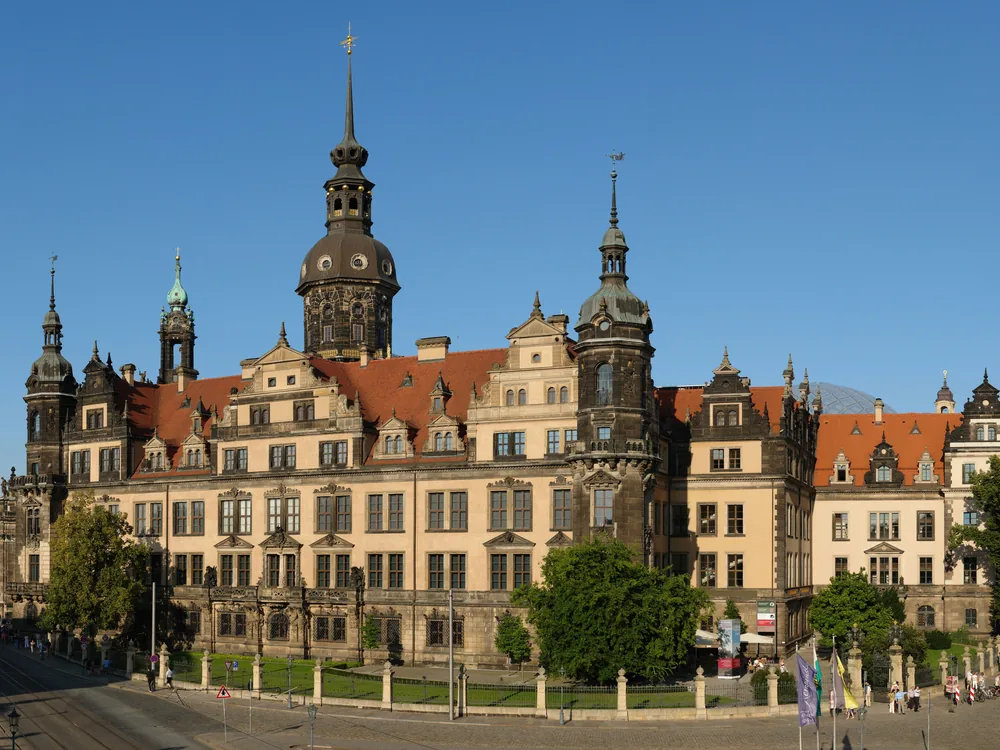
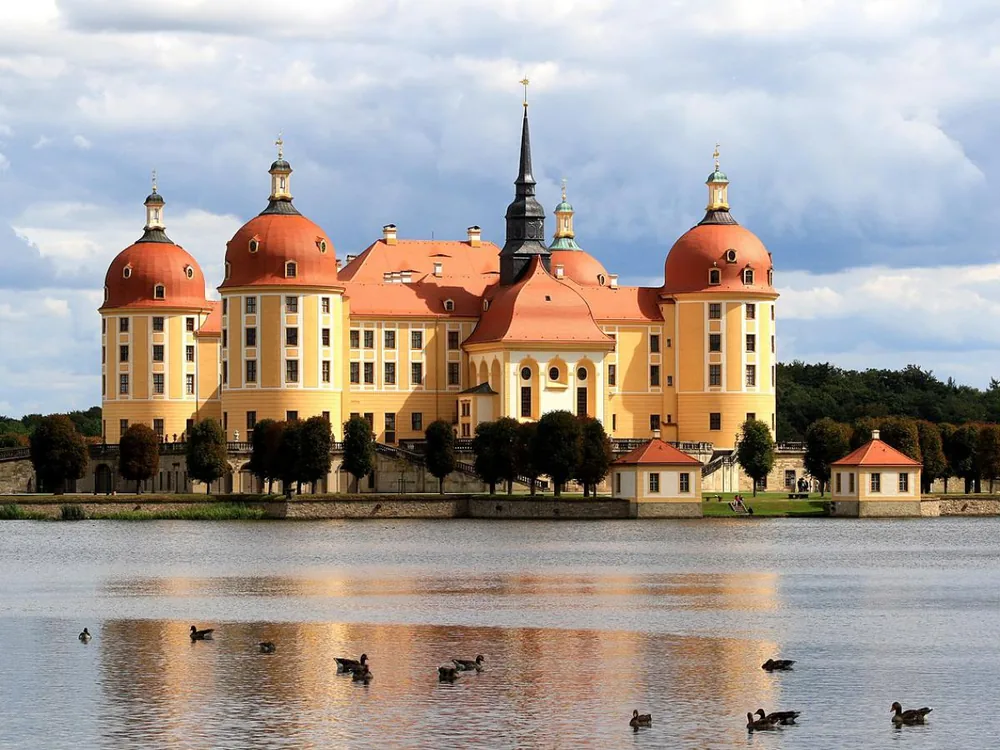
Pillnitz pairs naturally with [Dresden Castle](/castles/germany/dresden-castle) — the Electoral and Royal Palace of Saxony in the city centre — and [Moritzburg Castle](/castles/germany/moritzburg-castle), Augustus the Strong's Baroque hunting lodge north of Dresden.
History
Augustus the Strong — Friedrich August I, Elector of Saxony and King of Poland — was the defining cultural patron of Baroque Dresden, and Pillnitz was his riverside pleasure palace: a chinoiserie fantasy built between 1720 and 1724 on the south bank of the Elbe by the architect Matthäus Daniel Pöppelmann, who was simultaneously working on the Zwinger. The Wasserpalais and Bergpalais — the Water Palace and the Mountain Palace, facing each other across the formal garden with the Elbe as the architectural foil on one side and the forested Elbe hills on the other — established a visual dialogue that remains the palace's defining spatial quality.
A fire in 1784 damaged the original Neues Palais connecting structure; it was rebuilt in the early 19th century in a neoclassical style that sits as an architectural addendum to the chinoiserie ensemble around it. A camellia planted in the garden in 1801 — now the oldest potted camellia in Europe, requiring its own mobile greenhouse — has outlasted the political order that planted it: the Saxon monarchy used Pillnitz as a summer residence through the 19th and early 20th centuries until its abolition after the First World War in 1918.
The palace survived the 1945 Dresden bombing undamaged — the raid that destroyed the city centre did not reach the Elbe's upper course. It is now managed by Staatliche Schlösser, Burgen und Gärten Sachsen, with the museums open from May to October and the camellia and park accessible year-round.
How to Visit
Getting there: Bus 63 from Pirnaischer Platz in central Dresden takes approximately 40 minutes to the palace entrance. The Elbe cycle path from the city also passes directly in front of the palace. By car, the B6 takes 15–20 minutes from central Dresden; a seasonal Elbe ferry runs from the opposite bank.
Tickets: Adult entry to the palace museums is €9, children €5; the park and garden are free. Note that the GetYourGuide Elbe river cruise passes the Wasserpalais facade from the water but does not stop at Pillnitz and does not include palace entry — GetYourGuide's own listing states this explicitly. Book the cruise to see the building from the river; travel independently by bus for palace access.
Practical tips: The camellia bloom (February–April) is worth timing a visit around — the mobile greenhouse slides back on its rails each spring to expose the 230-year-old tree, and this happens before the palace museums reopen for the season. Check schlosspillnitz.de for the bloom start date each year.
Combine with: Dresden Castle in the city centre is the Electoral Palace of Saxony and the natural companion to Pillnitz. Moritzburg Castle, Augustus the Strong's Baroque hunting lodge north of Dresden, completes the picture of his architectural legacy in the region.
How to Stay
Getting there: About 20 minutes by car or Elbe ferry from central Dresden; the Pillnitz steamer stop is directly nearby for a scenic river approach.
Rooms & rates: 42 rooms and 3 suites within the historic Schlossschenke Pillnitz (castle inn) building — first documented in 1724, rebuilt in 1841 and again in 1869 after a fire — on the upper and attic floors. From €119/night.
On-site: Two restaurants, a bar, an attached winery, picnic area, canoeing and mini golf, golf course access.
Good to know: This hotel occupies the historic castle inn (Schlossschenke), a separate building within the Pillnitz estate, about 20 metres from the Wasserpalais/Bergpalais museums covered above in How to Visit. It is the same Pillnitz estate, not a different property — easy to combine a stay here with a ticketed visit to the palace and camellia garden.
Combine with: The Wasserpalais/Bergpalais museums and camellia garden (see How to Visit above, a 1-minute walk); Dresden Castle and Moritzburg Castle, both already linked on this page.
Frequently Asked Questions
No. GetYourGuide's own product description for this tour explicitly states that there is no time to visit Pillnitz Castle during the cruise. The boat passes the Wasserpalais facade from the river and continues without stopping. To visit the palace and garden, travel independently by bus 63 from Dresden city centre (approximately 40 minutes) and pay the museum entry fee on site.
Location
August-Böckstiegel-Straße 2, 01326 Dresden-Pillnitz, Germany
Nearby Castles
Tours & Tickets
Powered by GetYourGuide
From
€32/ person