
Schwerin Castle
Schweriner Schloss
Germany · Mecklenburg-Vorpommern · Near Hamburg
Built 1845 · Historicism (Neo-Gothic, Neo-Renaissance)
This page is part of an independent travel guide and is not affiliated with, endorsed by, or operated by Schwerin Castle.
© Castles & Palaces
Quick Facts
- Hours
- Tue–Sun 10:00–18:00. Closed Mon
- Day trip from
- €79
- Duration
- 2–3 hours
- Best time
- May to September for gardens and lake views
- Nearest city
- Hamburg
Featured Tour
Schwerin: Express Walk with a Local
Cancellation available · Instant confirmation
Highlights
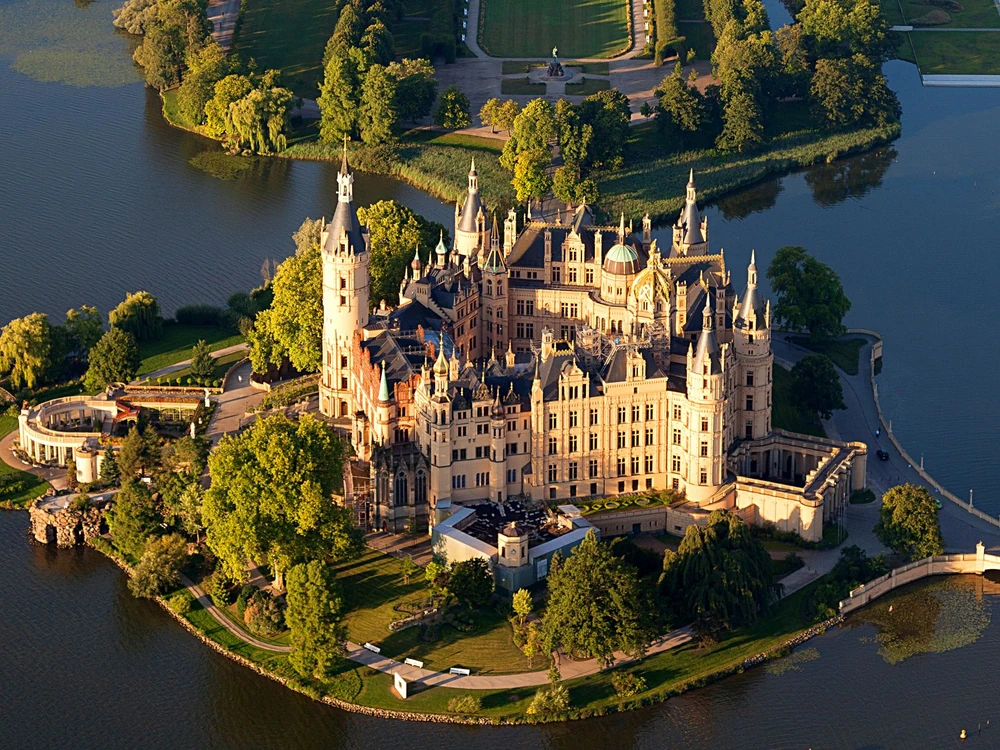
- ✦Set on a small island in Lake Schwerin, reached via a single ornamental bridge
- ✦86 spires and towers reflected in the surrounding water — one of Germany's most photogenic palaces
- ✦State apartments preserve original 19th-century furnishings from the Grand Duchy of Mecklenburg
- ✦Surrounding landscaped gardens designed in the tradition of English landscape parks
- ✦Often called the 'Versailles of the North' — with far fewer crowds than its French counterpart
Skip the queue with a guided tour
Skip-the-line tickets & expert guides
Few German palaces stop visitors in their tracks the way Schwerin Castle does. Sitting on a small island in the middle of Lake Schwerin, ringed by water on all sides and crowned with 86 towers and spires, it looks less like a real building and more like the castle a child draws when given a blank page and told to imagine royalty. That combination of island setting, reflective water and fairy-tale silhouette makes Schwerin one of the most photographed buildings in northern Germany — and one of the most underrated in all of Europe.
The palace you see today was built between 1845 and 1857 on the foundations of a medieval fortress that had stood on the island since the 14th century. The grand duke of Mecklenburg-Schwerin wanted a residence that could rival the great palaces of Europe, and his architects drew from the Château de Chambord for the roofline, from English Gothic for the towers, and from the Italian Renaissance for the courtyard arcades. The result is an architectural hybrid that somehow achieves total coherence — every detail contributes to an overall effect of romantic grandeur.
Inside, the state apartments retain their original 19th-century furnishings in remarkable condition: gilded throne rooms, tapestry-hung audience chambers, and intimate private quarters that feel as though the Grand Duke simply stepped away for the afternoon. The basement holds an archaeological museum tracing the site's history back to a Slavic settlement from the 10th century. Outside, the English landscape garden wraps around the lake's shore, offering views across the water to the castle that rival anything in northern Europe.
History
The island on which Schwerin Castle stands has been occupied since at least the 10th century, when a Slavic tribe called the Obodriti built a fortified settlement here. The Christianised name 'Zuarin' — meaning animal enclosure — gave the city its name. After the German conquest of Mecklenburg in the 12th century, the island became the seat of the Counts of Schwerin, who built the first stone fortress.
Grand Duke Friedrich Franz II decided not to restore the deteriorating existing structure but to rebuild from scratch on an almost unimaginable scale — the result is the building visible today, completed in 1857. Schwerin remained a royal residence until 1918, when Kaiser Wilhelm II abdicated and the monarchies of the German states collapsed with him. Since German reunification in 1990 — Schwerin is the capital of the newly reconstituted state of Mecklenburg-Vorpommern — the palace has been gradually restored to its 19th-century splendour, with the state parliament (Landtag) occupying one wing.
How to Visit
Getting there: Direct trains from Hamburg Hauptbahnhof to Schwerin run frequently and take about 1 hour 15 minutes. From Berlin Hauptbahnhof trains run roughly every 2 hours and take about 2 hours 15 minutes. From Schwerin station, the castle is a 15-minute walk through the old town or a short bus ride.
Tickets: Walk-up admission costs €13 for adults; children are free. No advance booking required — tickets at the door. The GetYourGuide "Schwerin: Express Walk with a Local" provides a 1–2 hour guided walk of the city and castle with a local expert.
Practical tips: The most iconic shot — all 86 spires mirrored in calm water — is taken from the ornamental bridge connecting the island to the mainland. Arrive early morning for the best light and flat reflections before tour groups arrive. The palace is closed on Mondays.
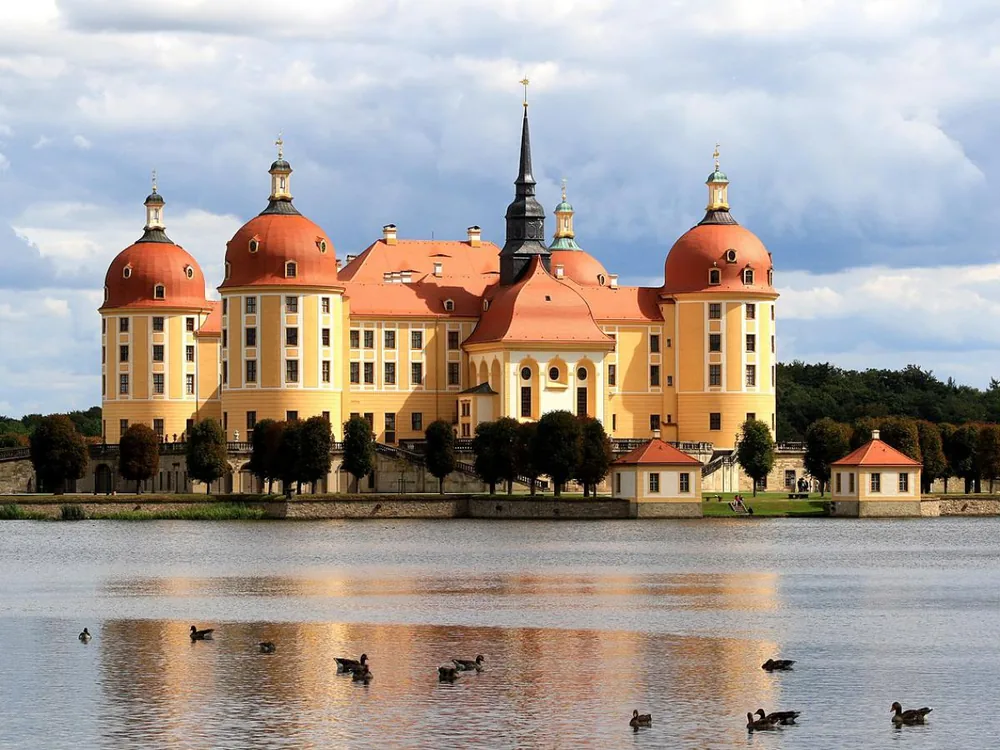
Combine with: Wesenberg Castle lies east in the Mecklenburg Lake District, an easy drive away. Moritzburg Castle is a good choice for a broader northern Germany palace day if travelling by car.
Frequently Asked Questions
Direct trains from Hamburg Hauptbahnhof to Schwerin run roughly every 30–60 minutes and take about 1 hour 15 minutes. From Schwerin station, the castle is a 15–20 minute walk or a short bus ride. The journey is entirely feasible as a day trip from Hamburg.
Location
Lennéstraße 1, 19053 Schwerin, Germany
Nearby Castles
Tours & Tickets
Powered by GetYourGuide
From
€79/ person