
Würzburg Residence
Würzburger Residenz
Germany · Bavaria — Lower Franconia (Unterfranken), Würzburg city · Near Würzburg
Built 1720 · South German Baroque palace, 1720–1744, designed principally by Balthasar Neumann with contributions from Johann Lucas von Hildebrandt and French and Italian masters — the Würzburg Residence was commissioned by Prince-Bishop Johann Philipp Franz von Schönborn as the new seat of the ecclesiastical rulers of the Prince-Bishopric of Würzburg, replacing the medieval Marienberg Fortress across the Main River; the building is widely regarded as one of the finest Baroque palaces in Europe and the supreme achievement of Balthasar Neumann (1687–1753), the German Baroque master; the palace's central feature is the Grand Staircase (Treppenhaus), a single vast room whose unsupported vaulted ceiling spans 18 by 30 metres without any intermediate supports — a structural feat that Neumann demonstrated by having a cannon fired inside the completed vault to prove it would not collapse; above this ceiling, Giovanni Battista Tiepolo painted the world's largest ceiling fresco (677 square metres) in 1752–53, depicting an allegorical representation of the four continents; the Imperial Hall (Kaisersaal) contains a second Tiepolo fresco cycle; the palace was severely damaged in the Allied bombing of Würzburg on 16 March 1945 but the main structural shell survived, allowing postwar restoration to restore the principal rooms
This page is part of an independent travel guide and is not affiliated with, endorsed by, or operated by Würzburg Residence.

© Castles & Palaces
Quick Facts
- Hours
- Tue–Sun 09:00–18:00. Closed Mon
- Guided tour from
- €74
- Duration
- 2–3 hours (Grand Staircase, Tiepolo ceiling fresco, Imperial Hall with second Tiepolo cycle, Court Garden, and principal state rooms)
- Best time
- Year-round
- Nearest city
- Würzburg
Featured Tour
Würzburg in Winter: Residence, Old Town, and Mulled Wine
Cancellation available · Instant confirmation
Highlights
- ✦The Grand Staircase and Tiepolo's ceiling fresco — 677 square metres of heaven, the world's largest — the central architectural and artistic experience of the Würzburg Residence is the Grand Staircase (Treppenhaus), a single enclosed room whose unsupported vaulted ceiling spans 18 by 30 metres without any intermediate columns or supporting piers; Balthasar Neumann solved the structural challenge through a sophisticated system of longitudinal and transverse arches that distribute the vault's weight to the peripheral walls, creating an unobstructed indoor space of unprecedented scale; Giovanni Battista Tiepolo — the greatest ceiling painter of the 18th century — arrived from Venice in 1750 and completed the fresco in 1752–53; the painting covers 677 square metres, the largest ceiling fresco on earth, depicting an allegorical representation of the four continents (Europe, America, Africa, Asia) surrounding a central celestial vision with the portrait of the Prince-Bishop's court painter and Tiepolo's own self-portrait incorporated among the figures; the experience of ascending the staircase under this ceiling — the fresco visible from the entire room as a continuous panoramic composition — is one of the defining art encounters in European architecture
- ✦The Imperial Hall — the second Tiepolo fresco cycle and the palace's ceremonial heart — the Kaisersaal (Imperial Hall) on the piano nobile above the staircase is the formal reception room of the Prince-Bishops: an oval hall with white stucco and gilded decoration whose ceiling carries a second Tiepolo fresco cycle, also completed 1751–52, depicting scenes from the history of the medieval Bishop of Würzburg's relationship with the Holy Roman Emperor; the combination of Tiepolo's narrative cycle on the ceiling and the room's architectural elaboration below — pilasters, mirrors, gilded festoons, coloured marble door surrounds — makes the Kaisersaal one of the most complete decorative programmes in European Baroque interiors, where every surface participates in a unified artistic system rather than simply coexisting
- ✦Balthasar Neumann and the structural achievement of the staircase vault — German Baroque engineering at its most ambitious — Balthasar Neumann (1687–1753) was the master of German Baroque architecture whose projects ranged from parish churches to fortifications to the Würzburg Residence; the staircase vault was his most celebrated structural demonstration; when French and Italian architectural advisers consulted on the design expressed scepticism about whether the unsupported vault could stand, Neumann reportedly offered to allow a cannon to be fired inside the completed vault — which it was, without any structural consequence; the staircase's importance in architectural history lies not only in its scale but in the way Neumann used the spatial challenge as an opportunity for theatrical effect, designing the staircase ascent as a processional experience that reveals the Tiepolo ceiling progressively as the visitor climbs
- ✦The March 1945 bombing and the survival of the frescoes — the palace's 20th-century chapter — on the night of 16 March 1945, RAF bombers devastated Würzburg in approximately 20 minutes, killing 5,000 people and destroying 90% of the city's historic centre; the Würzburg Residence was hit and burned; the roof of the main palace block collapsed, filling the Grand Staircase and the Kaisersaal with burning debris; but Tiepolo's ceiling frescoes — protected by the solid vaulted masonry that Neumann had built rather than conventional wooden ceilings — survived; the frescoes were found intact under the rubble when the ruins were cleared; postwar reconstruction restored the shell of the building and the principal interiors over several decades, with the Grand Staircase and Kaisersaal reopening to visitors in their restored state; the UNESCO World Heritage designation in 1981 recognised both the palace's architectural significance and its survival through the 20th century's most destructive event in German urban history
Skip the queue with a guided tour
Skip-the-line tickets & expert guides
The first decision a visitor to the Würzburg Residence makes is where to look. The entrance foyer opens immediately into the Grand Staircase — a single room with an unsupported vaulted ceiling spanning 18 by 30 metres — and above it, covering every centimetre of that vault, is Tiepolo's fresco. All 677 square metres of it. The world's largest ceiling painting. It is visible in its entirety from the first step.
The palace was built for the Prince-Bishops of Würzburg — the ecclesiastical rulers of a powerful independent principality in the Holy Roman Empire — who wanted a new residence to replace the medieval Marienberg Fortress on the opposite bank of the Main. Prince-Bishop Johann Philipp Franz von Schönborn initiated the project in 1720 and commissioned the 33-year-old Balthasar Neumann to design it. Neumann had been working as a military engineer and artillery officer before turning his attention to architecture; he brought to the Residence's design both a technical mastery of structure and an architectural imagination capable of creating spaces of genuine theatrical power.
The Grand Staircase was the central structural challenge of the project. Neumann wanted a single vast room — no columns, no intermediate supports — whose vault would demonstrate the possibilities of masonry engineering. Consultants from Paris and Vienna expressed doubt. Neumann reportedly offered to stand under the vault while a cannon was fired inside it. The cannon was fired. The vault did not move. The staircase today is exactly the room Neumann designed: an unsupported vault of perfect structural confidence, which Giovanni Battista Tiepolo then covered with a painting that describes the entire known world.
Tiepolo arrived from Venice in 1750, aged 54, at the height of his powers. The commission for the Würzburg ceiling was the largest of his career. He completed it in approximately two years, working with his sons Giandomenico and Lorenzo. The result depicts an allegorical representation of the four continents — Europe, America, Africa, Asia — arranged around a central celestial vision in which the Prince-Bishop is shown being crowned by Apollo and accompanied by personifications of the arts. The court painter is depicted as a figure among the allegory. Tiepolo included his own portrait, looking down at the visitor from the composition. Every face in the painting is identifiable; the allegory is simultaneously universal and intensely personal.
Above the staircase, in the Imperial Hall (Kaisersaal), Tiepolo completed a second fresco cycle depicting scenes from the historical relationship between the medieval bishops of Würzburg and the Holy Roman Emperors. The room is an oval hall of exceptional decorative completeness: stucco by Johann Peter Wagner, gilded festoons, coloured marble door surrounds, mirrors, and the fresco overhead operating as a unified whole. The Kaisersaal is the formal reception room where the Prince-Bishop would have received the Emperor; Tiepolo's paintings make that ceremony present in perpetuity.
On 16 March 1945, RAF bombers devastated Würzburg in approximately 20 minutes. The fire that swept the Residence's main block burned for days. The roof collapsed. The rubble filled the staircase and the Kaisersaal. When it was cleared, Tiepolo's frescoes were found intact — protected by Neumann's solid masonry vault rather than the wooden ceilings that collapsed everywhere else. The frescoes had survived the destruction of almost everything built around them.
Postwar reconstruction restored the shell and the principal rooms over several decades. UNESCO inscribed the Residence as a World Heritage Site in 1981, recognising it as one of the supreme achievements of European Baroque architecture and a monument to the survival of cultural heritage through 20th-century destruction.
The GYG winter guided tour (t1022746, from €74, 3 hours) covers the Würzburg Residence with admission included, followed by 30 minutes of free time at the Residence and a walk through Würzburg's Old Town finishing with a mulled wine stop at the Old Main Bridge. The mulled wine finale is the seasonal character of the tour — it operates in the winter period when Würzburg's Christmas market is running; the Residence visit itself is standard and available year-round. The tour runs with a 5.0★ / 2 reviews.
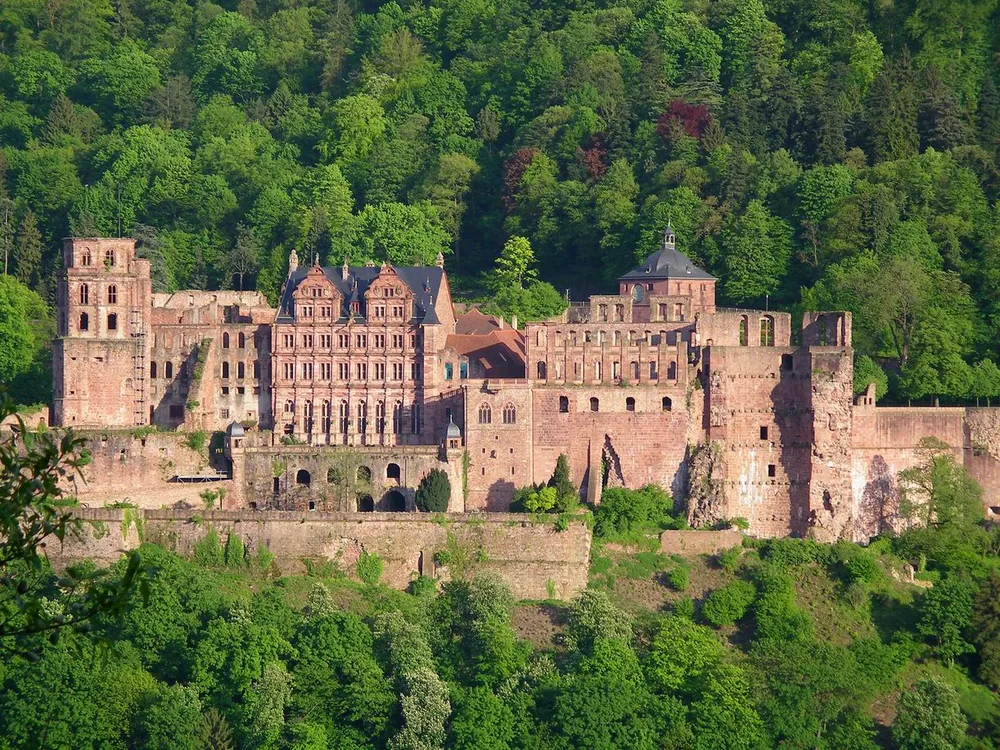
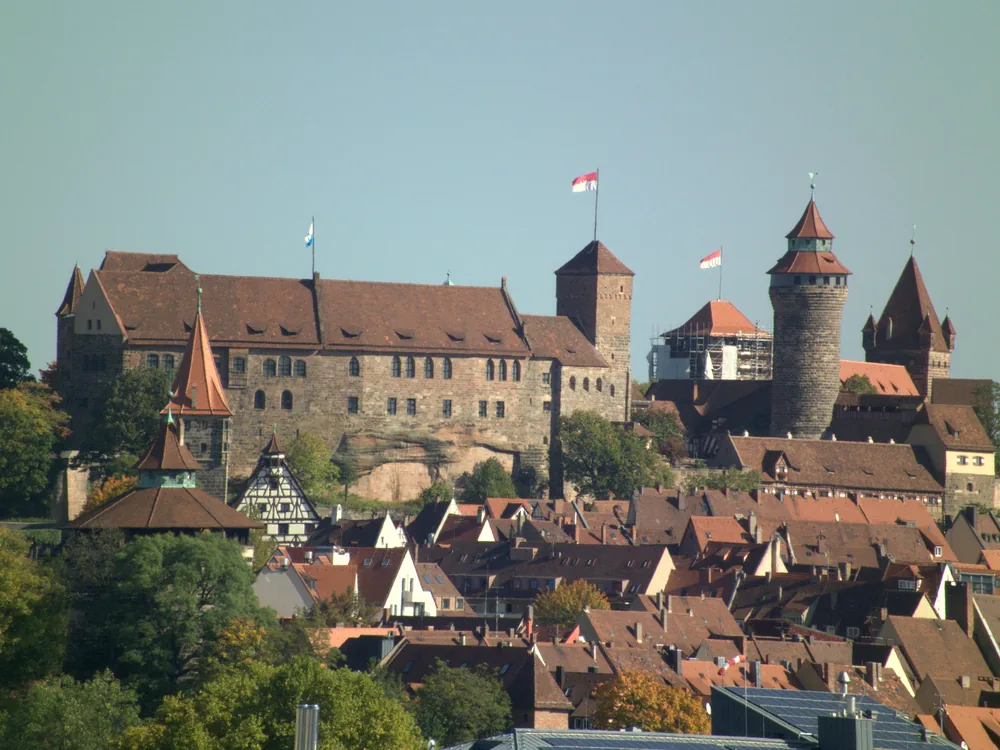
[Leuchtenburg Castle](/castles/germany/leuchtenburg-castle) — the medieval hilltop fortress above the Saale valley in Thuringia — offers a contrast: a rough-edged medieval fortification with a completely different history from the Prince-Bishops' palace. [Heidelberg Castle](/castles/germany/heidelberg-castle) and [Nuremberg Castle](/castles/germany/nuremberg-castle) extend the Franconia and Rhine circuit for visitors with more time in Bavaria and Baden-Württemberg.
History
The commission that would produce one of the 18th century's most celebrated palace interiors arrived in 1720, when Prince-Bishop Johann Philipp Franz von Schönborn asked the young architect Balthasar Neumann to design a new residence for the Prince-Bishopric of Würzburg. Neumann was 33 and largely untested at this scale; Schönborn supplemented his work with consultations from architects in Paris and Vienna, including Robert de Cotte and Germain Boffrand, who reviewed successive design iterations. The result was a palace whose Grand Staircase vault — a single unsupported span of 18 by 30 metres — has remained one of the most admired structural achievements in European Baroque architecture.
Construction proceeded in stages: the partially completed palace received its first resident in 1737, when Prince-Bishop Christoph Franz von Hutten moved in, and the exterior was substantially complete by 1744. The definitive transformation came in 1750, when Giovanni Battista Tiepolo arrived from Venice with his sons Giandomenico and Lorenzo. Between 1752 and 1753, Tiepolo completed the Grand Staircase ceiling fresco — 677 square metres, the largest ceiling painting in the world — and the fresco cycle in the Kaisersaal. The Court Garden and its garden buildings were finished in 1772.
Napoleon's reorganisation of German territories in 1806 incorporated Würzburg into a satellite Bavarian kingdom, and the Residence became a royal Bavarian palace. The RAF bombing raid of 16 March 1945 set the building alight; the roof collapsed but Tiepolo's vault frescoes survived beneath the unsupported ceiling that Neumann had designed. Postwar reconstruction through the 1950s and 1960s restored the palace shell and principal rooms, and UNESCO World Heritage designation followed in 1981.
How to Visit
Getting there: The Würzburg Residence is a 10-minute walk from Würzburg Hauptbahnhof. Würzburg is 1 hour 20 minutes from Frankfurt by ICE train; from Nuremberg, allow 1 hour by car or train.
Tickets: Walk-up admission is €9 for adults; children under 18 enter free. Open Tuesday–Sunday (closed Monday); April–October 09:00–18:00, November–March 10:00–16:30. English guided tours of the Grand Staircase and Kaisersaal run at scheduled times — confirm at residenz-wuerzburg.de. The GYG winter guided tour "Würzburg in Winter: Residence, Old Town, and Mulled Wine" (t1022746, from €74, 5.0★/2 reviews) includes Residence admission, an Old Town walk, and a mulled wine stop on the Old Main Bridge; it runs in the winter season (typically December–February).
Practical tips: The Grand Staircase and Kaisersaal are open year-round; some wing rooms are accessible April–October only. Approach the staircase slowly — the full Tiepolo fresco is visible in a single sweep from the bottom step, and the composition repays time before reaching for a camera.
Combine with: [Heidelberg Castle](/castles/germany/heidelberg-castle), the great ruin of the German Renaissance, offers a dramatic architectural contrast to the Residence's Baroque perfection. [Nuremberg Castle](/castles/germany/nuremberg-castle), 1 hour east, extends the Franconian itinerary deep into the medieval era.
Frequently Asked Questions
The ceiling fresco painted by Giovanni Battista Tiepolo over the Würzburg Residence's Grand Staircase covers 677 square metres of vaulted ceiling without interruption — the single largest ceiling fresco surface ever painted. Tiepolo completed it between 1752 and 1753, working with his sons. The fresco depicts an allegorical representation of the four continents (Europe, America, Africa, Asia) arranged around a central celestial vision and is visible in its entirety from anywhere within the Grand Staircase — the spatial design ensures that the ascending visitor encounters the full composition as a single panoramic image rather than a series of sections.
Location
Würzburger Residenz, Residenzplatz 2, 97070 Würzburg, Germany
Nearby Castles

Tours & Tickets
Powered by GetYourGuide
From
€74/ person