
Heidelberg Castle
Heidelberger Schloss
Germany · Baden-Württemberg · Near Heidelberg
Built 1214 · Gothic and Renaissance ruins
This page is part of an independent travel guide and is not affiliated with, endorsed by, or operated by Heidelberg Castle.
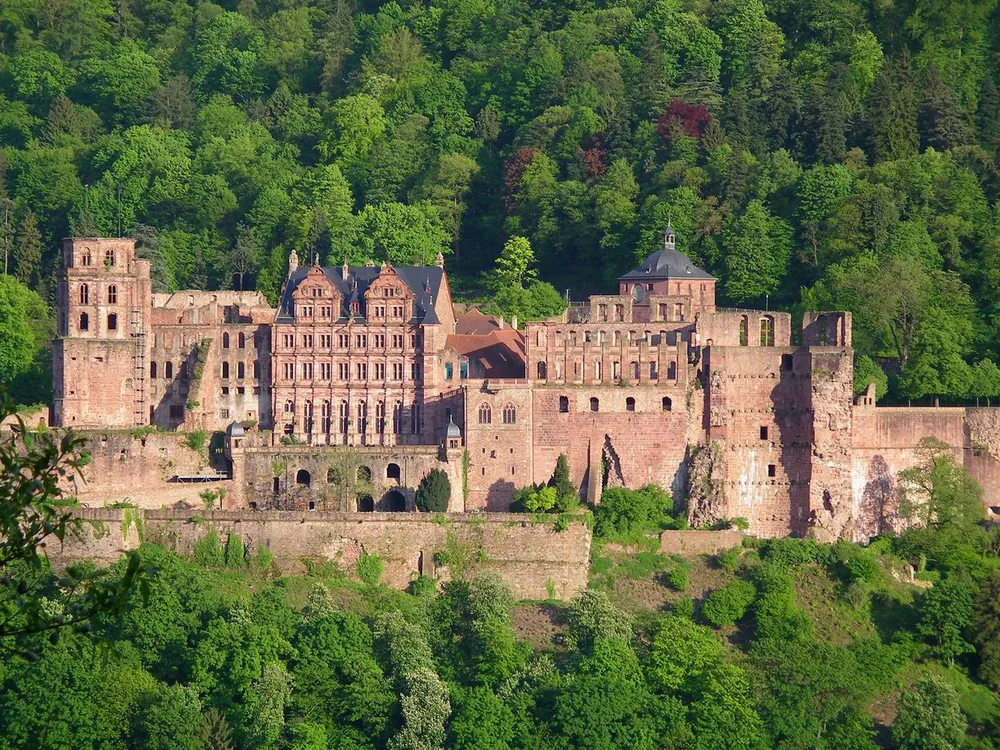
© Unsplash
Quick Facts
- Hours
- Daily 08:00–18:00
- Guided tour from
- €39
- Duration
- 2–3 hours
- Best time
- Late April to June and September to October
- Nearest city
- Heidelberg
Featured Tour
Heidelberg: Discover Heidelberg Castle – Experience history up close
Cancellation available · Instant confirmation
Highlights
- ✦The Friedrichsbau facade — the finest Renaissance architecture in Germany
- ✦The Great Heidelberg Tun: the world's largest wine barrel, holding 220,000 litres
- ✦Panoramic views of the Neckar Valley, the Old Town and the Rhine plain from the terrace
- ✦The ruined Ottheinrichsbau — a roofless Renaissance palace open to the sky for 350 years
- ✦The German Pharmacy Museum, one of the most unusual castle museums in Europe
Skip the queue with a guided tour
Skip-the-line tickets & expert guides
Heidelberg Castle is the most romantic ruin in Germany — which is saying something in a country that has elevated the picturesque ruin to a philosophical ideal. Perched on the Königstuhl hillside above Germany's oldest university town, the castle is partly intact, partly hollowed-out shell, and wholly extraordinary: a complex where Renaissance architecture of the highest quality stands roofless against the sky, its red sandstone glowing amber at sunset over a city of baroque towers and a river snaking through forested hills.
The castle's dual state — complete and ruined simultaneously — is the result of two catastrophes. French forces demolished it twice under Louis XIV (in 1689 and 1693), blowing up the towers with gunpowder. Lightning finished off the Ottheinrichsbau in 1764. What they left behind has been debated ever since: whether to restore or preserve the ruin. The Romantic movement of the 19th century argued passionately for the ruin — Victor Hugo visited and pronounced it magnificent as it was; Mark Twain, who spent several weeks in Heidelberg in 1878, wrote that it was the most poetically beautiful thing he had ever seen.
The intact sections are no less impressive than the ruins. The Friedrichsbau, completed in 1607, is one of the most sophisticated Renaissance façades in northern Europe, its gallery of carved Wittelsbacher rulers reading like a dynasty in stone. The Great Hall of the German Kings, built in the 14th century, hosted actual medieval diets (imperial councils) and is now used for concerts. In the cellar, the Great Heidelberg Tun — a barrel capable of holding 220,000 litres, built in 1751 — has a dance floor on top and a dwarf guardian whose statue stands at the door.
History
Heidelberg Castle's origins lie in the 13th century, when the Counts Palatine of the Rhine — one of the Holy Roman Empire's most powerful dynasties — built their first fortifications on the Königstuhl. What began as a medieval fortress was transformed by a succession of ambitious rulers over the following four centuries into one of the most elaborate palace complexes in the Empire.
The castle reached its architectural apogee under the Electors Palatine in the 16th and early 17th centuries. Friedrich II built the Gothic hall around 1530; Ludwig V added the Ruprechtsbau; Ottheinrich (Otto Heinrich) constructed the palatial Ottheinrichsbau between 1556 and 1559 — a Renaissance masterwork with a three-storey sculptural façade that art historians consider the equal of anything in Italy. Friedrich V, whose marriage to the English Princess Elizabeth Stuart was celebrated with enormous festivities in 1613, added the English Wing and the Hortus Palatinus, a garden terrace so ambitious it was called the 'eighth wonder of the world' while still under construction.
The catastrophe came with the Thirty Years' War (1618–1648). Friedrich V accepted the crown of Bohemia in 1619, was defeated at the Battle of White Mountain in 1620, and lost everything — the Palatinate, the castle, his title. The castle was occupied and stripped by Imperial forces. It partially recovered, only to be completely destroyed by the armies of Louis XIV in 1689 and again in 1693 during the Nine Years' War, when French troops systematically blew up the towers and burned the interiors.
The ruins were left largely untouched, becoming a defining image of European Romanticism. The 19th-century debate over whether to restore the castle or preserve the ruin remains one of the great cultural arguments in German architectural history — and was ultimately resolved by leaving things more or less as they are.
How to Visit
Getting there: Heidelberg is on direct train lines from Frankfurt (50 min), Stuttgart (40 min), and Mannheim (15 min). From Heidelberg Hauptbahnhof, take tram or bus 33 to the Rathaus/Bergbahn stop in the Old Town, then the Bergbahn funicular to the castle (€5 return separately). The Burgweg footpath takes about 20 minutes uphill through the forest — the funicular down is kinder on the knees.
Tickets: Entry costs €9 for adults and €5 for children, covering the castle grounds, Great Hall, German Pharmacy Museum, and Great Cask. The GetYourGuide guided tour covers a 2-hour guided walk through the castle's architecture and history. Guided tours in English and German also run several times daily from the castle entrance.
Practical tips: The classic exterior view is from the Old Bridge (Alte Brücke) across the Neckar — ruin silhouetted above baroque spires. The Heidelberg Illumination, on the last Saturday of June, July, and September, lights the castle red to simulate the 1689 French bombardment — visually spectacular but draws large crowds.
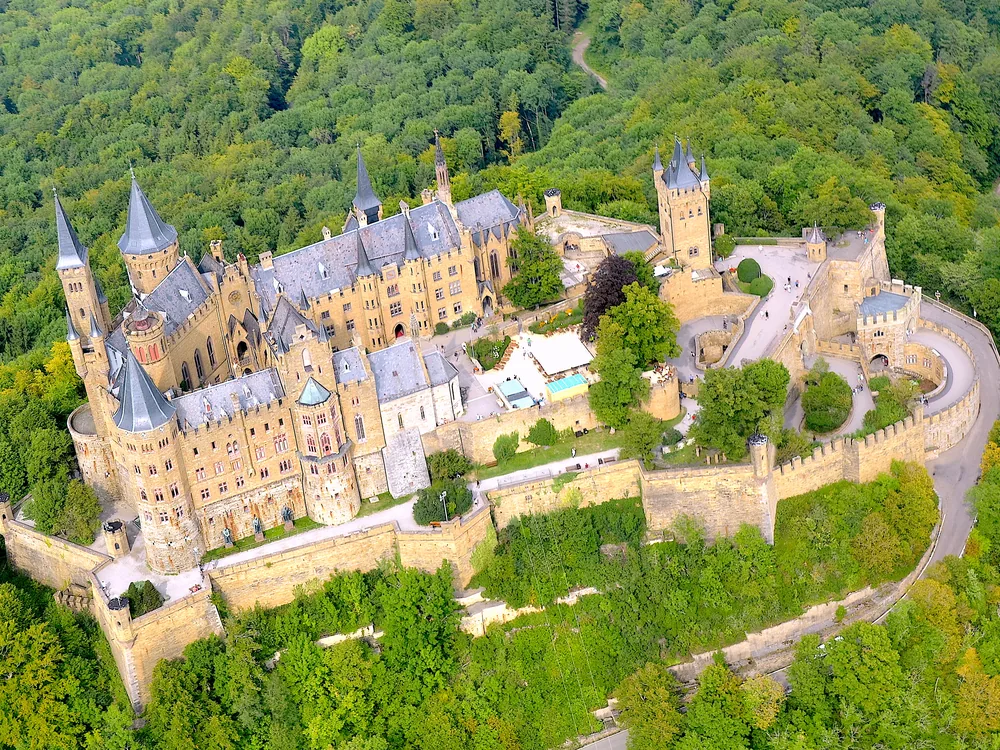
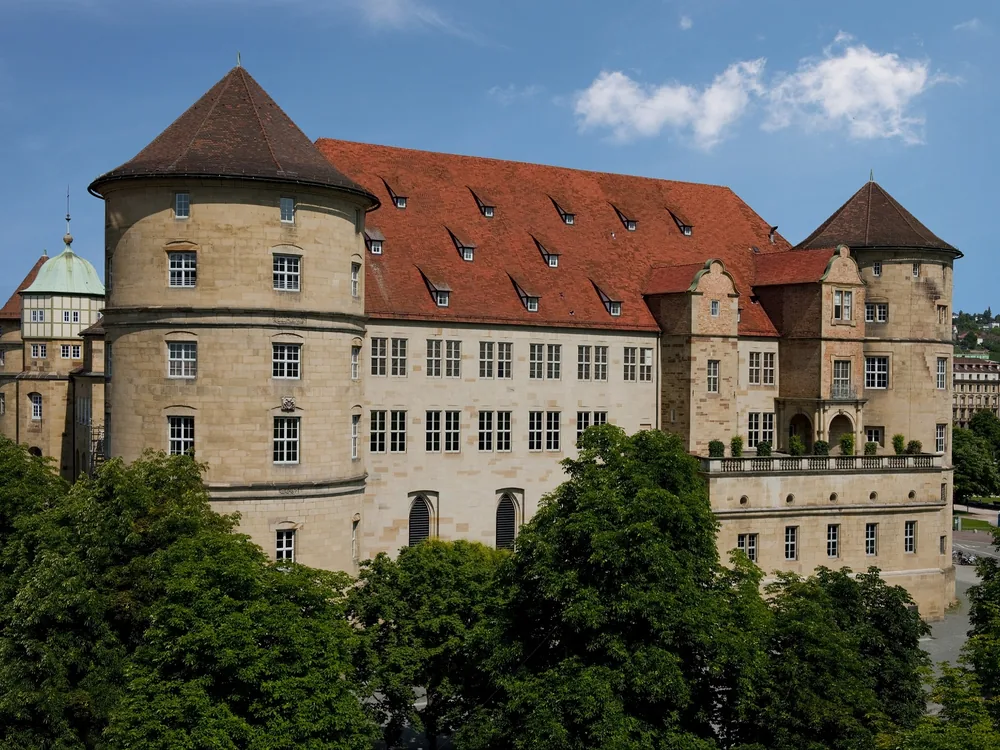
Combine with: Hohenzollern Castle is 90 km south in the Swabian Alb. Altes Schloss Stuttgart is 80 km south in the state capital. Würzburg Residence is 120 km north on the Romantic Road.
Frequently Asked Questions
Partially. Parts of the castle — including the Friedrichsbau and the Great Hall — are intact and used for concerts and events. But the Ottheinrichsbau, the castle's most spectacular Renaissance wing, has been roofless and open to the sky since lightning destroyed it in 1764. The ruined towers blown up by French forces in 1689–93 also stand unreconstructed. This combination of intact grandeur and open ruin is what makes Heidelberg visually unique among German castles.
Location
Schlosshof 1, 69117 Heidelberg, Germany
Nearby Castles
Tours & Tickets
Powered by GetYourGuide
From
€39/ person