
Castel Sant'Elmo
Castel Sant'Elmo
Italy · Campania · Near Naples
Built 1329 · Six-pointed star fortress; original Angevin castle 1329–1343; comprehensively rebuilt as Spanish military fortress 1537–1546 by Pedro Luis de Escrivà; the star plan with six angular bastions replaced the earlier rectangular structure entirely
This page is part of an independent travel guide and is not affiliated with, endorsed by, or operated by Castel Sant'Elmo.
© Castles & Palaces
Quick Facts
- Hours
- Tue–Sun 08:30–19:30. Closed Mon
- Entry via GetYourGuide
- €14
- Duration
- 1.5–2 hours
- Best time
- Year-round
- Nearest city
- Naples
Featured Tour
Naples from Above: Castel Sant’Elmo Ticket & Audio Guide
Cancellation available · Instant confirmation
Highlights
- ✦A six-pointed star fortress built by Spanish military engineer Pedro Luis de Escrivà between 1537 and 1546, replacing an earlier Angevin castle entirely
- ✦A 360-degree panorama from the ramparts widely considered the finest urban view in Naples — Vesuvius, Capri, Ischia and the whole bay laid out below
- ✦Imprisoned the philosopher and astronomer Giordano Bruno before his trial and execution, and later held leaders of the 1799 Parthenopean Republic
- ✦Adjacent to the Certosa di San Martino, a 14th-century Carthusian monastery with one of the finest Baroque interiors in Naples
- ✦Reached by the Funicolare Centrale, a short and scenic funicular ride up from the historic centre
Skip the queue with a guided tour
Skip-the-line tickets & expert guides
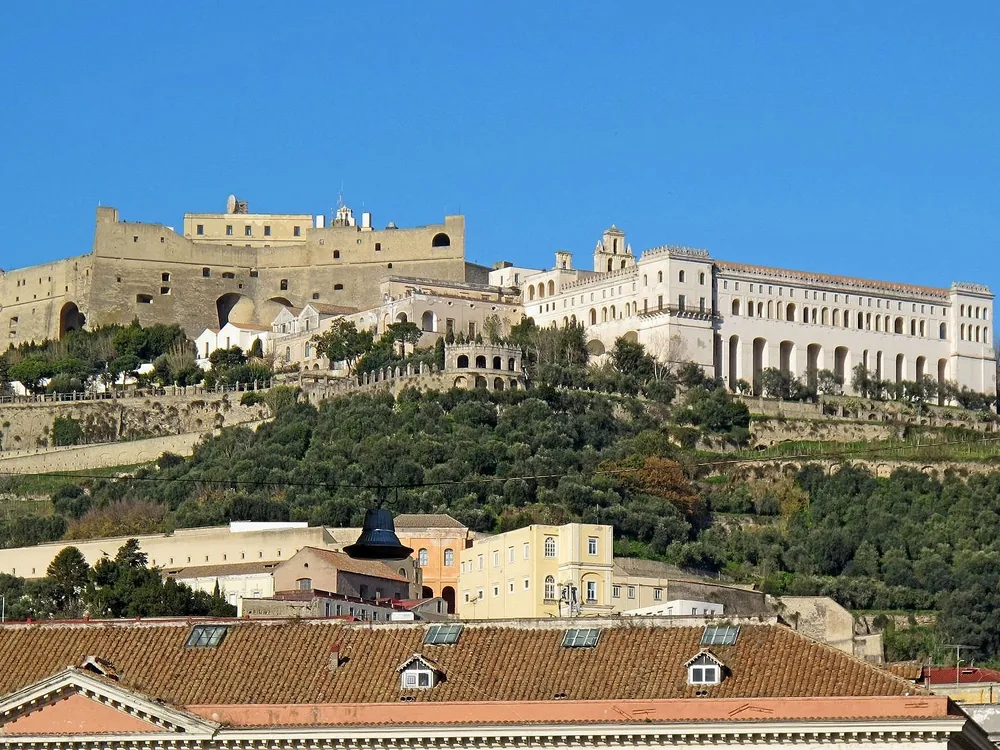
From the Vomero hill above Naples, at 250 metres above the bay, the view is the one that makes people understand why this city has been fought over continuously for 2,500 years. The entire arc of the Gulf of Naples spreads below: Vesuvius to the east, the islands of Capri and Ischia to the south, Castel dell'Ovo on its promontory to the left, the dense fabric of the historic centre directly underneath. Castel Sant'Elmo was built on this ridge for one reason — whoever held this height controlled Naples. For four centuries, it was the key to the city.
The first castle on the Vomero hill was built by the Angevin King Robert of Naples in 1329. Robert was one of the most sophisticated rulers of medieval Italy, his court attracting Petrarch, Boccaccio and Giotto. His castle, known as the Belforte, was rectangular with four towers, built in the local yellow tuff stone that gives Neapolitan architecture its warm colour. This first structure suited the medieval city well enough, but it was wholly inadequate for the changed conditions of 16th-century warfare, when artillery had rendered vertical walls obsolete almost overnight.
The Viceroyalty of Naples was the most important Spanish possession in Italy, and the Spanish crown needed to defend it against French attack and internal rebellion. Pedro Luis de Escrivà — a military engineer who had already worked on the fortifications of Ibiza and would later design defences at L'Aquila — was commissioned to rebuild the Belforte entirely. He demolished the Angevin structure and replaced it with a six-pointed star fortress: six triangular bastions projecting from a hexagonal central body, each positioned to provide flanking fire along the adjacent curtain walls. The geometry was simultaneously military and mathematical — no attacker could approach any section of wall without being exposed to fire from at least two directions at once.
The castle's history after its Spanish rebuilding is largely a history of imprisonment and repression. The philosopher and astronomer Giordano Bruno was held here in the late 16th century before his trial and execution in Rome — a man whose cosmological speculations had outpaced what the Church of his time could tolerate. The Neapolitan Parthenopean Republic of 1799, a French-backed revolutionary government that briefly overthrew the Bourbon monarchy, fell when Cardinal Ruffo's army retook the city; its leaders were executed in the Piazza del Mercato below, and the castle reverted to Bourbon control. During the Second World War the castle held Italian anti-fascist partisans. The walls carry, in compressed sediment, four centuries of political struggle.
Today the castle functions primarily as a cultural venue and museum, its inner parade ground hosting outdoor exhibitions in summer. But the primary reason to come remains the view. The 360-degree panorama from the ramparts is among the finest urban views in Europe, the kind that forces a recalibration of scale. Naples from this height reveals itself as an extraordinarily dense city, packed into a coastal plain between the volcano and the sea with no natural room to expand. The view also explains the logic of the castle's placement: any ship approaching from the sea, any army approaching from the mainland, would have been visible from here hours before arrival.
Directly adjacent to Castel Sant'Elmo, on the same Vomero hilltop, stands the Certosa di San Martino, a Carthusian monastery founded in 1325 and rebuilt in the 17th century, now one of the finest Baroque interiors in Naples. The monastery church contains works by Ribera, Luca Giordano and Giovanni Lanfranco. The Certosa and the castle are effectively one complex and reward being visited together; a combined ticket is available for both.
History
King Robert of Naples, one of the most cultured rulers of the Angevin dynasty, built the first castle on the Vomero hill in 1329, a rectangular structure known as the Belforte with four corner towers in the local yellow tuff stone. The structure served the medieval city adequately but became militarily obsolete with the advent of effective siege artillery in the 16th century, when the Spanish Viceroyalty of Naples needed a fortress capable of withstanding modern bombardment.
Between 1537 and 1546, the military engineer Pedro Luis de Escrivà demolished the Angevin castle entirely and rebuilt it as a six-pointed star fortress, with six triangular bastions arranged to give defenders overlapping fields of fire along every section of curtain wall. The new fortress became the dominant military structure of Spanish Naples, and over the following centuries it served primarily as a prison and instrument of political control, holding figures including the philosopher Giordano Bruno before his execution in Rome and the leaders of the short-lived Parthenopean Republic of 1799 after the Bourbon restoration. The castle continued in military and penal use into the 20th century, including as a detention site for anti-fascist partisans during the Second World War, before being converted to its current role as a museum and cultural venue.
How to Visit
Getting there: Castel Sant'Elmo is reached by the Funicolare Centrale from Piazza Augusteo (a 5-minute ride) or by taxi from the city centre in about 10 minutes. The funicular accepts standard Campania Artecard or transit tickets.
Tickets: Entry costs €5 for adults (EU citizens under 18 free). The GetYourGuide ticket with audio guide includes a digital audio guide and skip-the-queue access. A combined ticket with the Certosa di San Martino (the adjacent Carthusian monastery) is available at the castle ticket desk.
Practical tips: Allow 1.5–2 hours for the castle, plus 1 more hour if visiting the Certosa di San Martino. The 360-degree panorama from the ramparts — Vesuvius, Capri, Ischia, and the full bay arc — is the primary draw; go on a clear day. Last entry 1 hour before closing; closed Mondays, 1 January, and 25 December.
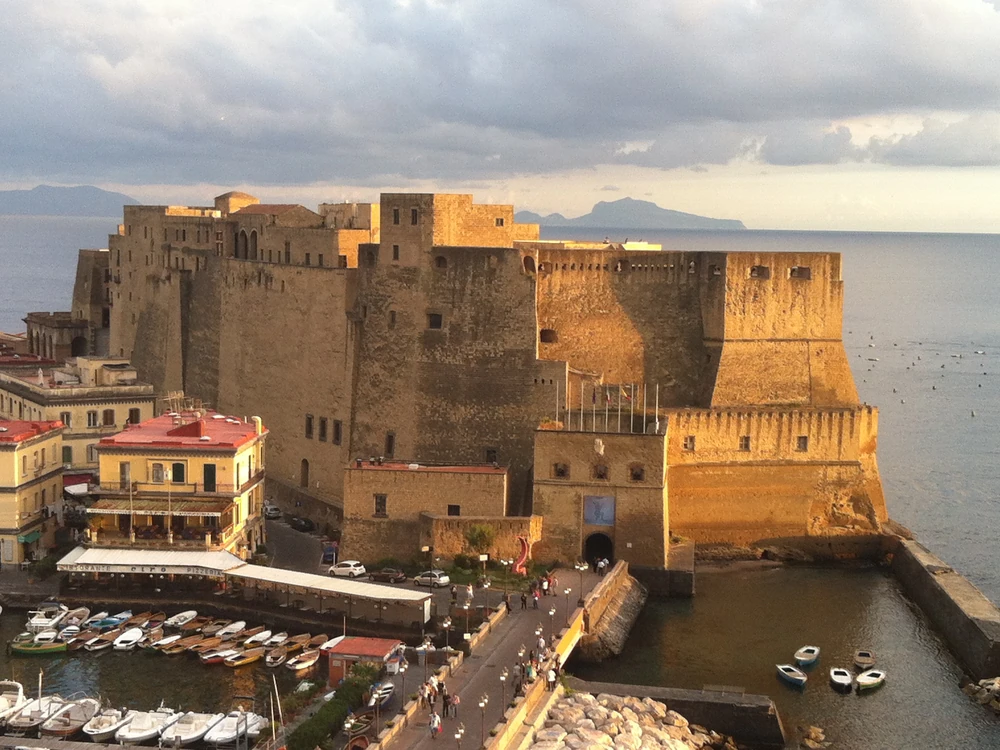
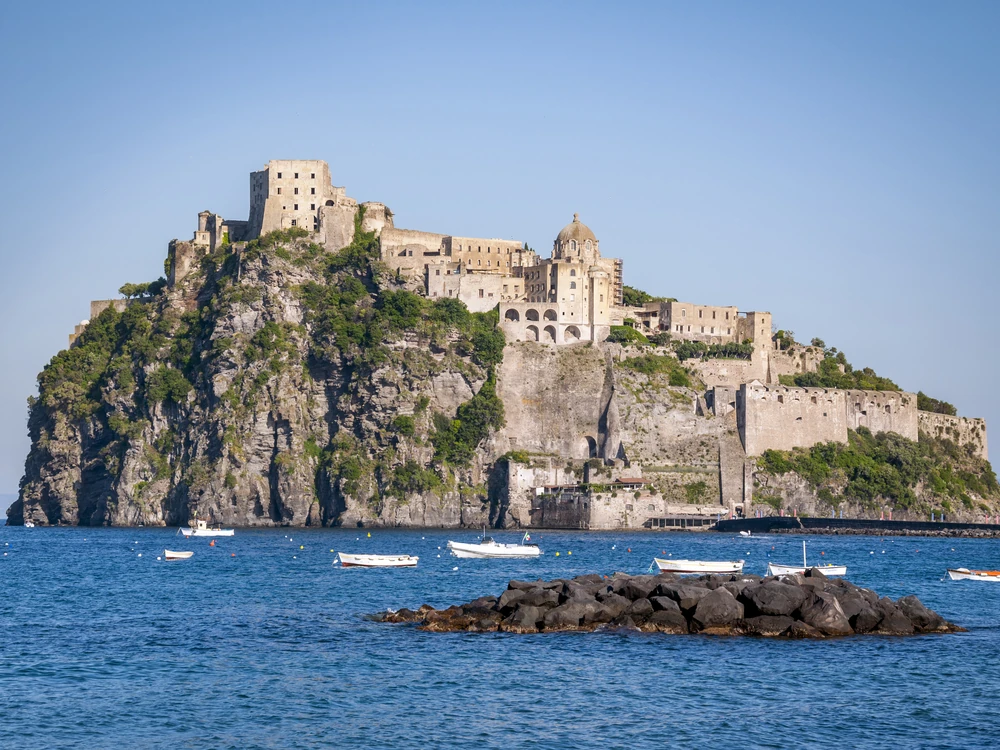
Combine with: Castel dell'Ovo on the Borgo Marinari waterfront (25 minutes by funicular and walk) and Aragonese Castle on Ischia for a Bay of Naples coastal fortresses itinerary.
Frequently Asked Questions
The Spanish military engineer Pedro Luis de Escrivà rebuilt the castle between 1537 and 1546 in a six-pointed star plan specifically to counter the threat of artillery, which had made traditional vertical castle walls obsolete. Each of the six triangular bastions was positioned to give defenders overlapping fields of fire along the adjacent curtain walls, so that no attacker could approach any section of the fortress without being exposed to fire from at least two directions at once.
Location
Via Tito Angelini 22, 80129 Naples, Italy
Nearby Castles
Tours & Tickets
Powered by GetYourGuide
From
€14/ person