
Naples Royal Palace
Palazzo Reale di Napoli
Italy · Campania · Near Naples
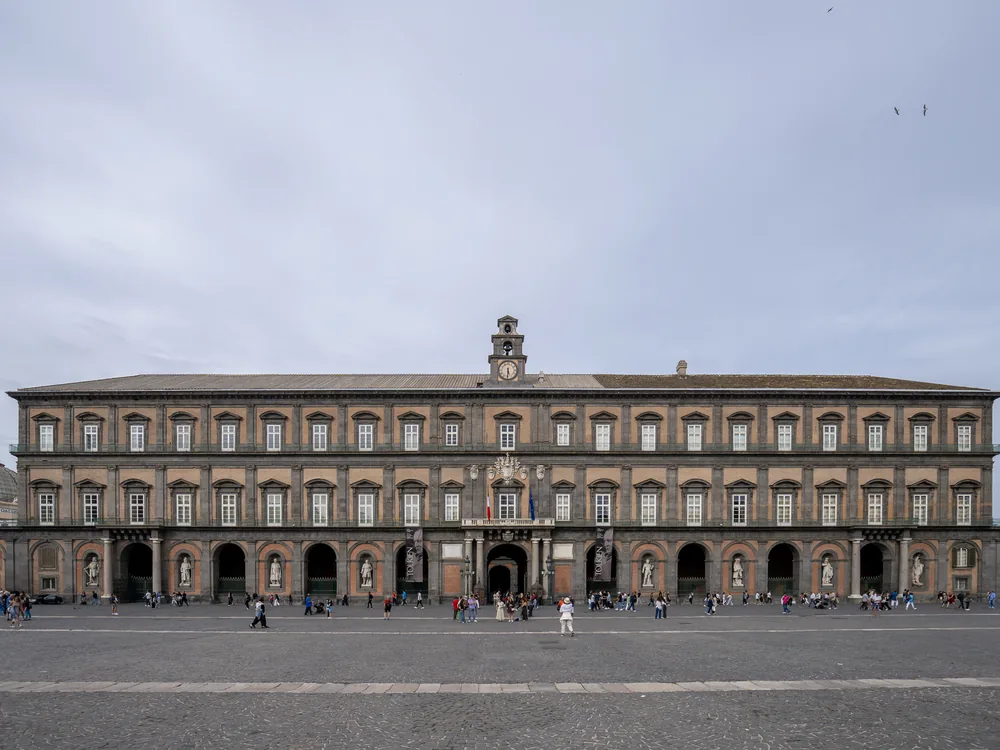
Built 1600 · Large Baroque palace begun in 1600 for the Spanish viceroys of Naples by architect Domenico Fontana; the principal facade on Piazza del Plebiscito has eight niches containing statues of the successive dynasties that ruled Naples — Norman, Swabian, Angevin, Aragonese, Habsburg, Bourbon Two Sicilies, Napoleon's kingdom, and Savoy — added in 1888 by Umberto I; the interior includes Bourbon-era state apartments and the Royal Chapel; the Biblioteca Nazionale (National Library of Naples) occupies part of the building; the Museo del Palazzo Reale houses the historic state rooms
This page is part of an independent travel guide and is not affiliated with, endorsed by, or operated by Naples Royal Palace.
© Castles & Palaces
Quick Facts
- Hours
- Mon 09:00–20:00. Wed–Sun 09:00–20:00. Closed Tue
- Entry via GetYourGuide
- €23.5
- Duration
- 1.5–2.5 hours
- Best time
- March to June and September to November
- Nearest city
- Naples
Featured Tour
Royal Palace Entry Ticket with Digital Audio Guide
Cancellation available · Instant confirmation
Highlights
- ✦The palace facade on Piazza del Plebiscito features eight niches containing standing statues representing every dynasty that ruled Naples — Norman, Swabian, Angevin, Aragonese, Habsburg, Bourbon Two Sicilies, Napoleonic, and Savoy — added by Umberto I in 1888 as a deliberate statement about dynastic continuity; reading them in sequence is a compressed lesson in Southern Italian political history spanning nearly nine centuries
- ✦The Royal Palace sits on Piazza del Plebiscito, one of Italy's grandest civic squares — a semicircular colonnade, the Basilica of San Francesco di Paola modeled on the Roman Pantheon, and equestrian statues of Ferdinand I and Charles III frame a space that Naples uses as a gathering point for everything from state funerals to outdoor concerts
- ✦The Bourbon state apartments — the Throne Room, the Royal Chapel, the Court Theatre — preserve the decorative programme of the Kingdom of the Two Sicilies as it was when the Bourbon kings used Naples as one of Europe's wealthiest royal capitals in the 18th century, with painted ceilings, period furniture, and the Royal Porcelain collection from the Capodimonte factory
- ✦The palazzo is a short walk from the Teatro di San Carlo, the oldest continuously active opera house in Europe (opened 1737, predating La Scala by 41 years), and from Castel Nuovo — making the area around Piazza del Plebiscito the densest concentration of high-heritage sites in central Naples
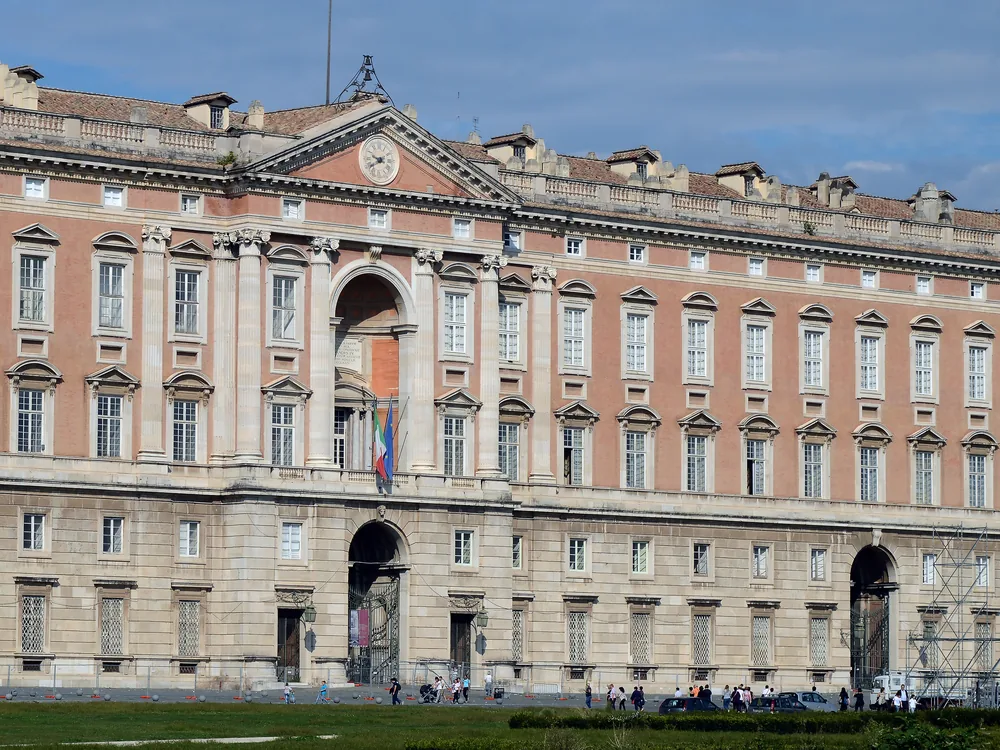
- ✦The Royal Palace of Caserta, the Bourbons' Versailles-rivaling second palace approximately 35 minutes north of Naples, is the essential pairing for visitors interested in the Kingdom of the Two Sicilies — together, the two palaces cover the full range of Bourbon architectural ambition in Southern Italy
Skip the queue with a guided tour
Skip-the-line tickets & expert guides
The facade of the Royal Palace of Naples is unusual among European royal palaces in that it tells its own political history. Running along the principal front on Piazza del Plebiscito are eight large niches, each containing a standing statue of one of the dynasties that ruled Naples from the 12th century to the 20th. From left to right: Roger II of Sicily (Norman), Frederick II (Swabian), Charles I of Anjou (Angevin), Alfonso I of Aragon (Aragonese), Charles V (Habsburg), Charles III of Bourbon (Bourbon Two Sicilies), Joachim Murat (Napoleonic), and Victor Emmanuel II (Savoy). Added in 1888 on the order of King Umberto I, the statues are a deliberate dynastic statement: here is every power that sat on the throne of Naples, arranged for public inspection on the building they all used. The sequence runs through Norman conquest, Hohenstaufen imperialism, French Angevin invasion, Aragonese reconsolidation, Habsburg absorption into the Spanish empire, Bourbon separation into an independent Italian kingdom, Napoleonic interruption, and Savoy unification — approximately 800 years of Southern Italian political history compressed into eight marble figures on a single facade.
The palace itself was begun in 1600 for the Spanish viceroy of Naples, Ferndinando Ruiz de Castro, by the architect Domenico Fontana, who had previously worked for Pope Sixtus V on the reorganisation of Rome and the relocation of the Vatican obelisk. Naples at this point was the capital of the Kingdom of Naples and one of the largest cities in Europe — larger than Madrid, roughly the size of Paris — and the Spanish viceroys who governed it in the name of the Habsburg crown required a residence that could project imperial authority in an appropriately monumental form. Fontana's building was designed from the outset to face the bay, with a principal facade oriented toward the sea approach that would announce the seat of viceregal power to arriving ships.
The building's history through the 17th and early 18th centuries is one of continuous modification and expansion as successive viceroys adapted it to changing functions and fashions. The defining transformation came in 1734 when Charles of Bourbon, who had conquered Naples and Sicily from the Habsburgs, established the independent Kingdom of the Two Sicilies and made Naples his capital. The Bourbon dynasty that followed — ruling with varying degrees of competence and autocracy until Italian unification in 1861 — converted the palace from a viceroy's administrative seat into a royal household. The state apartments that visitors walk through today are primarily Bourbon-era: the Throne Room, the Royal Chapel, the Court Theatre (one of the few private palace theatres still surviving in southern Italy), and the series of reception rooms decorated with painted ceilings, period furniture, and material accumulated across four generations of Bourbon rule.
The Throne Room is the largest and most formally impressive space in the apartment circuit. The ceiling fresco depicts the apotheosis of Ferdinand I — the Bourbon king who returned from exile in Sicily after Napoleon's defeat and consolidated the two crowns of Naples and Sicily into the formal title 'Two Sicilies' in 1816 — and the room preserves the gold and crimson ceremonial decoration of the Bourbon court as it functioned in the early 19th century. The Royal Chapel preserves an important presepe (Nativity scene) collection, a distinctively Neapolitan art form of which the palace has one of the most significant examples.
The palace's position on Piazza del Plebiscito places it at the centre of a dense heritage cluster. The piazza itself — semicircular in plan, enclosed by a colonnade and the neoclassical Basilica of San Francesco di Paola, with equestrian statues of Ferdinand I and Charles III at its heart — is one of the grandest civic spaces in Italy and the primary public gathering place of central Naples. The Teatro di San Carlo, immediately adjacent to the palace on its north side, opened in 1737 and remains Europe's oldest continuously active opera house, predating La Scala in Milan by 41 years and the Opéra de Paris by decades. Castel Nuovo, the medieval fortress built by Charles I of Anjou in the 13th century and later used by the Aragonese kings, is a 10-minute walk east along the waterfront. The entire area of the seafront Lungomare and the zone between the Royal Palace and Castel Nuovo contains more significant cultural heritage per square kilometre than almost any comparable area in a southern European city.
For the broader Naples heritage itinerary, the Royal Palace of Naples represents one end of a Bourbon axis whose other terminal is the Royal Palace of Caserta, approximately 35 minutes north by train. Caserta, commissioned by Charles III in 1752 and designed by Luigi Vanvitelli, is the more spectacular building — a Versailles-scale palace with a grand cascade and Italian-English garden combination that was explicitly designed to impress visiting European royalty and demonstrate that the Kingdom of the Two Sicilies was a major European power rather than a provincial backwater. The Naples palace is the working urban residence; Caserta is the ceremonial statement. Together they cover the full range of Bourbon architectural investment in the kingdom.
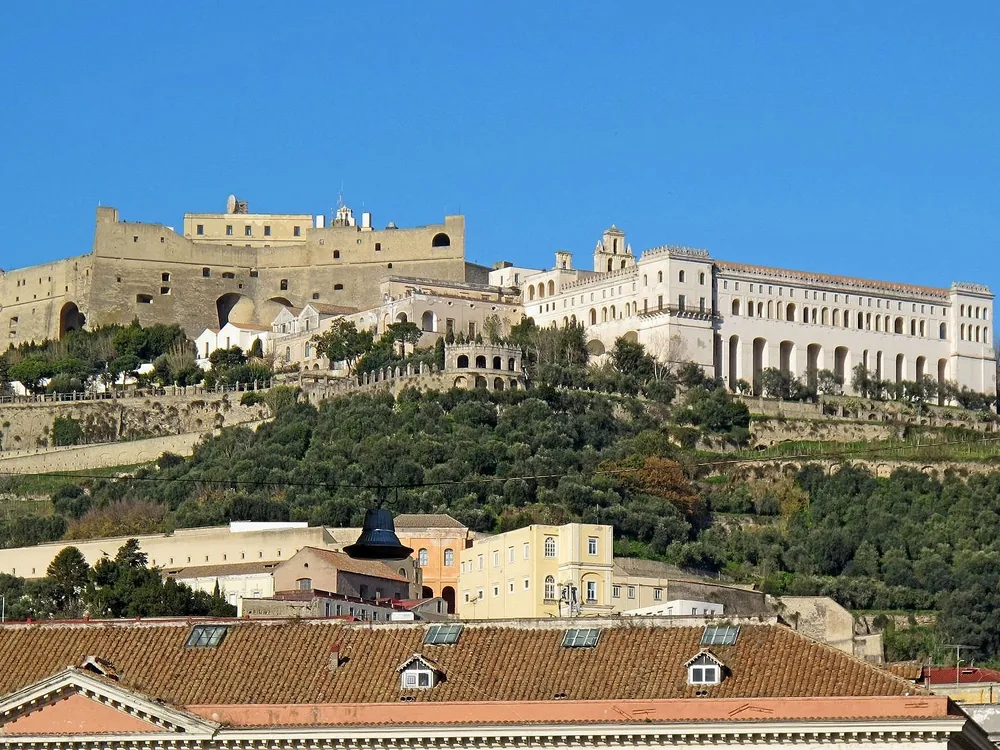
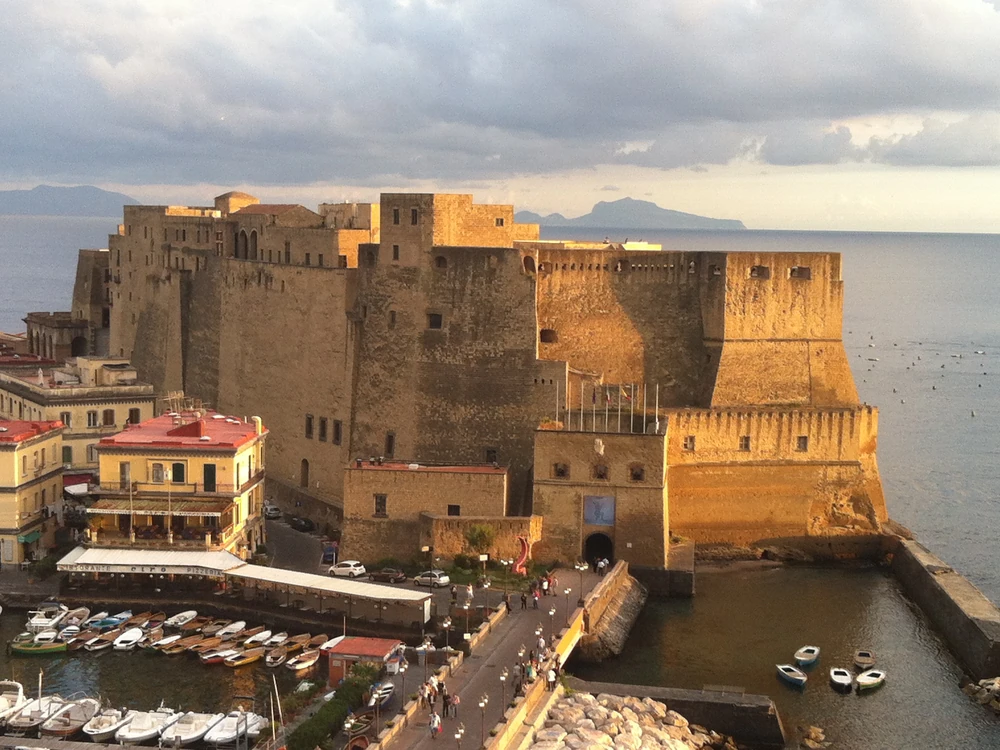
Castel dell'Ovo and Castel Sant'Elmo, the other Naples castles on this site, complete the city's medieval and early modern fortification history. Castel dell'Ovo sits on the Megaride islet in the bay — the oldest fortification in Naples, Roman in origin, with extraordinary views across the Gulf of Naples to Vesuvius. Castel Sant'Elmo crowns the Vomero hill above the historic centre, accessible by the Centrale funicular, with panoramic views over the entire city.
The GetYourGuide entry ticket with digital audio guide covers the state apartment circuit and includes a downloadable audio guide that can be used on a personal device throughout the visit. The audio guide is recommended for the Throne Room and the series of royal apartments, where the specific historical associations of each room are not always self-evident from the spaces themselves. The palace is open most days year-round, closed on Tuesdays — an unusual closure day that is worth checking before planning a Piazza del Plebiscito visit.
History
The Royal Palace of Naples was begun in 1600 for the Spanish viceroys who governed Naples as part of the Habsburg empire, designed by Domenico Fontana. When Charles of Bourbon conquered Naples and Sicily from the Habsburgs in 1734, the palace became the royal residence of the new Kingdom of the Two Sicilies, undergoing major interior modification. After Napoleon's brother Joseph briefly held Naples (1806–1808), followed by Joachim Murat (1808–1815), the Bourbons returned and continued development. Italian unification in 1861 brought the Savoy dynasty, who used the palace briefly before relocating the capital. The eight-statue facade was completed by Umberto I in 1888. Today the state apartments function as the Museo del Palazzo Reale; the Biblioteca Nazionale occupies an adjacent wing.
How to Visit
Getting there: The palace is on Piazza del Plebiscito in central Naples, directly accessible from Napoli Centrale station by taxi or metro (Line 1 to Toledo or Municipio, 15–20 minutes). Castel Nuovo is a 10-minute walk east; Castel dell'Ovo is 15 minutes west.
Tickets: The GetYourGuide entry ticket with digital audio guide covers the state apartments and includes an audio guide. Walk-up entry also available at the door.
Visit length: 1.5–2.5 hours for the state apartment circuit. Allow additional time if exploring Piazza del Plebiscito or the adjacent Teatro di San Carlo.
Practical tips: March to June and September to November.
Combine with: The Royal Palace of Caserta (35 min north by train) is the essential Bourbon pairing — the urban residence plus the ceremonial countryside palace together tell the full Bourbon Two Sicilies story. Castel dell'Ovo and Castel Sant'Elmo are both on this site for the complete Naples castle circuit.
Frequently Asked Questions
The eight niches on the principal facade each contain a standing statue of one of the dynasties that ruled Naples: Roger II (Norman), Frederick II (Swabian), Charles I of Anjou (Angevin), Alfonso I of Aragon (Aragonese), Charles V (Habsburg), Charles III (Bourbon), Joachim Murat (Napoleonic), and Victor Emmanuel II (Savoy). Added by Umberto I in 1888, the statues compress approximately 800 years of Southern Italian dynastic history into a single architectural sequence, making the facade a legible record of every power that held the Kingdom of Naples from its medieval founding through Italian unification.
Location
Piazza del Plebiscito, 1, 80132 Napoli NA, Italy
Nearby Castles
Tours & Tickets
Powered by GetYourGuide
From
€23.5/ person